When a Number Becomes an Authority
An AI detector labeled my article “100% AI.” But classification is not explanation. Drawing on Feynman, Popper, and Deutsch, I examine AI, authorship, authority, and the difference between intelligence and rationality. Who creates knowledge, who takes responsibility, and where does the error go?
Note
An AI detector classified a revised article as “100% AI.” The editor’s question was legitimate: How had AI been used? But the classification raised a deeper problem.
What can a machine actually establish about authorship, intellectual responsibility, and the creation of explanations?
This essay draws on Richard Feynman’s distinction between naming and understanding, Karl Popper’s theory of error-correction, David Deutsch’s philosophy of explanation, and my continuing investigations into authority and the open society.
It also examines my own use of AI in writing books and articles.
The question is not whether technology assists human thinking. It is whether its judgments remain open to criticism.
A classification is not yet an explanation.
A Percentage Did Not Write My Books
On Feynman, Popper, intelligence, rationality, authority, and the use of AI
Khaled Salih
20 November 2026
An editor recently wrote to me about an article I had revised. An AI detector, he said, had classified the text as “100% AI.” It was the second time he had used that exact formulation. He then asked: “How have you used AI?”
It was a legitimate question, and it deserves an accurate answer. I use AI in researching, drafting, criticizing, and revising my work. It sometimes helps formulate passages that appear in the finished text. But I was troubled by the repeated figure. Not because I regard myself as above scrutiny, and not because a magazine owes me publication. I was troubled by the possibility that a number produced by a classifier could acquire an authority that its evidence did not justify.
A more uncomfortable question followed. Had the article itself been read closely before the same percentage was repeated? I do not know. A short editorial message cannot establish whether its sender read every paragraph, skimmed the argument, or examined it carefully. I should not turn an unanswered question into an accusation. Yet the question matters: what happens to criticism when the first thing one asks of a text is not whether its explanation succeeds but how a machine has classified its language?
This is not merely a dispute about AI. For years I have studied how religious, ideological, and political claims acquire authority, and what happens when people lose the means of correcting them. It would be strange if I exempted the growing authority of technical systems—or my own cherished methods—from the same inquiry.
Naming Is Not Explaining
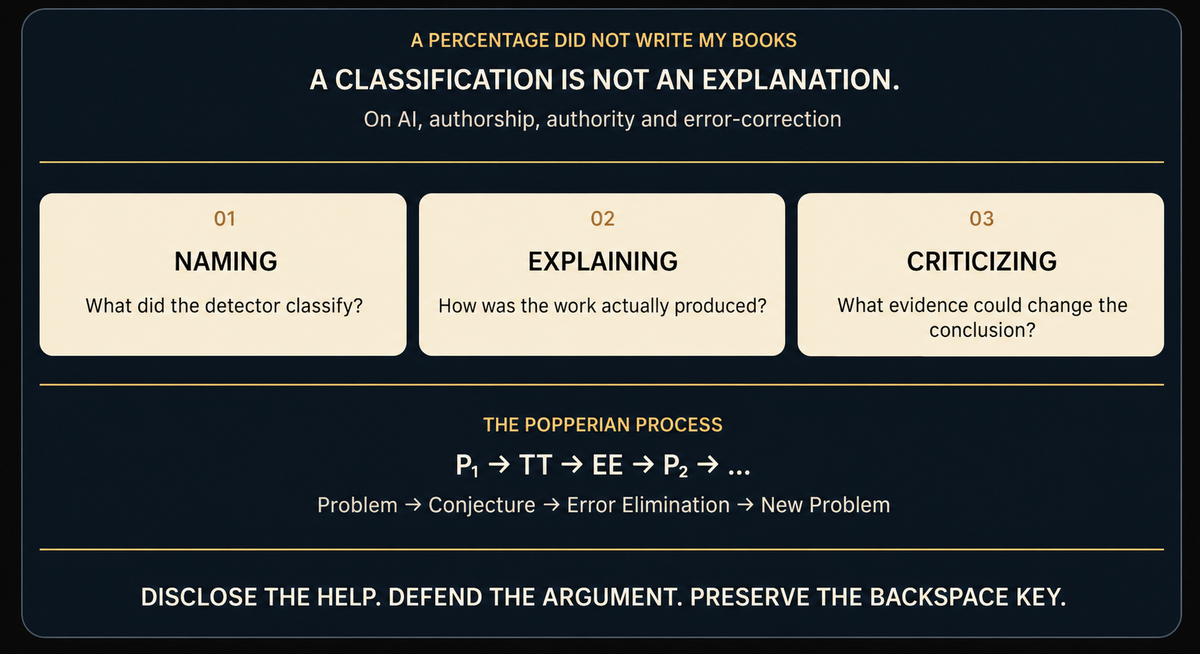
A Feynman-inspired infographic recently gave me a useful way to state the problem: naming, explaining, criticizing. What do we call a phenomenon? What mechanism accounts for it? What would show that the proposed explanation is mistaken?
The infographic is a modern pedagogical interpretation, not a verbatim statement of a formal method devised by Richard Feynman. Still, its distinction is indispensable. Saying “100% AI” names a model’s classification. It does not, by itself, explain how a particular article came to exist.
A detector can identify statistical or stylistic patterns associated with a category in its training and testing. Whether the reported percentage describes the proportion of a text flagged, a calibrated probability, or some other score depends on the tool and its reporting conventions. None of these measurements is direct observation of years of research, of a conversation between author and editor, or of the series of decisions through which ideas became prose.
Even a highly capable classifier can answer a different question from the one we actually care about. What was the author trying to explain? Where did the underlying conjecture come from? What did AI contribute to the final wording? Who selected the evidence, rejected alternatives, and accepted responsibility for what was published?
Those questions require an account of the process. The process itself can be criticized; an author’s recollection is not infallible either. That is exactly why neither testimony nor a detector should be treated as an unchallengeable authority.
When a Scientific Title Meets a Scientific Claim
The question was raised by an editor with academic training in history and professional experience in science journalism. That background matters, not as a personal accusation, but because the distinction between measurement, inference, and explanation is fundamental to scientific inquiry. That is relevant as professional context, not as a personal charge. Such qualifications make the distinction between measurement, inference, and explanation especially pertinent. A doctorate is evidence of intellectual training; it does not certify that every later inference is sound.
The temptation is to ask why someone with scientific credentials would use “100%” twice. But that would replace one shortcut with another. I do not know what the editor inferred from the result, what supplementary information he considered, or what editorial policy he had in mind. Perhaps the percentage was simply a prompt for the entirely reasonable question of disclosure.
The more precise challenge is therefore conditional: if a detector’s result is used to conclude that an author contributed no thought, no explanation, or no writing of their own, what inference makes that conclusion valid? Which independent evidence supports it? What observation would lead the evaluator to revise the judgment?
A scientific attitude is not a badge conferred by education. It is an ongoing practice of allowing one’s conclusions to be corrected. The same requirement applies to journalists, historians, authors, and AI developers.
Intelligence Is Not Rationality
One of the most consequential distinctions in my work is between intelligence and rationality. Intelligent people can solve difficult problems, develop ingenious instruments, administer complex organizations, and yet maintain beliefs or institutions that systematically resist criticism.
My submitted article used Nazi Germany as an extreme historical warning. German science, engineering, administration, and technical expertise did not simply vanish under National Socialism. Technical abilities could coexist with, and be mobilized by, a racist and antisemitic dictatorship. The destruction of democratic opposition, a free press, independent institutions, and the rights of those targeted by the regime helped remove means of political correction. The Holocaust and the devastation of Europe were the consequences of Nazi ideology, deliberate choices, state coercion, persecution, and organized violence, not an accidental by-product of an insufficiently critical seminar.
Nothing about a dispute over an AI detector is morally or historically comparable to those crimes. To suggest such an equivalence would be indefensible. The historical example serves a narrower explanatory purpose: intellectual and technical proficiency cannot substitute for institutions and habits that keep power and certainty open to correction.
Here, the coincidence was difficult to miss. The article offered that distinction, and the answer I received foregrounded a categorical-sounding numerical judgment. Did the editor engage with the distinction? I cannot know from the message. But a reader can see why I would want the article’s claims to be assessed, not merely its linguistic fingerprint.
Nor does this give my argument special protection. If the analogy is poorly formulated, historically inaccurate, or causally overextended, it should be criticized. That would be a better answer than a percentage.
How Authority Becomes Protected
A number can be useful precisely because it compresses information. But compression can conceal the inferential steps between an observation and a conclusion. The danger begins when the compressed output becomes a reason not to inspect those steps.
I have investigated protected authority in religious doctrines, political ideologies, and institutions. The question is not whether all these things are alike. They are not. It is whether a mechanism is shared: does a proposition gain such standing that objections are redirected away from the claim and toward the person challenging it?
An AI detector has no coercive power comparable to a state or a religious court. Its judgments are fallible outputs that institutions may choose to use. The relevant inquiry is therefore about institutional procedure. Is the result treated as a clue that warrants further examination, or as a verdict that ends it? Can the author see the basis for the judgment, explain the drafting history, and contest the inference? Can the editor change their conclusion?
The same questions must be asked of the author. Can I acknowledge that AI drafted a passage? Can I identify an unsupported citation in my own book? Can I abandon an elegant conjecture after stronger evidence appears? If I demand correction from others while shielding myself from it, the method has failed at its first serious test.
The Problem Comes First
My writing rarely begins with a finished thesis. It begins with something I cannot adequately explain. Why can a constitutional promise be undermined by the very institutions meant to preserve it? Why do communities protect certain inherited propositions from criticism? How do later accounts of makkah, muḥammad, and the transmitted qur’ān become connected into an authoritative narrative, and which of those connections can independent evidence sustain?
Then comes a conjecture, not a verdict.
Karl Popper described the growth of knowledge through problems, tentative theories, error elimination, and new problems: P₁ → TT → EE → P₂. David Deutsch adds a demanding criterion: good explanations are difficult to vary without losing their power to account for what they explain.
My working questions follow from this orientation. What is the puzzle? What observation can the reader check? What relationship is missing? What conjecture could account for it? What rival explanation survives? What criticism might make me change the conclusion? What else would an adequate explanation illuminate?
These are habits rather than an algorithm for discovering truth. They are useful only if allowed to expose the author to unwanted answers.
What AI Actually Does in My Work
AI is a substantial assistant, not a secret typist whose work I pretend never occurred. I use it to retrieve and organize candidate sources, reconstruct arguments, identify assumptions, formulate serious rivals, test transitions, draft alternatives, and improve language. In some instances it proposes paragraphs or sections that are then selected, rejected, revised, or incorporated into a final document. I should not reduce that contribution to spell-checking.
But AI can invent facts, misunderstand documents, infer causal mechanisms from correlations, and produce compelling prose without an adequate explanation. In historical work, I insist on distinguishing the surviving witness, the date of the witness, the event allegedly described, and the historian’s inference. A fluent AI answer cannot make an uncertain date certain or convert a late report into independent testimony.
My book The History That Begs to Be Questioned went through repeated examinations of its sources, chapter structure, inference bridges, transliterations, headings, page breaks, and publication files. The point was not to secure an AI certificate of perfection. It was to submit claims to criticism, make corrections where justified, and eventually stop revising so that others could examine the result.
Sometimes an AI suggestion improves the explanation. Sometimes it makes it worse. Sometimes a new source is intellectually interesting without justifying another change to the manuscript. The authorial decision lies in making those distinctions and taking responsibility for the outcome.
A Doctoral Dissertation, and a Short Article
Consider a doctoral student who spends years with a historical problem, receives supervision, reads others’ scholarship, presents at conferences, is criticized at seminars, rewrites chapters, and uses digital search and language tools. She eventually defends her dissertation successfully.
Provided she meets the standards of scholarly independence and appropriately acknowledges contributions, the dissertation is hers. Supervisory criticism and revision do not automatically deprive her of authorship.
Suppose she later produces a short article from the dissertation and an AI detector labels it “100% AI.” The classification does not erase her years of research. But neither does her successful defense automatically prove that every sentence of the new article was written unaided. Those are two different questions.
AI is not a human supervisor. It can generate complete passages, and the extent of that contribution may matter under a journal’s publication rules. The defensible principle is therefore not that all assistance is equivalent. It is that authorship and disclosure must be evaluated from the actual work and rules, not inferred wholesale from an ambiguous percentage.
The Backspace Rule
A responsible editor can ask an author how AI was used, request draft histories, enforce originality standards, or decline an article for editorial reasons. A responsible author should answer accurately and should not demand publication as a reward for having thought hard.
But where the issue is an explanation’s intellectual adequacy, I ask for something criticizable: a demonstrable factual error, a consequential failure of inference, or criticism that materially improves the explanation. Where the issue is transparency or policy compliance, name the requirement and examine the evidence relevant to it. Do not pretend these are interchangeable tests.
I also need a stopping rule. A book cannot remain forever unpublished because some additional objection might someday appear. After substantial scrutiny, the work must be allowed to face public criticism. Publication is not proof that the inquiry is final; it extends the community of people able to find errors.
That is the meaning of the Backspace key in my work. It does not promise that nobody will be wrong. It protects the ability to identify a mistake, acknowledge it, change what can be changed, and continue.
An AI classifier may have a useful place in that process. It should not be allowed to take the place of the process.
The deepest question raised by the editor’s message was therefore not whether I used AI. I did. It was whether a numerical judgment could become more authoritative than an examination of how a text was made and what its arguments say.
And the question I must ask myself is equally uncomfortable: will I accept a well-founded correction of this very essay, even if it comes from the editor, an AI system, or a reader who thinks I am entirely mistaken?
If the answer is yes, there is still room for knowledge to grow.
An author’s responsibility is not to have thought alone. It is to disclose the help received, defend what is published, and preserve the means of correcting it.