Kurdistan Must Not Lose the Right to Correct Itself
Kurdistan’s political home must survive disagreement. When correction is treated as surrender, mistakes can become institutional disasters. An appeal to protect common institutions—and use Backspace before the whole house burns.
Note
Kurdistan Must Not Lose the Right to Correct Itself
Political disagreement is not evidence that a society is failing. The real test is whether its institutions can survive disagreement, political mistakes, and the replacement of those who govern.
The present crisis in the Kurdistan Region raises a question more fundamental than who becomes President, who forms the next government, or which party prevails in a constitutional dispute: What must remain intact when political agreement fails?
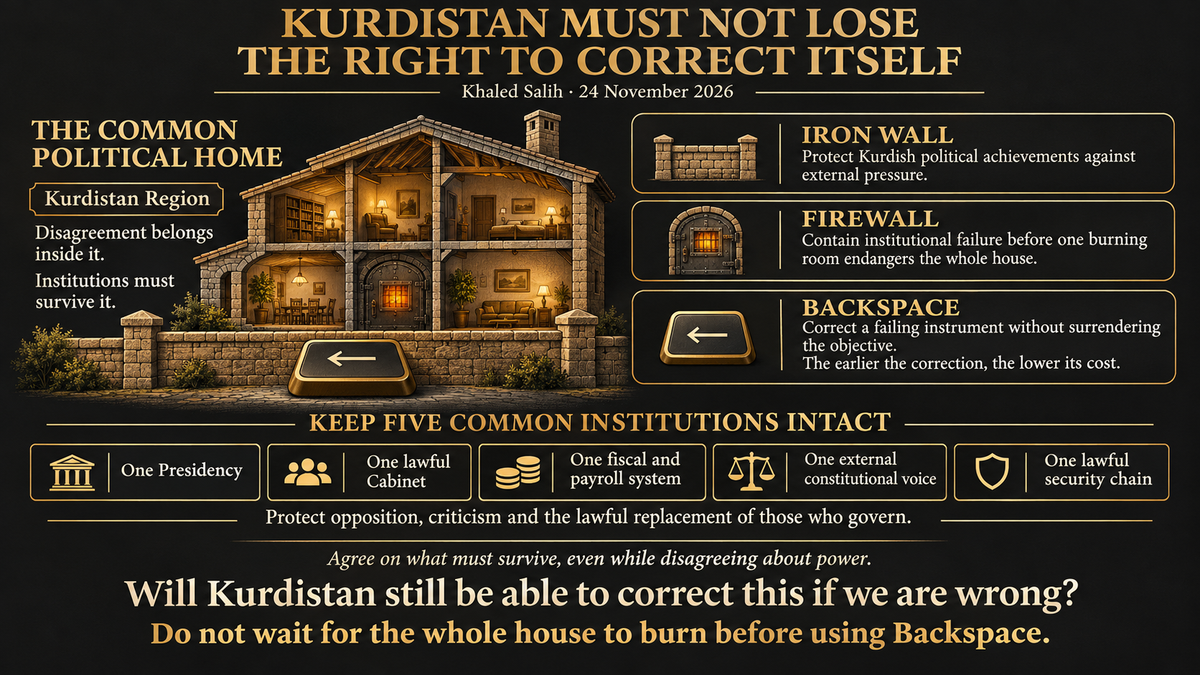
In this new essay, I distinguish between the Iron Wall that protects Kurdish political achievements against external pressure and the Firewall that should prevent internal disagreements from spreading through the entire institutional system.
The argument is not for permanent political consensus. It is for institutions capable of surviving its absence.
Kurdistan must retain the freedom to make mistakes without losing the capacity to correct them.
Read: Kurdistan Must Not Lose the Right to Correct Itself.
KURDISTAN MUST NOT LOSE THE RIGHT TO CORRECT ITSELF
A Personal Appeal for Early Correction Before Political Disagreement Becomes Institutional Damage
Khaled Salih
24 November 2026
I have been in Kurdistan since 14 November, watching the present political crisis unfold at close range, speaking with people from different backgrounds, and holding discussions around Kurdistanî Azad and the questions that led to it.
The more the crisis is watched, discussed and examined, the less useful it becomes to reduce it to a simple story of one guilty party and one innocent one.
That is not because the danger has diminished.
It is because the danger has become clearer.
The pressures are real. The grievances are real. The legal arguments are real. The institutional weaknesses are real. The accumulated mistrust is real. Serious political actors can therefore arrive at positions they regard as necessary, justified or even unavoidable.
That is precisely why the present moment requires more than another argument about who is right.
The danger may lie deeper than the visible disagreement. A dispute over government formation may conceal a struggle over who controls public institutions. A disagreement over constitutional rights may expose an unresolved relationship between party authority and the authority of the state. A contest over political leadership may reveal institutional arrangements that allow one failure to spread into every other part of the political system.
These are possibilities to investigate, not conclusions to assume.
But they raise a question that no settlement between political leaders can afford to ignore: What if the recurring crises are not separate problems requiring separate compromises, but symptoms of an institutional arrangement that repeatedly turns ordinary political disagreement into a threat to the common political home?
The gravest political errors do not require a lack of intelligence, experience, patriotism or commitment.
They can be produced by capable people confronting genuine problems, choosing instruments that initially appear reasonable, and then becoming progressively more committed to those instruments as the political cost of reconsidering them rises.
The danger, then, is not that Kurdish leaders cannot understand complex problems.
Intelligence, experience, historical legitimacy and political skill can make an existing course easier to defend, refine and continue even after the more important question has become whether that course should still be followed.
This is not an argument against one Kurdish party, one leader, one faction, one constitutional interpretation or one claimed grievance.
Nor is it a verdict on who is legally right in every disputed step.
The concern is narrower and more fundamental:
Does the Kurdistan Region still preserve enough room for correction before disagreement hardens into institutional damage?
That is the question around which everything else should now be organized.
Kurdistan still has choices.
But the political cost of changing course may be rising.
That is why Backspace must be used early—not after every side has made revision indistinguishable from surrender.
BACKSPACE IS NOT RETREAT
The Backspace key is one of the smallest keys on a keyboard.
It does not tell the writer what the correct sentence is.
It does not undo the past.
It does not erase responsibility for what has already been written.
It preserves something more modest and more important:
the possibility that the present sentence does not possess an automatic right to determine the next one.
Political systems need the same capacity.
Governments must decide. Parliaments must act. Parties must compete. Leaders must sometimes choose under uncertainty.
Nothing in the idea of Backspace requires permanent hesitation, endless negotiation or the suspension of lawful political action.
The question is different:
Can a political community revise an instrument without destroying the objective it was meant to serve?
Objectives and instruments are easily fused in politics.
Once that happens, criticism of an instrument can be misdescribed as hostility to the objective itself.
A procedural disagreement becomes a test of loyalty.
A request to pause becomes surrender.
A change of sequence becomes abandonment.
That is how Backspace becomes politically expensive while remaining formally available.
The earlier the correction, the lower its cost.
The later the correction, the more reputations, institutions, interests and identities become attached to the original course.
By the time everyone recognizes the error, correcting it may cost more than avoiding it would have cost in the first place.
That is the central warning.
THE IRON WALL: WHAT 2017 TAUGHT
The 2017 referendum expressed Kurdish political will.
It also revealed something else:
political will is not the same as protected political capacity.
Kurdistan possessed substantial achievements, but those achievements were not sufficiently protected against external reaction interacting with internal weakness.
Territorial control changed.
Bargaining power diminished.
The Region’s field of political choice narrowed.
The lesson need not be that Kurdish self-determination was wrong.
Nor that bold political action should be abandoned.
Nor that responsibility belongs to one leader or one party.
The more useful lesson is institutional:
An objective and an instrument must never become indistinguishable.
Independence was an objective.
A referendum on a particular date, under particular strategic conditions, was an instrument.
When changing an instrument begins to look like abandoning the objective itself, political Backspace becomes expensive.
That is the Iron Wall problem:
What protects a Kurdish political achievement against actors who believe sufficient pressure can reverse it?
For Kurdistan, the answer cannot be a single leader, a single armed force, a single foreign relationship or a single moment of political will.
Protection must be distributed across constitutional arrangements, diplomacy, economic capacity, fiscal stability, security institutions and relationships that do not collapse when one part of the political system comes under pressure.
A political community should be able to make a serious mistake without losing the ability to choose again.
The Backspace key is useless if pressing it after an error destroys the keyboard.
THE FIREWALL: WHAT THE PRESENT CRISIS MAY TEACH
The present dispute raises a different problem.
The central issue is not whether disagreement exists.
Disagreement is normal. Boycott is possible. Parliamentary procedures may be contested. Government formation may be disputed. Coalitions may collapse. Courts may fail to persuade every side. Leaders may make serious errors.
A resilient political order assumes that some of these things will happen.
The institutional task is not to create a Kurdistan in which nothing ever catches fire.
Political systems do not work that way.
Governments fail. Coalitions collapse. Leaders misjudge. Parties overreach. Parliamentary procedures are disputed. Courts sometimes fail to persuade. Political rooms will occasionally fill with smoke.
The purpose of a Firewall is different.
It is to make sure that a fire in one room does not become a fire in the whole house.
Perhaps the dispute has been framed too narrowly.
Majority rule and partnership answer questions about who may exercise power.
They do not, by themselves, answer the prior question of what must remain intact when those claims collide.
The deeper test is whether public offices, fiscal procedures and security commands can remain lawful and continuous when political agreement fails.
A settlement that changes officeholders without protecting that continuity would leave the underlying vulnerability in place.
A parliamentary dispute should not create two governments. A presidential dispute should not create two chains of recognition. A disagreement over government formation should not become two payroll systems. A fiscal dispute should not become two relationships with Baghdad. A political confrontation should never force pêşmerge, Asayish, police or Interior formations to choose between competing political commands.
The Kurdistan Region is the common political house within which all these disagreements occur.
The parties may argue over who should occupy a room, who should hold a key, who has the stronger constitutional claim, or who should govern after an election.
Those arguments matter.
Some may be fundamental.
One side may even be right.
But if smoke begins travelling under every door, the hierarchy of questions changes.
The first responsibility is no longer to win the argument inside one room.
It is to stop the house from burning.
That is what a political Firewall is for.
A resilient institutional order does not guarantee that nothing will fail.
It prevents one failure from acquiring the machinery to reproduce itself everywhere else.
Kurdistan built political rooms.
It did not build enough fire doors between them.
That is not an accusation.
It is a diagnosis of institutional incompleteness.
And incompleteness can still be corrected.
But fire doors are useful only before the fire has travelled through the house.
2017 IN REVERSE
The most useful warning is therefore not that Kurdistan is simply approaching another 2017.
The more interesting conjecture is that the present danger could become 2017 in reverse.
In 2017, the principal cascade ran from outside inward:
external confrontation → exposed internal weakness → cascade inward
Today the possible cascade could run from inside outward:
internal confrontation → institutional bifurcation → external exploitation → cascade outward
This is a conjecture, not a prediction.
It should be judged by what actually happens next.
If disagreement remains political; if negotiation can alter sequencing without being treated as defeat; if one Presidency, one Cabinet, one fiscal chain, one external constitutional voice and one lawful security chain remain intact; and if no side builds parallel authority, then the conjectured cascade has not occurred.
But if political disagreement begins generating separate executive, fiscal, external or security structures, outside actors will not need to create Kurdish vulnerability.
They will inherit opportunities created by Kurdish institutional fracture.
An internal Firewall failure can therefore weaken the external Iron Wall.
That is why the danger is larger than who becomes President, who becomes Prime Minister or which party obtains which ministry.
Those questions matter.
They belong to politics.
But they are downstream.
The prior question is whether Kurdistan will still possess one political system after they are answered.
FIVE THINGS THAT SHOULD NOT BE DIVIDED
The institutional problem can be reduced to five minimum conditions:
One Presidency.
One lawful Cabinet.
One fiscal and payroll architecture.
One external constitutional voice toward Baghdad and foreign actors.
One lawful security chain.
These are not arguments for permanent KDP–PUK consensus.
They are not arguments for preserving an old power-sharing formula regardless of election results.
They are not arguments against majority government.
They are not arguments for giving any party a permanent veto.
They are not arguments against opposition, boycott, criticism, replacement or political defeat.
They are the minimum conditions for ensuring that political competition does not become competing sovereignty.
One common institution must never mean one party beyond challenge.
A unified public authority must still allow opposition, judicial scrutiny, published decisions and the lawful replacement of those who govern.
Otherwise the Firewall intended to protect political competition could become a wall against criticism—and reproduce the very error it was built to prevent.
Parties should be able to lose because Kurdistan survives their loss.
Prime ministers should be replaceable because the political home survives replacement.
Coalitions should be able to collapse because public institutions remain standing.
Opposition should be able to remain opposition without becoming a second state-like authority.
Majorities should be able to govern without converting temporary electoral advantage into ownership of the political home.
Partnership should be able to matter without becoming a permanent right to immobilize institutions.
The purpose of common institutions is not to abolish conflict.
It is to make conflict survivable.
THE COST OF DELAYED CORRECTION
There is a dangerous political sequence that appears again and again:
A problem is real. One instrument is chosen. Public commitment accumulates around it. Reputation becomes attached. Supporters are mobilized. Criticism begins to look like disloyalty. Compromise begins to look like surrender. Eventually, changing course appears more costly than continuing.
That is when a reversible choice hardens into an irreversible path.
Everyone makes mistakes.
The danger is not the existence of error. The danger is that the political cost of admitting error rises faster than the institutional cost of continuing with it.
Once that happens, intelligence can become part of the mechanism of error-protection.
Clever arguments can defend a narrowing path.
Legal reasoning can be used to prove that what can be done must therefore be done.
Historical legitimacy can make reconsideration look like betrayal.
Institutional weakness can be redescribed as proof that stronger partisan control is necessary.
This is precisely the point at which criticism must become more careful and correction more urgent.
The question should therefore change from:
Who is right?
to:
What happens if those who are certain they are right are wrong?
And then to the practical question that matters even more:
What can still be corrected now, before correction becomes destructive later?
THE SYMMETRY TEST
One test can help distinguish institutional principle from partisan advantage:
Would the same rule still be defended if the rival party were using it?
Would a parliamentary interpretation still appear legitimate if the numbers were reversed?
Would a claim to partnership still appear indispensable if the positions of strength and weakness changed places?
Would the same presidential, fiscal, judicial or security rule still be accepted if it produced an outcome unfavorable to one’s own side?
The purpose of these questions is not to accuse any party of hypocrisy.
It is to test whether a rule has become genuinely institutional.
If the rule changes when the actor changes, the principle has not yet become fully common.
No political party is immune from this temptation.
Nor are commentators, academics, activists, writers or citizens.
A dangerous philosophy begins by granting one side an exemption from the rule demanded of the other.
It converts explanation into excuse, criticism into identity, and institutions into instruments of whichever side happens to control them.
The answer is not to ask Kurds to become less political, less loyal or less passionate.
The task is to build rules strong enough to survive loyalty.
THE RESPONSIBILITY BOUNDARY
Crises also encourage another dangerous mistake:
the search for one person who can save everything.
No President, Prime Minister, party leader, elder statesman or public intellectual should be made responsible for carrying the entire political home.
That would reproduce the institutional weakness that needs correction.
Responsibility should follow actual authority, knowledge, duty and realistic opportunity for correction.
Those who govern are responsible for decisions within their authority.
Parties are responsible for what they ask institutions and supporters to do.
Public institutions are responsible for remaining public institutions even when competition becomes severe.
Writers, analysts and citizens are responsible for testing claims, distinguishing conjecture from fact, criticizing without dehumanizing, and correcting explanations when better evidence arrives.
No one can carry Kurdistan alone.
The governing principle is simple:
Be responsible for what you do and what you can correct—not for carrying the whole world.
A leader may defend the wall.
No leader should have to become the wall itself.
A SMALLER AGREEMENT MAY NOW BE MORE IMPORTANT THAN A GRAND ONE
The Kurdistan Region may not presently be able to settle every argument about majority rule, partnership, government formation, parliamentary legitimacy, presidential selection and the distribution of power.
But nothing requires agreement on everything before agreement on one vital thing becomes possible.
The most valuable agreement may be smaller than a coalition agreement.
It could be a Minimum Non-Fracture Understanding.
Whatever else remains contested: no rival Presidency or Cabinet; no separate fiscal or payroll chain; no separate Kurdish executive relationship with Baghdad; no competing operational security instructions; no conversion of political non-participation into withdrawal from the common institutional system; and no treatment of pause, re-sequencing or reconsideration as surrender when the alternative is an irreversible breach.
Such an understanding would not determine who governs.
It would not predetermine who becomes President or Prime Minister.
It would not preserve any party’s share of government.
It would not abolish majority rule.
It would not grant a permanent veto.
It would not ask political parties to agree about the past.
It would establish only a floor beneath disagreement.
It would say, in effect:
We may continue to disagree about power. We will not destroy the common political home in order to win that disagreement.
That is not weakness.
That is institutional self-preservation.
THE QUESTION BENEATH ALL THE OTHERS
One question now deserves to stand above the rest:
What can fail in Kurdistan without everything else failing with it?
If a negotiation fails, what survives?
If a coalition fails, what survives?
If a leader is wrong, what survives?
If a party loses, what survives?
If a parliamentary interpretation is later corrected, what survives?
If Baghdad applies pressure, what survives?
If an ally changes policy, what survives?
A resilient political order should be able to answer:
Almost everything else.
That is what institutions are for.
This is not a prophecy of catastrophe.
It is an argument for acting while catastrophe remains avoidable.
There is still time to distinguish objective from instrument.
There is still time to make political defeat survivable.
There is still time to prevent one disagreement from travelling into every room of the Kurdish political home.
There is still time to discover that an opponent may be wrong about many things without therefore being wrong about everything.
There is still time to learn something from 2017 without turning 2017 into a weapon in today’s party conflict.
And there is still time to use Backspace before pressing it becomes so politically expensive that everyone begins pretending there is no key.
The appeal, therefore, is not for one party to surrender to another.
It is not for KDP to renounce electoral strength.
It is not for PUK to renounce its claims about partnership.
It is not for any side to abandon legitimate political objectives.
It is an appeal to separate objectives from instruments, to correct instruments before they become identities, and to preserve the common structures within which every party can continue to compete.
Before closing another option, every actor with the power to do so should ask:
Will Kurdistan still be able to correct this if we are wrong?
If the answer is uncertain, that is not the moment to accelerate beyond correction.
It is the moment to preserve Backspace.
The earlier the correction, the lower its cost.
The later the correction, the greater the danger that political disagreement will acquire institutions of its own.
A political house rarely burns down in a single dramatic moment.
First one room becomes unusable.
Then another door is blocked.
Someone insists that the smoke is exaggerated.
Someone else explains why opening the door would reward the other side.
Each actor continues defending the room immediately in front of them.
Meanwhile the fire moves through the structure everyone assumes will somehow remain standing.
That is the danger.
When the political home itself begins to burn, Backspace may still exist in theory while becoming almost impossible to use in practice.
Kurdistan does not need leaders who never make mistakes.
It needs leaders willing to correct early, parties capable of losing without withdrawing from the common system, and institutions capable of surviving the correction of everyone who temporarily governs them.
No party, leader, institution, commentator, temporary majority, historical memory or inherited grievance should possess the power to make error immune from criticism—or correction so costly that Kurdistan itself pays the price.
The safeguard can therefore be stated simply:
Do not destroy the means of error-correction.
Do not wait for the whole house to burn before using Backspace.
Keep the Kurdish political home intact enough that tomorrow’s correction remains possible.
That is not an argument for any party.
It is an argument for Kurdistan’s right to survive all of them—including their mistakes.