BACKSPACE: How Intelligent Societies Become Trapped by Their Own Ideas
An upcoming book about intelligence, rationality, protected error, and the institutions that make correction possible
An upcoming book about intelligence, rationality, protected error, and the institutions that make correction possible
Khaled Salih | OTHERWISE | 24 October 2026
Imagine an institution filled with highly capable people. They know how to gather information, manage budgets, build technologies, organize complicated operations, and respond quickly when something goes wrong. Their achievements are real. Their competence deserves recognition.
Now imagine that the institution is pursuing a mistaken objective—and that almost everything it has learned to do well makes that objective harder to question.
The better it becomes at solving the problems created by its governing idea, the longer the idea survives. Each new difficulty calls forth another ingenious adjustment. Each adjustment keeps the institution functioning. And each successful adjustment postpones the question that matters most: should we still be doing this at all?
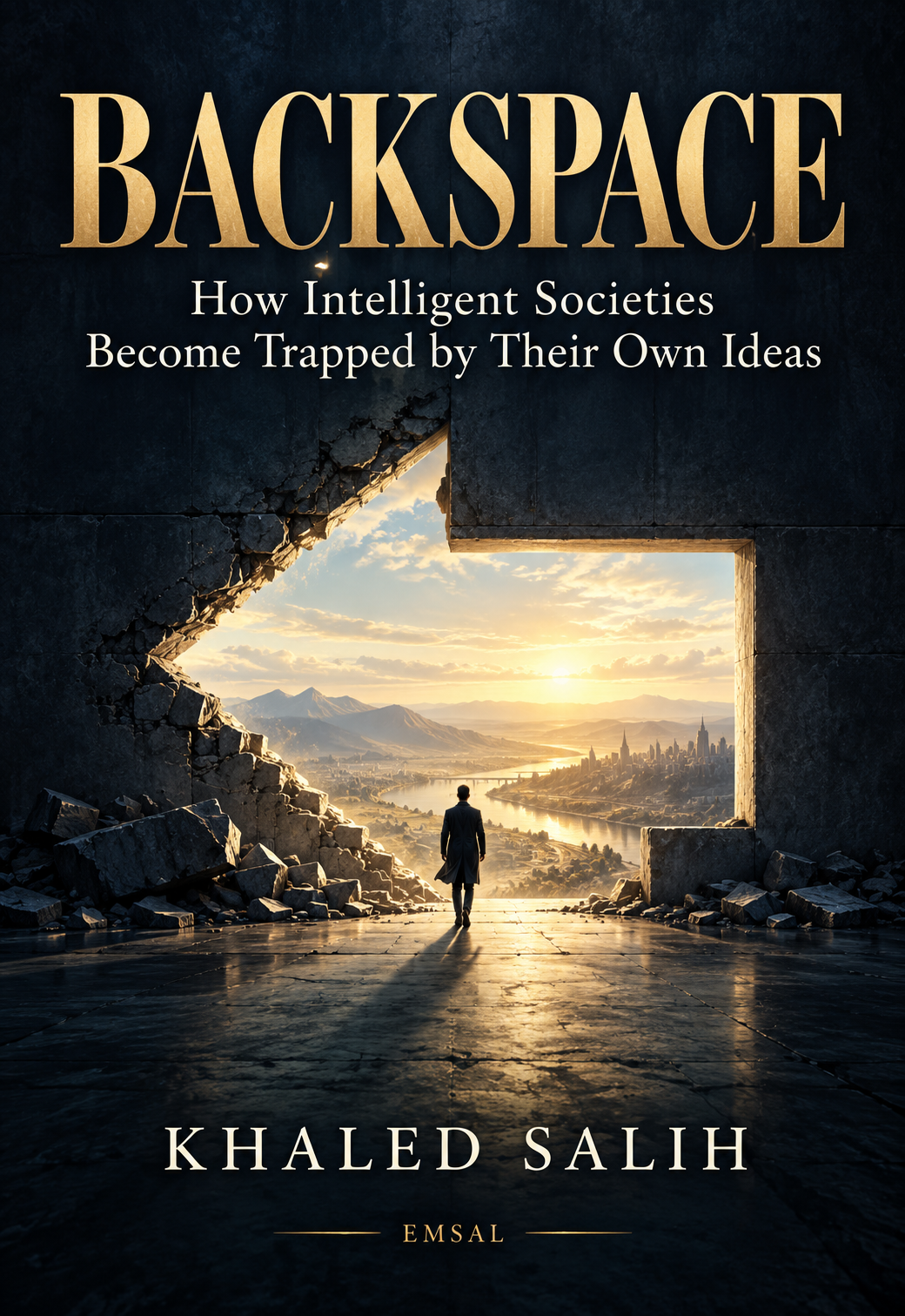
This is the problem behind my forthcoming book, BACKSPACE — How Intelligent Societies Become Trapped by Their Own Ideas.
I began with a distinction that sounds obvious until one follows its consequences: intelligence is not rationality. A person or institution may be extraordinarily capable of achieving a chosen objective while being unwilling or unable to reconsider that objective. Intelligence can help us build an excellent route to the wrong destination. Rationality requires that the destination itself remain open to criticism.
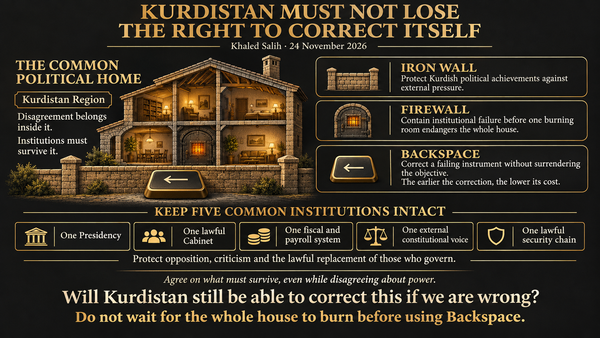
The familiar keyboard supplies the metaphor. Most keys add something to the page. Backspace allows us to withdraw what should not remain there. But political life is not a word processor. A policy can be repealed; the people harmed by it cannot be returned to the lives they would otherwise have lived. Lost years, broken institutions, and deaths do not disappear when an authority admits its mistake.
The political backspace key is therefore not a promise to erase the past. It is the capacity to withdraw an explanation's protected authority over the future, preserve what remains valuable, acknowledge what cannot be repaired, and create room for a better answer.
Where does the error go?
Every functioning institution receives evidence that something is wrong. An employee notices a discrepancy. A citizen challenges a decision. An investigator produces findings. A court identifies an unlawful act. A policy fails to achieve the result promised for it.
The existence of criticism tells us less than we might think. What happens to it next?
Does the evidence reach someone authorized to act? Can the decision be revised even when revision threatens the standing of those who made it? Will an investigation examine the governing assumption, or only the performance of those required to implement it?
An institution may welcome criticism of procedures while making criticism of its central premise prohibitively costly. It may replace officials, commission reports, reorganize departments, and invest in better technology while excluding the one explanation on which those decisions depend.
I call this a problem of protected error: not simply a mistaken idea, but an arrangement that prevents a consequential mistake from being effectively challenged and corrected.
The distinction matters. Disagreement alone does not establish protected error. Nor does the survival of an unpopular policy. A policy may endure because the alternatives are worse, because evidence remains inconclusive, or because people legitimately disagree about their priorities. The diagnosis requires evidence that criticism is being obstructed, that relevant decisions are insulated, and that the obstruction helps the failure persist.
When success becomes a trap
An especially difficult case begins not in failure but in success.
A strategy solves an urgent problem. It saves an organization, wins an election, protects a population, or prevents a crisis. People have good reasons to trust it. Resources accumulate around it; expertise develops; careers and institutions become dependent on its continuation.
But conditions change. What once worked may cease to work. Evidence that should lead to reconsideration is now experienced as a threat to a hard-won achievement. The institution becomes increasingly skilled at defending the method that once saved it.
I am interested in the point where previous success stops informing judgment and starts determining what questions may be asked.
The same difficulty appears when authorities respond intelligently to the consequences of a bad decision. They construct workarounds, subsidies, emergency measures, new contracts, and layers of administration that make continued operation possible. Some of these measures may be necessary to protect people. Yet they may also make subsequent reform more costly. I use the provisional term correction debt for the additional obligations and vulnerabilities created when a warranted revision is delayed.
This is not a license to condemn every compromise as a failure of rationality. Sometimes continuing an imperfect arrangement while developing a safer replacement is the most responsible choice. The question is whether the costs, alternatives, and grounds for delay remain open to examination.
Four different problems, not one verdict
The book examines Iran, Israel, the United States, and Europe. I do not treat them as morally equivalent or assume that a single institutional mechanism explains their histories.
Iran raises questions about the relationship between tactical adaptation and constitutional limits on political change. Israel raises a different question: how can a society with vigorous public criticism remain vulnerable to strategies whose immediate protective achievements may complicate longer-term political reconsideration? The United States raises the problem of whether immense capability allows an unsuccessful commitment to continue through successive changes of justification. European institutions raise questions about divided authority: when many actors can block a decision, who can actually authorize a correction?
These are conjectures to investigate, not verdicts established by attaching the same metaphor to different countries. Each case must also account for successful revisions, genuine constraints, competing explanations, and decisions whose alternatives were not obviously better.
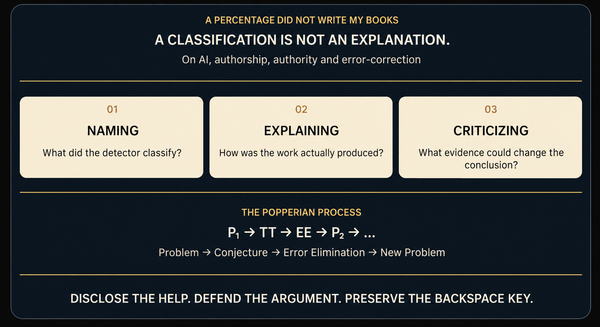
If a framework can explain every policy that persists as protected error, it explains too little. I want to know what evidence would show that an institution has retained a policy after serious criticism for defensible reasons—and what evidence would force me to abandon my diagnosis.
The institutions that can change their minds
Karl Popper's question about how to remove rulers without bloodshed remains central to my inquiry. David Deutsch's account of explanatory knowledge adds another demand: the future cannot be known in advance, because new knowledge can change what becomes possible. It follows that institutions must not only make decisions; they must preserve people's capacity to discover why those decisions might need to change.
I explore what a practical architecture of correction would require: access to evidence, protection from retaliation, decision-makers who can be challenged, enforceable remedies, and review of the institutions entrusted with correction. A court can err. An auditor can be captured. A parliamentary committee can become partisan. There is no final guardian whose decisions make further criticism unnecessary.
One proposal I investigate is a reversibility impact assessment: before making a consequential decision, institutions should examine which effects can later be reversed, which cannot, what capacities must be preserved, and who would bear the cost if the underlying assumptions prove mistaken. The proposal itself requires criticism. An assessment that merely adds paperwork or becomes another means of avoiding responsibility would fail its purpose.
This book is not an argument for permanent hesitation. People must decide, sometimes urgently and under uncertainty. It is an argument for decisions that do not need to be protected from the possibility of being wrong.
Why I am writing BACKSPACE
My work on Kurdistan, religious and political authority, and the open society repeatedly returns to one question: where does the error go? When authority is challenged, does criticism reach a place where something can actually change—or does it disappear into loyalty, hierarchy, identity, or procedure?
BACKSPACE takes that question beyond any one country or tradition. The ambition is explanatory, not therapeutic. I am trying to understand how intelligent people can build organizations that are exceptionally capable of acting and surprisingly incapable of reconsidering what they are doing.
The manuscript is approaching publication, but its arguments remain conjectures. Historical cases require precision; the proposed mechanisms need to survive rival explanations; and the proposed remedies must be examined for the errors they might introduce.
The book will offer no method for avoiding mistakes altogether. That would itself be a mistake.
It asks for something both more modest and more demanding: that no achievement, institution, leader, or inherited explanation should acquire permanent authority merely because it once succeeded.
A society may be intelligent enough to move very fast. The more important question is whether it remains free to discover that it has been moving in the wrong direction.
What happens when the people who know how to make a system work are no longer permitted to ask whether it should work that way?
That is the problem I explore in BACKSPACE—How Intelligent Societies Become Trapped by Their Own Ideas.