Women Are Not Phones: Why Public Broadcasters Should Not Sell Sharia as Fashion
Jina’s name reminds us that veiling is not only fabric. The open society must protect women, not romanticize the rules that may confine them.
20 June 2026
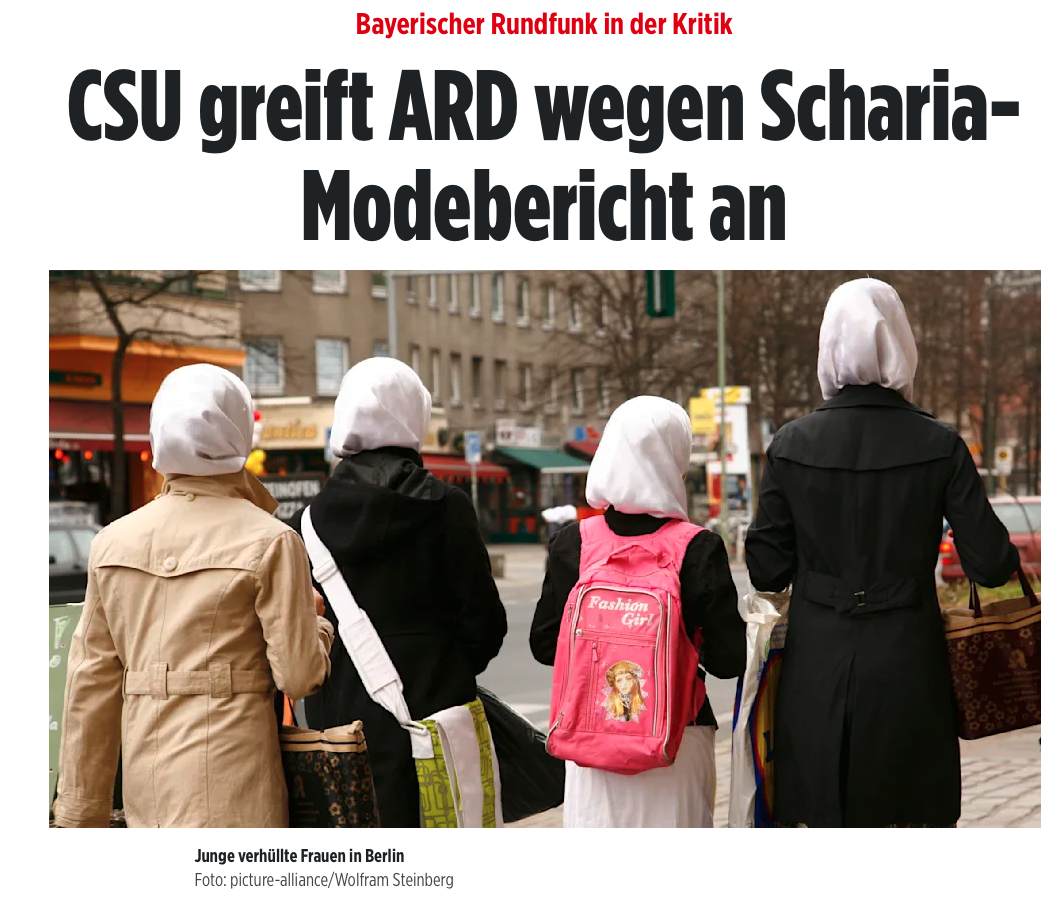
Bayerischer Rundfunk in der Kritik: CSU greift ARD wegen Scharia-Modebericht an
There is a simple test for every open society:
Can it distinguish between persons and ideas?
Persons must be protected. Ideas must remain open to criticism.
That distinction collapses when a public broadcaster presents Sharia-compliant clothing as a harmless fashion trend while leaving the deeper background almost untouched: religious pressure, family pressure, honor, shame, female modesty codes, and the global reality of women punished for refusing or loosening the veil.
The immediate occasion for this essay is a recent controversy in Germany. The Bayerischer Rundfunk, part of Germany’s public broadcasting system, aired a report on so-called “modest fashion” in Nürnberg and presented strongly covering, religiously coded clothing as a growing fashion trend. BILD criticized the segment for treating what it called Sharia-compliant clothing as lifestyle or even empowerment, while giving too little attention to the coercive realities faced by women in Iran, Afghanistan, and conservative Muslim milieus in Europe. The controversy intensified when CSU General Secretary Martin Huber attacked the broadcaster, arguing that such framing trivializes female oppression rather than examining it critically.
At the center of the dispute is not whether women in Germany may wear covered clothing. Of course they may. The question is whether public media can discuss such clothing responsibly without turning a religious modesty norm into a depoliticized lifestyle object. When a broadcaster presents veiling primarily through the language of fashion, confidence, and consumer choice, but does not seriously ask who may refuse, who may remove it, who may criticize it, and who pays the price for disobedience, journalism risks becoming aesthetic camouflage for power.
This is not an abstract issue.
Her name was Jina.
The world came to know her as Mahsa Amini, but her Kurdish name was Jina. She was arrested in Iran by the morality police after being accused of violating compulsory veiling rules. Her death ignited a revolt that began in Kurdistan and spread across Iran and far beyond it.
The slogan that rose from that revolt was Kurdish:
Jin, Jiyan, Azadî.
Woman, Life, Freedom.
Those three words matter because they name the whole problem. The issue was not fabric. It was not fashion. It was not “modest style.” It was power over the female body, power over female visibility, power over female refusal, power over the right of a woman to appear in public without being corrected by men, clerics, police, family, or state.
So when Western broadcasters describe covered clothing only as a lifestyle trend, they should remember Jina.
They should remember the women of Iran who burned their hijabs.
They should remember Afghan women pushed out of public life by the Taliban.
They should remember the girls in European schoolyards who may be praised for covering but shamed for refusing.
And they should remember that the decisive question is not whether a woman may wear the veil.
Of course she may.
The decisive question is whether she may take it off.
Of course every woman should be free to wear what she wants. That is not the issue. A woman in Germany, Britain, Sweden, France, or anywhere else in a free society must be free to wear a headscarf, a long coat, a hijab, an abaya, modest clothing, or no religious clothing at all.
Freedom means that the state should not dictate a woman’s appearance.
But freedom also means that we do not have to pretend that every religious norm is merely a lifestyle choice.
When veiling is described only as “modest fashion,” while the structures of pressure around it are ignored, something has gone wrong. The woman is not being protected. The idea is being protected from criticism.
That is the dangerous point.
In Iran, women have risked prison, beatings, and death because a piece of cloth was judged to sit wrongly on the body. In Afghanistan, under the Taliban, women have been pushed almost entirely out of public life. In many families and communities in Europe, the question of female covering is not simply a matter of fashion. It can be tied to honor, shame, marriageability, obedience, male authority, family reputation, and fear of social punishment.
To ignore all of this and speak only of confidence, identity, or style is not sensitivity.
It is a refusal to see the full reality.
The decisive question is not:
May a woman wear modest clothing?
Of course she may.
The decisive question is:
May she remove it without fear?
May she say no?
May she doubt?
May she disappoint her family?
May she criticize the religious rule?
May she laugh at it, reject it, leave it, reinterpret it, or live without it?
If the answer to those questions is uncertain, then we are not talking only about fashion.
We are talking about power.
This is where an open society has to be morally precise. It must not treat Muslims as suspects. It must not insult, exclude, or humiliate women who wear the hijab. It must not turn religious believers into enemies.
But it must also refuse to treat religious control systems as if they were only colorful fabrics.
An open society protects persons. It does not protect every norm that arrives in the name of those persons.
This rule applies to every religion, ideology, culture, and political movement.
If an idea says women must cover because their bodies are sources of temptation, that idea may be criticized. If an idea ties female dignity to male desire or male self-control, that idea may be criticized. If an idea compares women to phones that need protective covers, that idea may be criticized.
Women are not phones.
Women are not objects to be wrapped so that men may remain undisturbed.
Women are not the property of clerics, fathers, husbands, brothers, activists, states, or public broadcasters.
Women are free human beings.
That is not hatred of Muslims.
It is respect for women.
And it is also respect for Muslims — especially those Muslim women and men who suffer under such norms, resist them, reinterpret them, or quietly doubt them.
One of the great failures of Western institutions is the confusion of empathy with surrender. Out of fear of appearing intolerant, they become tolerant toward intolerance. Out of fear of offending Muslims, they sometimes end up protecting the very religious rules that may harm Muslim women most.
This is not enlightenment.
It is self-censorship with a good conscience.
In my forthcoming book, When Parochial Error Goes Global, I describe this as the problem of protected error. An idea becomes dangerous when it can no longer be criticized because it has been disguised as identity, religion, culture, minority protection, or compassion.
Then criticism becomes “hate.”
Satire becomes “violence.”
Doubt becomes “betrayal.”
Exit becomes “treason.”
And eventually the woman is left alone with a rule that respectable people no longer dare to name.
That is how parochial error goes global.
A local rule about female modesty, born inside a particular religious and social order, travels into liberal democracies and is repackaged as empowerment. A norm that can function as coercion in Tehran or Kabul is softened into fashion language in Munich, London, Stockholm, or Paris. The coercive structure is not abolished. It is aestheticized.
This does not mean every covered woman is oppressed.
It means the rule must remain criticizable.
That distinction is everything.
The woman wearing the headscarf must be protected as a person. The doctrine that may pressure her to wear it must be open to criticism. The girl who chooses modest clothing must be defended in her choice. The girl who refuses it must be defended with equal force.
The open society fails when it protects only one of them.
Public broadcasters have a special responsibility here. They should not run propaganda against religion. But neither should they run soft-focus advertising for religious submission without asking hard questions.
A serious report on modest fashion would have been possible. But it would have had to show the whole reality: the voluntary choice, the religious conviction, the social pressure, the women of Iran, the Taliban, Jina’s name, the Kurdish revolt, the girls in European schoolyards, the family conflicts, the ex-Muslims, the reform Muslims, the fear of shame, and the right to refuse.
It would have had to ask:
Where is the freedom?
Where is the pressure?
Who may say no?
Who pays the price for refusal?
Who benefits when the rule is called fashion?
Only then would it have been journalism.
Without that wider frame, the message becomes dangerously simple:
What may be coercion elsewhere is presented here as a trend.
That is not only naive.
It is dangerous.
Because the open society does not die only when it hates people. It can also weaken itself when, in the name of kindness, it stops criticizing the ideas that make people smaller.
Jina’s name should prevent that mistake.
Jin, Jiyan, Azadî was not a fashion slogan.
It was a cry against a system that made women’s bodies a battlefield of obedience.
Woman, Life, Freedom means nothing if the West cannot say clearly that a woman must be free not only to wear the veil, but also to remove it, criticize it, mock it, refuse it, and live without it.
The woman wearing a headscarf is not the problem.
The problem begins when society stops asking whether she is also free to take it off.


