Truth and its Future. How One Species Reached the Moon Without Escaping Its Capacity for Barbarism
By Khaled Salih
18 October 2026
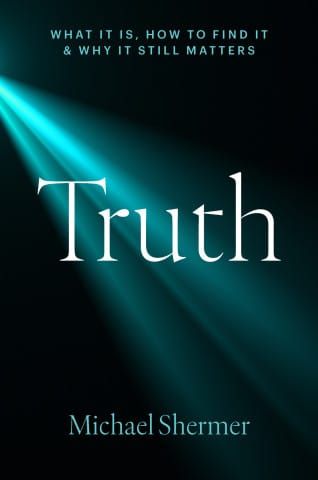
Some books answer questions. Others make the questions harder to abandon. Michael Shermer’s Truth: What It Is, How to Find It, and Why It Still Matters belongs to the second kind. It asks us to defend something both elementary and increasingly difficult: that reality exists independently of our wishes, that some accounts of it are better than others, and that human beings can discover the difference.
I approach this book with sympathy, gratitude, and a problem. Shermer has spent decades defending skepticism against superstition, conspiracy thinking, dogmatism, and the remarkable human talent for believing what we most wish to believe. His new book extends that defense at a moment when the word truth has become both a weapon and an object of suspicion. I share his insistence that evidence matters and that falsehood can injure people and institutions. His concern extends beyond defending particular conclusions. It includes the reasoning practices through which claims are evaluated, the distinction between correlation and causation, and the ways misinformation exploits human judgment. I want to begin from that achievement rather than suggest that his argument ends with a simple appeal to facts.
Yet something continues to trouble me. Even where truth is valued, error can become extraordinarily difficult to correct. Intelligent people defend bad explanations. Educated societies reproduce them. Governments call their failures necessities. Movements call their inherited answers destiny. Movements formed around genuine historical injuries can develop doctrines of collective innocence that make wrongdoing committed in their name harder to recognize. In each case, a claim can survive not because it has withstood criticism but because criticism has been made costly, disloyal, or unimaginable.
This is the problem I want to place beside Shermer’s book: not only how we find truth, but how we organize human affairs so that what we take to be true remains open to correction. And beyond that lies a still more demanding question.
How can a civilization preserve the possibility of discovering futures that no one presently knows how to imagine?
The Achievement Worth Defending
Shermer’s case begins with an intellectual and moral achievement that has become easy to take for granted. Human beings can be wrong about the world; they can recognize that possibility; and they can devise ways of discovering where they have gone wrong. Measurement, experiment, public argument, replication, and criticism are not ornamental features of modern life. They are inventions that make it possible to replace some explanations with better ones.
To defend objective truth is not to claim possession of it. A mountain does not move because a government changes its map. A disease does not yield to a more inspiring slogan. An election is not stolen merely because a defeated candidate declares it so. These statements matter because there are real consequences to confusing a representation with what it represents.
Shermer is particularly persuasive when he insists that mistakes do not make all claims equivalent. Scientific progress is not a sequence of equally arbitrary fashions. The distance between an explanation that can survive severe tests and an explanation insulated from testing is a genuine intellectual distance. The rejection of absolute certainty is not an invitation to treat every story as equally good.
But progress also has a deeper character than the accumulation of increasingly accurate observations. We have learned not merely to look harder but to ask different questions, create new instruments, invent new concepts, and criticize the frameworks within which earlier observations made sense. A theory changes what we can notice. A criticism changes what we can consider possible. This is where a defense of truth becomes a philosophy of the open future.
Knowledge Is Created, Not Merely Collected
Karl Popper gave a revolutionary answer to a deceptively simple question: how can human knowledge grow if experience cannot logically prove a universal theory? We do not begin with certainty and build outward. We propose explanations, subject them to criticism, and try to discover their errors. A theory survives provisionally, not because it has been certified true, but because it has so far resisted serious attempts to show what is wrong with it.
David Deutsch presses the argument further. Knowledge is not a warehouse of observations. It consists in explanatory ideas that can solve problems, survive criticism, and generate further problems. A good explanation is hard-to-vary without losing its ability to explain what it claims to explain. Its details are constrained by the problem and by reality, not merely adjusted to rescue the author’s preferred conclusion.
This distinction matters outside laboratories. An explanation of why a society is poor, why a state is repressive, or why a peace process failed should identify mechanisms that could, in principle, be mistaken. It should tell us what evidence would count against it. Above all, it should make us more capable of acting intelligently. If a story can explain every possible outcome after the event, it may be emotionally satisfying but intellectually empty.
I have come to think that truth-seeking requires a double humility. We must acknowledge a reality that does not answer to our preferences, and we must acknowledge the creative power of minds that can construct explanations no existing evidence could have dictated in advance. Fallibility need not produce paralysis. It can be the condition of rational optimism. Because ideas are corrigible, problems that now appear permanent may have solutions nobody has yet invented.
Where Does The Error Go?
My own preoccupation begins where the familiar praise of skepticism often ends. Imagine that a person notices an error in an institution. What happens next? Can the person name it without punishment? Can the institution investigate without treating the criticism as treason? Can the mistaken policy be reversed? Can those injured by it demand an account? Can the institution learn before the costs are transferred to people with less power?
An error does not disappear when it becomes unsayable. It changes location. It can move from a falsified prediction into an official narrative, from an official narrative into a schoolbook, from a schoolbook into a moral obligation, and from an obligation into the habits by which the next generation recognizes what is supposedly possible. A protected explanation can become a replicating institution. Replication does not occur simply because people believe something strongly. It requires identifiable channels of transmission, incentives for preservation, and conditions under which contrary evidence loses its power to change behavior.
This is not a law of history. It is a conjecture about a recurrent mechanism. It would need to be revised where institutions suppress criticism yet still correct errors reliably, or where open criticism is abundant but fails to improve decisions. That possibility of correction is not a weakness in the argument; it is one of the things the argument is meant to preserve.
The most consequential question, then, is not whether a movement, nation, religion, government, or intellectual school says that it respects truth. Almost all do. The question is what happens to a disconfirming explanation after it enters the room. Is it examined, buried, reclassified as hostility, or passed down as an injury for which someone else must pay?
A civilization may possess universities, elections, courts, research institutes, and vast informational resources, yet remain unable to apply criticism to its most protected convictions. Institutional sophistication is not identical to rationality. Intelligence increases the range of explanations we can invent; it does not guarantee a willingness to correct the ones we cherish.
The Inheritance Of The Invisible
Some of the most powerful causes in human affairs are invisible in the ordinary sense. Honor, shame, purity, historical destiny, guilt, chosenness, humiliation, sacred entitlement, and collective innocence cannot be photographed like a bridge or weighed like a stone. Yet people build laws around them, surrender rights to them, and sometimes kill or die for them.
Their reality lies in the consequences of explanations held by human minds and sustained by institutions. That is why it is insufficient to distinguish the empirical from the merely subjective and leave the matter there. We need to ask how an invisible belief acquires the capacity to organize visible life. Which authorities transmit it? Which incentives protect it? What sort of person is permitted to challenge it? Which imagined alternatives are ruled out before anyone begins to debate?
Here social inheritance matters. A society offers more than a menu of formal choices. It teaches people which options can be perceived as legitimate, honorable, realistic, or available to someone like them. The objective range of possibilities may be wider than the range that a person can imagine. To expand freedom, it is therefore not enough to offer an option on paper. People must also be able to notice it, criticize inherited categories, and create options that did not previously exist. Perceiving an alternative does not make it available. A person may understand what needs to change while lacking the security, resources, or authority required to pursue it. The distinction matters because a failure to act cannot automatically be attributed to a failure of imagination.
We correct inherited worlds using tools partly inherited from those worlds. This makes correction difficult, but not futile. Reflexivity—the capacity to turn criticism upon the concepts through which we see—can enlarge what is thinkable. Structure conditions possibility; it does not write the future. The moment someone asks whether an ancient division is a fact of nature or a human construction, a new possibility has entered history.
The Suffering That Explanations Can Conceal
My concern is not purely philosophical. Having studied the anfāl (Iraq’s genocidal) campaign against the Kurds, and having watched the destruction visited upon Yezidis in Shingal by ISIS, I cannot regard error merely as a mistake in a seminar room. Ideas can determine which people appear fully human, which suffering counts, and which deaths become administrative details. An explanation can arrive before the person it purports to explain.
That does not mean every false belief leads to atrocity, or that an atrocity is adequately explained by a single doctrine. Institutions, weapons, incentives, opportunities, orders, and human decisions matter. The causal work must be done, case by case. Yet a recurrent warning remains: when a theory of the world has already assigned a population a place outside ordinary moral consideration, reality may have little chance to correct it before violence begins.
A second danger arrives after catastrophe. Memory can preserve evidence and sustain demands for justice. It can also be turned into a prohibition on criticism. The suffering of a people does not make every claim issued in its name true. The crimes of an enemy do not confer permanent innocence on those who oppose it. Historical injury cannot grant a veto over future knowledge.
This is why the question of truth belongs together with the question of responsibility. To preserve memory honestly is to retain the capacity to distinguish explanation from exoneration, accusation from evidence, and solidarity with victims from obedience to those who claim to speak for them. An open society must be able to criticize both power and the stories told against power.
The Trap Of Civilizational Certainty
We often hear that civilization is in danger because people have lost confidence in its truths. There is something right in the warning. Shared institutions cannot function if no one distinguishes evidence from fabrication. But the opposite temptation is equally dangerous: to imagine that civilization can be saved by placing its foundational explanations beyond criticism.
Athens is worth remembering not because the Greeks possessed a completed answer to politics or knowledge. They did not. Its enduring importance lies partly in the emergence of a tradition in which inherited claims could become public arguments. That tradition remained incomplete, unequal, and often contradicted by the society that produced it. Precisely for that reason, its significance cannot be reduced to nostalgia for an imagined golden age.
A civilization is not protected by declaring its past sacred. It is protected by preserving the practices through which its errors can be discovered and its achievements surpassed. Western civilization, if the term is to mean more than geography or ancestry, is at its strongest when it treats the criticism of its own failures as an extension of its best discoveries. The open society is not a museum for approved conclusions. It is a continuing institutional experiment in permitting better ones to emerge.
The serious threat is not criticism itself. It is the capture of criticism by those who treat their own theory of civilization as the final court of appeal. A society that cannot criticize its defenders has merely exchanged one protected doctrine for another.
One Species, Two Kinds of Progress
Three images place a difficult question before me. The pyramids of Egypt. The entrance to Auschwitz. A human being standing on the Moon.
One species.
The first reminds me that human beings developed extraordinary capacities for construction, organization, and planning long before modern science. The second confronts me with a civilization in which institutions, administrative capacities, and technical knowledge were mobilized for systematic persecution and mass murder. The third reveals what explanatory knowledge and human cooperation made possible when people attempted something no previous generation had accomplished.
These are not three stages of moral progress. Auschwitz was not a necessary passage between the pyramids and the Moon. Nor can one achievement redeem another atrocity.
What connects the images is a more disturbing fact: the capacity to accomplish something extraordinary does not establish the wisdom or justice of the purpose being pursued.
A society may become extraordinarily capable of carrying out decisions while remaining dangerously resistant to questioning them.
I want to distinguish two capacities. The first is transformative: the knowledge and means to change the physical and social world. The second is corrective: the institutional and cultural capacity to expose mistaken explanations, challenge destructive purposes, interrupt harmful decisions, and hold their authors accountable.
These capacities do not necessarily grow together.
The first can strengthen the second. New knowledge can reveal harms, make evidence accessible, and provide means of prevention. But the first can also increase the reach of a protected decision. Administrative sophistication can make an unjust command easier to execute. Communications technology can help expose a falsehood or distribute it more efficiently. Scientific knowledge can enlarge the possibilities of medicine or the destructive power of weapons.
I call this the Capability–Correction Divergence: the possibility that a civilization’s power to transform the world can expand while its capacity to question, restrain, and correct the purposes for which that power is used remains weak or deteriorates.
The conjecture requires care. It does not explain Auschwitz by describing genocide as an administrative mistake. The Nazi regime’s crimes involved deliberate choices, organized persecution, and murderous objectives. The relevant failure concerned, among other things, the institutions and political arrangements through which those objectives were imposed and opposition was suppressed. The distinction matters because deliberately pursuing an atrocity is not equivalent to making an honest mistake. The relevant questions include who defined the objective, which institutions made its pursuit possible, and what prevented those who opposed it from stopping the machinery of persecution.
Nor does the Moon landing establish the moral superiority of the society that achieved it. Technical accomplishment cannot certify political innocence.
The images instead expose a distinction that every account of progress must confront. What human beings can accomplish and what human beings ought to accomplish are different questions. Knowledge can improve the means available for pursuing an objective without making the objective just.
A civilization therefore needs more than institutions capable of discovering how to do things. It needs institutions in which people can challenge whether particular things should be done, whose interests they serve, what harms they impose, and whether their purposes should be abandoned.
This is not an argument against scientific or technological progress. It is an argument for making the institutions that govern its applications increasingly answerable.
Humanity’s ability to reach the Moon is evidence of an extraordinary capacity to create explanatory knowledge and put it to work. Auschwitz is evidence that organizational capacity and technical sophistication can coexist with a systematic assault on human beings.
The most dangerous civilization may not be one that has stopped learning how to accomplish things. It may be one that continues learning how to accomplish things while progressively losing the capacity to question what it is accomplishing.
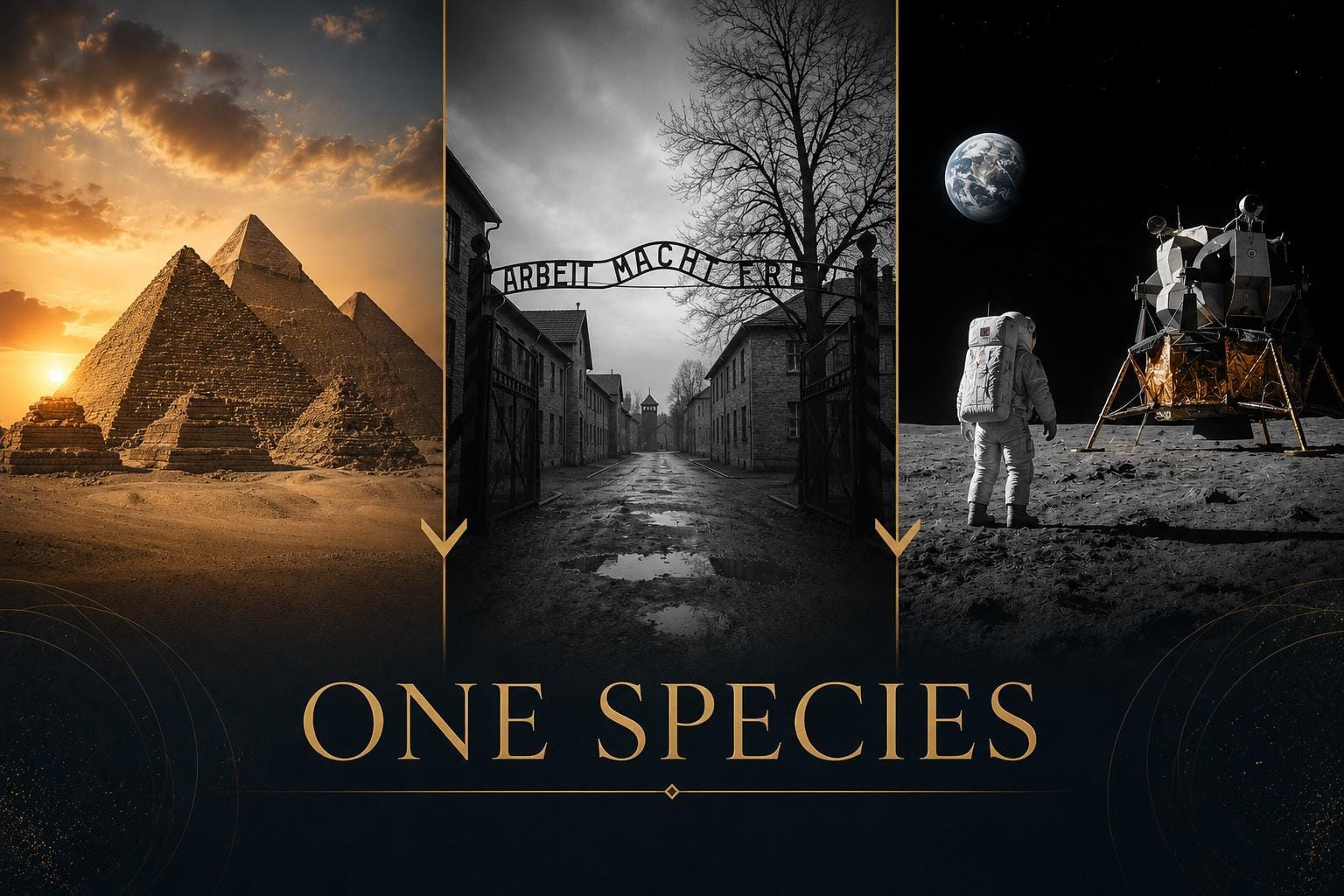
One Species: Human beings built the pyramids, organized Auschwitz, and reached the Moon. These are not stages of moral progress. They reveal the difference between what humanity can accomplish and the purposes for which its knowledge and power are used.
Truth And The Sovereignty Of The Future
This brings me to a political conjecture I have been developing across my work on Kurdistan, political belonging, and the open society. Much of political argument begins from inherited borders, inherited grievances, inherited identities, and inherited solutions. Each side is asked to choose among futures already authorized by the past. Yet why should the people who came before us possess the authority to exhaust the possibilities of those who come after?
I call the alternative Future Sovereignty: the principle that no generation, party, state, doctrine, or inherited grievance is entitled to close the space in which future people may criticize and create political arrangements. It does not abolish present obligations, existing rights, legitimate security concerns, or the difficult work of institutional construction. Nor is it a magical answer to conflicts over territory and sovereignty. It changes the test to which proposed answers must submit.
The claim must itself remain subject to criticism. An institution cannot establish that it protects future freedom merely by describing its policies as long-term investments. Its claims require evidence about the rights it preserves, the alternatives it forecloses, the costs it transfers to others, and the lawful means available for reconsidering its decisions. An appeal to future generations cannot excuse avoidable injury to people living now.
A political settlement should be judged not only by whether it ends a present dispute but by whether those living under it can correct its defects without having to destroy the settlement—or one another. Does it preserve peaceful revision? Can minorities challenge majorities? Can officials lose power? Can a community reconsider a constitutional arrangement without its members being treated as traitors? Can new knowledge change what once appeared nonnegotiable?
For Kurdistan this is neither an instruction to renounce statehood nor a demand to declare it the only conceivable future. The political home of the Kurds should not be defined by outsiders as an impossibility, nor frozen by Kurds into an answer immune to criticism. Statehood, federalism, confederation, and other arrangements must be subject to the same demanding inquiry: what freedoms, capabilities, responsibilities, safeguards, and powers of peaceful correction can they actually sustain?
Protection matters, especially where history has given people good reason to fear abandonment. But protection alone does not produce agency. A people needs the institutions and capacities to act, learn, cooperate, and correct its own rulers. The decisive movement is from being protected to becoming capable of protecting an open future—including against mistakes made in the name of protection.
The Problem Of The Backspace Key
Every political and intellectual order makes errors. The distinction is what it permits people to do afterward. A computer program needs a way to interrupt a destructive instruction. A scientific community needs criticism, replication, and revision. A government needs legal limits, independent scrutiny, reversibility, and removal from office. A culture needs practices that separate a person’s dignity from the infallibility of the person’s ideas.
I have used the backspace key as a metaphor for this capacity. The metaphor has limits: a death cannot be undone, and some technologies spread harmful consequences faster than institutions can reverse them. That is exactly why error-correction cannot be postponed until after every experiment has run its course. The faster an intervention travels, the more autonomous and opaque its operation, and the harder its consequences are to reverse, the more serious the demand for detection, interruption, and accountability becomes.
One must be able to say, without humiliation, that an explanation was wrong; without sacrilege, that an inherited rule requires revision; and without civil war, that a political settlement requires alteration. Protect the person, expose the idea to criticism: this is both a moral discipline and an institutional design principle. It protects dissenters without pretending that all dissent is correct. It defends the right to be wrong while preserving the obligation to respond to evidence.
Nor does correction mean endless hesitation. Decisions are unavoidable. The relevant question is whether they are constructed as provisional solutions to real problems or as monuments to the wisdom of their authors. Good institutions permit action under uncertainty and make learning from the consequences possible.
An Unfinished Conversation With Shermer
What, then, would I put to Michael Shermer? First, a note of agreement: the defense of objective truth is indispensable, and skepticism remains one of the great tools of intellectual emancipation. The abandonment of evidence does not liberate humanity from power; it makes people more vulnerable to those who manufacture convincing stories.
Then I would ask whether the deepest unit of analysis should be the true belief, the reliable method, or the corrigible explanation situated within a social architecture. I do not assume that Shermer would reject this formulation. My purpose is to explore a problem that his defense of truth helps make visible: the distance between possessing evidence and creating institutions through which that evidence can alter consequential decisions.
A belief may be true by accident. A method may work within a limited domain and fail beyond it. A good explanation, by contrast, invites criticism of its mechanisms and opens further questions. But even the best explanation may be powerless if institutions forbid its consequences from being heard.
What protects a society from intelligent irrationality? What enables a truthful objection to survive an organization whose status depends upon rejecting it? How do people discover choices that their upbringing has trained them not to perceive? How can a culture preserve its achievements without converting them into commandments? And how can descendants inherit history without inheriting an obligation to repeat it?
These questions are not objections to the search for truth. They are attempts to make that search more demanding. They extend skepticism from propositions to institutions, from evidence to the channels through which evidence acquires influence, from the exposure of error to the protection of the human capacity to correct it.
There is a further criticism I must aim at my own argument. An appeal to openness can itself become a comfortable slogan. If every failure is described as a failure to correct, the account explains too much and predicts too little. Some failures arise because the relevant knowledge does not yet exist, because feasible alternatives are genuinely limited, or because legitimate purposes conflict even after the available evidence has been examined. It must identify mechanisms, compare cases, admit contrary evidence, and specify what different institutions would make possible. Future Sovereignty, likewise, would be empty if it could not distinguish a settlement genuinely open to peaceful revision from one that merely celebrates the language of openness while preserving unaccountable power. The argument stands or falls with such distinctions.
The Beginning That Does Not End
I began this dialogue with a book about truth. I end with a possibility that no book can complete. Human beings are not condemned to choose only among the futures bequeathed to them. They can create new knowledge. New knowledge changes what can be done. What can be done changes which political, moral, and civilizational arrangements become possible.
This is not an assurance of progress. Nothing in the universe promises that people will welcome criticism, construct better explanations, or act upon what they discover. Civilizations can destroy the conditions of their own learning. Open institutions can be captured. Tools intended to correct error can themselves become instruments for protecting it. Rational optimism is not a forecast that things will turn out well. It is the refusal to treat any currently unsolved problem as proof that no solution can be created.
Michael Shermer reminds us why truth matters. Popper helps us understand why we must remain fallible. Deutsch shows why explanations, and the creation of explanations, make progress possible. My own question is what human institutions must preserve if knowledge is to remain capable of changing the world rather than serving as its decoration.
There may be no final political arrangement, no complete civilizational self-description, no last explanation that settles the meaning of freedom. This need not be cause for despair. It can be the strongest reason to defend institutions that allow criticism to travel, mistakes to be corrected, and new choices to become visible.
The sovereignty worth leaving to our children is not sovereignty over the answers they must give. It is sovereignty over the questions they will be free to ask, the explanations they will be free to challenge, and the futures they will be free to create.
Truth matters because reality can correct us. Freedom matters because we must be permitted to correct ourselves. The future matters because the next good explanation may not yet exist.
That is the beginning of infinity. And its most extraordinary property is that the beginning need not end.
Sources and Further Reading
Truth, Knowledge, and the Open Society
Shermer, Michael. 2026. Truth: What It Is, How to Find It, and Why It Still Matters. Baltimore: Johns
Hopkins University Press.
ISBN: 9781421453729.
https://doi.org/10.56021/9781421453729
My article’s principal point of departure. Shermer examines objective truth, skepticism, misinformation, scientific reasoning, causation, and the evaluation of competing claims.
Popper, Karl R. 1963. Conjectures and Refutations: The Growth of Scientific Knowledge. London: Routledge & Kegan Paul.
A foundational source for conjectures, criticism, fallibility, and the growth of knowledge.
Popper, Karl R. 1945. The Open Society and Its Enemies. 2 vols. London: Routledge.
Deutsch, David. 2011. The Beginning of Infinity: Explanations That Transform the World. New York: Viking.
Originally published in two volumes: The Spell of Plato and The High Tide of Prophecy: Hegel, Marx, and the Aftermath. This is an essential source for discussions on intellectual authority, criticism, historicism, and the political institutions of an open society.
The Author’s Related Works
Salih, Khaled. 2026. When Parochial Error Goes Global: Islam, Epistemological Closure, and the Defense of the Open Society. EMSAL. ISBN 978-91-531-0309-7.
This book provides the broader theoretical and historical foundation for my analysis of protected error, anti-rational explanations, and institutions that obstruct criticism.
Emanuelsson, Ann-Catrin, and Khaled Salih. 2026. Kurdistanî Azad: The Long Dream of Kurdish Self-Rule. EMSAL.
This book provides the historical and political background for your discussion of Kurdistan, self-rule,
political recognition, and the responsibilities associated with freedom.
Auschwitz and the Holocaust
United States Holocaust Memorial Museum. n.d. “Auschwitz.” Holocaust Encyclopedia. Washington, DC:
United States Holocaust Memorial Museum.
https://encyclopedia.ushmm.org/content/en/article/auschwitz
Auschwitz-Birkenau State Museum. n.d. “Mini Dictionary.” Oświęcim: Auschwitz-Birkenau State Museum.
Anfal and the genocide against the Kurds
Middle East Watch. 1993. Genocide in Iraq: The Anfal Campaign Against the Kurds. New York: Human
Rights Watch.
ISBN: 9781564321084.
https://www.hrw.org/reports/1993/iraqanfal/
A major historical investigation based on captured Iraqi government documents and interviews with survivors. It documents the planning and execution of the Anfal campaign and concludes that the Iraqi government committed genocide against the Kurds.

