Who Stole the Backspace Key?
What Kurdistan Can Teach Us About Freedom, Fallibility, and the Right to Correct Our Mistakes
2 September 2026
Note:
What if the deepest political freedom is not the freedom to be right—but the freedom to discover that we are wrong?
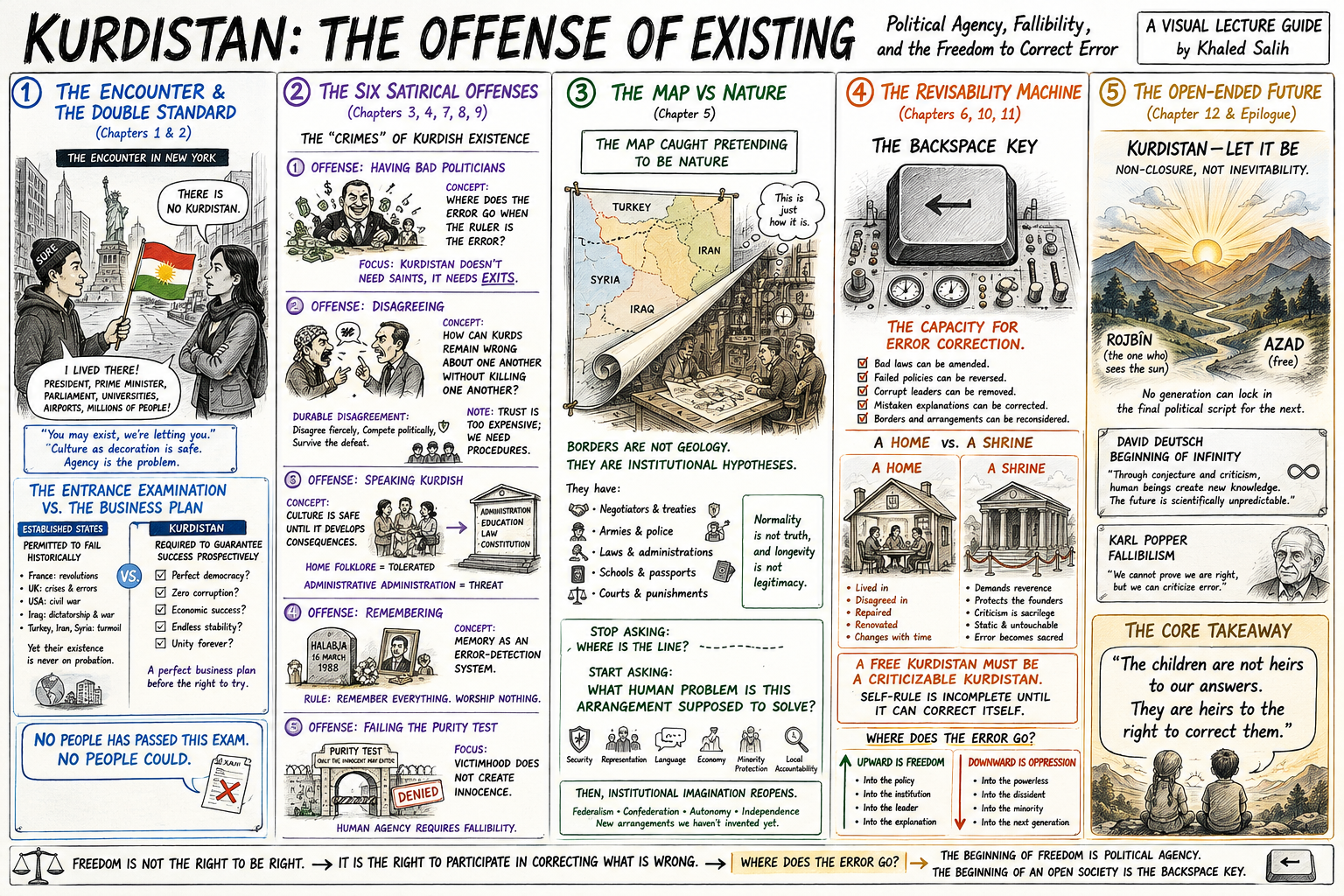
Kurdistan: The Offense of Existing began with an absurdity: Kurds are repeatedly asked to prove that they can govern perfectly before being permitted the political agency that existing states take for granted. No people could pass that examination.
But following that argument led somewhere larger. Bad politicians, disagreement, failed policies, inherited borders and historical mistakes are not uniquely Kurdish problems. They are human problems. The real test of a political order is therefore not whether it avoids error. No society can. It is whether error can be exposed, criticized and peacefully corrected.
That is the Backspace Key.
This essay asks a question that begins in Kurdistan but should not remain there: When a leader, party, institution, movement—or an entire society—gets something badly wrong, where does the error go?
If criticism cannot travel upward, if leaders cannot be replaced, if institutions cannot be revised, and if yesterday’s answers become sacred, someone has effectively removed the Backspace Key.
Kurdistan provides the case. Fallibility provides the problem. Error-correction makes the lesson universal.
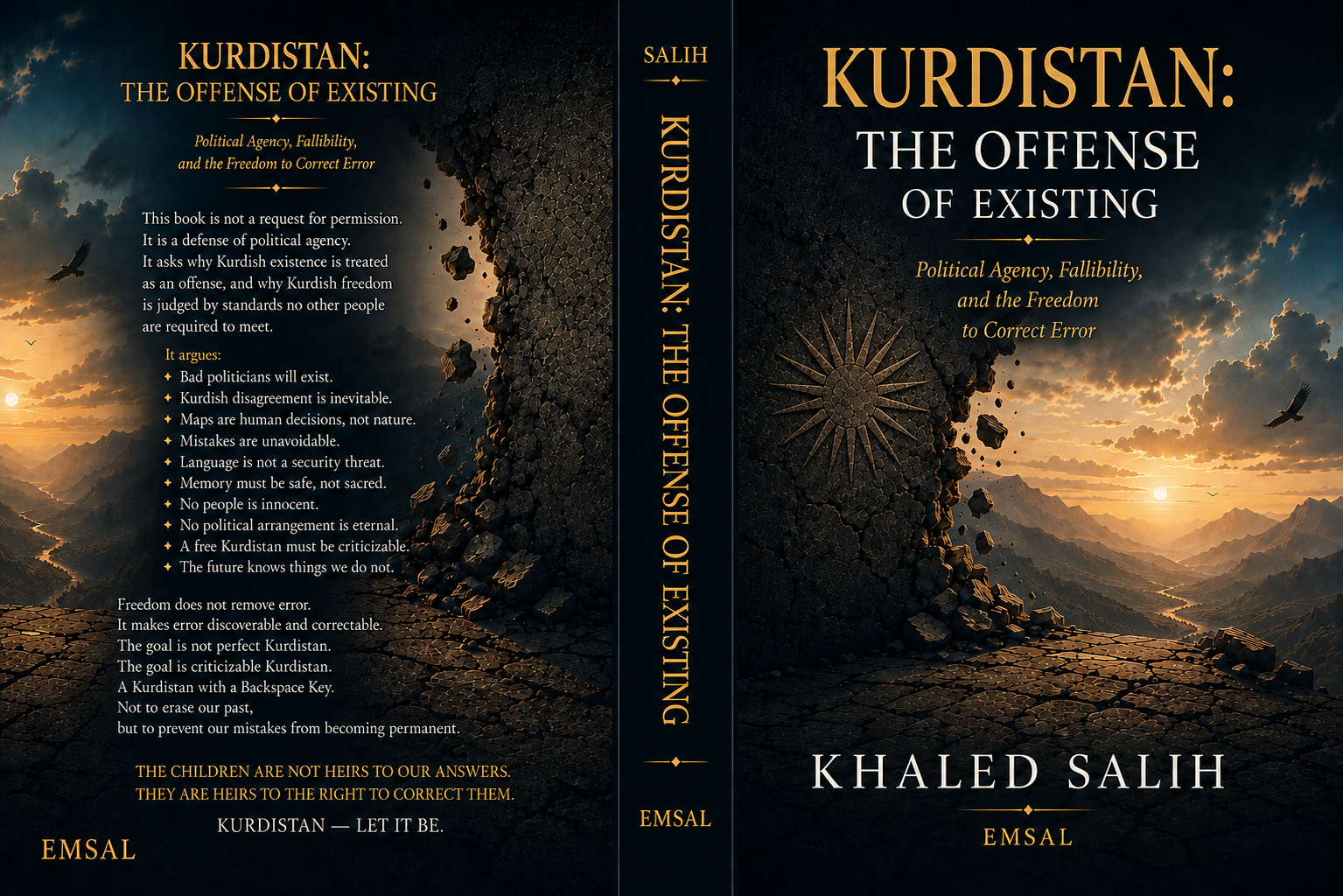
My new essay: Who Stole the Backspace Key? — What Kurdistan Can Teach Us About Freedom, Fallibility, and the Right to Correct Our Mistakes.
Imagine a courtroom.
The judge looks down from the bench. The room falls silent. The charge is read:
You are accused of making a mistake.
Guilty.
A second defendant appears.
You are accused of disagreeing with your compatriots.
Guilty.
A third is brought forward.
You are accused of having bad politicians.
Guilty.
Then comes the final defendant.
The judge examines the file, pauses, and announces the most serious charge of all:
You are accused of existing.
Guilty.
There is something almost comic about this courtroom. Kafka might have recognized it. Monty Python could have staged it.
But for Kurds, the joke has lasted more than a century.
And somewhere in writing Kurdistan: The Offense of Existing, the joke stopped being principally about Kurdistan.
It became a question about freedom itself.
Because beneath the borders, wars, betrayals, revolutions, failed agreements, bad politicians, heroic leaders, corrupt leaders, disputed maps and impossible demands placed upon Kurds lies a much simpler philosophical problem:
What do human beings actually need political freedom for?
The conventional answer is that people need freedom in order to govern themselves.
That is true.
But it is incomplete.
Human beings need freedom because human beings are fallible.
They need political agency not because they know what the right answers are, but because nobody does. They need institutions through which bad answers can be criticized, mistaken decisions reversed, unsuccessful leaders replaced and better explanations discovered.
Freedom, in this sense, is not principally the right to be right.
It is the right to participate in correcting what is wrong.
And once we understand freedom that way, Kurdistan becomes something larger than the Kurdish question.
It becomes a laboratory for understanding the Open Society.
The Offense of Existing
Consider a seemingly trivial encounter on a New York street.
A young American who had lived for years in Silêmanî approached football supporters carrying different national flags. He showed one woman, draped in the Turkish flag, the flag of Kurdistan.
She did not recognize it.
He explained what it was.
Her answer was categorical:
There is no Kurdistan.
He explained that he had lived there. There was a Kurdistan Regional Government. A president. A prime minister. A parliament. Ministries. Universities. Airports. Security institutions. Millions of inhabitants.
None of this disturbed the proposition.
There is no Kurdistan.
The fascinating thing about such a statement is not its hostility. It is its certainty.
Reality has encountered doctrine, and doctrine has won.
Eventually, the woman explained that Kurds could have houses, jobs and ordinary lives because, in her formulation,
“we’re letting you guys do it.”
There, almost accidentally, the political architecture becomes visible.
You may exist.
You may work.
You may marry.
You may cook Kurdish food.
You may dance in Kurdish clothes.
You may sing Kurdish songs.
Perhaps you may even commemorate Kurdish suffering.
But all this remains tolerable only while culture remains politically decorative.
The problem begins when existence produces agency.
When language becomes administration.
When memory becomes criticism.
When history questions sovereignty.
When people cease asking permission to exist and begin asking why someone else possesses the authority to grant that permission.
The distinction is fundamental.
A subject may be permitted to exist.
An agent participates in deciding the conditions of existence.
A subject petitions authority.
An agent can criticize, change and ultimately replace authority.
That is why the Kurdish problem has never simply been whether Kurds exist.
Their existence became increasingly difficult to deny.
The more consequential question was what political conclusions Kurds were permitted to draw from that existence.
The Impossible Business Plan
Once Kurdish political agency is admitted even hypothetically, another courtroom opens.
Now Kurdistan must prove that it deserves freedom.
Will it be democratic?
Will its economy work?
Will there be corruption?
Will Kurdish parties cooperate?
Will minorities be protected?
Will oil revenues be managed responsibly?
Will there be peace?
Can all this be guaranteed ten years from now?
Fifty?
A century?
These are legitimate questions when they are asked as criticism.
They become illegitimate when uncertainty itself becomes grounds for permanently denying agency.
Because there is an obvious question:
Compared with what?
France has changed constitutions and republics.
Britain has made enormous political mistakes.
The United States experienced a civil war.
Iraq has endured dictatorship, invasion, sectarian war and institutional dysfunction.
Iran and Turkey have experienced repression, coups, insurgencies and profound political crises.
Syria catastrophically collapsed into civil war.
Yet nobody concludes from these failures that the peoples inhabiting those states must first demonstrate their competence before their political existence can continue.
Existing states receive something Kurdistan is repeatedly denied:
the right to have a future containing mistakes.
That asymmetry exposes something important.
No society can submit a reliable business plan for history.
Human beings create knowledge. New technologies appear. Alliances change. Institutions fail. Unexpected problems emerge. Solutions themselves create new problems.
The future therefore cannot be politically pre-certified.
This is where David Deutsch’s epistemology becomes politically explosive.
If knowledge grows through conjecture and criticism, then the demand to know beforehand whether a political arrangement will succeed asks human beings to possess knowledge that has not yet been created.
The proper question cannot be:
Can Kurdistan guarantee that it will work?
No country can.
The better question is:
If Kurdistan does not work as intended, what institutions will allow its inhabitants to discover why and change it?
That is an entirely different standard.
And unlike perfection, it is a standard we can demand from everyone.
Yes, Kurds Have Bad Politicians
The prosecution now produces its strongest evidence.
Kurds have bad politicians.
The allegation is devastating because it is true.
There has been corruption.
Patronage.
Nepotism.
Factionalism.
Parties have accumulated power.
Institutions have sometimes become subordinate to parties and families.
Kurdish factions have fought one another.
Opportunities have been squandered.
Governments have failed.
Excellent.
Now politics can begin.
Because the existence of bad politicians is not an argument against political institutions.
It is the reason political institutions are necessary.
Constitutions are not written because rulers are trustworthy.
Elections are not invented because politicians voluntarily surrender power.
Independent journalism is not necessary because governments reliably expose their own failures.
Opposition parties are not useful because rulers enjoy criticism.
These institutions exist because human beings are fallible and power magnifies the consequences of their errors.
A corrupt Kurdish politician therefore proves nothing about whether Kurds deserve political agency.
He proves that Kurdish political power requires criticism, accountability and replacement just as every other form of political power does.
There is a dangerous conceptual trick in doing otherwise.
The politician fails.
Responsibility is transferred to the population.
The population is declared politically immature.
And the failure of its rulers becomes evidence that the ruled deserve less freedom.
We would recognize the absurdity immediately elsewhere.
A corrupt French politician does not invalidate France.
An incompetent British government does not invalidate Britain.
A disastrous American president does not invalidate America.
Why should a bad Kurdish politician invalidate Kurdistan?
The proper response to bad Kurdish government is not less Kurdish political agency.
It is better mechanisms for correcting Kurdish government.
Gratitude Is Not a Constitution
But this argument must also turn inward.
Liberation movements face a peculiar danger.
Their leaders often possess genuine historical legitimacy.
They suffered.
They fought.
Their friends died.
Families sacrificed generations.
Without them, political institutions that later generations take for granted might never have existed.
That deserves gratitude.
But gratitude contains a temptation.
Yesterday’s sacrifice can become today’s immunity.
Criticize the leader and you are accused of insulting the struggle.
Question the party and you are accused of weakening the nation.
Expose corruption and you are accused of helping the enemy.
Demand institutional reform and someone invokes the mountains, the martyrs or the existential threat.
At that moment, history stops being memory.
It becomes political armor.
The answer must be simple:
Gratitude is not a constitution.
Historical sacrifice deserves remembrance.
It cannot confer infallibility.
Indeed, the greatest achievement of a liberation leader may ultimately be to construct institutions that no longer require liberation leaders.
The measure of institution-building is not how indispensable the founder remains.
It is whether the political system continues functioning when the founder is gone.
A movement liberates a people.
An institution must eventually liberate the people from dependence on the movement.
That transition may be harder than liberation itself.
The Right to Disagree
Then comes another Kurdish offense.
Kurds disagree.
Constantly.
About borders.
Religion.
Parties.
Independence.
Federalism.
Turkey.
Iran.
America.
Oil.
History.
Each other.
The familiar response is:
Why can’t the Kurds unite?
But unanimity is not democracy.
It is not even necessarily strength.
The relevant distinction is between disagreement and fragmentation.
Disagreement is epistemologically productive.
One person proposes an explanation.
Another finds an error.
A third proposes something better.
That is how knowledge grows.
Fragmentation is different.
Fragmentation occurs when disagreement cannot be processed through common institutions.
Two parties disagree and therefore require separate armies.
Election defeat threatens livelihoods.
Losing power threatens physical security.
Political competition becomes existential.
Rivals cannot trust neutral institutions because neutral institutions barely exist.
The problem is therefore not disagreement.
The problem is the absence of mechanisms capable of making disagreement survivable.
This suggests an important political principle:
A successful institution does not eliminate disagreement. It lowers the cost of losing an argument.
The opposition must be able to lose today without disappearing tomorrow.
The government must be able to lose an election without losing its safety.
A journalist must be able to expose wrongdoing without losing freedom.
A party member must be able to criticize a leader without losing livelihood.
When defeat becomes survivable, political disagreement becomes less existential.
That is how institutions replace forced unity.
When the Map Pretends to Be Nature
Then there is the map.
Perhaps no political technology is more successful at concealing its own history.
Look at a contemporary map and the borders appear almost geological.
Turkey.
Iraq.
Iran.
Syria.
Colored spaces separated by authoritative lines.
The lines look as though they belong to the Earth.
But maps are not mountains.
Political borders are human explanations.
Someone negotiated them.
Someone fought over them.
Someone signed them.
Someone recognized them.
Someone administered them.
Then children were born inside them.
Schools taught them.
Passports reproduced them.
International organizations encoded them.
And eventually a historical settlement acquired the appearance of nature.
This does not mean borders are meaningless.
Nor does it mean every border should be abolished.
It means something much more modest:
No border becomes true merely by becoming old.
The same principle must apply to Kurdistan.
A Kurdish map cannot answer an inherited sacred map by becoming another sacred map.
That would reproduce the same epistemological mistake under different colors.
The correct question is not simply:
Where should the line be?
It is:
What human problem is the political arrangement supposed to solve?
Security?
Representation?
Language?
Economic cooperation?
Minority protection?
Local accountability?
Self-government?
Once the problem replaces the sacred line as the starting point, institutional imagination reopens.
Federalism becomes conceivable.
Confederation becomes conceivable.
Autonomy becomes conceivable.
Independence becomes conceivable.
Arrangements not yet invented become conceivable.
The map returns to its proper status:
not nature,
but conjecture.
Remember Everything. Worship Nothing.
A stateless people lives partly through memory.
For Kurds, the archive contains terrible things.
Anfal.
Halabja.
Destroyed villages.
Deportation.
Arabization.
Executions.
Broken agreements.
Forced assimilation.
Denial.
Memory is therefore indispensable.
But memory itself can become a protected error.
A government may tolerate commemorative memory precisely because commemoration can be politically harmless.
Build the monument.
Hold the ceremony.
Read the names.
Say never again.
Then return home without asking how the machinery worked.
Critical memory asks harder questions.
Who ordered this?
Which institution executed it?
Which ideas justified it?
Which people remained silent?
Which mechanisms made resistance impossible?
Do any of those mechanisms survive under another name?
And Kurdish memory must tolerate the same questions when Kurds are responsible.
Kurdish civil war belongs in the archive.
Kurdish strategic errors belong there.
Kurdish repression belongs there.
Bad alliances belong there.
Failures of Kurdish government belong there.
Not because they somehow cancel Anfal or justify oppression.
They do not.
But because a society unable to preserve evidence of its own mistakes cannot learn from them.
The governing principle should therefore be:
Remember everything. Worship nothing.
Not the state.
Not the party.
Not the leader.
Not the martyr.
Not the map.
Not even Kurdistan.
Because the moment something becomes politically sacred, criticism becomes sacrilege.
And where criticism becomes sacrilege, error acquires protection.
Where Does the Error Go?
This brings us to the question beneath almost everything else:
Where does the error go?
Imagine a leader makes a disastrous decision.
Can an adviser tell him?
Can a journalist expose it?
Can parliament investigate it?
Can a court constrain it?
Can citizens organize against it?
Can voters remove those responsible?
Can the policy be reversed?
Now imagine none of those things is possible.
The mistake does not disappear.
It travels somewhere else.
Downward.
Into the citizen.
Into the dissident.
Into the minority.
Into the taxpayer.
Into the soldier.
Into the prisoner.
Into the next generation.
Systems incapable of correcting error do not eliminate its cost.
They redistribute it toward people with less power.
This is why the question “Where does the error go?” may tell us more about a political system than its constitution does.
In an open system, error can travel upward.
Into the policy.
Into the institution.
Into the governing explanation.
Into the leader.
In a closed system, error travels downward.
The doctrine remains innocent.
The leader remains right.
Reality receives the punishment.
The Backspace Key
Think of an old typewriter.
Every keystroke matters.
Make enough mistakes and eventually the page must be torn out.
Now compare it with writing on a computer.
We write more freely precisely because we know something remarkable:
We can delete.
We can revise.
We can move a paragraph.
We can abandon an argument.
We can begin again.
The backspace key does not make the writer infallible.
It makes fallibility survivable.
That is what good political institutions do.
A bad law can be amended.
A failed policy can be abandoned.
A corrupt government can be removed.
A constitutional provision can be revised.
A mistaken interpretation can be criticized.
A leader can lose.
A border arrangement can, under peaceful and legitimate conditions, be reconsidered.
The Backspace Key is therefore not a metaphor for indecision.
It is a metaphor for civilization.
A political system without Backspace does not stop making errors.
It merely accumulates them.
Error becomes precedent.
Precedent becomes tradition.
Tradition becomes authority.
Authority becomes identity.
Identity becomes sacred.
And eventually criticism of the original mistake becomes an attack upon the community itself.
That is Protected Error.
Even Independence Must Remain Criticizable
This argument has consequences Kurdish nationalism itself may find uncomfortable.
Suppose Kurdistan becomes independent.
A flag rises.
A constitution is adopted.
A seat is taken at the United Nations.
Then what?
If independence becomes sacred, Kurdistan will have reproduced precisely the epistemological architecture it once criticized.
Independence is not the end of politics.
It is another political arrangement.
If future generations discover that a confederal structure, federation, regional union or institutional arrangement we cannot currently imagine solves their problems better, they must possess the freedom to consider it.
Otherwise today’s liberation becomes tomorrow’s inherited constraint.
No generation possesses the moral authority to close history for its descendants.
This follows directly from Deutsch’s insight about knowledge.
Future generations will know things we cannot know.
They will possess technologies that do not exist.
They will encounter problems we cannot foresee.
They will create explanations unavailable to us.
We therefore cannot give them final answers.
We can give them something better:
institutions through which they can correct ours.
Children are not merely heirs to our answers.
They must inherit the right to reject them.
A Home, Not a Shrine
What, then, should Kurdistan become?
Not a shrine.
A shrine demands reverence.
Its founding stories become sacred.
Its heroes become untouchable.
Its borders become holy.
Its critics become suspicious.
A political home is different.
People argue inside a home.
They repair it.
They renovate rooms.
They replace the roof.
They discover bad plumbing installed by their grandparents and, without dishonoring their grandparents, replace it.
A good house is not built on the assumption that nothing will ever break.
It is built so that things can be repaired when they do.
That is the Kurdistan worth imagining.
And this immediately produces a minority test.
If Kurdish freedom means acquiring the right to do to Arabs, Turkmen, Assyrians, Yazidis, Christians or anyone else what Kurds once condemned when done to them, then nothing fundamental has been learned.
The flag changed.
The mechanism survived.
A free Kurdistan therefore requires a rule more demanding than nationalism:
We were denied; therefore we must understand denial.
Not:
We were denied; therefore now it is our turn.
Freedom cannot mean transferring domination.
It must mean correcting the architecture that made domination possible.
Let It Be
And perhaps that is where the Kurdish story finally becomes universal.
Azad means free.
In Kurdistan: The Offense of Existing, the imagined daughter Kurdistan carries a deliberately impossible burden in her name:
Kurdistanî Azad.
Kurdistan, daughter of Azad.
And simultaneously:
Free Kurdistan.
But no author can promise her freedom.
No revolutionary can.
No president can.
No constitution can.
No flag can.
Because freedom cannot be permanently bestowed by one generation upon another.
It must remain reproducible through institutions.
The freedom of future generations depends upon whether they can criticize what today’s generation builds.
That is why “Let it be” ultimately means something very different from historical inevitability.
It does not mean:
Kurdistan must become exactly what today’s nationalists imagine.
It means:
Do not close the possibility before knowledge has had the chance to grow.
Let people conjecture.
Let them criticize.
Let them experiment.
Let them govern.
Let them fail.
Let them learn.
Let them replace leaders.
Let them revise constitutions.
Let them reconsider maps.
Let them remember.
Let them disagree.
Let them correct.
Let them be.
Who Stole Your Backspace Key?
The courtroom has disappeared.
Kurdistan has led us somewhere else.
Now the defendant is every political system.
Every nation.
Every party.
Every religion.
Every university.
Every corporation.
Every movement.
Every family.
Every one of us.
And the charge is no longer that someone made an error.
Of course they did.
That case is already proven.
The question is what happened next.
Look at an institution you care about.
Imagine that the person at its very top makes a catastrophic mistake tomorrow.
Who can tell them?
Where can the criticism be published?
Who investigates?
What evidence can overturn the governing explanation?
Can the decision be reversed?
Can the leader be removed?
Can those who expose the mistake survive doing so?
And, most importantly:
Where does the error go?
If it can travel upward—into the policy, the doctrine, the institution and the person responsible—there is hope.
If it can travel only downward—into the powerless, the dissident, the minority, the citizen or the next generation—something essential has been lost.
Perhaps Kurdistan’s greatest contribution need not be proving that Kurds deserve a state because they are uniquely virtuous.
They are not.
That would be another purity test.
Its more interesting contribution may be to expose the absurdity of requiring any people to be infallible before allowing them political agency.
Kurds do not need the right to be right.
Neither does anyone else.
What human beings need is the right to discover that they were wrong without having to destroy the entire political order in order to correct themselves.
That is why the deepest political distinction may not finally be between statehood and statelessness, independence and federalism, Kurd and Arab, East and West.
It may be between systems that protect answers and systems that protect the means of correcting answers.
The first can appear extraordinarily strong.
Until reality discovers their mistake.
The second often look noisy, argumentative, indecisive and imperfect.
That noise is sometimes the sound of civilization working.
The beginning of freedom is political agency.
The beginning of responsibility is admitting fallibility.
And the beginning of an open society is ensuring that when the inevitable mistake arrives, someone has not stolen the Backspace Key.