Who Protects the Backspace Key?
And What Is the Protected Error Kurdistan Most Needs to Correct?
24 September 2026
Note
Yesterday I concluded the Fifty Commandments series with a proposition that has run through all five books:
Keep the Backspace Key.
A friend then asked two questions that immediately exposed a deeper problem.
First:
What protects the mechanism of correction itself from being captured by intelligent people who become very good at defending what should be reconsidered?
And second:
What is the most important protected error in relation to the political entity we call Kurdistan?
Those questions take the argument beyond the Fifty Commandments.
If every institution needs Backspace, then the institution protecting Backspace must also remain corrigible. Otherwise the guardian of correction can become the next protected error.
And if Kurdistan needs institutions capable of correction, then another question follows: what happens when political achievement remains attached to leaders, parties, movements, security structures, external patrons, or inherited legitimacy instead of being converted into institutions that can survive them?
This follow-up essay develops two conjectures that emerged from those questions:
Backspace must itself have Backspace.
and:
Kurdistan’s recurring problem may be less the absence of achievement than the failure to convert achievement into durable, corrigible institutions.
That leads to a new set of questions:
Who corrects the corrector?
Who controls the Backspace Key?
What happens when the mechanism designed to expose error becomes protected from error correction itself?
And in Kurdistan:
What survives the leader?
What survives the party?
What survives the alliance?
What survives the generation that created the political opening?
The Fifty Commandments asked repeatedly:
Where does the error go?
This essay asks the question that comes next:
Who still has the power to send it back?
Who Protects the Backspace Key?
And What Is the Protected Error Kurdistan Most Needs to Correct?
A friend wrote to me after reading the final instalment of my Fifty Commandments series.
She said the pieces were “so full to digest and so intense to comprehend fully—in a very good way.”
Then she asked two questions that immediately took the entire project somewhere I had not quite taken it myself.
The first was:
What protects the mechanism that exists to protect Backspace from cunningly convincing human intelligence?
The second was:
What is the most crucial protected error of our time in relation to the entity we call Kurdistan?
I think these questions belong together.
Because the problem of protecting Backspace and the problem of protecting Kurdistan from protected error may turn out to be the same problem.
Who Protects the Backspace Key?
The Fifty Commandments end with a simple proposition:
Keep the Backspace Key.
But my friend’s question exposes a weakness in that formulation.
Who keeps it?
Who decides when it should be pressed?
Who decides which proposition is mistaken?
Who decides that yesterday’s successful explanation has become today’s obstacle?
The obvious answer would be: build institutions whose purpose is to protect correction.
But that merely moves the problem.
What protects those institutions?
Suppose we establish an independent commission for error correction.
Who corrects the commission?
Suppose we empower courts.
Who corrects the courts?
Suppose we rely on universities.
Who corrects the universities?
Suppose we rely on experts.
Who corrects the experts?
Suppose we rely on democracy.
Who corrects the electorate when majorities become attached to a bad explanation?
This is not a paradox that can be solved by discovering the right guardian.
It is a warning against guardians.
Backspace Must Have Backspace
My first conjecture is therefore:
Backspace must itself have Backspace.
There can be no final institution of correction.
No final class of experts.
No final constitutional mechanism.
No final philosophy.
No final critic.
No final Open Correction Framework.
The moment the mechanism of correction becomes protected from correction, it reproduces the architecture it was designed to defeat.
That produces a new rule:
Do not protect the Backspace Key by making its protector sacred.
The task is not to find the wisest guardian.
It is to prevent any guardian from acquiring a monopoly over correction.
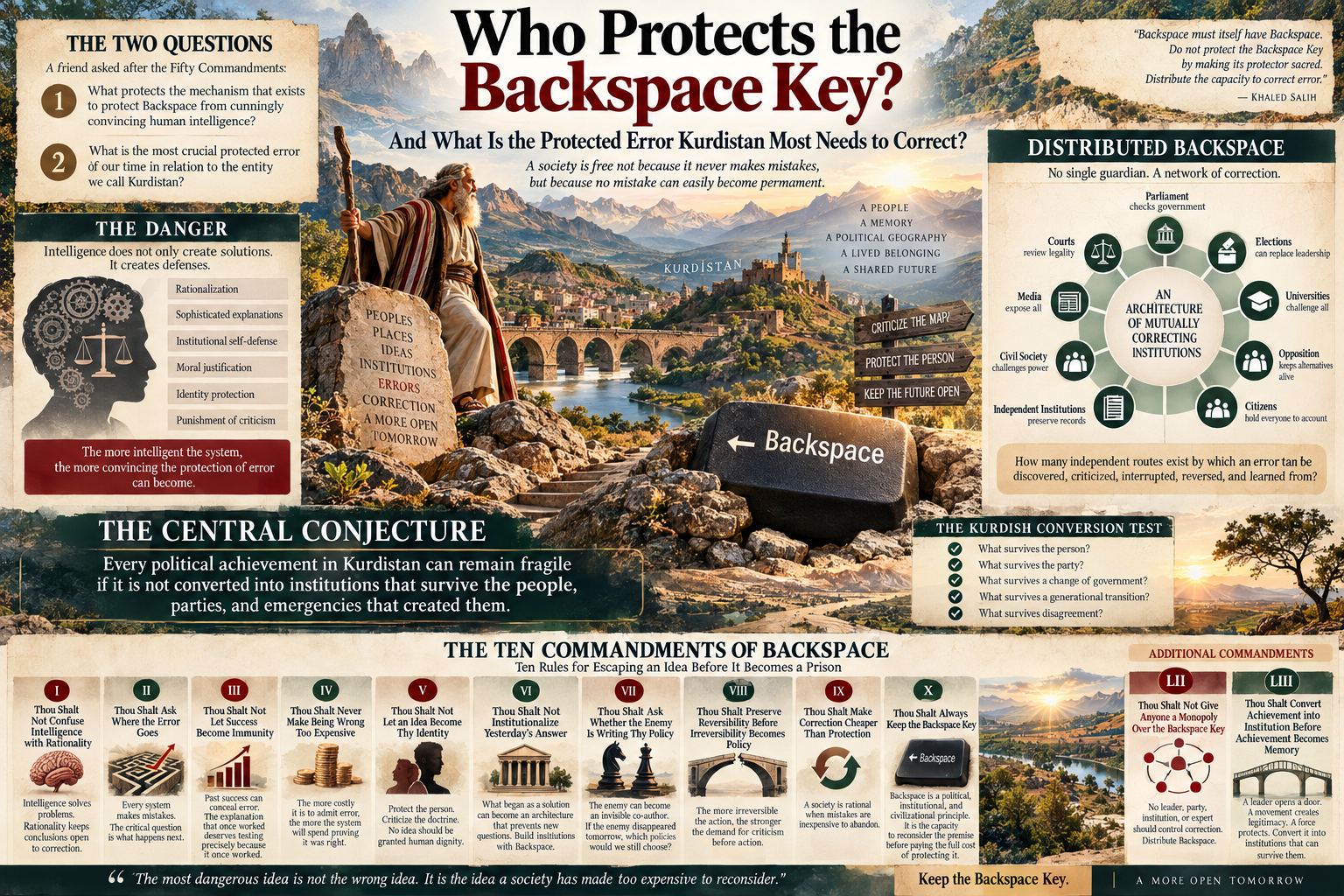
The Distributed Backspace Conjecture
This takes me to a stronger formulation.
A rational society should distribute the capacity to correct error across institutions that can themselves be corrected by other institutions.
Backspace should therefore not be a button held by one hand.
It should be an architecture.
Parliament can correct government.
Courts can correct unlawful government action.
Elections can correct parliament.
Journalists can expose all three.
Scholars can challenge journalists.
Citizens can challenge scholars.
Opposition parties can challenge governing parties.
Civil society can challenge all of them.
Institutions can preserve records so that yesterday’s prediction can be compared with today’s result.
And none of these should acquire permanent immunity merely because it happens to be performing the function of correction.
That is not checks and balances merely as constitutional engineering.
It is epistemological decentralization.
The question becomes:
How many independent routes exist by which an error can be discovered, criticized, interrupted, reversed, and learned from?
The more routes that remain open, the less likely one captured institution can close the whole system.
The Danger Is Intelligent Capture
My friend’s wording is especially important: “cunningly convincing human intelligence.”
That is exactly the danger.
Intelligence does not simply create solutions.
It creates defenses.
A mediocre institution may defend an error badly.
An intelligent institution may make the error look indispensable.
A weak bureaucracy may simply resist reform.
A sophisticated bureaucracy can produce models, procedures, terminology, reports, and expert justifications explaining why reform would be irresponsible.
A political movement may begin with an open argument and eventually become extremely skilled at teaching its members why every criticism proves the movement’s necessity.
A successful leader may become surrounded by intelligent people whose professional incentive is no longer discovering whether the leader is wrong, but constructing increasingly sophisticated reasons why the leader must still be right.
This is why intelligence cannot be the final safeguard of Backspace.
The safeguard must be contestability.
The answer to dangerous intelligence is not superior intelligence alone. It is an architecture in which intelligence encounters rival intelligence that it cannot silence.
Who Corrects the Corrector?
This may be the Fifty-Second Commandment:
Thou Shalt Correct the Corrector.
But even that formulation is incomplete.
Because the corrector of the corrector also requires correction.
The sequence has no final resting place.
That sounds unstable.
It is actually the basis of stability in an open society.
An open society is not stable because it reaches final agreement.
It is stable because disagreement does not require destruction.
Government loses and survives.
A leader is criticized and remains a person.
A theory fails and its author is not burned with it.
A party leaves office and may return.
A constitutional arrangement can be amended without civil war.
An institution can be redesigned without the state collapsing.
The deepest political achievement is therefore not agreement.
It is peaceful corrigibility.
The Protected-Protector Problem
This gives us a new diagnostic.
Whenever someone says:
“This institution protects democracy.”
Ask:
Can the institution itself be criticized?
Whenever someone says:
“This organization protects Kurdistan.”
Ask:
Can the organization itself be corrected without being accused of betraying Kurdistan?
Whenever someone says:
“This leader protects national unity.”
Ask:
Can disagreement with the leader remain compatible with national belonging?
Whenever someone says:
“This doctrine protects our identity.”
Ask:
Can the doctrine be criticized without the critic being expelled from the identity?
The protected protector is one of the most dangerous political objects.
Because it combines moral legitimacy with insulation from criticism.
Then Comes Kurdistan
My friend’s second question is more difficult:
What is the most crucial protected error in relation to Kurdistan?
I would resist identifying one eternal Kurdish error.
That would violate the argument I have just made.
But I can propose a conjecture.
The error I would put under maximum pressure is this:
Kurdish political gains can remain durable without converting personal, partisan, military, diplomatic, and historical power into institutions that survive the people and factions that created them.
I have called this the Kurdish Conversion Problem.
The problem is not leadership.
Kurdistan has often needed strong leadership.
The problem is what happens afterward.
A leader creates access.
Does access become diplomatic capacity?
A party creates security.
Does security become a public institution?
A movement creates legitimacy through sacrifice.
Does legitimacy become accountable procedure?
A military organization protects political space.
Does that force become subordinate to a common institutional command?
A political opening appears.
Does it become an institution that can survive the people who negotiated it?
That is the conversion test.
Why This Matters Now
There are signs of both the problem and the possibility of correction in the Kurdistan Region today.
The most striking recent example is the Peshmerga reform process. Recently, the Ministry of Pêșermge Affairs announced that forces historically associated with separate party structures had been reorganized under a unified ministry command structure. President Nechirvan Barzani subsequently stressed that unification was not the end of the process but the beginning of the harder phase: common command, decisions, training, doctrine, discipline, rights, and duties.
That distinction matters enormously.
Moving units on an organizational chart is one thing.
Creating an institution that becomes more powerful than the partisan loyalties that preceded it is something else.
That is precisely the conversion problem.
The question is no longer:
Have the forces been unified?
It is:
Has party power been successfully converted into institutional loyalty?
The government has also presented broader administrative reforms involving civil-service records, salaries, pension files, public-sector administration, and Peshmerga organization. These are all potentially examples of the same transition: from discretionary or fragmented arrangements toward systems, records, procedures, and institutional continuity.
But the same period has also exposed continued dependence on party bargaining. Government formation after the 2024 regional election remained stalled well into 2026 amid KDP-PUK disagreements, with public reporting describing prolonged deadlock and periods in which meaningful interparty dialogue had broken down.
So both processes exist simultaneously:
institutionalization
and
repersonalization
That is exactly where a correction framework becomes useful.
The Protected Error May Be Party Substitution
Here is the sharper conjecture:
The protected error may not be factionalism. It may be the normalization of party substitution for common institutions.
Factionalism is normal.
Democrats and Republicans compete.
Labour and Conservatives compete.
European parties split, disappear, re-form, and defeat one another.
Political competition is not the pathology.
The diagnostic question is:
Where does the disagreement go?
Does it go into parliament?
Courts?
Elections?
Rules?
Negotiations governed by known procedures?
Public budgets?
Transparent institutions?
Recorded decisions?
Or does it return to:
party headquarters,
personal relationships,
external mediation,
informal bargains,
separate chains of command,
patronage structures,
and agreements whose authority depends primarily on the people who made them?
That distinction is decisive.
Party Is Not Institution
A party can be highly institutionalized internally and still weaken public institutions externally.
This is easy to miss.
A disciplined party may have:
strong leadership,
clear hierarchy,
effective finances,
experienced negotiators,
security capacity,
international relationships,
and institutional memory.
All of that can look like institutional strength.
But the relevant question is not:
How institutionalized is the party?
It is:
How much of its capacity has been converted into institutions that remain common property even when the party loses power?
That is much harder.
The Conversion Test
I would now formulate the Kurdish Conversion Test as follows.
For every major political achievement, ask:
What survives the person?
Then:
What survives the party?
Then:
What survives a change of government?
Then:
What survives a generational transition?
Then:
What survives disagreement?
If the answer is very little, then what looks like political strength may actually be political fragility.
Success Can Become the Protected Error
There is another danger.
Some arrangements survive because they worked.
That is precisely why they become difficult to reconsider.
A party structure may once have been necessary.
A military organization may once have been the only available defense.
A patronage network may once have held together a fragile political community.
A particular diplomatic relationship may once have been indispensable.
A strong leader may once have been the only person capable of keeping competing actors in the same room.
The mistake is not having used those arrangements.
The mistake begins when:
yesterday’s solution becomes today’s immunity.
This is Commandment III of BACKSPACE:
Thou Shalt Not Let Success Become Immunity.
Kurdistan may therefore face a peculiar success trap.
Institutions that helped the Kurdish movement survive may become obstacles to the next stage of Kurdish political development if their original protective function becomes a reason they cannot be criticized.
Survival Architecture Versus Freedom Architecture
This may be the most important distinction.
A survival architecture asks:
How do we prevent destruction?
How do we preserve the movement?
How do we protect leadership?
How do we keep territory?
How do we survive stronger neighbors?
Those questions were—and remain—real.
But a freedom architecture asks different questions:
How does authority become accountable?
How does temporary power become legitimate procedure?
How does party security become public security?
How does sacrifice become institution rather than permanent entitlement?
How does political competition become normal rather than existential?
How does a leader become replaceable without the system becoming vulnerable?
How does criticism become cheaper than factional breakdown?
These are different architectures.
Survival may require concentration.
Freedom requires corrigibility.
That transition is exceptionally difficult because the very institutions that succeeded in survival may resist the architecture required for freedom.
The Kurdish Backspace Paradox
Now the two questions come together.
Suppose Kurdish political institutions finally acquire a Backspace Key.
Who controls it?
If the ruling party controls it, Backspace may correct rivals more easily than itself.
If opposition parties control it, correction may become another name for regime destruction.
If external powers control it, Kurdistan has outsourced correction.
If intellectuals control it, a new epistemic elite can become protected.
If judges control it, courts can become uncorrectable.
If parliament controls it but parliament itself is subordinated to party leadership, the institutional form may exist while the correction mechanism remains elsewhere.
Therefore:
Kurdistan does not merely need Backspace. It needs distributed Backspace.
That may be the most important addition to the entire project.
Distributed Backspace for Kurdistan
What would that mean?
Not one powerful institution.
A network of institutions with overlapping correction capacity.
A parliament capable of scrutinizing government.
A government capable of governing without bypassing parliament.
A judiciary capable of reviewing both.
Independent media capable of investigating all of them.
Universities capable of producing criticism without becoming party extensions.
Civil servants whose careers do not depend entirely on political loyalty.
Security institutions whose chain of command is public rather than factional.
Political parties capable of losing elections without losing their existence.
Leaders capable of being corrected without being destroyed.
Citizens capable of criticizing Kurdish institutions without having their Kurdishness questioned.
And perhaps most importantly:
no institution capable of silencing all the others at once.
That is not perfection.
It is correction architecture.
The Most Dangerous Protected Error
So if my friend asks me again:
What is the most dangerous protected error concerning Kurdistan?
My answer would now be more precise.
Not tribalism.
Not factionalism.
Not bad leadership.
Not dependence.
Not corruption.
Not even division.
Those may all matter.
The deeper error is:
the belief that political achievements can remain durable without being converted into institutions that are stronger than the people, parties, relationships, and emergencies that originally produced them.
Everything else may flow through that bottleneck.
Foreign support disappears because it was not converted into capacity.
Leadership disappears because it was not converted into procedure.
Military strength fragments because it was not converted into public command.
Economic success becomes patronage because it was not converted into transparent systems.
Diplomatic access dies with the diplomat because it was not converted into institutional memory.
Political sacrifice becomes entitlement because legitimacy was not converted into replaceable authority.
That is the conversion failure.
But the Conjecture Must Remain Criticizable
I must apply Backspace to my own argument.
Perhaps I am wrong.
Perhaps the central protected error is elsewhere.
Perhaps it is dependence on external powers.
Perhaps it is the unresolved relationship between party and state.
Perhaps it is territorial fragmentation.
Perhaps it is the continued conflation of political unity with ideological conformity.
Perhaps it is something I have not yet identified.
That is why this must remain a conjecture.
The test is not whether it sounds persuasive.
The test is whether it explains more than its rivals, survives criticism better, and identifies mechanisms that can actually be changed.
The Question Underneath the Fifty Commandments
The Fifty Commandments asked repeatedly:
Where does the error go?
Who protects it?
Can criticism reach it?
Can the person survive correction?
Can the institution revise its answer?
Can another choice be created?
Can yesterday’s success remain criticizable?
My friend has forced one more question into the architecture:
Who corrects the mechanism of correction?
And perhaps the answer is:
No one final actor should.
The corrector must remain correctable.
The institution must remain revisable.
The critic must remain criticizable.
The Backspace Key must itself possess Backspace.
The Fifty-Second Commandment
So perhaps there is now a Fifty-Second Commandment:
Thou Shalt Not Give Anyone a Monopoly Over the Backspace Key
Because correction becomes dangerous when the same actor can:
define the problem,
select the explanation,
control the evidence,
punish criticism,
declare the solution,
and decide when the solution may be revised.
That applies to states.
Religions.
Universities.
Political movements.
Experts.
Parties.
Leaders.
And Kurdistan.
The solution is not leaderlessness.
It is not institutional weakness.
It is not permanent suspicion.
It is something harder:
strong institutions whose strength includes the capacity to be corrected.
And Maybe a Fifty-Third
My friend’s second question may require one more.
Thou Shalt Convert Achievement into Institution Before Achievement Becomes Memory
A leader opens a door.
Convert the opening.
A movement creates legitimacy.
Convert the legitimacy.
A military force protects political space.
Convert the force.
A diplomatic relationship creates influence.
Convert the access.
A generation sacrifices.
Convert the sacrifice.
Otherwise history becomes a museum of heroic achievements that each generation must reconstruct from the beginning.
That is not freedom.
It is recurring survival.
Conclusion: The Backspace Republic
I have spent much of this project asking how Kurdistan might become freer.
Perhaps I should now state the answer differently.
A free Kurdistan would not be a Kurdistan without error.
It would be a Kurdistan in which no error can easily acquire permanent protection.
No party owns correction.
No leader owns legitimacy.
No institution owns truth.
No generation owns the future.
No map owns possibility.
No historical sacrifice grants permanent immunity.
And no Backspace Key belongs to a single hand.
That is the architecture I now see more clearly because of my friend’s questions.
The next stage is not merely:
Keep the Backspace Key.
It is:
Distribute the Backspace Key.
And behind that is the larger principle:
Preserve not one corrector, but an ecology of correction.
Because the final danger is not merely that intelligent people will defend bad ideas.
It is that intelligent people will eventually learn how to capture the institutions created to correct them.
That is why Backspace must have Backspace.
That is why Kurdistan must convert achievement into institution.
And that is why the question after the Fifty Commandments is no longer simply:
Where does the error go?
It is:
Who still has the power to send it back?