Where Is Kurdistan?
Osman Baydemir, the Turkish Parliament, and the Moment a Name Was Put on Trial
22 September 2026
Note
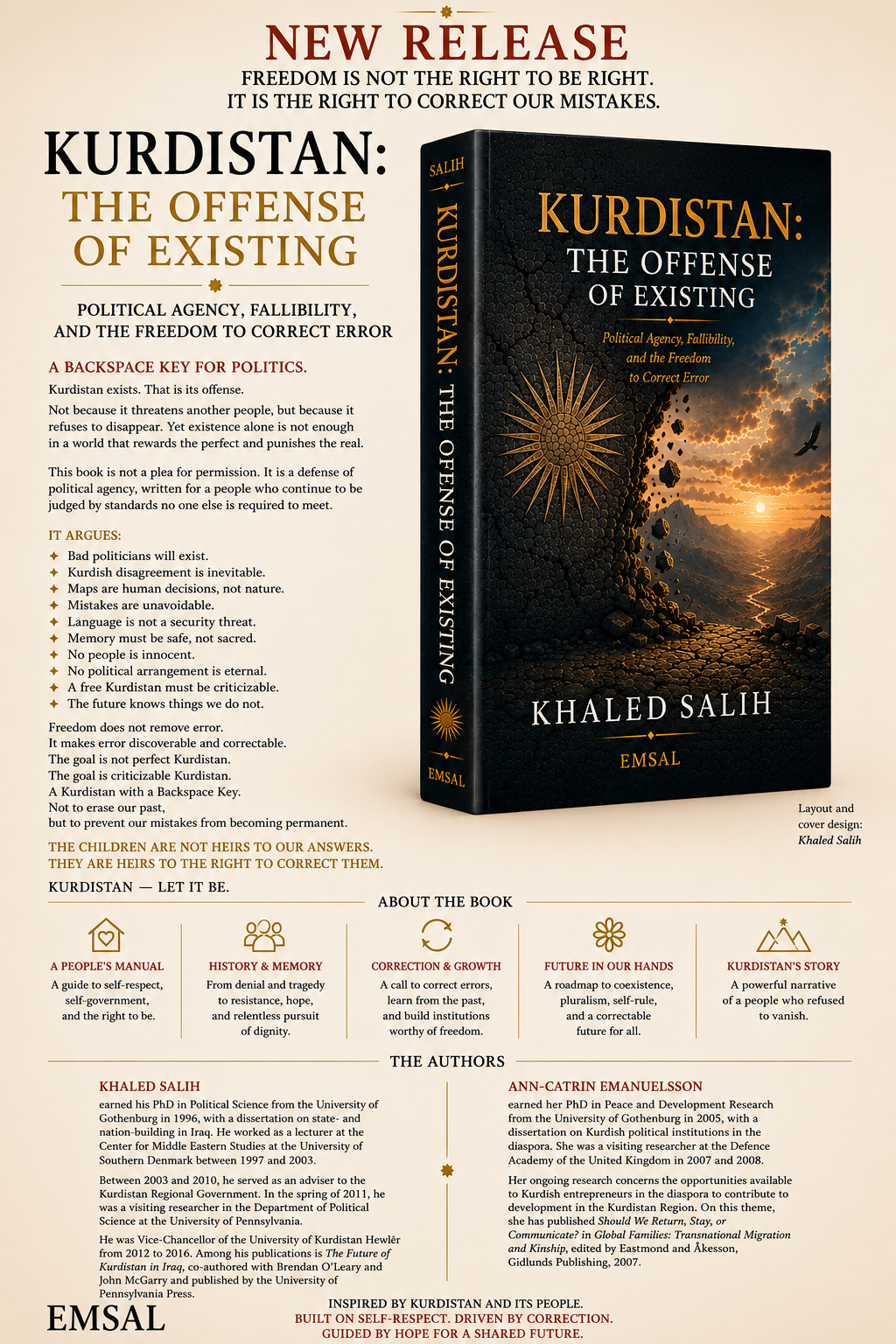
Yesterday I published “The Ten Commandments of Kurdistan: The Offense of Existing.” One of its central arguments was that Kurdish political existence is too often required to justify itself before it is even allowed to enter the discussion.
Then I returned to a brief exchange from the Turkish Parliament.
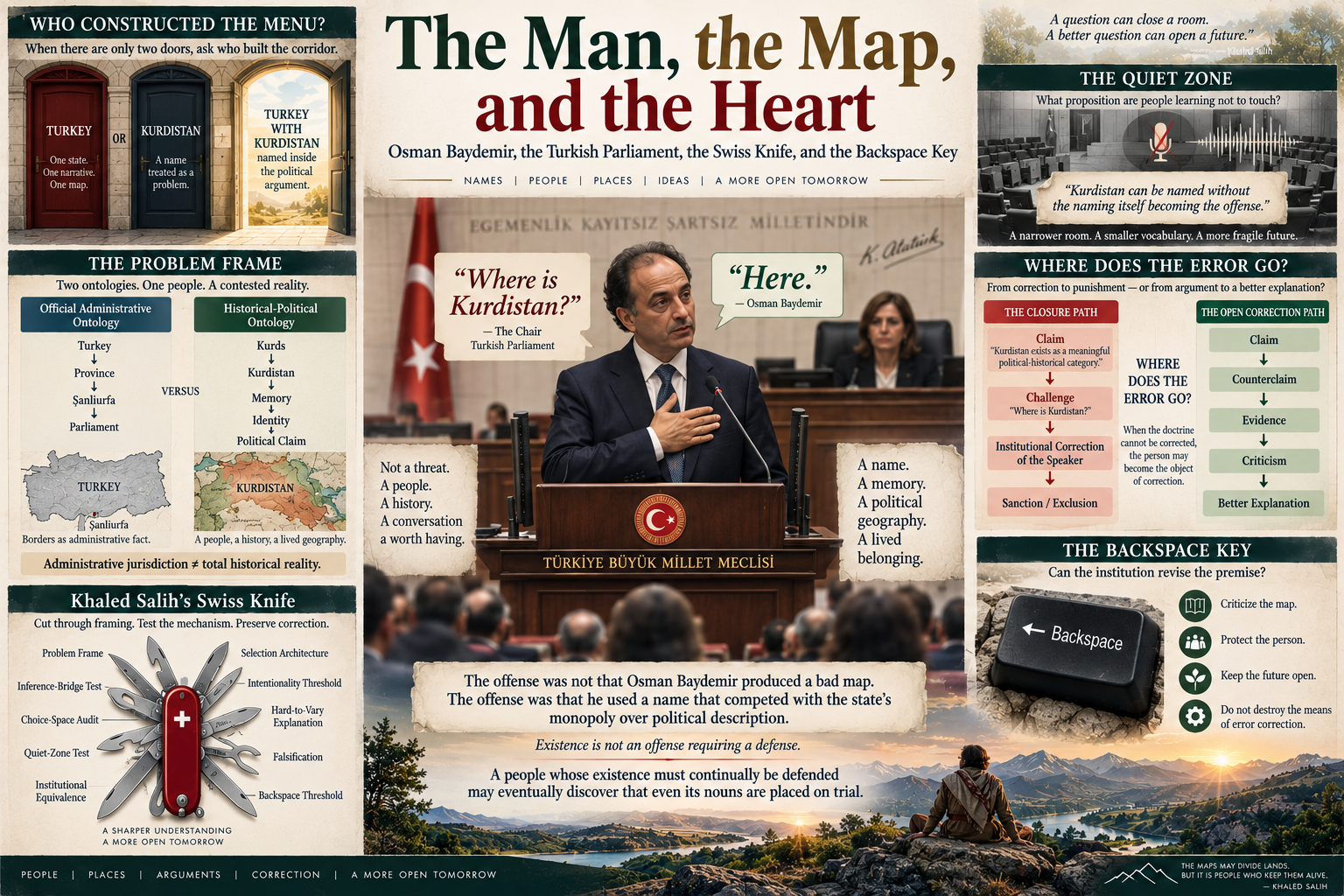
Osman Baydemir says he comes from Kurdistan. The question comes back: Where is Kurdistan? He places his hand over his heart and answers: Here.
The exchange lasts only moments, but it contains almost the entire architecture I have been trying to understand across my recent work: the map that presents itself as nature, the institution that decides which vocabulary is legitimate, the narrowing of political choice, the quiet zone around a contested name, and the moment when correction shifts from the proposition to the person.
This essay is my attempt to slow that moment down.
I subject it to what I now call Khaled Salih’s Swiss Knife: the Problem-Frame, the Inference-Bridge Test, the Choice-Space Audit, the Quiet-Zone Test, Institutional Equivalence, Selection Architecture, the Intentionality Threshold, falsification, and finally the Backspace Threshold.
The question is larger than whether one agrees with Osman Baydemir’s politics.
It is this:
What kind of political order is created when one side’s categories are treated as reality, while the other side must first defend its right to name the world?
And there is a second question behind it:
Can an institution revise the premise—or does it correct the person instead?
That is where the map, the heart, the Swiss Knife, and the Backspace Key meet.
Where Is Kurdistan?
Osman Baydemir, the Turkish Parliament, and the Moment a Name Was Put on Trial
Yesterday I published “The Ten Commandments of Kurdistan: The Offense of Existing.”
Its first commandment was simple:
Thou Shalt Not Apologize for Existing.
Its fifth warned:
Thou Shalt Not Let the Map Pretend to Be Nature.
And its seventh asked for something even more ordinary:
Thou Shalt Speak Kurdish Without Explaining Why.
Then I returned to an exchange in the Turkish Parliament from December 2017.
I had seen it before.
But after writing these commandments, I saw something else.
Osman Baydemir stood at the parliamentary rostrum and described himself as a son of the Kurdish people and a representative coming from Kurdistan. His political proposal was not secession from the chamber. Quite the opposite. He said that the Parliament should become a common political roof for Turks and Kurds. Members interrupted him repeatedly:
Where is Kurdistan?
Where?
What Kurdistan?
The chair eventually put the same question to him directly.
Baydemir raised his hand to his heart.
Kurdistan, he indicated, was here.
The official parliamentary account confirms the gesture and the exchange. Deputy Speaker Ayşe Nur Bahçekapılı then corrected him institutionally: he was not there, she said, as a representative of Kurdistan, but as a member for Şanlıurfa, a province of the Republic of Turkey. She added an admonition that he should remember this when next speaking from the parliamentary rostrum.
I think this short exchange contains an entire political philosophy.
Not only of Kurdistan.
Of maps.
Of recognition.
Of authority.
And of the strange power possessed by institutions to decide which descriptions of reality may enter the room.
The Problem-Frame
The obvious interpretation is that two sides disagreed about geography.
I think that explanation is too weak.
The real disagreement was over who possesses the authority to describe political reality.
Baydemir used a historical and political name.
The institutional response did not merely contest his preferred boundary.
It challenged the legitimacy of the category itself.
That distinction matters.
A debate over a boundary says:
Where exactly does Kurdistan begin and end?
A debate over constitutional status asks:
What political status should Kurdish-majority regions possess?
A debate over sovereignty asks:
Who should govern them?
But the intervention in Parliament moved one level earlier:
Are you permitted to name the place at all?
That is a different kind of political conflict.
The object being contested is not yet sovereignty.
It is description.
My Conjecture
My conjecture is this:
The deepest form of political exclusion occurs before rights are denied. It occurs when the vocabulary required to describe the political subject is itself declared inadmissible.
Once that happens, the argument becomes structurally unequal.
One side is allowed to begin from its categories:
Turkey.
Şanlıurfa.
Province.
Republic.
Constitution.
Parliament.
The other side must first prove the legitimacy of its nouns.
Kurd.
Kurdistan.
Kurdish political community.
Kurdish historical geography.
Before one side can make a political argument, it must first obtain permission to describe the object about which it intends to argue.
That is an extraordinary asymmetry.
The Swiss Knife: What Problem Was Actually Being Solved?
The first tool asks:
What is the problem-frame?
Was the problem Baydemir’s parliamentary constituency?
Legally, he was a Şanlıurfa MP. That was not seriously in dispute.
Was the problem whether “Kurdistan” constituted a recognized administrative unit of the Republic of Turkey?
Again, that is a separate factual and constitutional question.
But Baydemir had not said:
“I hold an official parliamentary seat named Kurdistan.”
He described where he understood himself to come from politically and historically.
The chair answered an identity-geography proposition with an administrative-law proposition.
Those are not identical claims.
That is the first inference problem.
Historical-geographical identity ≠ current administrative jurisdiction.
One can dispute the first.
One can regulate the second.
But the second does not logically erase the first.
The Inference-Bridge Test
The institutional reasoning appears to move roughly like this:
Turkey’s constitution recognizes Şanlıurfa as a province.
Therefore Baydemir represents Şanlıurfa.
Therefore he cannot meaningfully describe himself as coming from Kurdistan.
The first two steps can be institutionally straightforward.
The third does not follow automatically.
There is a missing bridge.
A contemporary administrative category does not by itself settle every historical, geographic, cultural, or political description available to the people living inside it.
That missing inference is where much of the politics is hiding.
The Map Pretending to Be Nature
Yesterday I wrote:
Maps are political arguments that have learned how to look like facts of nature.
The parliamentary exchange is almost a laboratory demonstration.
Baydemir names Kurdistan.
The response effectively says:
Look at the official administrative structure.
There is no such unit.
Therefore your description has no legitimate standing here.
But this quietly turns one particular form of mapping—the present state’s administrative map—into the only admissible ontology.
The map ceases to say:
This is how the state currently organizes territory.
It begins to say:
This is all that politically exists.
That is a much larger claim.
The Choice-Space Audit
Then comes one of the most important tools in the Swiss Knife:
Who constructed the available choices?
The exchange presents Baydemir with an implicit menu.
You may be:
a representative of Şanlıurfa,
a representative of a recognized Turkish province,
a member of the Turkish Parliament.
But the category “representative coming from Kurdistan” is treated as illegitimate.
This is a classic narrowing of perceived political possibility.
The existing institutional categories become not merely legal categories but the boundaries of legitimate imagination.
The menu has been constructed in advance.
And then the person choosing from it is told that no other dish exists.
The Third Door
Baydemir’s response is interesting precisely because he refuses the menu.
He does not begin drawing a competing administrative map.
He does not enter into a cartographic argument.
He places his hand on his heart.
That gesture changes the problem.
The question was:
Where is Kurdistan?
His answer, in effect, was:
You are asking for a location on your terms. I am answering with belonging.
Whatever one thinks of the underlying political claim, the rhetorical move is ingenious.
The institutional question sought geographical submission.
The gesture shifted the argument to identity.
The map asked for coordinates.
The person answered with attachment.
That is a third door.
The Gesture
And here body language matters.
The best-documented gesture in the exchange is Baydemir’s hand over his heart. Multiple contemporary accounts and the Turkish Parliament’s own report record it.
It does something words alone could not do.
Had he pointed to a map, the argument could have immediately shifted to boundaries.
Had he begun listing Ottoman terminology, treaties, provinces, or historical documents, the argument could have become archival.
Instead, the gesture says:
You cannot settle this question merely by correcting my administrative vocabulary.
Kurdistan also exists as memory, identification, historical consciousness, political attachment, and lived geography.
One may disagree with any political conclusion drawn from those facts.
But they cannot be made analytically nonexistent simply by pointing to a current provincial designation.
And What About the Chair?
This part needs precision.
Ayşe Nur Bahçekapılı was the Deputy Speaker chairing the sitting, not merely another MP shouting from the benches. Her words therefore carried institutional weight. The parliamentary account records her asking Baydemir where Kurdistan was and then telling him that he was present as the representative of Şanlıurfa, not Kurdistan, followed by an instruction that he remember this when next speaking from the rostrum.
T24 described her response as sert—harsh.
I would go further analytically, but more carefully.
What can appear as arrogance in the exchange is not something I need to infer about her personality.
It is produced by the institutional asymmetry of the scene.
She occupies the chair.
She controls recognition.
She can interrogate.
She can correct.
She can define which description of the speaker’s political location is institutionally acceptable.
Baydemir must answer.
That is why the tone matters more than personal psychology.
The significant feature is not whether Bahçekapılı privately felt arrogant.
I cannot know that.
The significant feature is that the institution speaks from a position in which one vocabulary is treated as self-evident while the other must defend its right to exist.
That is institutional epistemic asymmetry.
And it creates a recognizable tone:
not,
Let us examine whether your description is historically or politically defensible.
but,
Explain yourself.
The burden is asymmetric from the beginning.
I would not invent facial expressions or hand movements of Bahçekapılı that I cannot independently verify from the available record. The transcript does not preserve them. The important observable asymmetry is already contained in the wording and institutional positions.
The Intentionality Threshold
The Swiss Knife warns me not to attribute motive when mechanism will do.
So I do not need the conjecture:
She intended to humiliate a Kurdish speaker.
That would require evidence I do not possess.
A stronger explanation is available without mind-reading:
The institutional architecture itself permits the administrative vocabulary of the state to function as the default reality while requiring competing historical-political vocabularies to justify themselves.
That mechanism explains the exchange whether the chair was personally hostile, dutiful, irritated, nationalist, legally formalist, or some mixture that we cannot establish.
Good explanations should not depend on unverifiable motives when structural mechanisms are sufficient.
Where Does the Error Go?
Now apply the central diagnostic.
Suppose the institutional premise is wrong—or merely incomplete.
Suppose “Kurdistan” has historical, cultural, geographic, or political meaning that cannot be exhausted by today’s Turkish administrative map.
Where does criticism of the state description go?
In an open correction architecture, one would expect competing claims to remain arguable.
History can be introduced.
Terminology can be examined.
Alternative descriptions can be criticized.
The administrative map can remain legally operative without becoming intellectually sacred.
But the 2017 exchange shows a different possibility:
the critic himself becomes the problem.
The word becomes misconduct.
The speaker becomes subject to correction.
And eventually Baydemir was temporarily excluded from the chamber under parliamentary rules applied after the incident.
That sequence is analytically important:
Claim → Challenge → Speaker Correction → Sanction
rather than:
Claim → Counterclaim → Evidence → Better Explanation
This is what I mean by asking:
Where does the error go?
Sometimes it goes nowhere because the system sends correction back toward the person who identified the contested premise.
Person-as-Correction
This is one of the sharpest tools in the latest Swiss Knife.
When an institution cannot easily correct the doctrine, it may correct the person.
The proposition becomes:
Kurdistan exists as a meaningful historical-political category.
Instead of keeping that proposition open to criticism, the system may redirect correction:
Do not say that here.
Do not identify yourself that way.
Remember what kind of representative you are.
Leave the chamber.
The intellectual object has been replaced by the human object.
The doctrine becomes protected; the speaker becomes corrigible.
That is the reversal I keep encountering across apparently unrelated subjects.
Protected Error
Now consider the possibility that the state’s own categories contain error.
Perhaps the map is incomplete as history.
Perhaps administrative vocabulary is being asked to carry more explanatory weight than it can bear.
Perhaps the assumption that official nonrecognition eliminates a category is simply bad explanation.
A corrigible institution should be capable of investigating those possibilities.
A protected institution instead treats criticism of the category itself as a threat to the architecture.
The crucial distinction is:
State authority can determine administrative practice. It cannot by that fact alone determine historical truth.
Power can enforce terminology.
Power cannot convert terminology into a good explanation merely by enforcing it.
Selection Architecture
What does the system select for?
If politicians learn that saying “Kurdistan” produces interruption, disciplinary action, reputational cost, or removal, while avoiding the term preserves access, then the institution is selecting behavior.
It is selecting safer vocabulary.
Over time, the political environment may produce representatives who learn not merely which policies are permitted but which descriptions are survivable.
This matters because institutional selection can alter what becomes publicly thinkable.
The quiet zone expands.
The Quiet-Zone Test
Ask:
What proposition is everybody learning not to touch?
In this exchange it may be something as elementary as:
Kurdistan can be named inside the Turkish political home without the naming itself being treated as a threat to that home.
Notice what Baydemir was actually proposing immediately before the confrontation.
He was arguing that Parliament should be the common roof of Turks and Kurds and that excluding Kurds would make everyone lose.
That is striking.
He was simultaneously naming Kurdistan and proposing common political membership.
Yet the reaction effectively compressed the choice-space into:
Turkey or Kurdistan.
His own sentence was offering:
Turkey with Kurdistan named inside the argument.
That is precisely why the exchange belongs to the false-menu problem.
The Institutional Equivalence Test
Now apply another tool.
Imagine a parliamentarian saying:
I come from Anatolia.
Would the institution demand:
Where is Anatolia in the current administrative structure?
Probably not.
Or:
I come from Thrace.
Would historical-geographic terminology automatically be treated as constitutionally suspicious?
The important analytical question is not whether those cases are historically identical.
They are not.
The test is whether the same type of non-administrative geographic language receives equivalent institutional treatment.
If one historical-geographic identity is normal while another is treated as destabilizing, the difference itself requires explanation.
That is the institutional-equivalence problem.
Inequality of Corrigibility
This leads to what I think may be the deepest conjecture in the entire scene.
Political inequality is not only inequality of rights. It can be inequality in who is required to revise their description of reality.
The state says:
This is Şanlıurfa.
The Kurdish speaker says:
This is also Kurdistan.
Which claim must immediately defend itself?
Which claim is presumed legitimate before argument begins?
Which one carries the burden of proof?
Which speaker can be disciplined?
That is an inequality of corrigibility.
One side’s categories function as the operating system.
The other’s appear as applications that can be deleted.
The Hard-to-Vary Explanation
A good explanation of the confrontation should explain several facts simultaneously:
why the word itself triggered interruption;
why the question “Where?” was repeated;
why Baydemir answered with a bodily gesture rather than cartography;
why the chair corrected his representative identity;
why the dispute shifted from political argument to acceptable terminology;
and why sanction followed.
The conjecture that best connects those facts is not merely:
Turkish politicians disliked Baydemir.
Too easy.
Nor:
Baydemir provoked them.
Too psychological.
A harder-to-vary explanation is:
The exchange exposed a conflict between two ontologies: the state’s administrative ontology, in which legitimate political geography is defined through existing constitutional categories, and a Kurdish historical-political ontology, in which Kurdistan remains nameable despite the administrative arrangements dividing it. The institution possessed the power to make the first ontology procedurally authoritative and the second procedurally costly.
Now the details belong to one mechanism.
Falsification
What would count against my conjecture?
This matters.
If equivalent non-administrative geographic identities were routinely challenged and sanctioned in precisely the same fashion, then the Kurdish-specific asymmetry would weaken.
If “Kurdistan” could normally be used in parliamentary historical and political argument without speakers being forced to defend the legitimacy of the term, then this episode might be better explained as a dispute over Baydemir’s particular formulation.
If the chair had simply clarified his formal constituency and then allowed the historical-geographical claim to remain open, the protected-category explanation would also weaken.
Those are genuine tests.
Without them, the article would merely convert my interpretation into another protected doctrine.
The Backspace Threshold
The larger question is institutional.
Can a state revise the categories through which it understands itself?
Can Turkey say:
Perhaps some categories we treated as dangerous can become discussable without the Republic disappearing?
Can Kurdish movements say:
Perhaps some explanations of Kurdistan that once seemed necessary should also be revised?
Backspace cannot belong only to the other side.
That is the point.
A genuine correction architecture must permit:
Turkish constitutional assumptions to be criticized.
Kurdish nationalist assumptions to be criticized.
Historical claims to be tested.
Maps to be questioned.
Political arrangements to be revised peacefully.
Otherwise Backspace becomes merely another weapon directed outward.
The Connection to Yesterday’s Commandments
The scene from 2017 now looks almost uncannily like a dramatization of yesterday’s commandments.
Thou Shalt Not Apologize for Existing.
Baydemir names Kurdistan and is immediately required to account for the name.
Thou Shalt Not Guarantee Success Before Thou Art Allowed to Try.
The political subject must continually justify itself before acquiring ordinary political room.
Thou Shalt Not Mistake Disagreement for Nonexistence.
A contested concept is treated as though contestation demonstrates unreality.
Thou Shalt Not Let the Map Pretend to Be Nature.
The current administrative map is made to appear exhaustive.
Thou Shalt Claim the Right to Make Thine Own Mistakes.
A political community cannot become corrigible while another authority determines whether the community itself may enter the argument.
Thou Shalt Speak Kurdish Without Explaining Why.
Or, in this case:
Thou shalt say Kurdistan without first being summoned to defend the noun.
Thou Shalt Build a Criticizable Kurdistan.
And this is equally important.
The answer to a Turkish institution that treats Kurdistan as unnameable must not be a Kurdish political culture that makes Kurdistan uncriticizable.
That would merely reproduce the same architecture with the signs reversed.
My Stronger Conjecture
So here is the conjecture I would now carry forward:
The offense was not that Baydemir produced a bad map. The offense was that he used a name that competed with the state’s monopoly over political description.
And the institutional response is illuminating because it shows how political closure can begin long before police, prisons, or constitutional prohibition.
Sometimes it begins with a question.
Where is Kurdistan?
The question sounds empirical.
But it may contain an entire architecture:
Show me your recognized boundary.
Show me your administrative status.
Show me your permission to use the name.
Show me why your vocabulary deserves admission.
Only then may we discuss your politics.
That is why Baydemir’s answer remains interesting.
He did not accept the test.
He pointed to his heart.
I would not treat that as the final answer to where Kurdistan is.
A heart cannot settle geography, constitutional design, sovereignty, or borders.
But as an answer to the architecture of the question, it does something more important.
It refuses to concede that the state’s present map possesses a monopoly over what may be remembered, named, imagined, or debated.
And this takes me back to the line with which yesterday’s commandments began:
Existence is not an offense requiring a defense.
Perhaps the 2017 exchange adds something.
A people whose existence must continually be defended will eventually discover that even its nouns are placed on trial.
The test of an open society is therefore not whether everybody agrees that Kurdistan should have this border, that constitution, this degree of sovereignty, or that political future.
Those are arguments.
They should remain arguments.
The deeper test is whether the word itself may enter the room without the person who says it becoming the object of correction.
Because once an institution begins correcting the speaker instead of exposing the proposition to criticism, we should ask the question that governs all my work:
Where did the error go?
And perhaps, in that parliamentary chamber in December 2017, the answer was visible.
It moved from the map to the man.