When the Theory Becomes the Eye
Ernst Haeckel, Beautiful Explanations, and the Need for Error-Correction
28 May 2026
This is the kind of story that should frighten anyone who loves ideas.
This essay is a follow-up to Intelligence Is Not Rationality. That essay argued that intelligence can build beautiful systems, defend inherited frames, and make ideas travel — while rationality begins only when intelligence turns toward correction.
Here I want to make that distinction visible through the case of Ernst Haeckel: a brilliant scientist, artist, communicator, and theorist whose embryo drawings reveal a deeper danger than ordinary error. Haeckel matters because he shows how a powerful explanation can become so beautiful, persuasive, and emotionally necessary that it begins to shape what the mind is able to see.
The problem is not theory. We need theories. The problem begins when theory becomes immune to correction — when the map becomes cleaner than the territory, when the explanation disciplines the evidence, and when the theory becomes the eye.
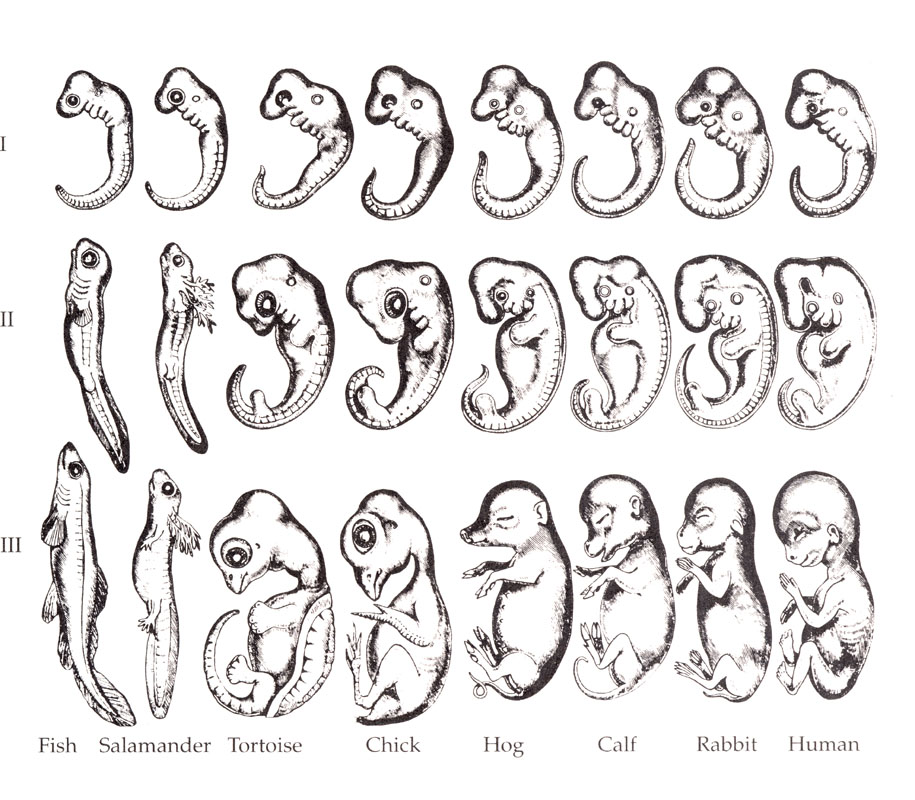
Source: Wikipedia
Ernst Haeckel, Beautiful Explanations, and the Need for Error-Correction
This is the kind of story that should frighten anyone who loves ideas.
Not because it is a story about stupidity.
Not because it is a story about vulgar fraud.
Not because it is a story about an ignorant man pretending to know.
It is more dangerous than that.
It is a story about brilliance without sufficient error-correction.
Ernst Haeckel was not a minor figure. He was one of the most influential scientific communicators of the nineteenth century. He helped make evolution visible. He coined the word ecology. He drew organisms with astonishing artistic precision. He built some of the most memorable visual representations of evolutionary thought. He translated Darwin’s careful, cautious theory into a grand civilizational vision that millions could understand.
And yet his name remains attached to one of the most contested accusations in the history of science: the charge that his famous embryo drawings were misleading, overdrawn, idealized — perhaps even falsified — in order to make a theory appear more visually obvious than the evidence allowed.
The easy lesson would be: Haeckel was a fraud.
The better lesson is harder:
A theory becomes dangerous when it stops helping us see and begins deciding in advance what may be seen.
That is why Haeckel matters far beyond the history of evolutionary biology. He reveals something about the human mind, about science, about ideology, about beautiful explanations, and about the Open Society itself.
He shows us what happens when an explanation becomes so elegant, emotionally necessary, and visually powerful that it begins to discipline perception.
The theory becomes the eye.
The man who made evolution visible
Before Haeckel, evolution was a difficult idea for the educated public to see.
Darwin had provided the mechanism. But Darwin was cautious. He built slowly. He hedged carefully. He worked like a man who knew that the world would not forgive premature certainty. His prose moved through evidence, qualification, inference, objection, and reply. Darwin did not want his theory to become a doctrine. He wanted it to survive criticism.
Haeckel had a different temperament.
He saw the architecture.
He wanted evolution not merely to be argued, but to be seen. He wanted the history of life to become visible in diagrams, trees, forms, embryos, radiolarians, and branching patterns. He gave evolution a visual grammar. He made descent, development, and deep time appear not only as arguments, but as images.
This was his genius.
A good image can do what a thousand pages cannot. It can compress a theory into a single act of recognition. It can make the abstract appear physical. It can turn a difficult explanation into something memorable, teachable, portable.
That is not trivial. It is one of the ways knowledge spreads.
But it is also dangerous.
Because an image does not merely explain. It persuades.
And when an image is too beautiful, too simple, too satisfying, it can make a conjecture look like a fact.
The embryo drawings
Haeckel’s most famous drawings showed embryos of different vertebrates — fish, salamander, tortoise, chicken, pig, cow, rabbit, human — arranged side by side at similar stages of development.
The visual message was overwhelming.
At the early stages, they looked almost the same.
The image seemed to say: look, here is evolution written into the body. Here is common ancestry before your eyes. Here is deep time compressed into the fragile beginning of individual life.
The drawings became immensely influential. They entered textbooks. They shaped generations of students. They made evolution feel visible and intimate. They suggested that the history of species could be read in the development of the individual organism.
There was truth in this.
Early vertebrate embryos do share important similarities. Comparative embryology is real. Evolutionary developmental biology is real. The basic intuition that development can reveal ancestry was not nonsense.
But Haeckel’s drawings did more than show similarity.
They intensified it.
They cleaned the evidence.
They smoothed variation.
They made the embryos more alike than they were.
They made a contested theory look visually settled.
That is the epistemological danger.
The falsehood was not detached from truth. It was parasitic on truth. Haeckel saw something real — then drew it more cleanly than reality allowed.
That is often more dangerous than an outright lie.
A lie can sometimes be exposed by simple contradiction. But a partial truth, made too beautiful, can survive by absorbing criticism into its own elegance.
Not merely fraud: theory-pressure
The most instructive question is not simply whether Haeckel lied.
The deeper question is this:
When he drew those embryos, was he recording what he saw, or drawing what his theory required him to see?
The answer may be: both.
That is what makes the case so important. Haeckel was not necessarily a crude forger sitting at a desk and consciously inventing evidence out of nothing. The more unsettling possibility is that his theory had become part of his perception.
A recent documentary on Haeckel captured the problem in a devastating formulation:
“The theory had become part of the seeing. The conviction had become the instrument of observation.”
That sentence deserves to be remembered.
Because it names a danger that reaches far beyond Haeckel.
A mind can sincerely believe it is observing reality while actually observing reality through a theory that has already decided what matters, what counts, what should be emphasized, and what may be ignored.
This is not ordinary dishonesty.
It is theory-pressure.
Theory-pressure occurs when an explanatory frame becomes so dominant that evidence is unconsciously bent toward it. The mind does not first see and then interpret. It interprets in the act of seeing. It selects, cleans, arranges, and emphasizes before criticism has had time to intervene.
The danger is especially strong when the theory is beautiful.
A clumsy theory is easier to criticize.
An ugly theory is easier to suspect.
A theory that explains nothing is easy to abandon.
But a beautiful explanation can become a cognitive home. It can carry emotional need, aesthetic satisfaction, intellectual elegance, moral purpose, and social identity. Once that happens, criticism of the theory can feel like an attack on meaning itself.
That is when intelligence becomes vulnerable.
Intelligence is not rationality
Haeckel was intelligent. That is not in doubt.
He was visually brilliant, scientifically productive, linguistically inventive, institutionally influential, and intellectually courageous in many ways. He saw patterns others had missed. He communicated ideas with extraordinary power. He named ecology. He helped create the visual world in which modern evolutionary thought could become publicly imaginable.
But intelligence is not rationality.
Intelligence can build a system.
Rationality asks whether the system is wrong.
Intelligence can produce a beautiful diagram.
Rationality asks whether the diagram has edited reality.
Intelligence can defend a theory with elegance.
Rationality asks whether the defense is protecting the theory from correction.
Intelligence can make an idea travel.
Rationality asks whether the idea remains corrigible as it travels.
This distinction is central to the Open Society.
A society does not become open merely because it has clever people, sophisticated theories, advanced institutions, or beautiful representations of reality. It becomes open when it preserves error-correction: the capacity to detect failure, criticize authority, revise inherited frameworks, and let bad explanations die before people must die for them.
Haeckel’s error was not lack of intelligence.
It was intelligence insufficiently disciplined by criticism.
Beautiful explanations are dangerous when they become immune
We should be honest: human beings need beautiful explanations.
We do not think in lists of data. We think through patterns, metaphors, images, maps, stories, diagrams, and conceptual structures. A good explanation does not merely collect facts; it organizes them. It reveals why things are as they are rather than otherwise.
Beauty is not the enemy of truth.
Some explanations are beautiful because they are deep. Newtonian mechanics had beauty. Darwinian evolution had beauty. Einstein’s relativity had beauty. The periodic table has beauty. The double helix has beauty. A hard-to-vary explanation often possesses a kind of elegance because its parts fit together in a way that cannot be casually rearranged.
The danger begins when beauty becomes insulation.
An explanation becomes anti-rational when it stops inviting criticism and begins protecting itself from criticism.
This can happen in religion.
It can happen in politics.
It can happen in ideology.
It can happen in science.
It can happen in one’s own manuscript, theory, or moral project.
The question is always the same:
Does the explanation help us see more clearly?
Or has it begun deciding what reality is allowed to show?
That is the Haeckel test.
The map and the specimen
The simplest way to state the lesson is this:
Do not draw the embryo before looking at the specimen.
This sounds obvious. But it is one of the hardest intellectual disciplines in the world.
We all carry maps. We carry political maps, moral maps, historical maps, religious maps, psychological maps, civilizational maps. We need them. Without maps, reality is noise.
But maps can become tyrants.
A good map helps us navigate reality.
A bad map replaces reality.
An anti-rational map forbids us from noticing when it no longer describes reality.
Haeckel’s drawings are powerful because they show the moment when the map begins to command the specimen.
He did not invent evolution. He did not invent embryological similarity. He did not invent the real biological connections between living things. His error was subtler: he allowed a theory to become too visually complete before the evidence had earned that completeness.
The map became cleaner than the territory.
That is always a warning sign.
When a theory becomes too clean, too total, too smooth, too satisfying, too immune from anomaly, we should become alert. Reality is usually more jagged than ideology. Evidence is more stubborn than system. Human beings are more complicated than categories. History is more uneven than doctrine. Civilizations are more contradictory than manifestos.
A theory that cannot tolerate roughness is not strong.
It is fragile.
Why this matters for the Open Society
The Open Society depends on a moral and epistemological discipline:
Let ideas die in our place.
This is the Popperian and Deutschian heart of error-correction. We do not need to defend every theory as if our life depended on it. We can expose theories to criticism. We can let them fail. We can abandon what does not survive contact with reality.
That is civilization.
A closed society does something different. It binds identity to theory, authority to doctrine, belonging to obedience, and criticism to betrayal. It makes people defend explanations as if their moral worth depended on them.
The Open Society separates the person from the theory.
This separation is sacred in the best sense.
A person may be protected absolutely while their ideas are criticized fiercely. A scientist may be honored while a theory is refuted. A tradition may be studied while its claims are rejected. A community may be defended against hatred while its doctrines remain open to scrutiny.
Without this distinction, correction becomes cruelty.
With this distinction, correction becomes respect.
Haeckel matters because he reminds us that even science needs this discipline. Scientific institutions are not rational because scientists are morally superior people. They are rational only insofar as they institutionalize criticism: replication, peer review, correction, adversarial testing, revised models, retracted errors, better instruments, and public criticism.
Science is not protected by the purity of scientists.
It is protected by the Backspace Key
The Backspace Key
The Backspace Key is my metaphor for the human and institutional capacity to recognize error, delete what has failed, revise the explanation, and try again.
Every dynamic society needs this key.
Individuals need it when they discover that an inherited belief no longer explains reality.
Institutions need it when a policy fails.
Science needs it when a theory overreaches.
Democracy needs it when public language becomes evasive.
Civilization needs it when inherited maps become prisons.
Haeckel’s embryo drawings survived for a long time because they were powerful, memorable, and pedagogically convenient. But they were eventually criticized more severely. Better instruments, better comparisons, better developmental biology, and better historical scrutiny reopened the question.
That is the crucial difference between error and irretrievability.
Haeckel’s error was serious. But it was not made sacred beyond correction. The correction channel remained damaged perhaps, delayed certainly, but not destroyed.
The drawings could be challenged.
The theory could be revised.
The evidence could be re-examined.
The history could be rewritten.
The field could move forward.
This is why the Open Society matters.
It does not prevent error. Nothing does.
It prevents error from becoming final.

The anti-Haeckel safeguard
There is a personal lesson here for anyone writing a book, building a theory, making an argument, or developing a public philosophy.
The more beautiful your explanation becomes, the more fiercely you must expose it to criticism.
Not because beauty is bad.
Not because confidence is always wrong.
Not because theory should be avoided.
But because powerful theories have gravity. They begin to attract evidence. They generate language. They create communities of recognition. They make some things easy to see and other things harder to notice. They can become lenses, and eventually cages.
This is why I have become increasingly disciplined about the structure of my own book, When Global Error Goes Global.
The book argues for error-correction. Therefore, it must practice error-correction. It cannot merely tell the reader that no idea should become immune while smuggling in its own immunity through tone, structure, or conceptual pressure.
At one stage, my manuscript had too much conceptual machinery at the front. I had built a long epistemological lexicon and placed it before the reader had encountered the problems that made those concepts necessary. My intention was good: I wanted clarity. But the structure was wrong.
It was too much map before territory.
The correction was to move from a heavy front-loaded lexicon to a short Reader’s Compass, followed by chapter-end Conceptual Debriefings. The reader should first encounter the problem, then receive the conceptual tool that helps them see what happened.
That change was not merely editorial.
It was epistemological.
The old structure said: learn the system first.
The new structure says: encounter the problem first.
That is the anti-Haeckel safeguard.
Do not draw the embryo before looking at the specimen.
Do not impose the concept before the problem appears.
Do not let the map become more authoritative than reality.
Evidence disciplined by expectation
The most useful phrase for Haeckel’s error may be this: evidence disciplined by expectation.
This is not the same as evidence interpreted by theory. All evidence is interpreted through theory. There is no pure, theory-free observation. We always bring expectations, problems, background knowledge, instruments, categories, and prior explanations.
The problem is not that theory shapes seeing.
The problem is when theory cannot be corrected by what it sees.
A rational theory says:
Here is what I expect. Let reality test me.
An anti-rational theory says:
Here is what I expect. Let reality be arranged until it confirms me.
That difference is everything.
The first is science.
The second is ideology.
The first can learn.
The second can only defend.
The first allows anomalies to become problems.
The second treats anomalies as threats.
Haeckel’s drawings matter because they show how easily a brilliant mind can drift from the first posture toward the second.
Not because he was uniquely corrupt.
Because he was human.
The secular warning
One reason Haeckel is so valuable as an example is that he prevents us from making the easy mistake of locating anti-rationality only in religion.
Anti-rationality is not identical with belief in God.
It is not identical with tradition.
It is not identical with old texts.
It is not identical with ritual, piety, or metaphysics.
Anti-rationality is a relation to criticism.
A religious idea can be held rationally if it remains open to criticism, interpretation, moral evaluation, historical inquiry, and revision. A scientific or secular idea can become anti-rational if it protects itself from correction, treats dissent as moral failure, bends evidence toward its prior needs, or converts method into worldview.
That is why Haeckel is so important.
His case shows that the problem is not “religion versus science.” The problem is closed explanation versus error-correction.
A scientific worldview can become too total.
A secular ideology can become sacred.
A political doctrine can become immune.
A moral vocabulary can become unfalsifiable.
A beautiful theory can become a lens that edits reality.
The Open Society must therefore defend criticism everywhere — including against its own favorite explanations.
What Haeckel teaches my book
Haeckel’s story strengthens my own framework because it imposes discipline on it.
My book argues that some systems survive by disabling error-correction. It analyzes anti-rational memeplexes, epistemological closure, memeticization, irretrievability, and the modern capture of the Open Society. It uses strong concepts. It has a powerful architecture. It has a central metaphor: the Backspace Key.
Precisely for that reason, it must remain exposed to correction.
The Haeckel warning says:
Do not let “anti-rational memeplex” become a label that sees only what it expects.
Do not let “closure” become a concept that erases complexity.
Do not let “memeticization” become a theory that explains everything too quickly.
Do not let “Open Society” become a sacred self-image.
Do not let “Backspace Key” become a slogan instead of a discipline.
Every concept must remain a tool.
If a concept helps us see, keep it.
If it begins to obstruct criticism, revise it.
If it becomes a cage, delete it.
That is intellectual hygiene.
Intellectual hygiene
Intellectual hygiene is the practice of keeping knowledge-creation possible.
It means making errors speakable.
It means making authority criticizable.
It means making correction safer than concealment.
It means distinguishing persons from doctrines, criticism from hatred, compassion from surrender, tolerance from immunity, data from explanation, and intelligence from rationality.
Haeckel teaches one more distinction: explanation from theory-pressure.
We need explanations. Without them, data is blind. But explanations must not become so dominant that they predetermine the data.
So intellectual hygiene must protect two boundaries at once:
Data without explanation becomes blind accumulation.
Explanation without correction becomes a lens that edits reality before reality can object.
The Open Society needs both: powerful explanations and powerful correction.
It needs maps.
But it must never worship maps.
The final lesson
Haeckel’s legacy is not simple. That is why it is useful.
He was right and wrong in historically consequential ways. He helped millions see evolution. He also made evolution appear cleaner than the evidence allowed. He gave biology concepts and images of immense power. He also gave science a warning about the danger of beautiful overreach.
He saw something true.
Then he drew it too perfectly.
That is the human danger.
We do this in science.
We do this in politics.
We do this in religion.
We do this in personal life.
We do this in books, theories, identities, institutions, and moral causes.
We see something real, then clean it until it flatters the explanation we need.
The cure is not cynicism. It is not the abandonment of theory. It is not fear of beauty. It is not passive neutrality.
The cure is error-correction.
Let the drawing be criticized.
Let the theory face the specimen.
Let the map answer to the territory.
Let the explanation remain corrigible.
Let the beautiful idea die if it no longer describes reality.
That is the discipline of the Open Society.
And that is why Haeckel still matters.
Because the greatest danger is not that we see nothing.
The greatest danger is that we see through a theory so completely that we mistake the theory for sight itself.
The theory becomes the eye.
And the Backspace Key becomes harder to reach.



