When Return Becomes a War
A Review of Einat Wilf’s Wartime Writings: Making Sense of October 7 and Its Aftermath
4 July 2026
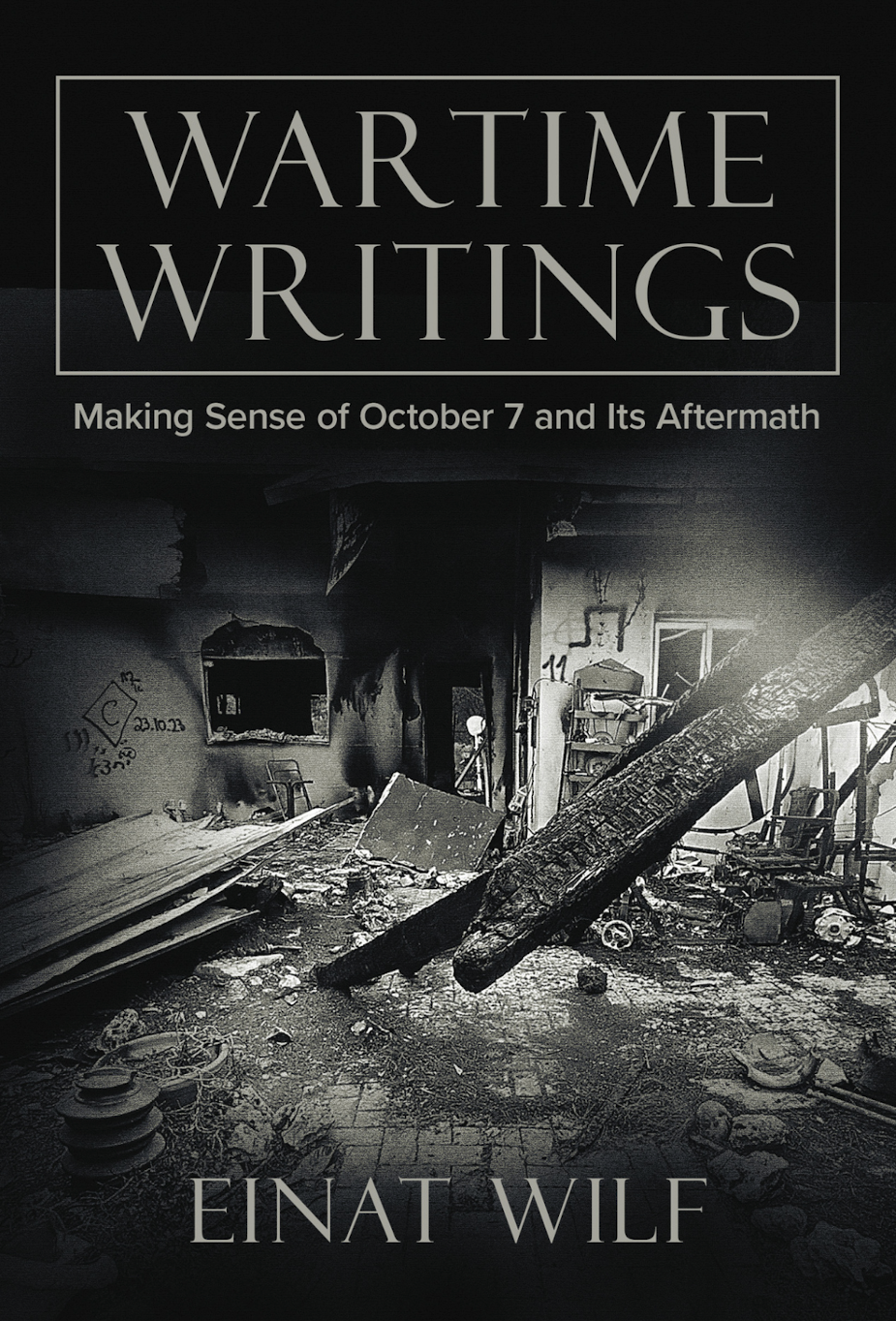
There are books written after an event, and there are books that reveal that the event was not sudden at all.
Einat Wilf’s Wartime Writings belongs to the second kind.
It is not a calm book. It is not written from the distance of the archive. It is a book written in shock, anger, grief, urgency, and clarity. It is a book of tweets, posts, essays, arguments, fragments, repetitions, and interventions composed in the long aftermath of October 7. But beneath its wartime form lies a coherent and severe explanation.
Wilf’s central claim is that October 7 was not an inexplicable eruption, nor merely the work of Hamas as an isolated organization, nor the result of “despair,” “occupation,” “settlements,” or “lack of economic opportunity.” It was, in her view, the latest and most brutal expression of a century-long Palestinian war against Jewish sovereignty in any part of the land.
That is the bold conjecture of the book.
It is bold because it refuses the polite explanations that dominate diplomacy, journalism, academia, and much of Western liberal opinion. It is conjectural because it makes a claim about the deep structure of the conflict: not that Palestinians lack grievances, not that Israel has made no mistakes, not that every Palestinian thinks in identical terms, but that the governing Palestinian political ethos has been organized around one negative goal — no sovereign Jewish state between the river and the sea.
Wilf gives this ethos a name: Palestinianism.
That word is central. It distinguishes Palestinians as persons from the ideological structure that, in her argument, has captured Palestinian political identity. This distinction matters morally. A Palestinian is a person. Palestinianism is a doctrine. The person must be protected. The doctrine must be criticizable.
This is where Wilf’s book becomes useful beyond the Israeli-Palestinian conflict. It is a study of protected error.
In the Popperian and Deutschian terms I have been exploring, the danger is not error as such. Every society contains error. Every national movement contains error. Every religion, state, party, and memory contains error. The real danger begins when error becomes protected from correction.
Wilf’s claim is that the Palestinian refugee system, the myth of “return,” the international role of UNRWA, campus antizionism, and the diplomatic habit of rewarding Palestinian rejection have together protected the founding error of Palestinianism: the refusal to accept Jewish sovereignty as legitimate.
That is the architecture of her book.
October 7 becomes the moment when the protected error became visible in blood.
The Problem Wilf Is Solving
Wilf is trying to solve a problem of explanation.
Most Western accounts of the conflict begin with a presumed solution and then work backward. They assume that Palestinians want a state alongside Israel, that the conflict is about occupation, that economic development would moderate rejection, that Hamas is an extremist deviation from a more moderate Palestinian mainstream, and that “the peace process” failed because of bad timing, Israeli settlements, weak leaders, mistrust, or diplomatic mismanagement.
Wilf’s answer is harsher: the peace process failed because the basic premise was wrong.
The Palestinians, she argues, were never primarily negotiating over the size of a Palestinian state. They were negotiating over whether the Jewish state had a right to exist at all. The issue was not the borders of Palestine but the legitimacy of Israel. The “right of return” was therefore not a bargaining chip, not a sentimental memory, not a symbolic claim to be traded at the end of negotiations. It was the preserved mechanism by which Israel’s Jewish majority, and therefore Jewish sovereignty, would eventually be undone.
That is why UNRWA occupies such a central place in Wilf’s thought. To a casual observer, UNRWA appears as a humanitarian agency. To Wilf, it is the institutional constructor of Palestinianism. It keeps the 1948 war open. It tells generations born in Gaza, the West Bank, Jordan, Lebanon, and elsewhere that they remain refugees from a war they did not experience, with a right to return not to a future Palestinian state but into Israel itself.
In my language, UNRWA is the institution that removes the Backspace Key.
Instead of saying: the war ended, build where you are, accept reality, make peace, create a future — it says, or at least enables Palestinians to hear: the war is unfinished, return remains open, Israel is temporary, the world recognizes your claim.
Wilf’s great contribution is to see that refugeehood here is not merely legal status. It is political metaphysics.
It preserves a world in which Israel’s existence is still reversible.
The Strength of the Book: It Takes Ideas Seriously
The most important sentence behind Wilf’s entire project could be this:
Ideas matter.
This seems obvious, but much of Western policy toward the Palestinians has behaved as if ideas are decorative and material incentives are decisive. Give money. Improve infrastructure. Open crossings. Ease pressure. Recognize statehood. Fund institutions. Support civil society. Keep hope alive. Avoid humiliation. Preserve the possibility of negotiations.
Wilf says: listen to what people say they want.
This is her anti-Westplaining point. She believes Western diplomats, journalists, academics, and sometimes Israelis themselves refuse to treat Palestinians as adults. They explain away Palestinian words and actions. They translate “slaughter the Jews” into “resistance.” They translate “from the river to the sea” into “freedom.” They translate “return” into nostalgia. They translate rejection into despair. They translate rejectionist ideology into a cry for recognition.
Wilf insists that this is not compassion. It is condescension.
To treat Palestinians as adults is to take their stated goals seriously, including when those goals are destructive. A people capable of building tunnels, planning attacks, organizing institutions, sustaining a global propaganda campaign, and preserving a century-long national project is not helpless. The problem is not lack of capability. The problem is the direction in which capability has been organized.
That is a deeply Deutschian insight.
The danger is not stupidity. The danger is brilliance assigned the wrong task.
Wilf repeatedly argues that Palestinians are capable. Hamas is capable. UNRWA is capable. The propaganda system is capable. The internationalization of the conflict is capable. The tragedy is that extraordinary human capacity has been assigned to the task of undoing Jewish sovereignty rather than building Palestinian freedom.
This point gives the book much of its force.
The Book’s Deepest Explanation: The War of Return
Wilf’s strongest explanatory move is to connect October 7 to the idea of return.
The word “return” often sounds gentle. It evokes memory, home, loss, longing, poetry, grandmother’s key, childhood garden, village, wound. Wilf forces the reader to confront another meaning. Return, in the political structure she analyzes, does not mean peaceful nostalgia. It means the reversal of Israel’s victory in 1948. It means the continuation of the war by demographic, diplomatic, educational, and eventually military means.
October 7, in her argument, was return enacted as massacre.
This is a severe claim. But it is not arbitrary. It follows from her larger explanation: if Gaza is not understood by many of its inhabitants as home, but as a launching pad for return; if UNRWA and the refugee system preserve that consciousness; if “Palestine” means not a state beside Israel but a future without Israel; then October 7 is not an interruption of the Palestinian national story. It is one of its possible fulfillments.
This is what makes the book so uncomfortable.
Wilf is not merely saying that Hamas is evil. Many people can say that. She is saying that Hamas is not an alien growth on Palestinian politics, but the executive arm of a deeper Palestinianism. Hamas did not invent the rejection of Jewish sovereignty. It inherited it, militarized it, theologized it, filmed it, and carried it into Israeli homes.
That claim will anger many readers. It should also force them to produce a better explanation if they reject it.
A good explanation is hard to vary. Wilf’s explanation has that quality. It connects refugeehood, UNRWA, “return,” campus slogans, rejection of Jewish statehood, international diplomacy, and October 7 into one structure. One may dispute parts of it. One may argue that she compresses Palestinian plurality too sharply. One may insist on more internal distinctions. But one cannot easily remove UNRWA, return, or rejection of Jewish sovereignty from her account without weakening the explanatory architecture.
That is why the book deserves serious attention.
Zionism as the Backspace Key of Jewish History
Wilf’s account of Zionism is not sentimental. It is not only about memory, religion, Holocaust trauma, or national feeling. Zionism, for her, is the correction of Jewish political helplessness.
This is one of the book’s strongest themes.
She rejects the claim that Israel exists because of the Holocaust. Israel, in her argument, exists because Jews willed themselves back into history as a sovereign people. The Holocaust did not justify Zionism; Zionism was the project that might have prevented the Holocaust from becoming genocide on the scale it did, had Britain not betrayed the Mandate and blocked Jewish immigration at the decisive moment.
Her formulation — Zionism was not “never again” but “never at all” — is among the most powerful in the book.
It means that Zionism was not merely a response to catastrophe. It was an attempt to exit the condition in which Jews depended on the mercy, tolerance, fatigue, or guilt of others. It was the Jewish Backspace Key against exile as political vulnerability.
That also explains why antizionism is so central to the book. Antizionism is not merely criticism of Israeli policy. Wilf is careful, in practice, to criticize Israeli leaders, institutions, strategy, and failures with extraordinary harshness. The book contains some of its fiercest pages against Netanyahu, the Israeli government, the collapse of state capacity on October 7, the ultra-Orthodox exemption from military service, and Israel’s habit of confusing necessity with virtue.
So when Wilf condemns antizionism, she is not saying Israel must be beyond criticism. She is saying that antizionism denies the Jewish people the right to exercise sovereignty at all.
In my terms:
Criticism of Israel is a Backspace Key.
Antizionism is the demand that the Jewish Backspace Key be removed.
That distinction is essential.
Antizionism as Protected Scapegoating
One of Wilf’s most important claims is that antizionism is not merely a view about Israel. It is a repeated pattern in failing societies and ideological movements.
Nazism, pan-Arabism, Soviet communism, Islamism, sections of the Western radical left — in Wilf’s telling, all find in antizionism a way to organize resentment, explain failure, and present the collective Jew as the obstacle to salvation.
This is where her book connects with René Girard’s scapegoating mechanism. Societies in crisis can ask “What should we do?” or “Whom should we blame?” Zionism, in Wilf’s framework, was a Jewish answer to the first question: what should we do? Antizionism is the answer of failed societies to the second: whom shall we blame?
This is powerful because it explains the emotional intensity of anti-Israel politics. The Jew, now collective and sovereign, becomes once again the figure through whom others explain their own failures. Israel is made to stand for colonialism, racism, apartheid, Nazism, genocide, white supremacy, and every evil currently available. Wilf calls this the “placard strategy”: the repeated equation of Zionism with the supreme evil of the age.
In Bold Conjectures terms, this is bad explanation protected by repetition and institutional laundering.
A placard does not argue. It compresses.
It does not explain. It signals.
It does not test. It accuses.
It does not seek correction. It seeks general agreement.
The danger is that once enough institutions repeat the equation, many people begin to ask: could the whole world be wrong?
Wilf’s answer is yes. The whole world can be wrong. Jews have historical experience of this.
Israel’s Failure: The State Without a Functioning Government
One of the reasons the book is more serious than propaganda is that Wilf turns the same severity inward.
She does not absolve Israel. She indicts Israeli leadership for catastrophic failure. October 7 exposed not only the enemy’s intention but Israel’s institutional decay. The state was absent. The government was missing in action. Civil society, reservists, volunteers, and protest networks became emergency state-builders.
This is one of the most important parts of the book for my protocol.
A state exists to protect its citizens. If it fails in that task, it must be corrected. Wilf repeatedly invokes the British precedent of 1940, when Neville Chamberlain was replaced in wartime after failure in Norway. Her point is institutional: democracies must be able to remove failed leadership even during war.
Here Wilf is deeply Popperian.
The question is not whether the leader understands danger. Netanyahu may understand the hostile space. The question is whether he has built strength. Wilf’s answer is no. A state cannot remain strong if ministries decay, excellence is pushed out, incompetent loyalists are appointed, public service is mocked, and political survival replaces national seriousness.
This is one of the book’s most important lessons beyond Israel.
The Open Society is not the society without error. It is the society that can correct error. If Israel cannot correct its own leadership failure after October 7, then Zionism’s state form is endangered from within, not only from without.
In this sense, Wilf’s Zionism is demanding. It does not permit Jewish sovereignty to become an excuse for mediocrity. On the contrary, because Israel has no margin of error, sovereignty demands excellence.
The Moral Risk of Wilf’s Argument
A serious review must also identify the book’s danger.
Wilf’s explanatory power comes from her willingness to generalize. She says “Palestinians” where many writers would say “Hamas.” She argues that Hamas reflects rather than distorts the dominant Palestinian ethos. She insists that the burden of proof lies on Palestinians to show, publicly and politically, that they accept Jewish sovereignty and reject return into Israel.
This is the source of the book’s clarity. It is also the source of its risk.
The risk is that a necessary critique of an ideology may be read, or may sometimes sound, like a flattening of persons. The person must remain larger than the category. Palestinianism may be an ideological structure. Palestinians remain human beings: individuals with fear, coercion, private doubts, contradictory loyalties, family pressures, survival needs, moral possibilities, and different degrees of belief or dissent.
The strongest version of Wilf’s argument therefore requires the distinction to be made again and again:
The Palestinian person must be protected.
Palestinianism must be criticizable.
Without that distinction, the critique of protected error risks becoming a new category error.
To her credit, Wilf’s insistence that Palestinians are adults partly works against dehumanization. She refuses to describe them as helpless children, passive victims, or mere objects of Israeli or Western action. She attributes agency. But agency must remain individual as well as collective. The dissenter inside Palestinian society matters. The frightened critic matters. The person who cannot safely speak matters. The child raised inside UNRWA’s world matters. The future Palestinian who may reject Palestinianism matters.
A rational civilization lets theories die instead of people.
That sentence must govern any use of Wilf’s book.
Why This Book Matters for When Parochial Error Goes Global
For my own work on epistemological closure, Wilf’s book is immensely useful.
It shows how a protected error becomes global. Palestinianism, as she describes it, is not merely local nationalism. It is an ideology that learned to attach itself to international law, humanitarian language, refugee categories, anti-colonial theory, academic fashion, UN legitimacy, and Western guilt. It became a portable memeplex.
Its genius lies in translation.
Return becomes justice.
Rejection becomes resistance.
Defeat becomes refugeehood.
Jewish sovereignty becomes colonialism.
Self-defense becomes genocide.
Terror becomes desperation.
Hamas becomes a symptom.
UNRWA becomes aid.
Antizionism becomes human rights.
This is exactly how protected error travels inside the Open Society. It does not always arrive as command. It arrives as compassion, rights language, legalism, anti-racism, trauma, humanitarianism, and academic vocabulary.
Wilf’s book therefore helps explain how the Open Society can be captured by terms whose moral content has been emptied and refilled. The same civilization that should protect criticism begins protecting the categories that prevent criticism.
That is the warning.
Why This Book Matters for Kurdistanî Azad
Wilf’s book also has unexpected relevance for Kurdistan.
Like Zionism, the Kurdish cause is a struggle for a people to become political masters of their fate in their own land. Like the Jews, Kurds know what it means to be explained by others: tribe, minority, mountain people, separatists, security problem, administrative inconvenience, demographic threat. Like Israel, Kurdistan must ask whether self-rule means only symbols of sovereignty or institutions of correction.
Wilf’s insistence on taking national ideas seriously helps clarify the Kurdish problem. A people can be denied not only by violence but by a false explanation. The map can say: you do not exist as a political subject. The state can say: your language is secondary. The bureaucracy can say: your memory is disorder. The constitution can say: your correction will come later.
In this sense, Kurdistan is also a Backspace Key. It is the return of correction to maps that misdescribed the people inside them.
But Wilf’s book also warns Kurdish nationalism. A just cause can become closed if it protects its own errors. A free Kurdistan must not become a sacred category to which Kurdish persons are sacrificed. The Kurdish journalist, woman, Yazidi, Assyrian, Arab, Turkmen, dissenter, and opposition voter must not disappear behind the national cause.
Kurdistan exists for Kurdish persons. Kurdish persons do not exist for Kurdistan.
That is the universal lesson.
A Book of Wartime Clarity
Wartime Writings is not a polished systematic treatise. It is something else: an intellectual field journal written during a civilizational emergency. Its repetitions are part of its form. Wilf is hammering at the same protected error from different directions because she believes the world has spent decades refusing to see it.
Her central claim is severe:
The conflict will not end until Palestinianism — the organized negation of Jewish sovereignty — is defeated, discredited, and replaced by a constructive Palestinian future that accepts Israel as the Jewish state.
One does not need to agree with every formulation, every policy proposal, or every generalization to see the strength of the explanation. Wilf asks the question that serious peace requires:
What exactly must change for peace to become possible?
Her answer is not borders first. Not aid first. Not recognition first. Not elections first. Not another process first. Her answer is: the idea must change.
The idea that Jews are temporary must die.
The idea of return into Israel must die.
The idea that Palestinians remain refugees from a war five generations past must die.
The idea that Israel is the world’s unique evil must die.
The idea that Palestinian violence is always someone else’s fault must die.
The idea that Jewish sovereignty is conditional must die.
And if those ideas die, persons may live.
That is the deepest moral structure of the book. It is not a call to hate Palestinians. It is a call to stop protecting an ideology that has consumed Palestinians and Jews alike. It is a call to let a bad theory die before more people do.
This is why Wilf’s book matters.
It restores the central question that diplomacy, academia, and humanitarian language too often evade:
What is the protected error?
Until that error is named, peace will remain performance. Aid will become fuel. Recognition will become reward. Ceasefires will become pauses before the next massacre. Refugeehood will become hereditary war. Compassion will become indulgence. And the Open Society will again confuse the protection of persons with the protection of the doctrines that make persons unsafe.
Einat Wilf has written a hard book because she believes reality has become harder than the language used to describe it.
Her book is not comforting. But comfort was never its purpose.
Its purpose is correction.


