When Moses Visits Kurdistan
What Would He Recommend?
18 September 2026
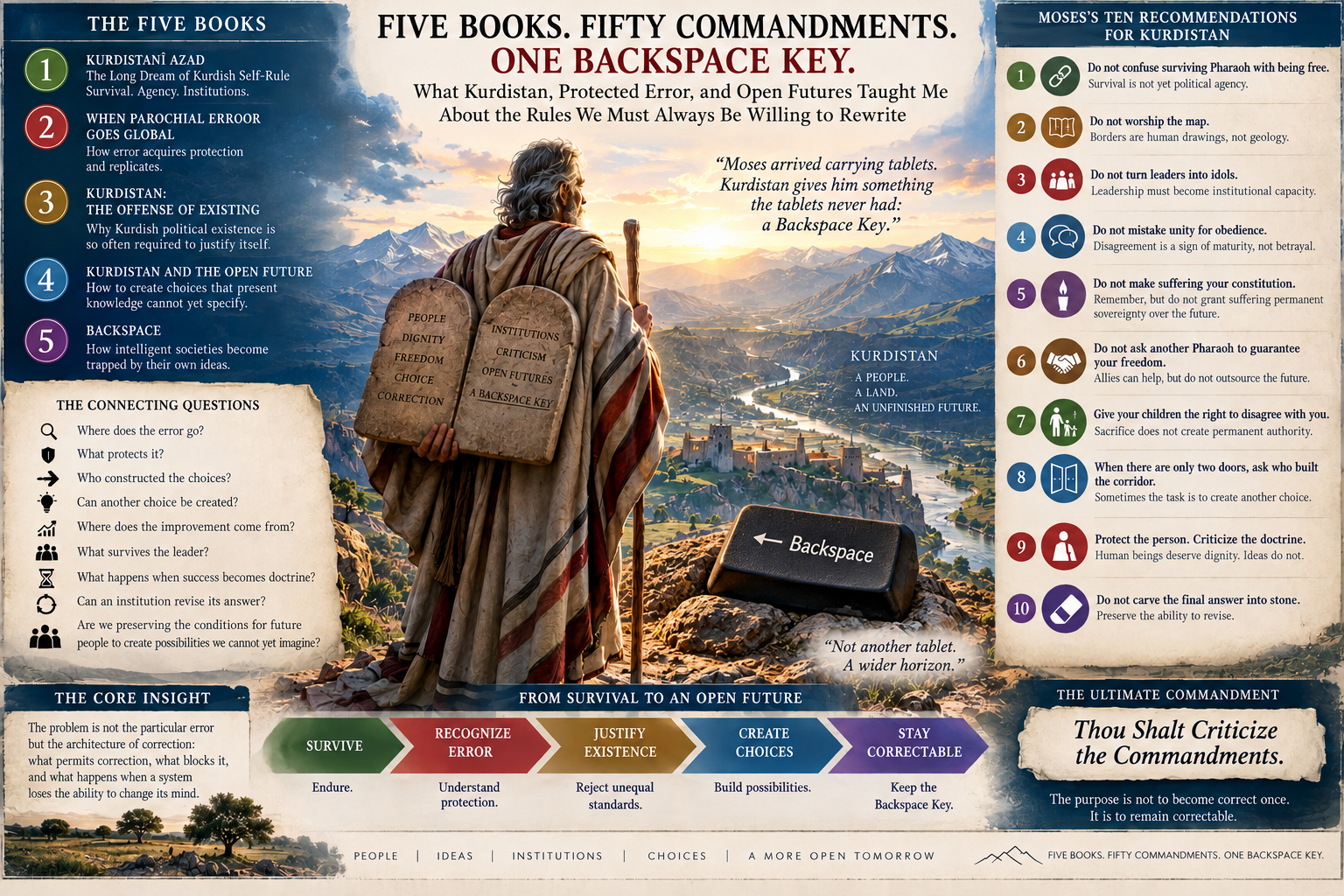
Imagine Moses arriving in Kurdistan with two stone tablets under his arm.
He comes from a story of bondage, escape, law, leadership, wandering, memory, and the difficult transformation of a people from subjects into a political community.
He expects to offer commandments.
But Kurdistan presents him with a peculiar problem.
This is a people who have already had too many things written in stone.
Borders drawn by others.
Identities defined by others.
Languages prohibited by others.
Political choices narrowed by others.
Agreements broken by others.
And, repeatedly, historical arrangements presented as though they were permanent facts of nature.
So perhaps Moses would hesitate before carving anything else.
He might first ask what Kurdistan has learned from surviving.
And perhaps his commandments would sound something like these:
Do not confuse surviving Pharaoh with being free.
Escape is not yet freedom. Survival is not yet political agency. A people becomes freer when it acquires the capacity to shape its own future.
Do not worship the map.
Human beings draw borders. Time can make them familiar, but familiarity does not turn political arrangements into geology.
Do not turn leaders into idols.
Honor those who opened doors. But ask what remains after they are gone. Leadership that cannot become institutional capacity leaves every generation starting again.
Do not mistake unity for obedience.
A political community does not prove its existence by agreeing about everything. It proves its maturity when disagreement can occur without destroying the political home in which disagreement takes place.
Do not make suffering your constitution.
Remember Anfal. Remember Helebje. Remember Dersim. Remember Mehabad. Preserve witness. Permit mourning. Demand truth. But do not grant suffering permanent sovereignty over the future.
Do not ask another Pharaoh to guarantee your freedom.
Allies can help. Powers can intervene. Governments can change policy. But political capacity that exists only while someone else permits it is fragile capacity.
Give your children the right to disagree with you.
Sacrifice does not create permanent intellectual authority. Future generations should be able to say: you were courageous, you were necessary—and you were wrong about this.
When there are only two doors, ask who built the corridor.
Submission or war. Baghdad or Ankara. Tehran or Washington. Religion or nation. Unity or criticism. The visible choices may themselves be the problem. Sometimes the rational task is to create another choice.
Protect the person. Criticize the doctrine.
Human beings deserve dignity. Ideas do not. No doctrine becomes better because criticism of it has been made morally dangerous.
And then Moses reaches the tenth commandment.
He looks at the stone in his hands.
Perhaps this is where Kurdistan changes the story.
Because the deepest lesson of these five books is that no human proposition should become untouchable merely because an authority once carved it into stone.
So the final recommendation would be different:
Do not carve the final answer into stone.
Preserve the ability to revise.
Preserve the right to criticize.
Preserve institutions capable of admitting error.
Preserve the conditions under which better possibilities can still be created.
Moses arrived carrying tablets.
Kurdistan gives him something the tablets never had:
a Backspace Key.


