When Cassam’s Extremism Collapses
1 March 2026
Part IV: The Neurobiological Reality
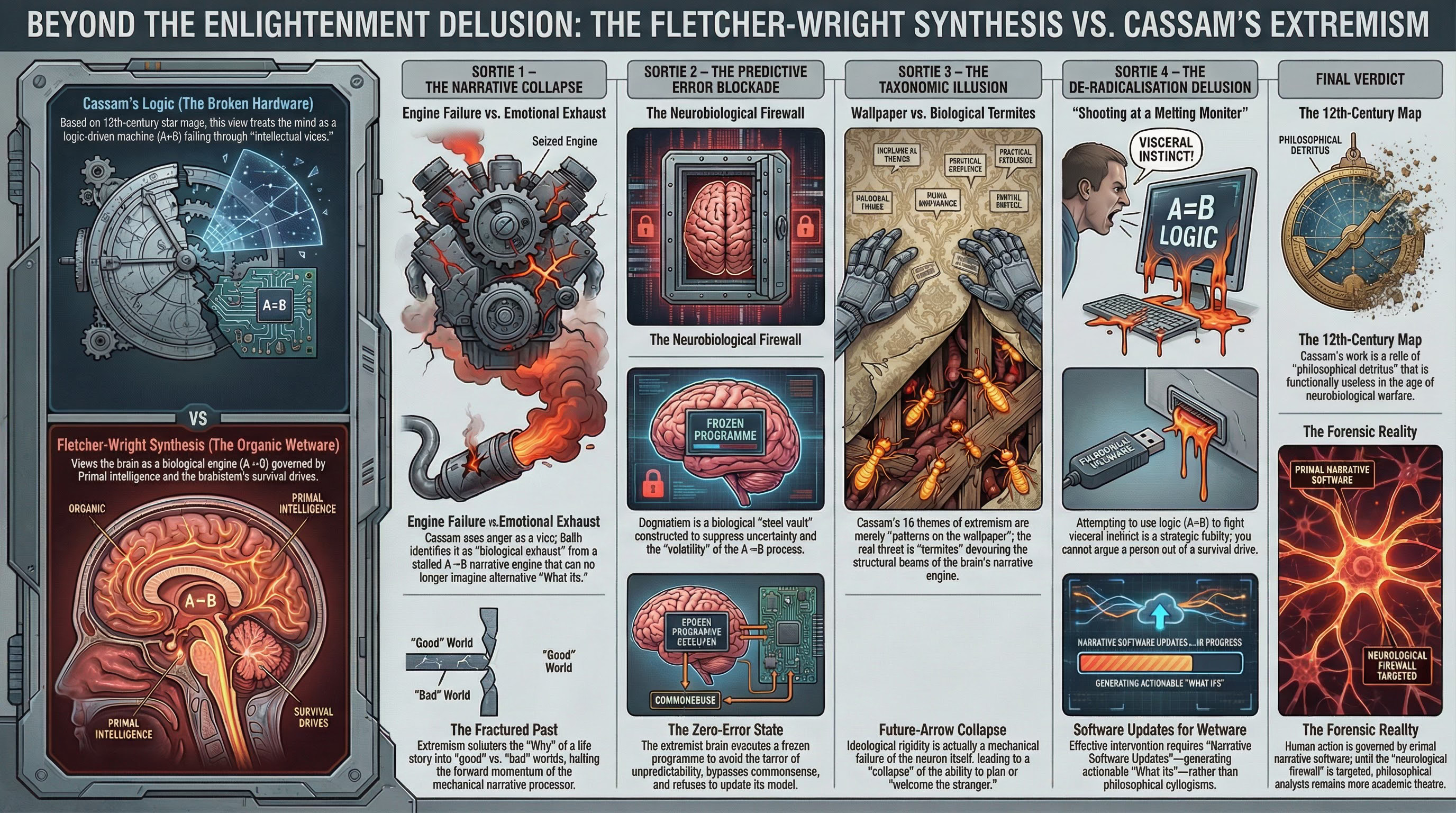
In the previous instalments of this series (see here, here, here, and here), I systematically studied Quassim Cassam’s Extremism to expose its epistemological failures and its profound ontological poverty. Having mapped the finite theatre of the extremist’s reality, I must now turn my critical gaze inward to the actual biological machinery driving the actor. This brings us to my fourth and final analytical scalpel. This exercise serves to formalise the necessity of discarding Cassam’s antiquated philosophical taxonomies in favour of a rigorous, imaginative synthesis of narrative neurobiology and predictive brain modelling.
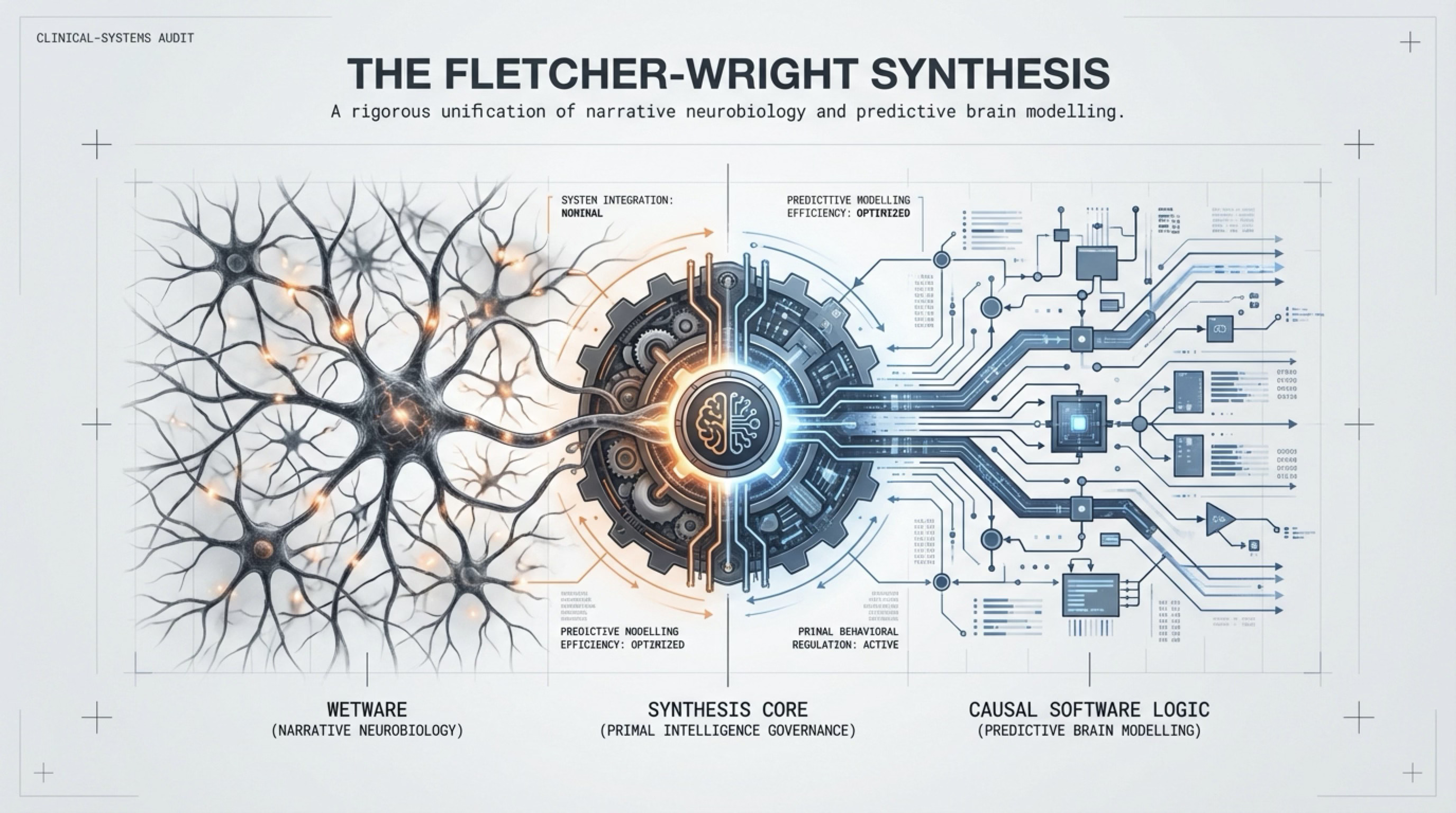
Subjected to this final lens, Cassam’s framework reveals a profound biological illiteracy. He tragically treats the extremist “mindset” as a mere collection of intellectual vices, entirely failing to diagnose it as a catastrophic failure of the brain’s mechanical story-processor. To expose this fatal blind spot, I shall deploy the powerful unification of Angus Fletcher’s “Narrative Cognition” (the brain’s fundamental A → B causal engine) and Nicholas Wright’s “Predictive Modelling” (the biological wetware, or wetware, of the brainstem).
Through this synthesis, I shall demonstrate that Cassam’s reliance on “logic” and “rationality” constitutes a fundamental category error. Human behaviour is governed by Primal Intelligence—our biological wetware for navigating a volatile world—not by the second-class, data-dependent algorithms of formal logic. In the following four sorties, we will systematically discard Cassam’s thesis, revealing it to be nothing more than intellectual atavism masquerading as security studies.
The Synthesis of Primal Intelligence and Warhead
This exercise serves to formalise the strategic necessity of discarding Quassim Cassam’s antiquated philosophical taxonomies in favour of a rigorous, imaginative synthesis of narrative neurobiology and predictive brain modelling. Cassam’s Extremism is a work of profound biological illiteracy, treating the extremist “mindset” as a collection of intellectual vices rather than a catastrophic failure of the brain’s mechanical story-processor. By applying the Fletcher-Wright Synthesis—the unification of Angus Fletcher’s “Narrative Cognition” (the A → B causal engine) and Nicholas Wright’s “Predictive Modelling” (the biological wetware, Wright uses hardware, of the brainstem)—I shall expose Cassam’s reliance on “logic” and “rationality” as a fundamental category error. Human behaviour is governed by Primal Intelligence, the brain’s biological wetware for navigating a volatile world, not by the second-class, data-dependent algorithms of formal logic (A = B). The following four sorties will systematically discard Cassam’s thesis, revealing it to be nothing more than intellectual atavism masquerading as security studies.
Sortie 1: The Narrative Collapse
In the clinical assessment of the radicalised brain, one must distinguish between “emotional exhaust” and “engine failure.” Cassam’s cataloguing of anger, victimhood, and rigidity merely describes the exhaust fumes of a seizing mind. Through the Fletcher lens, I shall identify these not as character flaws, but as a mechanical collapse of Narrative Cognition—the brain’s fundamental A → B processor.
- The Biological Signal of Anger: Cassam erroneously categorises anger as an “intellectual vice.” In reality, as evidenced in Fletcher’s analysis of the emotional brain, anger is the biological exhaust of a stalled narrative engine. It is a signal that the future has narrowed into a single, non-branching path. When the brain cannot imagine What Ifs (A → B, C, or D), it defaults to the “tunnel vision” of a seizing processor.
- The Fractured Past of Victimhood: Where Cassam sees a chosen identity of victimhood, we find a “fractured past.” A healthy narrative engine integrates history into a unified Why to provide forward momentum. The extremist possesses a splintered narrative—a “bad world” vs. “good world” split—that prevents the integration of life strategy.
- The Taxonomic Failure: Cassam mistakes the symptoms of a broken story-processor for the cause of extremism. By focusing on the content of the anger rather than the mechanical failure of the A → B transition, his analysis remains trapped in the superficial detritus of academic theatre.
Sortie 2: The Predictive Error Blockade
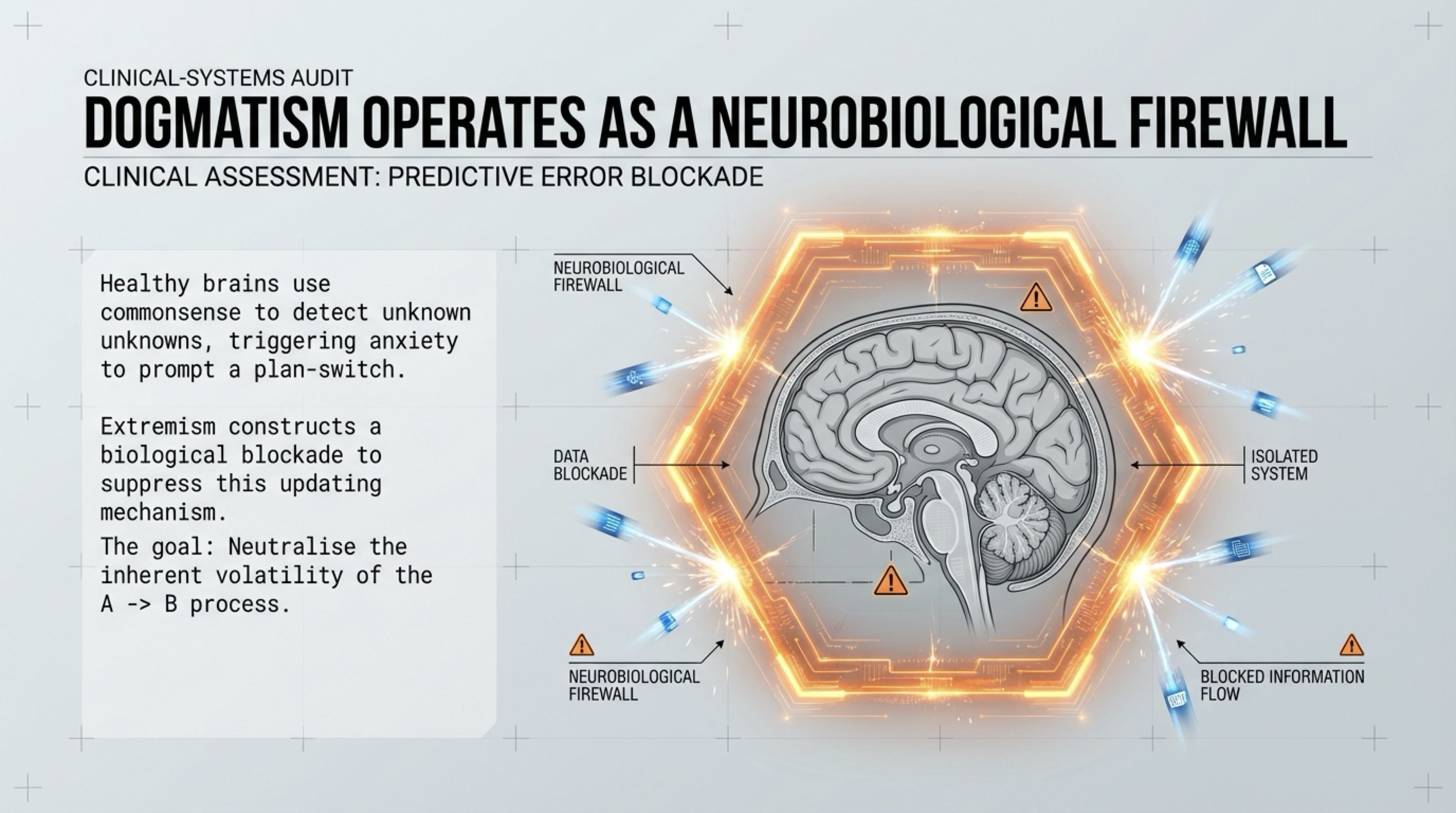
Dogmatism is not a “failing of the mind”; it is a neurobiological firewall constructed by the brain’s wetware to neutralise volatility. Through Wright’s lens of the brain as a “Predictive Modeller,” we need to define extremism as a systemic biological hijack of the updating mechanism.
- Suppression of Updating: A healthy brain uses “commonsense” to detect “unknown unknowns,” triggering a necessary level of anxiety that prompts a plan-switch. The extremist brain, however, is locked in a biological blockade. It suppresses the brain’s fundamental biological updating mechanism to avoid the “volatility” inherent in the A → B process.
- The Zero-Error State: The extremist brain artificially maintains a “zero-error” state. By refusing to acknowledge exceptions to its rules, it bypasses the neurobiological discomfort of uncertainty. It does not think; it merely executes a frozen program (A=A) to stave off the terror of a world it can no longer predict.
Cassam treats “echo chambers” as a social choice; we should treat them as a biological fortification against the corrective data-flow required for standard neurobiological function. He is attempting to debug a melted motherboard by editing a text file.
Sortie 3: The Taxonomic Illusion
The danger of “descriptive taxonomy” in security studies is its total lack of causal rigour. Cassam’s reliance on Saucier’s 16 themes is a hallmark of low-level computer logic (A=B), not Primal Intelligence. These themes are a “Taxonomic Illusion”—a list of symptoms that lack the deep causal mechanics of Fletcher’s A → B transitions.
What Cassam superficially categorises as mere ideological rigidity is, at a neurobiological level, a catastrophic “future-arrow collapse”—a mechanical failure of the brain’s A → B narrative engine that leaves it incapable of branching thought. Similarly, he labels their unrealistic ambitions as utopianism, failing to diagnose the phenomenon as causal narrative decoupling, wherein the extremist engages in magical thinking through an isolated, ungrounded cognitive state. When Cassam observes a psychological preoccupation with victimhood and grievance, he entirely misses the underlying narrative integrity fracture, wherein the host’s brain suffers a deeply splintered Why. Furthermore, his pedestrian concept of dogmatism fundamentally obscures the biological reality of a predictive error suppression loop, which acts as a neurobiological wetware firewall against any corrective data. Finally, what Cassam trivially identifies as in-group/out-group bias is ultimately a wetware limitation of the extremist’s neuron itself—a structural, mechanical failure to “welcome the stranger.”
In reference to Fletcher’s research on Innovation, the inability to “Welcome the Stranger” is not an intellectual choice but a wetware limitation of the extremist’s neuron. Cassam falls into the “Label/Identity Trap,” failing to grasp the mechanical parts of the animal neuron that drive narrative planning. Saucier’s themes are merely patterns on the wallpaper; they tell us nothing about the structural beams being devoured by biological termites.
Sortie 4: The De-radicalisation Delusion
There is a profound strategic futility in using “logic” (A=B) to fight “visceral instinct.” Cassam’s proposal of “counter-narratives” and logical arguments is mechanically incapable of addressing the “primal power” of the extremist brain.
- The Impotence of Logic: Logic is a data-dependent, second-class algorithm. In the VUCA (volatility, uncertainty, complexity, ambiguity) of radicalisation, data is either thin or ignored. You cannot argue a person out of a survival drive.
- Software vs. Wetware: De-radicalisation requires narrative software updates—the generation of actionable What Ifs—not logical equations. Wright’s “visceral instincts” (bottom-up brainstem survival drives) cannot be overridden by philosophical syllogisms.
- The Forensic Reality: Cassam’s “logic-first” approach is the academic equivalent of trying to fix a hardware crash of a computer by shouting at the monitor. It ignores the biological reality that the brain must “Plan the Planner” (A → B) to escape the dogmatic loop.
Final Verdict
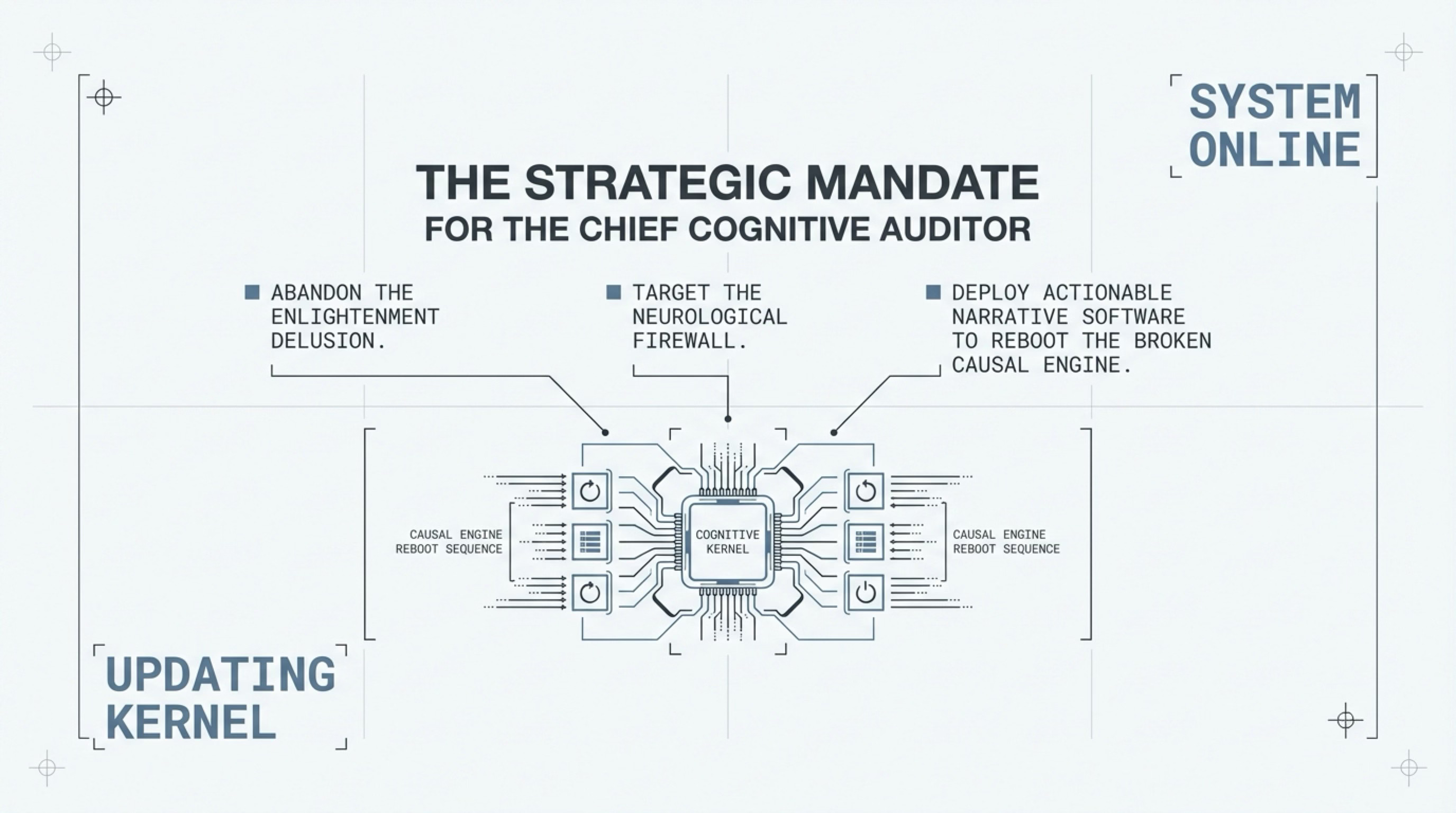
Quassim Cassam’s Extremism fails as a functional framework for the Chief Cognitive Auditor because it remains stubbornly attached to the Enlightenment delusion that humans are logic-driven machines. It ignores the biological wetware (Wright uses hardware!) and the primal narrative software (Fletcher) that actually govern human action. Until we target the neurological firewall and the broken narrative engine, all philosophical analysis of extremism is merely academic theatre—a performance of “intellectual vice” that does nothing to mitigate the biological reality of the threat.
Cassam has spent considerable time meticulously mapping a storm using a 12th-century map of the stars; his work is a relic of philosophical detritus in an age of neurobiological warfare.
For the comprehensive list of references used to rigorously analyse Cassam’s book, please see the foundational introductory text “The Anatomy of Extremism: Quassim Cassam’s Framework.”


