When a Question Becomes a Test of the Open Society
A Reflection on the Controversy Surrounding Mohamed El Fayed in Morocco
31 August 2026
Note:
What happens when a question no longer requires an answer—but requires the questioner to defend his right to have asked it?
The controversy surrounding Mohamed El Fayed in Morocco began with a theological question about Muhammad. But the reaction reveals a much larger problem: Where does error go when a foundational belief becomes difficult to criticize?
If El Fayed is wrong, correct him. Give us the evidence. Give us the better explanation.
But if the error cannot be allowed to travel upward into the claim—if it travels downward instead into the person who questioned it—then the controversy has exposed something more important than a dispute about Islam.
It has exposed a test of the Open Society.
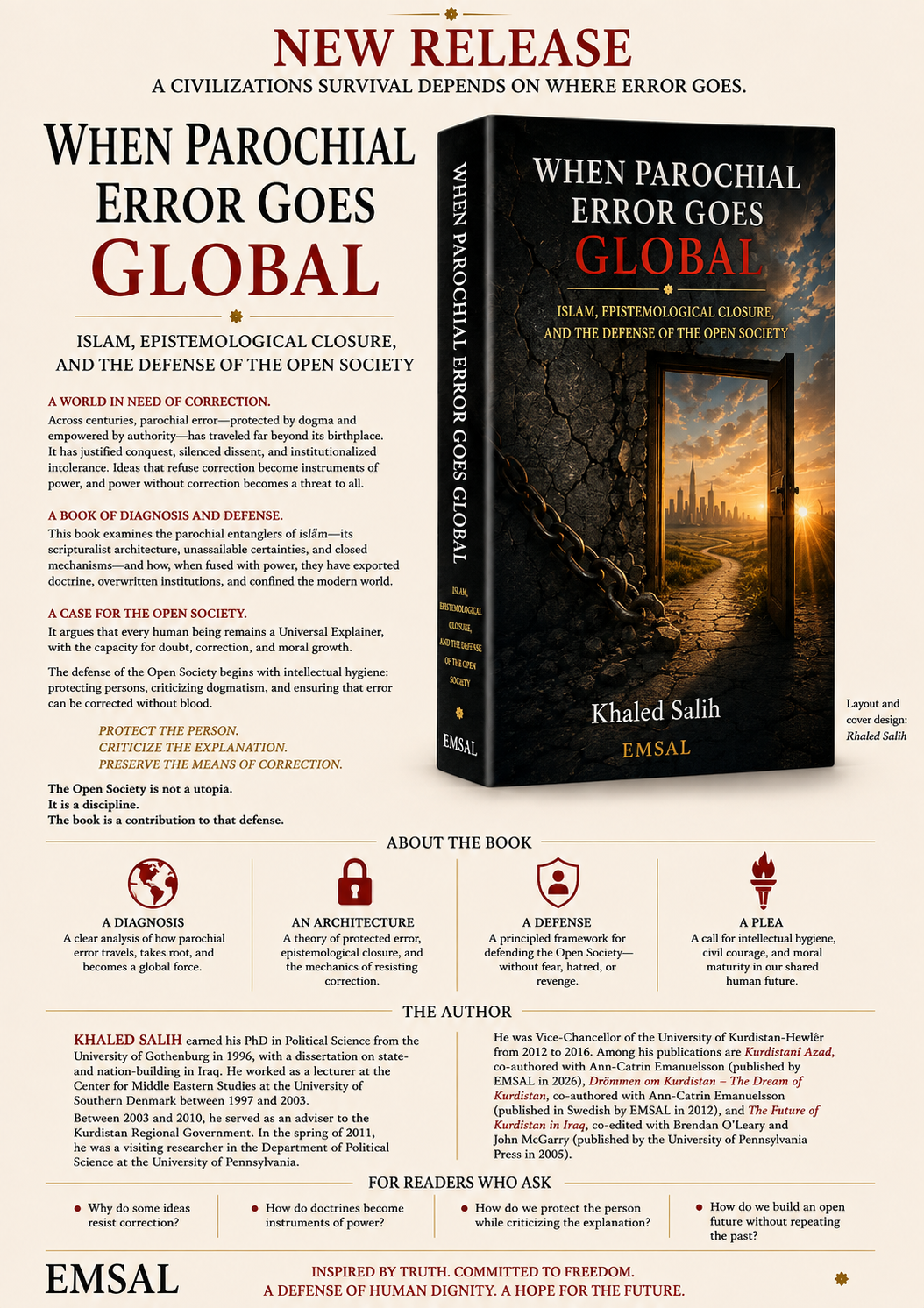
This new essay uses one small controversy to explore the larger thesis of When Parochial Error Goes Global:
Protect the person. Criticize the explanation. Preserve the means of correction.
Because bad explanations do not need human beings to die for them.
Bad explanations can die in our place.
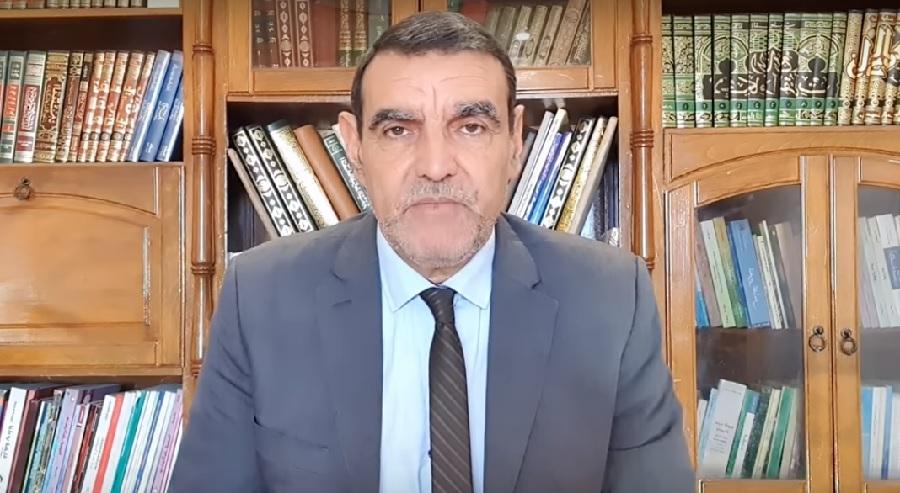
The storm surrounding the Moroccan nutrition specialist Mohamed El Fayed appears, on the surface, to concern a fairly narrow theological question: Was Muhammad really illiterate, and how should the qur’ānic term ‘ummī be understood?
But the reaction to the question makes the matter larger.
What interests me is not only what El Fayed said. It is what happens when someone says it.
His remarks triggered theological objections, accusations of kufr, and reported calls for legal investigation and punishment. El Fayed, in turn, felt compelled to emphasize that he is himself a believing Muslim, that he has memorized the qur’ān, and that his words had been distorted.
That is where the question that interests me begins.
What happens in a society when a question about a religious claim no longer merely requires an answer, but forces the questioner to defend his right to have asked it?
This is one of the central problems I explore in When Parochial Error Goes Global: Islam, Epistemological Closure, and the Defense of the Open Society.
The book is not fundamentally about whether Islam is true or false. Nor is its deepest question whether Muslims possess more erroneous beliefs than other human beings.
Error is universal.
The harder question is:
What happens to error once it enters a system?
Can it be identified?
Can it travel upward into the doctrine, institution, authority, interpretation, or foundational premise that produced it?
Can it be criticized without destroying the person carrying the criticism?
And, ultimately:
Can it be corrected?
The controversy surrounding El Fayed offers a small but unusually clear laboratory in which to examine those questions.
A Question Does Not Have to Be Good to Deserve an Answer
El Fayed may be wrong.
That possibility should be stated at the beginning, not conceded reluctantly at the end.
His formulation may have been provocative. His reasoning may be historically or theologically weak. There may be better philological and religious interpretations of ‘ummī. Islamic tradition has its own arguments for why Muhammad’s alleged inability to read and write might strengthen, rather than weaken, the claim that the qur’ān has a divine origin.
All of this can be discussed.
And that is precisely the point.
If El Fayed’s argument is poor, show why.
If the traditional interpretation is stronger, defend it.
If alternative readings of ‘ummī exist, compare them.
What does the text say?
What does the historical evidence permit us to conclude?
Which explanation accounts for the evidence better?
What evidence could cause either side to reconsider?
This is how knowledge grows: through conjecture, criticism, disagreement, correction, and better explanations.
The problem begins when the question moves from the seminar room to the police station.
When the response is no longer merely:
You are wrong, and here is why.
but begins to become:
You should not have been allowed to ask.
Something important has changed.
Truth Does Not Need Handcuffs
The principle at stake seems to me simple:
Truth does not need handcuffs.
A belief does not become more true because the state punishes those who question it.
A prophet does not become more credible because the critic is silenced.
A sacred text does not become more divine because historical questions become costly.
And a religion does not become intellectually stronger because a doubter must first prove that he still belongs to the community before his argument may be heard.
A tradition confident in its explanations should be capable of saying:
Ask the question.
Here is our answer.
Here are our texts.
Here is the evidence.
Here are the competing interpretations.
Here is why we think our explanation is better.
You remain free to think.
That movement—from authority to argument—is close to the heart of the Open Society.
It does not require anyone to abandon faith.
It requires something both more modest and more demanding:
No explanation receives immunity merely because people consider it sacred.
The Invisible Reality Behind the Visible Controversy
The visible event is a social-media post, a theological dispute, and a public storm.
The invisible reality is more interesting.
Behind the reaction lies a question about how propositions acquire protected status.
Muhammad’s ‘ummiyya is not necessarily an isolated proposition. It can belong to a wider explanatory architecture. If Muhammad could neither read nor write, his inability to have produced the qur’ān himself may be understood as evidence supporting revelation.
An apparently small question can therefore travel backward through the architecture.
What does ummī mean?
becomes:
What do we know about Muhammad?
which can become:
How did the qur’ān come into being?
which can eventually become:
What kinds of historical questions may be asked about revelation itself?
Suddenly the controversy is no longer about one word.
It has reached the origin.
And origins are often where corrigibility is most severely tested.
A tradition may tolerate thousands of disagreements about secondary matters while remaining extraordinarily closed around the premises from which the entire explanatory structure derives its authority.
This gives us a better diagnostic than merely asking whether disagreement exists.
We should ask:
What would count as a legitimate correction here?
And an even harder question follows:
Is there any conceivable evidence, argument, or better explanation that the system would permit to reach the foundational premise?
If the answer is no, we have learned something important—not necessarily about whether the premise is false, but about whether it remains corrigible.
That distinction is central to my argument in When Parochial Error Goes Global.
The Backspace Key
I use a simple metaphor in the book: the Backspace Key.
Human beings need the capacity to return to an explanation and say:
That was mistaken.
That is what we once believed.
That requires reinterpretation.
That belonged to another historical setting.
That explanation no longer survives criticism.
We need a better one.
Backspace is therefore not a metaphor for destruction.
It is a metaphor for correction.
It does not require people to throw away their inheritance. It means only that inheritance must not acquire irreversible ownership of the future.
Science needs Backspace.
Religions need it.
Nations need it.
Universities need it.
Political movements need it.
Families need it.
And I, as an author advancing arguments about all of them, need it too.
Otherwise criticism becomes something we demand from our opponents while quietly exempting our own explanations.
For me, therefore, the fundamental question raised by the El Fayed controversy is not whether his interpretation of ‘ummī is correct.
It is:
Can the Backspace Key be used on this question?
Can a Muslim reconsider an established claim about the Prophet without his identity as a Muslim becoming the object of prosecution, denunciation, or exclusion?
Can a theological question remain a theological question?
Can a bad argument be answered by a better one?
If not, the cost of correction has itself become part of the problem.
When the Error Moves From the Idea to the Person
This brings us to one of the central mechanisms examined in When Parochial Error Goes Global.
When an idea becomes difficult to criticize, the location of the problem often shifts.
Instead of asking:
Is this claim mistaken?
people begin asking:
What is wrong with the person who said it?
Is he really a believer?
Is he an apostate?
What are his motives?
Does he respect the Prophet?
Does he still belong to the community?
Notice what has happened.
The criticism has changed direction.
It no longer travels upward into the proposition.
It travels downward into the questioner.
This is why El Fayed’s insistence that he is a devout Muslim is so revealing.
Why should his religious credentials determine whether the proposition is true?
A claim about ummī should stand or fall independently of whether the person advancing it can produce an acceptable religious biography.
Knowledge requires arguments.
It should not require identity papers.
This is the error-route problem.
When criticism cannot safely reach the explanation, it may be displaced onto the human being carrying the criticism.
The doctrine remains standing.
The questioner becomes the problem.
Protect the Person. Criticize the Doctrine.
Here the central moral distinction of my book becomes indispensable.
The Muslim is the person.
The doctrine is not the human being.
The organization is not the individual.
This distinction works in both directions.
Muslims should never be treated as problems merely because Islam is being criticized.
But Islamic doctrines should not acquire immunity merely because human beings identify with them.
The person deserves dignity.
The doctrine deserves criticism.
The organization deserves scrutiny.
This is not an attempt to weaken religion.
It is an attempt to make possible a society in which people do not have to choose between their dignity and their freedom to think.
That distinction is also a safeguard against a different error.
Criticism of Islam can itself become parochial. It can harden into contempt for Muslims, civilizational self-congratulation, collective suspicion, or hatred.
That is not the Open Society either.
The alternative to protecting a doctrine cannot be attacking the people who inherited it.
The correct asymmetry is harder:
Protect the person. Criticize the explanation.
The Decisive Issue Is Not Violence but Corrigibility
It is tempting to measure openness principally by the absence of violence.
That test is insufficient.
A society can remain relatively peaceful while making certain thoughts extraordinarily expensive.
The cost can be legal.
Religious.
Familial.
Social.
Professional.
Reputational.
It can concern livelihood, marriage, friendship, belonging, or one’s relationship with one’s own community.
Then something easily overlooked happens:
Silence begins to resemble agreement.
But silence is not always consent.
Sometimes silence means that people have learned which questions cost too much.
This changes the diagnostic.
The useful question is not merely:
How many people criticize?
It is:
What would happen if they did?
Could they speak without losing their livelihood?
Could they reconsider without losing their family?
Could they doubt without losing their citizenship?
Could they criticize a doctrine without losing their dignity?
Could they change their minds without becoming enemies?
These questions reveal more about the architecture of openness than the visible amount of disagreement.
Morocco Is Not “the Other”
It would be easy to turn this controversy into another story about a pathology somewhere in “the Muslim world.”
That would be too easy—and philosophically mistaken.
The mechanism is universal.
Every society has sacred cows.
Every institution can begin protecting foundational assumptions.
Every group can redefine criticism as disloyalty.
Universities can do it.
Political parties can do it.
Nations can do it.
Families can do it.
Scientific communities can do it.
Even movements calling themselves liberal can do it.
Islam is a central case study in When Parochial Error Goes Global.
Epistemological closure is the larger problem.
The relevant question for Morocco is therefore the same question I would ask of Sweden, Europe, universities, religions, political movements—and my own ideas:
Which propositions have become so central to our identity that we would rather interrogate the critic than reconsider the proposition?
That is where Backspace is needed most.
Do Not Use El Fayed as Ammunition
There is therefore something else I want to resist.
I do not want to turn Mohamed El Fayed into ammunition for another culture war.
That would reproduce part of the problem this essay is trying to diagnose.
I would rather use the controversy as an invitation to criticism.
To the Muslim believer who thinks El Fayed is wrong, I would say:
Show us why.
Give us the better interpretation.
Explain ‘ummī.
Explain why Muhammad’s illiteracy matters.
Present the historical and theological argument.
Let the explanation carry the weight of the belief.
And to the secular critic I would say something equally important:
Do not allow criticism of the doctrine to become contempt for the believer.
The human being is always greater than the explanation he or she currently carries.
The Open Society requires both disciplines simultaneously.
Without criticism, error survives.
Without protection of persons, criticism becomes persecution.
Neither produces an open civilization.
From Punishment to Conversation
Imagine, then, a different response to El Fayed’s question.
Not:
Arrest him.
Not:
Declare him an unbeliever or traitor.
Not:
Turn him into an enemy.
But:
Let us examine the question.
What does the text say?
What does the historical evidence say?
What competing interpretations exist?
Which explanation is better?
What could cause us to revise our present understanding?
That is where an Open Society begins.
Not when everybody agrees.
Not when everybody is right.
But when disagreement can exist without the person having to be destroyed so that the idea can survive.
The institutional task is therefore not to guarantee correct speech, but to preserve the means by which mistaken speech, mistaken doctrine, and mistaken authority can all be criticized and corrected.
That is why freedom of expression matters.
It is not a guarantee that people will speak wisely.
It is part of the architecture by which error becomes discoverable.
And that architecture must itself be protected.
A government cannot simultaneously serve as the institution to be corrected and possess unlimited authority to decide which criticism of its protected premises may occur.
A religious establishment cannot reliably expose its own errors if questioning its premises is treated as an offense against the questioner’s standing.
A society committed to correction therefore needs something deeper than tolerance.
It needs a principle:
Do not destroy the means of error correction.
The Larger Problem
This is why the storm surrounding El Fayed interests me more than his original proposition.
His argument may turn out to be mistaken.
That possibility does not weaken my argument.
It strengthens the test.
Because if El Fayed is wrong, the answer should be straightforward:
Correct him.
Show where the argument fails.
Produce the evidence.
Offer the better explanation.
If an erroneous proposition instead requires courts, denunciation, social excommunication, or threats to neutralize it, another problem has revealed itself.
Not necessarily a problem with the proposition.
A problem with the system’s relationship to propositions.
This is among the most important distinctions I try to develop in When Parochial Error Goes Global:
An open system is not one without errors. It is one capable of correcting them.
A closed system is not distinguished primarily by possessing more errors than everyone else.
All human systems contain error.
The crucial difference is whether some errors have acquired protection from correction.
Once they have, intelligence does not necessarily save us.
Intelligent people can defend bad explanations.
Institutions can elaborate them.
Law can enforce them.
Identity can sanctify them.
Power can reproduce them.
And success can make them harder to reconsider.
The problem is therefore not merely error.
The problem is protected error.
The Backspace Key Must Be Handed Over With Care
I therefore do not imagine the Backspace Key as a hammer.
I imagine it as a key that should be handed over carefully.
To the believer:
You do not have to abandon your faith in order to ask a question.
To the doubter:
You do not have to hate your background in order to reconsider it.
To the religious leader:
Your tradition does not lose its dignity because someone examines it.
To the secular critic:
The freedom to criticize a doctrine does not include permission to degrade the people who believe it.
To the state:
Your responsibility is to protect people, not to protect ideas from people.
And to all of us:
Do not construct an identity that requires certain questions never to be asked.
That is the opening I see in this Moroccan controversy.
Not an opportunity to win another trench war over Islam.
An opportunity to ask something much larger:
Can we create societies in which human beings are permitted to discover that something they inherited may be wrong—without therefore losing their right to belong, think, speak, and live?
If the answer is yes, something has begun to open.
The error can travel upward.
The explanation can be criticized.
The person can remain standing.
And criticism can become what it should be:
not a weapon against the human being,
but an instrument of human freedom.
Protect the person.
Criticize the doctrine.
Test the organization.
Preserve the means of correction.
Preserve the Backspace Key.
And above all:
No person is the prison of a doctrine.
Captured minds are not deleted.
Bad explanations can die in our place.


