What Is an Anti-Rational Memeplex?
18 May 2026
This is the fourth essay in the series on the ideas behind my upcoming book When Parochial Error Goes Global. The first essay describe how a Levantine matrix went global and how a parochial error learned to travel. The second essay applied the principle of no error is final to my own manuscript and showed how the book itself had to change through criticism. The third essay dealt with protecting the person, while criticizing the doctrine.
Some ideas survive because they are true. Some survive because they are useful. Some survive because they solve problems.
Some survive because they make better predictions, produce better institutions, reduce suffering, increase freedom, or expose themselves to criticism and improve over time.
But some ideas survive for a darker reason.
They survive because they protect themselves from being corrected.
They do not win by being better explanations. They win by making criticism dangerous. They do not spread because they solve more problems. They spread because they disable the mind’s ability to ask whether they are the problem.
That is what I mean by an anti-rational memeplex.
But it is important to see that such a system does not survive by fear alone. It also survives by offering relief. A closed system converts the anxiety of freedom into the comfort of submission. It gives the believer certainty instead of doubt, identity instead of open-ended self-formation, obedience instead of judgment, sacred order instead of plural confusion.
It does not only say: “You must not question.”
It also says: “You no longer have to bear the burden of questioning.”
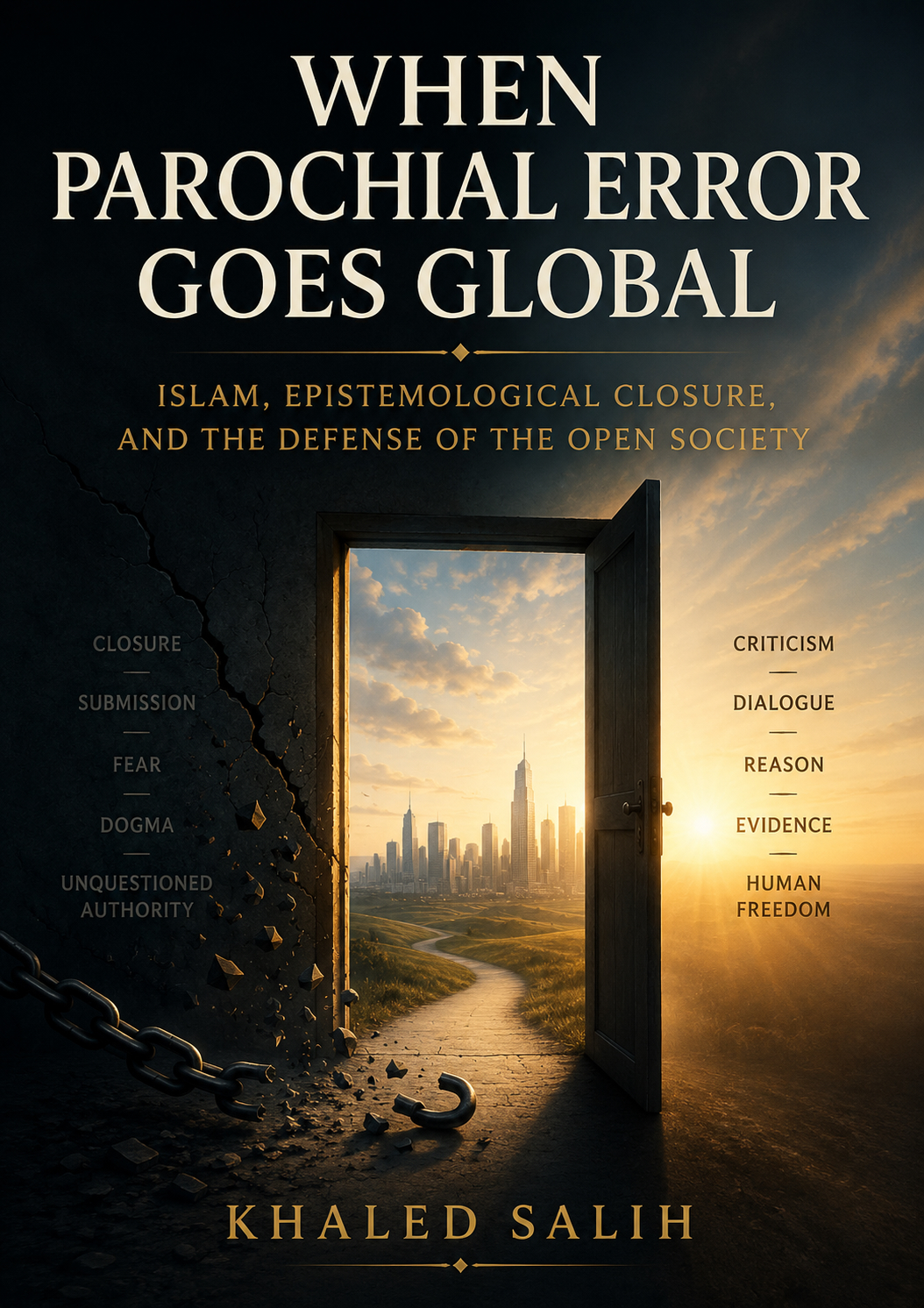
It is one of the central concepts in my book, When Parochial Error Goes Global: Islam, Epistemological Closure, and the Defense of the Open Society. The term sounds technical, but the underlying idea is simple:
An anti-rational memeplex is not merely a false idea. It is a system of ideas that survives by making its own correction dangerous.
That distinction matters.
All human beings carry false ideas. All cultures inherit errors. All civilizations begin with local assumptions, sacred memories, tribal heuristics, emotional loyalties, and incomplete explanations. The mere presence of error is not the problem.
The problem begins when error becomes protected.
The problem begins when a system says:
You may not question this.
You may not leave this.
You may not mock this.
You may not historicize this.
You may not revise this.
You may not compare this.
You may not delete this.
At that point, an idea is no longer just an idea. It has become a cage around error-correction.
What is a meme?
A meme is not just an internet joke.
In its deeper sense, a meme is a unit of cultural transmission: an idea, habit, story, ritual, rule, image, phrase, prohibition, practice, or pattern that can pass from one mind to another.
A melody can be a meme. A proverb can be a meme. A prayer can be a meme. A political slogan can be a meme. A dress code can be a meme. A sacred story can be a meme. A scientific method can be a meme. A taboo can be a meme.
A meme survives if it is copied. But memes do not all survive for the same reason. Some survive because they help people solve real problems. Others survive because they exploit human fear, loyalty, guilt, hope, shame, belonging, or obedience.
Some memes invite criticism. Others punish it. That is the decisive difference. Rational memes and anti-rational memes A rational meme survives by allowing itself to be tested.
It says, in effect:
Try to improve me.
Find my errors.
Compare me with reality.
Replace me if you can produce a better explanation.
Science is the clearest example. A scientific theory does not become stronger by forbidding criticism. It becomes stronger by surviving attempts to refute it, by explaining more with less arbitrariness, by solving problems that rival theories cannot solve, and by remaining open to replacement.
A rational meme does not need sacred immunity. It survives by correction. An anti-rational meme works differently.
It says:
Do not test me at the root.
Do not question my origin.
Do not criticize my founder.
Do not leave my community.
Do not expose my contradictions.
Do not laugh at my sacred claims.
Do not revise my law.
Do not compare me too closely with rival explanations.
A rational meme treats criticism as oxygen. An anti-rational meme treats criticism as treason.
That is the difference between a tradition of knowledge and a tradition of submission.
What makes it a memeplex?
A single meme may be simple. A memeplex is a cluster of mutually reinforcing memes.
One idea protects another. One rule supports another. One taboo reinforces another. One fear stabilizes another. One ritual makes another belief feel real. One social punishment makes a doctrine harder to leave. One sacred story makes a law seem eternal. One identity marker makes criticism feel like betrayal.
A memeplex is not just a belief. It is an ecosystem of beliefs and practices.
For example, a closed religious memeplex may include:
a sacred origin story,
a final prophet or final authority,
an untouchable scripture,
a law code,
ritual obligations,
gender rules,
purity rules,
apostasy fear,
blasphemy pressure,
family honor,
shame mechanisms,
afterlife reward and punishment,
social surveillance,
community identity,
and institutions that present themselves as guardians of the truth.
Each element strengthens the others.
The sacred origin makes the law harder to criticize. The law makes the community boundary more visible. The boundary makes exit more costly. The cost of exit makes doubt more frightening. The fear of doubt protects the sacred origin.
That is how a memeplex becomes durable.
It does not need every individual to be fanatical. It only needs enough inherited incentives, punishments, symbols, habits, and fears to make root-level correction difficult.
The Backspace Key
The best way to understand the problem is through the metaphor of the Backspace Key.
A healthy mind needs a Backspace Key. A healthy institution needs a Backspace Key. A healthy civilization needs a Backspace Key.
The Backspace Key is the capacity to say:
This explanation was wrong.
This rule was inherited but harmful.
This sacred story does not survive scrutiny.
This authority was mistaken.
This practice should end.
This doctrine must be revised.
This belief no longer deserves obedience.
Without the Backspace Key, errors accumulate. They become tradition. Then identity. Then law. Then sacred duty.
An anti-rational memeplex disables the Backspace Key.
It may not disable it completely. Human beings remain creative. The captured mind is not deleted. People still doubt, reinterpret, resist, joke, soften, compromise, hide, reform, and escape.
But the system raises the cost. It makes the Backspace Key dangerous to use. That is the point.
In an open system, error-correction is difficult but legitimate.
In a closed system, error-correction becomes socially, morally, legally, or spiritually punishable.
The cost of conjecture
Human beings create knowledge through conjecture and criticism.
We guess. We test. We fail. We revise. We compare. We try again.
This is not merely how science works. It is how human life works. A child learning language does it. A musician does it. A doctor does it. A free society does it. A good institution does it. A writer does it.
An anti-rational memeplex targets this process.
It does not need to stop every thought. It only needs to make some thoughts too costly to say aloud.
The child observes what may not be questioned. The family learns which doubts must remain unspoken. The believer learns which questions signal danger. The woman learns which refusals will be read as dishonor. The dissenter becomes a warning to others. The critic is not merely answered. He is made socially radioactive.
In this way, the cost of conjecture rises until new explanations are not merely rejected, but driven underground before they can become socially transmissible.
That is how a closed system preserves itself.
It does not abolish human intelligence. It captures and disciplines it.
Why apostasy, blasphemy, and innovation matter
Apostasy, blasphemy, and innovation are not side issues. They are diagnostic instruments. They tell us whether a system permits root-level correction. Apostasy tests whether a person may leave.
Blasphemy tests whether sacred claims may be demoted, mocked, criticized, or treated as human objects.
Innovation tests whether inherited forms may be changed. Historical criticism tests whether sacred origin may be examined as history. Satire tests whether fear has replaced argument.
Gender dissent tests whether the individual body belongs to the person or to the collective.
The question is not whether every believer wants to punish apostasy or blasphemy. Many do not. The question is whether the doctrine, institutions, social norms, and inherited authorities make such punishment thinkable, defensible, or emotionally plausible.
That is where anti-rationality appears.
A system does not have to punish every dissenter to become closed. It only has to create an atmosphere in which enough dissenters understand the cost.
Why Islam is the central case study
My book uses Islam as the central case study because Islam, in its closed configuration, presents one of the most consequential examples of an anti-rational memeplex going global.
This is not a claim about Muslims as people. The Muslim is the person. The doctrine is not the human being. The organization is not the individual. That distinction must remain absolute.
The claim is about a system of ideas and authority: sacred origin, prophetic finality, scriptural immunity, legal classification, apostasy pressure, blasphemy norms, gender rules, communal surveillance, and resistance to root-level correction.
Islam is not dangerous because it is Arab. It is not dangerous because it is Middle Eastern. It is not dangerous because Muslims are somehow defective. Those explanations are crude and morally wrong.
The issue is not ethnicity. The issue is corrigibility. Can the system correct itself at the root? Can “founder” be criticized? Can the scripture be historicized? Can apostasy be accepted? Can blasphemy be tolerated? Can women refuse compulsory piety? Can children grow beyond inherited boundaries? Can secular Muslims and ex-Muslims speak without fear? Can reformers change foundational claims without being branded traitors? Can the Backspace Key be used?
That is the test.
Anti-rational does not mean unintelligent An anti-rational memeplex can produce highly intelligent people.
It can produce scholars, lawyers, poets, architects, mystics, philosophers, theologians, engineers, doctors, merchants, administrators, and political strategists.
Anti-rational does not mean stupid. It means protected from root-level criticism.
This is why Popper’s distinction between open and closed societies matters. A closed society may be intelligent, disciplined, scholarly, and organized. Its defect is not lack of cognition. Its defect is that certain corrections are forbidden.
A society can be technically sophisticated and epistemologically closed. It can use modern technology while resisting modern error-correction. It can build institutions, run universities, produce media, use smartphones, master public relations, and speak the language of rights while still protecting sacred claims from examination.
That is one of the central dangers of our time.
Technological modernity is not the same as epistemological modernity.
A closed system can use the tools of modernity without accepting the method of criticism that made modernity possible.
It can use English, migration, universities, courts, NGOs, television, YouTube, and social media while still rejecting the right to criticize its sacred core.
Modernity supplies the bandwidth. The memeplex supplies the closure. Why the Open Society misunderstands this
Modern liberal societies often misunderstand anti-rational memeplexes because they are trained to think in terms of identity, discrimination, material conditions, and representation.
These are important, but they are not enough.
If a person is poor, poverty matters. If a person faces racism, racism matters.If a person is excluded, exclusion matters. If a person is humiliated, humiliation matters.
But none of these explains everything.
A bad explanation enters when institutions say:
The ideology is only a symptom.
The doctrine is irrelevant.
The sacred claims do not matter.
The violence is only poverty.
The coercion is only marginalization.
The gender control is only culture.
The apostasy fear is only misunderstanding.
The blasphemy pressure is only hurt feelings.
This is the root-cause confabulation. It refuses to see ideas as causal.
But ideas are causal. Sacred claims are causal. Afterlife beliefs are causal. Legal categories are causal. Gender codes are causal. Blasphemy norms are causal. Apostasy penalties are causal. Founder models are causal. Scriptures are causal. Organizations are causal.
An Open Society that cannot analyze ideas as causes will misread closed systems until it is too late.
The peaceful believer fallacy
Many people respond to criticism of Islam by saying:
“But I know Muslims who are peaceful.”
Of course. So do I.
Many Muslims are peaceful, kind, generous, hospitable, intelligent, funny, brave, loving, and morally serious. But this does not answer the question.
The existence of peaceful believers does not prove that a doctrine is open to correction.
A person can be better than the doctrine. A family can soften a system. A culture can domesticate a law. A believer can ignore a command. A community can live in contradiction with its own inherited texts.
That is not a refutation of the critique.
It is evidence for one of the book’s deepest claims: The person remains greater than the code. The issue is not whether Muslims can be good. They can. The issue is whether the system can be corrected.
There is also an opposite danger.
Some people recognize the dangers of Islam but then collapse Muslims into Islam. They treat the believer as if he or she were identical with the doctrine. They see only demographic threat, not human beings. They speak of Muslims as if they are extensions of a system rather than persons capable of criticism, change, contradiction, and freedom.
That is not the Open Society. That is tribal fear. It makes the same category error in reverse.
An anti-rational memeplex must be criticized because the human being is not the memeplex.
If you forget the human being, you have not escaped closure. You have built a counter-closure of your own.
This is why the moral rule must remain clear:
Protect the person.
Criticize the doctrine.
Test the organization.
Restore the Backspace Key.
The organization must be tested
Organizations are not persons either. A mosque, council, association, charity, school, religious federation, political movement, or advocacy group may claim to represent Muslims. But representation is not innocence.
An organization must be tested by how it handles criticism.
Does it defend the right to leave? Does it defend the right to criticize the “founder”? Does it defend the right to historicize the scrripture? Does it defend the right of women to refuse religious dress? Does it defend the right of ex-Muslims to speak publicly? Does it oppose blasphemy norms without hesitation? Does it tolerate satire? Does it protect internal dissent? Does it allow young people to choose unbelief? Does it treat secular Muslims as legitimate? Does it accept equal citizenship without hidden hierarchy? Does it preserve the Backspace Key?
If not, the organization may be using the language of pluralism while preserving the structure of closure.
That is what must be tested.
Criticism as hygiene
Criticism is often treated as aggression. But in an Open Society, criticism is hygiene.
It is how societies remove errors without removing people. It is how bad explanations die before they become prisons.
A society that loses criticism does not become compassionate. It becomes contaminated by uncorrected error.
Intellectual hygiene means asking:
What claim is being protected?
Who is not allowed to question it?
What happens to dissenters?
Who pays the cost of silence?
Which people are erased by the official story?
Which errors cannot be deleted?
This is not hatred. It is care for reality. It is care for the human beings trapped under bad explanations. What makes a memeplex anti-rational? We can now state it clearly.
A memeplex becomes anti-rational when it does several things at once:
It sacralizes its origin. It treats its founder or revelation as beyond ordinary criticism. It makes doubt morally suspect. It treats innovation as corruption. It punishes or stigmatizes exit. It frames satire or criticism as injury. It fuses personal identity with doctrinal loyalty. It uses family and community to enforce conformity. It controls women as boundary markers. It protects inherited authority from historical investigation. It uses the language of victimhood to avoid scrutiny. It makes the person feel that using the Backspace Key would be betrayal.
Not every individual inside such a system believes all of this. Not every community enforces it equally. Not every historical period expresses it with the same intensity. There are always contradictions, softenings, evasions, reformers, mystics, skeptics, and ordinary people trying to live decent lives.
But the structure matters.
And if the structure protects its errors from correction, it is anti-rational.
The distinction
An anti-rational memeplex is not simply a bad idea. It is a system that prevents bad ideas from dying. That is why it matters.
A rational society says:
Let us find the error before the error destroys people.
An anti-rational system says:
Protect the sacred answer, even if people must suffer for it.
A rational memeplex globalizes correction.
An anti-rational memeplex globalizes submission.
The Open Society survives only if it can tell the difference.
The question is not whether any tradition began locally. They all did.
The question is whether it can correct its local beginning without punishing the people who notice the error.
That is the Backspace Key test.
And it may be the most important test of any civilization.


