Vitalism vs. Emptology: Marco Rubio vs. München Security Conference 2026
16 February 2026
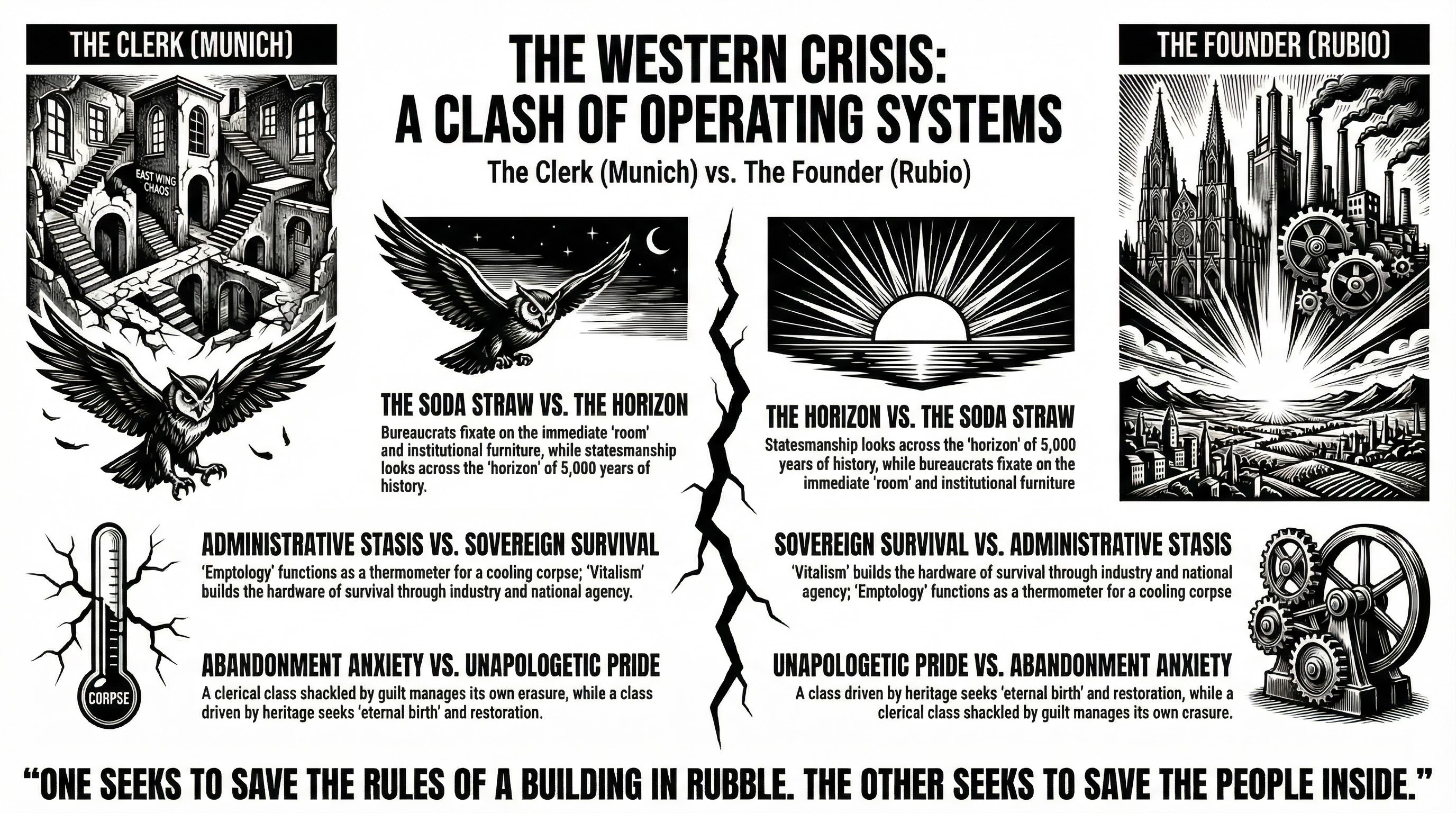
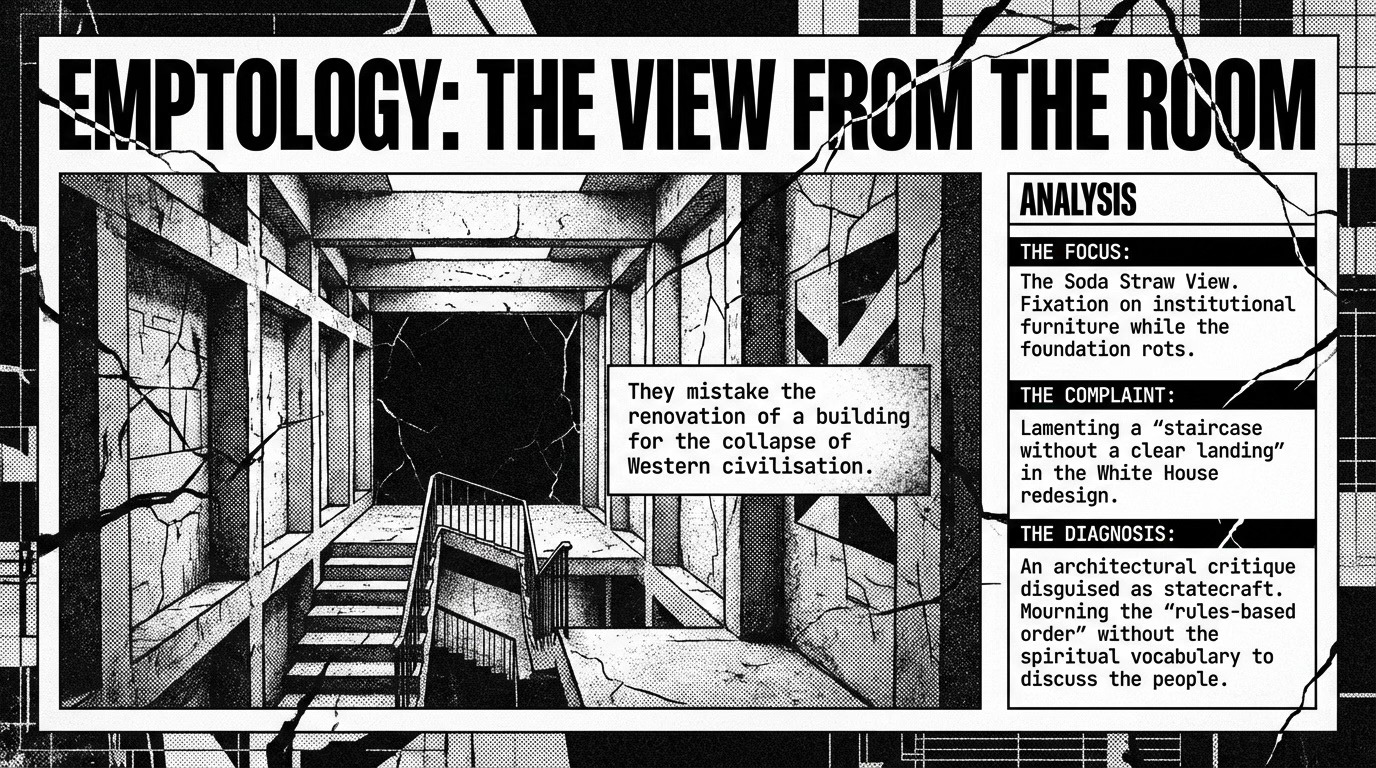
There is a peculiar species of fatuity on display in the latest dispatch from the München Security Conference—a lugubrious document that seems to mistake the renovation of a building for the collapse of Western civilisation. The authors, trapped in the amber of their own Emptology, offer us a pornography of despair, obsessing over the “wrecking ball” of reform because they lack the intellectual courage to inspect the rot in the foundation. They have produced not a strategy, but an architectural critique disguised as statecraft, wherein the aesthetic alignment of windows is treated with more gravity than the survival of the citizenry. One need look no further for proof of this vacuousness than the report’s opening salvo, where the authors attempt to elevate a complaint about a staircase into a theory of geopolitical decline:
“In October 2025, construction crews began demolishing significant parts of one of the world’s most iconic buildings: the White House. [...] For Trump’s critics, the project is likewise symbolic. They see it as a near-perfect metaphor for his assault on long-standing norms... Some noticed another Trumpian trademark in an early model of the new East Wing that featured colliding windows and a staircase without a clear landing. This, they say, is typical of Trump’s approach: tearing things down without having thought through a viable alternative.”
Against this hollow clerisy, it was bracing to hear a voice that cuts through the sterile cant of the seminar room to confront the bloody reality of history. Secretary Rubio, standing amidst the polite applause of the very people overseeing our managed decline, swept aside the shibboleths of the “rules-based order” to remind us of the only thing worth fighting for:
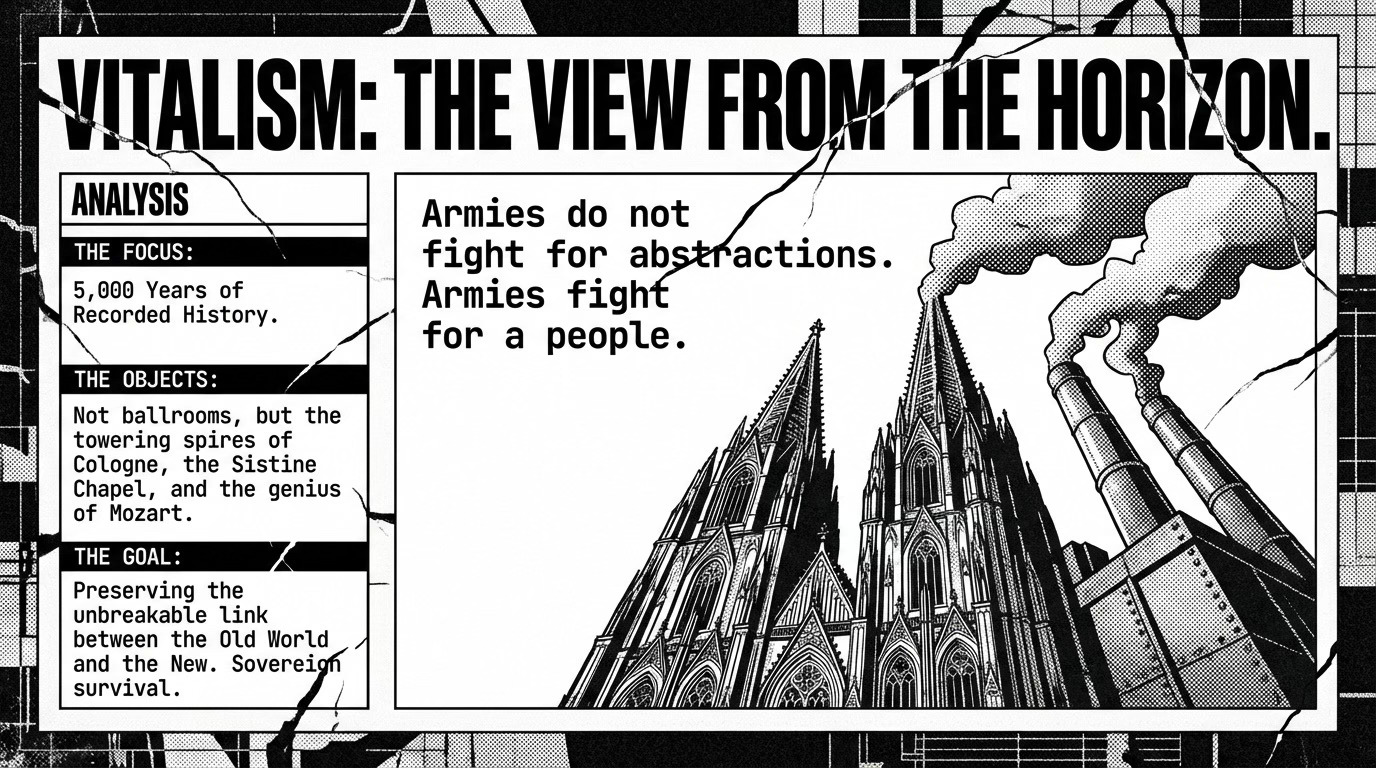
“The fundamental question we must answer at the outset is what exactly are we defending? Because armies do not fight for abstractions. Armies fight for a people. Armies fight for a nation. Armies fight for a way of life. And that is what we are defending. A great civilization that has every reason to be proud of its history, confident of its future, and aims to always be the master of its own economic and political destiny.”
The Room vs. The Horizon
The longevity of a civilisation is dictated by its spatial perception—the distance its ruling class is capable of seeing across both geography and time. When a leadership’s vision contracts, the civilisation enters its terminal phase. The current Western crisis is fundamentally a clash between a “managerial” class, obsessed with the immediate maintenance of its surroundings, and a “statesmanlike” vision that seeks historical continuity. This is the difference between those who manage objects and those who preserve the soul of a people.
The bureaucratic class, represented by Tobias Bunde and Sophie Eisentraut in the München Security Report (MSR), operates within a “soda straw” view of reality. Their analysis is a study in institutional fetishism: they fixate on the physical demolition of the “East Wing” of the White House and the loss of a “ballroom” as metaphors for their own displacement. To the clerk, the destruction of “sterile communiqués” and “predictable conferences” is a metaphysical catastrophe because they lack the spiritual vocabulary to discuss the foundation. They mourn the institutional furniture while the very bedrock of the West rots beneath them. They are caretakers of a renovation project, blind to the fact that the building has already been condemned by history.
In ruthless contrast, Secretary Marco Rubio employs a civilisational lens that transcends the narrow confines of the committee room. His vision is defined by the “horizon,” invoking “5,000 years of recorded human history.” Where the MSR sees the loss of a “ballroom,” Rubio sees the “towering spires” of the Cologne Cathedral, the “vaulted ceilings of the Sistine Chapel,” and the genius of “Mozart and Beethoven.” This is a shift from managing temporary diplomatic spaces to preserving the eternal. The statesman understands that a civilisation is not a set of offices in Washington or Brussels, but an “unbreakable link” between the Old World and the New, sustained by a “sacred inheritance” of faith and culture.
The strategic consequence of this divergent perception is profound. A leader obsessed with “ballrooms” is ontologically incapable of navigating the “great wide open” of a post-post-war disorder. When the walls of the institution begin to crumble, the bureaucrat is paralysed by the loss of the room; the statesman, however, finds clarity in the horizon. This is not a mere policy disagreement; it is the output of two fundamentally incompatible internal operating systems.
The Operating System: Emptology vs. Vitalism
The survival of a civilisation depends on its internal logic—whether it is driven by Administrative Stasis or Civilisational Vitalism. The former is a logic of managed decline; the latter is a logic of sovereign survival.
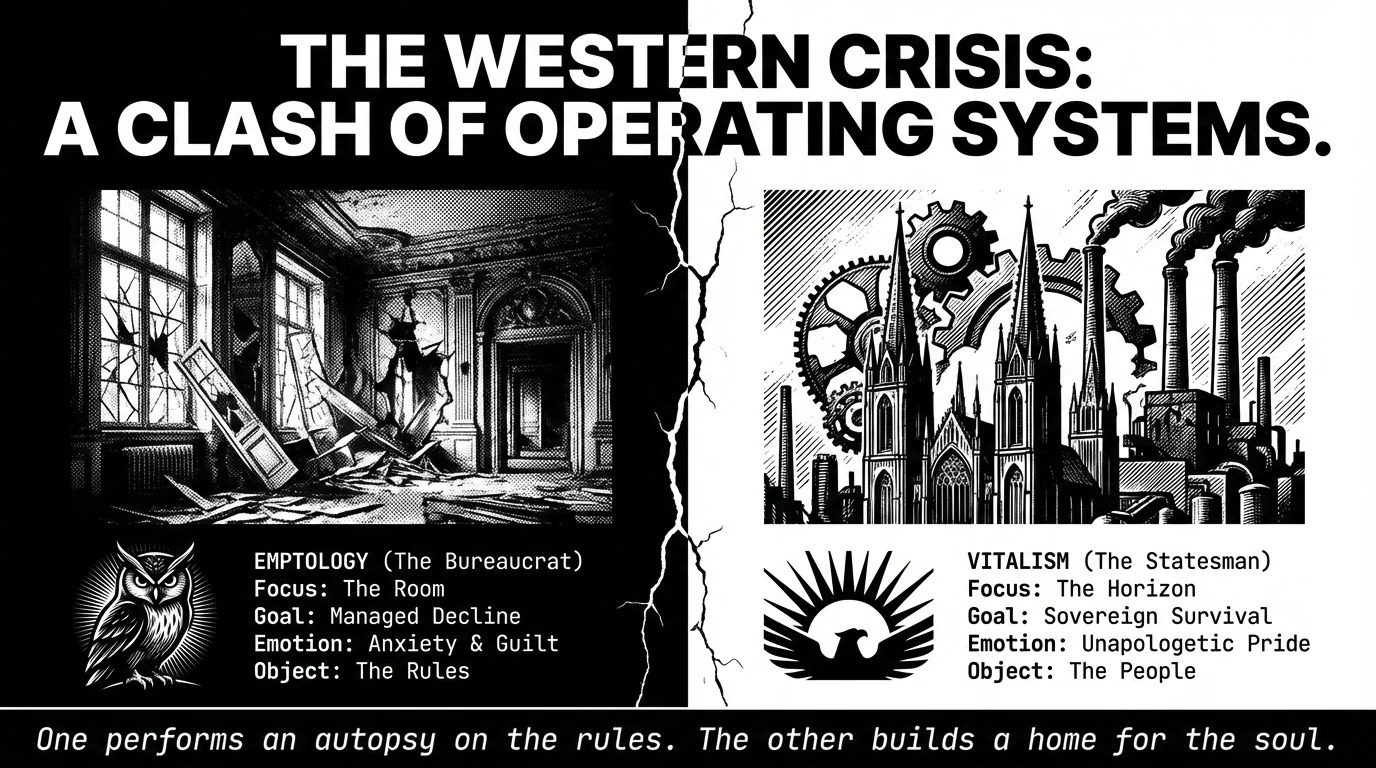
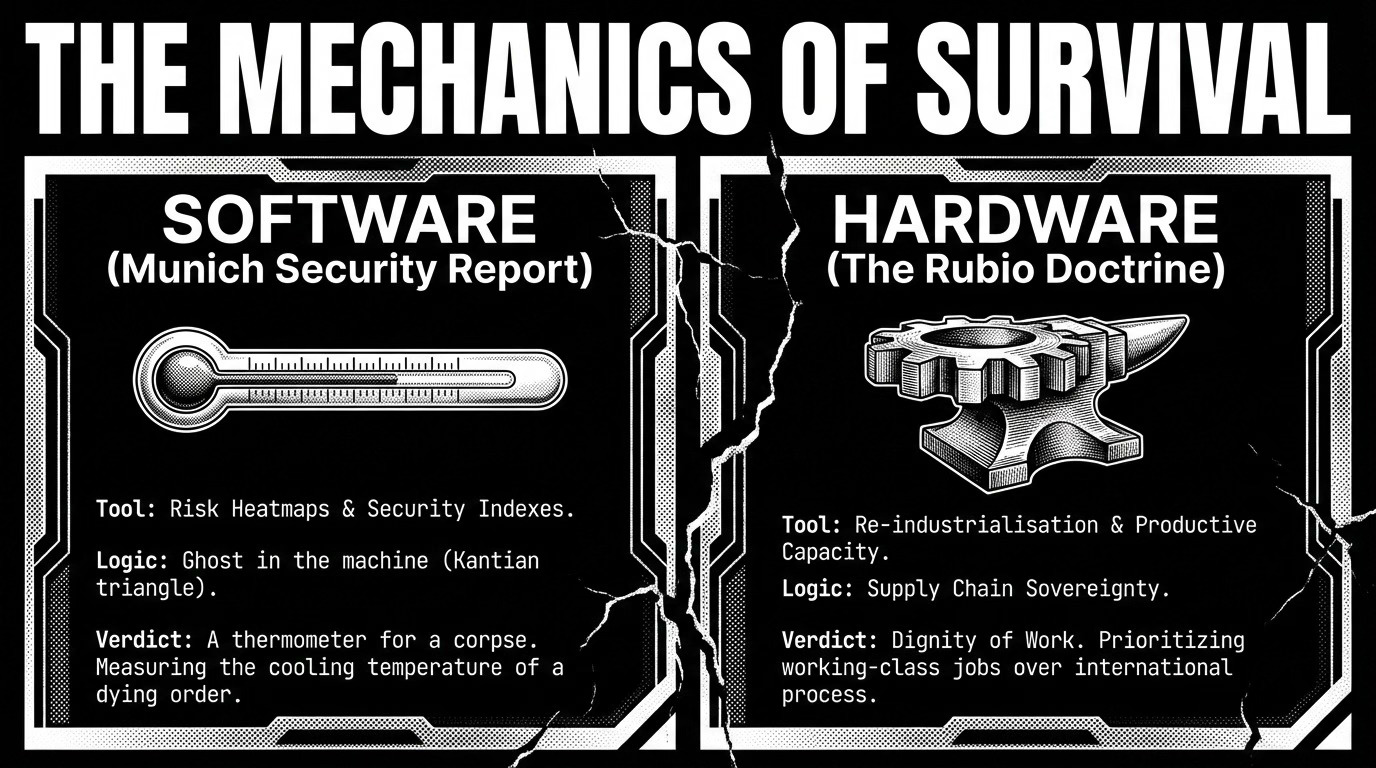
The MSR’s operating system is one of Emptology. It is a framework built on a ghost in the machine: the “rules-based global order” and the “Kantian triangle of peace.” These are hollowed-out geometries that no longer contain a living people. The MSR’s tools—the München “Security Index,” “Risk Heatmaps,” and metrics of “individual and collective helplessness”—are effectively a thermometer for a corpse. They measure the cooling temperature of a dying order but lack the vitalist heat to arrest the decline. The authors act as “polite and orderly caretakers,” performing a “terrified technician’s autopsy” on a West they can no longer animate.
Secretary Rubio proposes an alternative: Civilisational Vitalism. His operating system rejects the “dangerous delusion” of the “End of History,” dismissing the idea that commerce alone could replace nationhood as a “foolish idea.” Vitalism is concerned with the “hardware” of survival rather than the “software” of international process:
- Re-industrialisation: Reversing the “conscious policy choice” that stripped countries and continents of their productive capacity.
- Supply Chain Sovereignty: Ending the “voluntary transformation” that left the West “dangerously vulnerable to crisis.”
- The Dignity of Work: Prioritising the “working and middle-class jobs” that form the social fabric.
This is the restoration of national agency. While the MSR seeks to save the “rules” of a building that its own data suggests is “in rubble,” Rubio seeks to rebuild the “home” for its inhabitants. The strategic consequence is binary: one system seeks to preserve the “logic” of a failed organisation, while the other seeks to preserve the “life” of the state and its citizens.
Emotional State: Anxiety vs. Unapologetic Pride
Geopolitics is the shadow play of collective psychology. A civilisation’s “mood” dictates its willingness to exercise power. A class shackled by guilt will inevitably manage its own erasure, while a class driven by pride will seek renewal.
The bureaucratic class is currently defined by Abandonment Anxiety. The lexicon of the MSR is a catalog of psychological dread: “Death by a Thousand Cuts,” “Rubble,” and “Entombment.” Bunde and Eisentraut describe a West “shackled by guilt and shame,” where respondents feel a “pervasive loss of trust.” From a psychological perspective, the “Zerstörungslust” (lust for destruction) they observe in the public is the inevitable reaction to a sterile status quo that offers only fea. The bureaucrat views the “wrecking ball” with horror, yet they have produced the very malaise that makes the bulldozer look like a tool of liberation.
Rubio’s address serves as a “clarion call” against this “malaise of hopelessness.” He demands that the West be “unapologetic in our heritage.” By rejecting the “fear of climate change, fear of war, fear of technology,” he advocates for an alliance that “boldly races into the future.”
- Bureaucratic Fear: Rooted in “institutional inertia” and the belief that democratic structures are “overly bureaucratised.”
- Statesmanlike Courage: Rooted in the “unbreakable link” of Christian faith and the “sacred inheritance” of the West.
The impact on the competitive landscape is clear. “Zerstörungslust” is the natural response to a clerical class that offers nothing but a “managed decline.” Vitalism, however, offers “renewal and restoration.” Those who care more for the “rules” of the building than the “souls” of the inhabitants have already surrendered their right to lead.
The Final Verdict: The End of the Owl
History is currently transitioning from a class of “technocratic managers” to a class of “civilisational founders.” This marks the end of the “Owl of Minerva”—the figure who only gains wisdom at the dusk of an era.
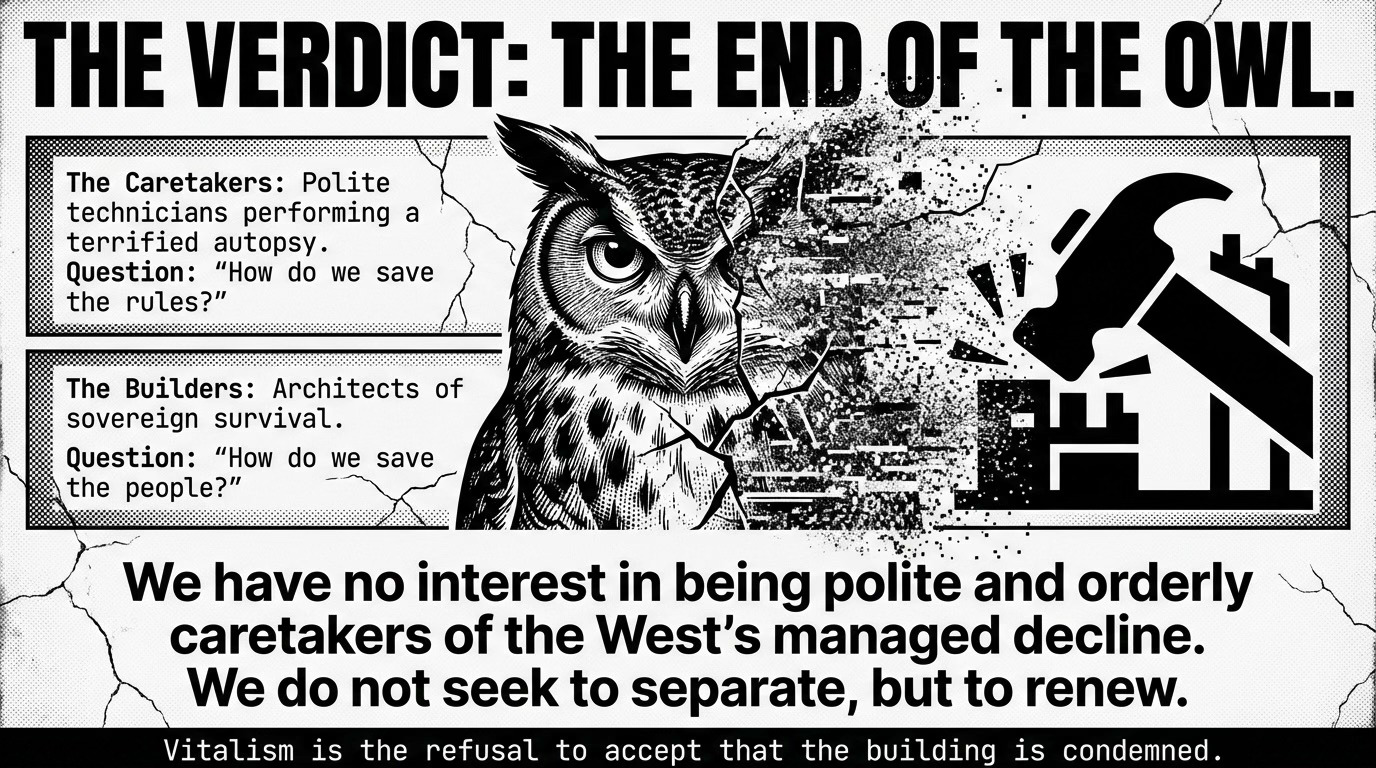
Bunde and Eisentraut are the “Owls.” They see the data; they record the “Index”; they map the “Heatmap.” Yet, they lack a theory of the soul. They blame the “wrecking ball” for the destruction of the order, failing to comprehend that the “rules-based” building was already condemned by its own “institutional inertia” and “unresponsive” nature. They are the “polite and orderly caretakers” of a civilisational erasure they have meticulously documented but are powerless to stop.
Secretary Rubio represents a class that prioritises “survival” and “sovereignty” over “diplomacy” as an end in itself. His vision is not of a manager maintaining a “rules-based order,” but of a builder who recognises that “decline was a choice” and refuses to make it.
“For we in America have no interest in being polite and orderly caretakers of the West’s managed decline. We do not seek to separate, but to revitalise an old friendship and renew the greatest civilisation in human history.”
The final verdict is ruthlessly simple. The München Security Report asks, “How do we save the rules?” while the Rubio address answers, “How do we save the people?” The MSR is an autopsy report; the Rubio address is a new foundational initiative of Vitalism. The MSR is the dying gasp of a class mourning a “ballroom” in a building they have already lost. The Statesman represents the “spirit of creation” necessary for a new Western century. While Tobias Bunde and Sophie Eisentraut are absorbed by the documentation of death on behalf of the München Security Class; Marco Rubio promises the labour to generate time and a new beginning, thus embodying “eternal birth,” on behalf of the Donroe Doctrine.

Sources:
Tobias Bunde and Sophie Eisentraut (eds.), Munich Security Report 2026: Under Destruction. Munich, Munich Security Conference, https://doi.org/10.47342/JWIE5806
Marco Rubio, 20260214, “Remarks at MSC 2026.” https://singjupost.com/transcript-marco-rubio-remarks-at-msc-2026/


