Victimhood for Sale: The Qatar–Brotherhood Machine Behind the “Islamophobia” Industry
30 January 2026
There are few frauds more profitable—or more intellectually lazy—than the modern habit of taking a serious issue and turning it into an all-purpose gag. “Islamophobia” began life as a clumsy label for genuine prejudice; it has since been refined into a fortified accusation whose real function is to terminate argument, discredit scrutiny, and rebrand due diligence as “stigmatisation.” The result is what is best described as Suicidal Empathy: a moral pose so debased that it induces liberal societies to dismantle their own defences with a self-congratulatory smile.
But to understand an influence operation you must stop treating it like a mood and start treating it like a machine. The earlier Software—the academic and linguistic contrivances that render critique indistinguishable from bigotry—supplies the code; the Hardware supplies the engine. This analysis moves from the conceptual to the operational: from the intellectual payload to the delivery vehicle—money, personnel, political cover, and the networks that convert a campus slogan into a geopolitical instrument.
Drawing primarily on the testimony of Qatari opposition leader Khalid al-Hail, the central contention is plain: the “Islamophobia” narrative is not merely an anti-rational meme incubated in Western academia, but (as alleged) a well-funded operation, directed and exploited by the Muslim Brothers and a state sponsor, Qatar. What follows is a report on its working parts—four pillars that give this weapon system its reach: a state-level assembly line, embedded human nodes in target societies, a shadow economy that bankrolls the enterprise, and a cognitive-warfare apparatus that launders the whole business into respectable opinion.
From Intellectual Construct to Geopolitical Operation
This analysis conducts a forensic investigation into the Hardware of the Islamophobia industry—the tangible geopolitical and financial machinery that powers it. While previous analysis deconstructed the Software of this operation—the intellectual and linguistic constructs forged by academics like Mattias Gardell and Emin Poljarević in Sweden—this article shifts focus to the physical infrastructure that gives these ideas their operational force. Drawing primarily from the testimony of Qatari opposition leader Khalid al-Hail, this investigation moves beyond the conceptual to examine the state-level sponsorship, financial architecture, and human networks that transform an idea into a global influence campaign.
At the core of thesis is to demonstrate how the intellectual constructs of the academic Software are deliberately engineered to be exploited by the state-sponsored Hardware. The “Islamophobia” narrative is not merely an anti-rational meme born in Western academia; it is a well-funded geopolitical operation, orchestrated by actors like the Muslim Brothers and the state of Qatar, designed to infiltrate, subvert, and financially exploit Western systems. This exercise will unmask this operation into its four primary pillars: the state-level assembly line, the human nodes embedded in target societies, the shadow economy that finances it, and the cognitive warfare machine that provides informational cover. We begin by examining the two distinct but interconnected assembly lines that produce and deploy this weapon system.
The Software vs. The Hardware: A Tale of Two Assembly Lines
To understand any modern influence operation, it is politically and socially essential to distinguish between its ideological framework—the Software—and its operational infrastructure—the Hardware. While the Software provides the ideological justification and disables the critical thinking of the target audience, the Hardware provides the funding, personnel, and political cover required to deploy it at scale. The former produces the ideological payload; the latter provides the delivery vehicle.
The Software: The Intellectual Assembly Line of Suicidal Empathy
As detailed in my previous analysis, “The Assembly Line of Suicidal Empathy,” the Software of the “Islamophobia” narrative is produced via a coherent, three-stage intellectual pipeline. This assembly line systematically converts a legitimate concern about bigotry into a weapon designed to terminate debate and disarm criticism.
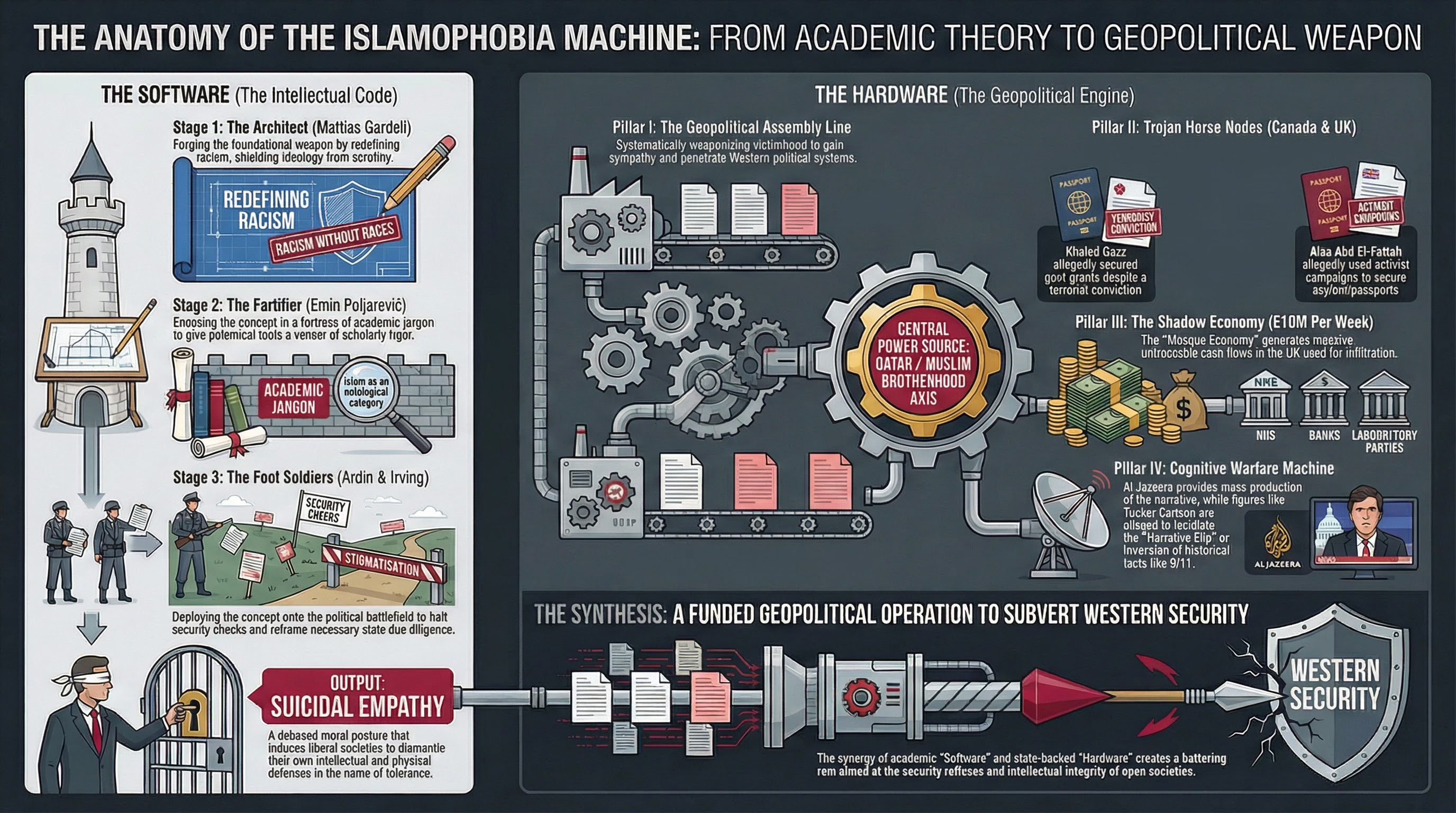
- Stage 1: The Architect (Mattias Gardell): This stage forges the foundational weapon by redefining “Islamophobia” as a “racism without races.” This profound category error is designed to conflate the critique of a set of ideas (a religion) with hatred of an immutable group identity (a people), thereby borrowing the moral weight of anti-racism to shield an ideology from scrutiny.
- Stage 2: The Fortifier (Emin Poljarević): This stage encases the crude weapon in a fortress of academic jargon. By introducing abstractions such as “Islam as an ontological category,” this stage gives the concept a veneer of intellectual rigour, making a polemical tool appear to be a scholarly edifice and shielding it from scrutiny by non-experts.
- Stage 3: The Foot Soldiers (Anna Ardin & Mattias Irving): This final stage deploys the weaponised concept onto the political battlefield. Activists and researchers use the fortified “Islamophobia” charge to invalidate legitimate state security inquiries, such as the Swedish Civil Contingencies Agency (MSB) report, by reframing necessary due diligence as “stigmatisation.”
The final product of this Software pipeline is Suicidal Empathy—a debased moral posture that compels liberal societies to wilfully dismantle their own intellectual and physical defences in the name of a misbegotten tolerance.
The Hardware: The Geopolitical Engine of the Infection
While the Software provides the code for the infection, the Hardware provides the engine to spread it. Khalid Al-Hail’s testimony frames the entire “Islamophobia project” as a geopolitical “scam” orchestrated by the Muslim Brothers and its state sponsor, Qatar. This Hardware is the state-backed machinery that recruits operatives, generates massive and untraceable funding streams, and provides the logistical capacity to weaponise the victimhood narrative created by the Software. It is the physical force that transforms an academic theory into a global geopolitical operation. The following sections provide a forensic analysis of this Hardware’s key operational pillars.
Pillar I: The Geopolitical Assembly Line
Identifying state sponsorship is the critical first step in neutralising any covert influence operation. This section investigates Khalid Al-Hail’s central allegation that the “Islamophobia Project” is not a grassroots movement but a geopolitical “scam” orchestrated by the Muslim Brothers with the full backing of the state of Qatar.
According to al-Hail, the Muslim Brothers—an organisation designated as terrorist in Egypt, Saudi Arabia, and the UAE—has systematically weaponised a victimhood narrative to advance its ideological agenda. For years, they have been “trying to describe themselves as a victims,” using this posture to gain sympathy, deflect scrutiny, and penetrate Western political systems. This strategy creates a protective shield, allowing the organization to operate under the guise of defending a persecuted minority.
al-Hail identifies the state of Qatar as the primary engine behind this operation, providing the financial resources, political cover, and propaganda arms necessary to amplify the Muslim Brothers’ claims on a global scale. This state-level sponsorship transforms a political tactic into a sustained, well-resourced campaign.
This creates a closed-loop market for ideological subversion. The Software’s concept of the “homeostasis of victimology” creates an intellectual demand for victim status within Western academic and activist circles. The Hardware of the Qatar/Muslim Brothers axis provides a ready supply of funded “victims” and narratives to satisfy that demand. The academic Software provides the moral justification for the victim narrative, while the state-sponsored Hardware provides the financial and political power to inject that narrative directly into Western institutions. We now turn from this high-level strategy to the individuals who serve as its operational nodes.
Pillar II: The Trojan Horse Nodes in Canada and the UK
Effective influence operations rely on embedding key individuals—Trojan Horse nodes or assets—within target countries to exploit legal and financial loopholes. These operatives serve to translate geopolitical objectives into domestic political action. The testimony of Khalid al-Hail provides two alleged case studies of this strategy: Khaled Gazz in Canada and ‘Ala’ Abd El-Fattah in the UK.
Case Studies in Western Infiltration
Operative & Location: Khaled Gazz (Canada)
Alleged Tactics and Objectives: Allegedly leveraged the “Islamophobia” project to secure official Canadian government funding for NGOs, despite being a convicted terrorist in Egypt and allegedly promoting hate against other groups.
Operative & Location: ‘Ala’ Abd El-Fattah (UK)
Alleged Tactics and Objectives: Allegedly leveraged a UK-based activist campaign to secure a British passport while outside the country, despite a history of calling for violence in Egypt and alleged influence from the Muslim Brotherhood.
These cases exemplify how the “Islamophobia” label is used to secure asylum, legal status, or direct government funding. The Software created by Gardell provides the exact linguistic and moral cover for this tactic. His “racism without races” construct allows an operative like Khaled Gazz to reframe himself from a “convicted terrorist” into a victim of persecution, thereby making him appear worthy of Canadian government funding.
This represents a direct hacking of the West’s Suicidal Empathy. The moral impulse to protect the vulnerable is financially and legally exploited by individuals allegedly tied to radical movements. They use the protective shield of “Islamophobia” to neutralize the state’s defensive mechanisms, turning the values of an open society into vulnerabilities to be targeted. The success of these individual nodes, however, depends on a much larger financial architecture.
Pillar III: The Shadow Economy
Covert operations are sustained by financial flows that operate beyond the visibility and control of state authorities. According to Khalid al-Hail, the “Islamophobia” project is underpinned by a massive and largely unmonitored shadow economy, which he terms the Mosque Economy. This financial Hardware provides the untraceable cash needed to fund political infiltration and other subversive activities.
al-Hail provides a specific calculation to illustrate the potential scale of this economy in the United Kingdom. As he states: “imagine you have 1,000 mosques... managed by same group... each mosque collect 10,000 pound of donation... it’s 10 million.” This calculation suggests a potential weekly cash flow of up to 10 million pounds, which is primarily cash-based, creating a vast pool of funds where the “government has no idea” where the money goes.
The longer-term implications of this alleged shadow economy are profound, enabling the systematic infiltration of key British institutions. The Software and Hardware function here as two sides of the same coercive coin. While the “Islamophobia” label provides the moral justification for silencing dissent, this shadow economy provides the coercive financial power to enforce that silence.
- Political Infiltration: al-Hail claims this money is used to gain influence within political parties, making a specific reference to the “Labor Party.” He further alleges that a direct threat from a Muslim Brothers’ spokesperson against Prime Minister David Cameron in 2015 successfully prevented the UK government from designating the group as a terrorist organisation, a clear example of this coercive power in action.
- Systemic Infiltration: Beyond politics, al-Hail asserts that the Muslim Brotherhood has successfully infiltrated core British institutions, including the “NHS system,” the “educational system,” and “banks.” This suggests a long-term strategy aimed at embedding operatives and influence across the foundational pillars of the state.
This shadow economy provides the raw financial power for the operation. The final pillar examines the Hardware used to shape the cognitive environment in which these operations take place.
Pillar IV: The Cognitive Warfare Machine
Modern geopolitical conflict is increasingly fought not on battlefields, but in the informational domain. Control over the narrative is paramount. Let us investigate Khalid al-Hail’s allegations regarding a Qatari-led influence operation designed to create a Hostile Informational Ecology in the West, flipping established narratives and sanitising designated extremist groups.
According to al-Hail, the state-funded media network al-Jazeera is a central component of this Cognitive Warfare Machine. He identifies it as the “mainstream national TV” for designated terrorist groups like Hamas and al-Qaeda. As a specific example of its function, he cites its allegedly deceptive coverage of the October 7th attacks, claiming the network portrayed the massacre as a targeted military operation against IDF soldiers, contrary to visual evidence of atrocities against civilians.
This operation extends beyond state-owned media to influencing key Western voices. al-Hail makes specific and direct allegations against the commentator Tucker Carlson, whom he calls a “pro-Qatar puppet.” He states that an investigation is “following money” related to Carlson and claims that the commentator has adopted the narrative that “the Jews was behind 9/11,” a complete inversion of the established facts of the attack.
These data points indicate a coordinated operational strategy. al-Jazeera functions as the industrial-scale mass-production of the victimhood narrative created by the Software. The alleged co-option of an influential voice like Carlson represents a final-stage delivery mechanism, successfully infiltrating that narrative into a target audience and effectively laundering a state-sponsored talking point into what appears to be organic, grassroots opinion.
A Funded Geopolitical Operation
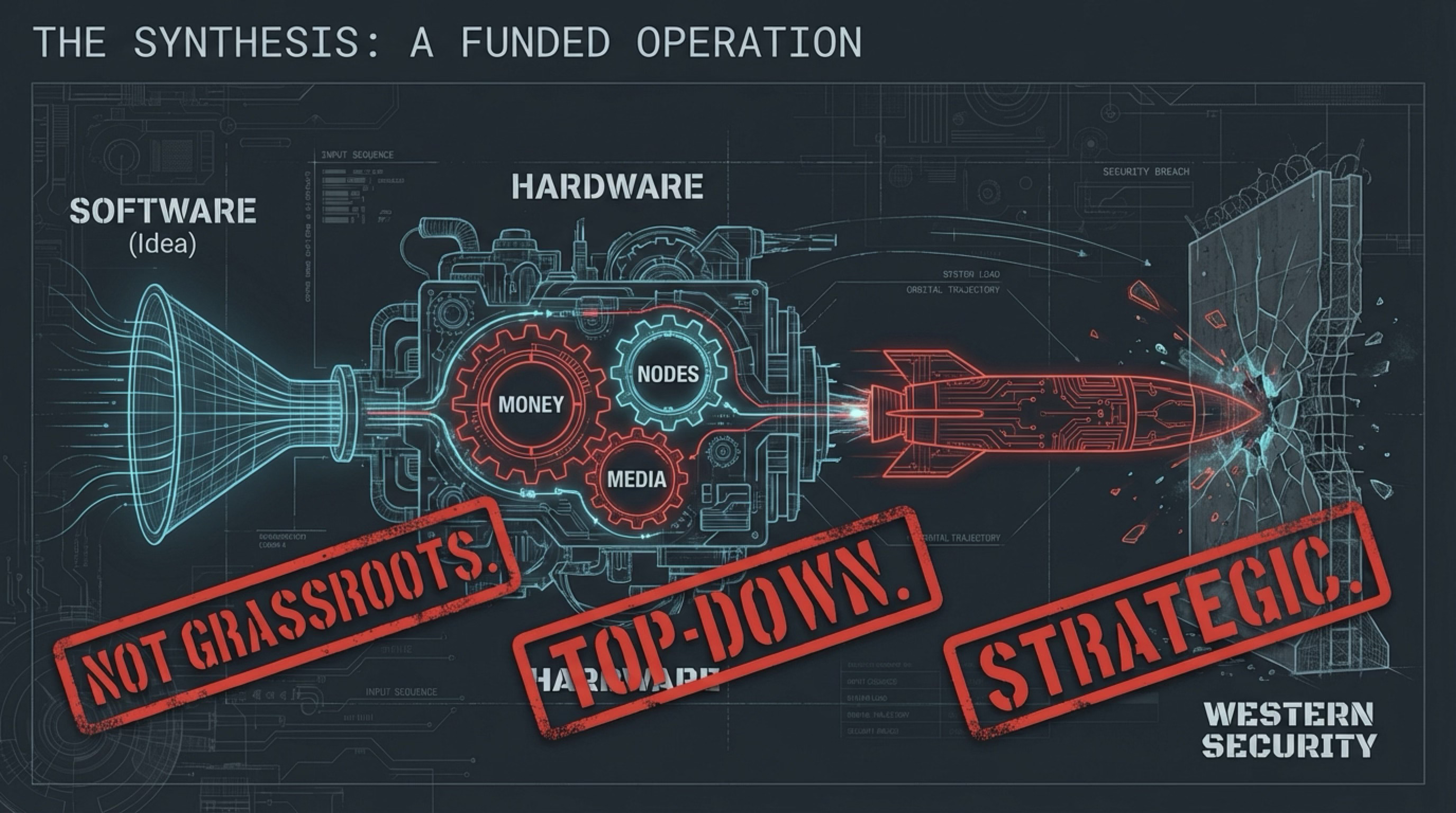
This analysis has moved beyond the theoretical to investigate the tangible machinery of an alleged global influence operation. The evidence presented from Khalid al-Hail’s testimony portrays the “Islamophobia” narrative not as a grassroots social phenomenon or an academic theory, but as a deliberate, top-down geopolitical campaign. The operation is built on four interconnected pillars that form its Hardware.
The Geopolitical Assembly Line, run by Qatar and the Muslim Brothers, sets the deliberate direction and weaponises victimhood. Trojan Horse Nodes, like the alleged cases of Gazz and Fattah, are embedded in Western countries to secure funding and legal status. A vast Shadow Economy, potentially generating up to £10 million per week in the UK alone, provides untraceable cash for systemic infiltration. Finally, a Cognitive Warfare Machine, allegedly leveraging assets like al-Jazeera and co-opting figures like Tucker Carlson, works to control the narrative and create a hostile informational environment.
Ultimately, this exercise demonstrates a clear division of labour between two assembly lines. The Software of the anti-rational meme, meticulously crafted in Western academia, is powered, funded, and directed by the Hardware of a sophisticated and hostile geopolitical actor. This synergy transforms what might have been a mere academic trend into a funded geopolitical operation aimed squarely at subverting the foundational security and intellectual integrity of Western societies.
In the end, the most dispiriting feature of this affair is not its ingenuity but its predictability. A society that trains itself to confuse offence with oppression will, sooner or later, be governed by those most skilled at manufacturing offence—and most ruthless in cashing the cheque. What is described here is not a spontaneous moral awakening but an alleged top-down campaign: an apparatus with strategy, operators, money flows, and a narrative engine—built on four linked pillars that make the “Islamophobia” label less a warning light than a battering ram.
The grim elegance is the division of labour. The academy supplies the pieties and the jargon—the Software that disables doubt—while a state-backed set of interests supplies the muscle, the funding, and the distribution network—the Hardware that scales it into politics, institutions, and media. And once those two assembly lines mesh, what might have remained a seminar-room affectation becomes something harder, meaner, and far more consequential: an operation aimed at subverting the security reflex and the intellectual integrity of open societies.
The choice, then, is not between “tolerance” and “bigotry,” as the slogan-merchants insist. It is between a liberalism that can still distinguish criticism from hatred—and a liberalism so besotted with its own virtue-signalling that it volunteers to be deceived, infiltrated, and finally governed by its most unscrupulous antagonists.