Trump’s Scalpel and Sledgehammer in the Cold War II Era
7 February 2026
The Return of Fear as Strategy
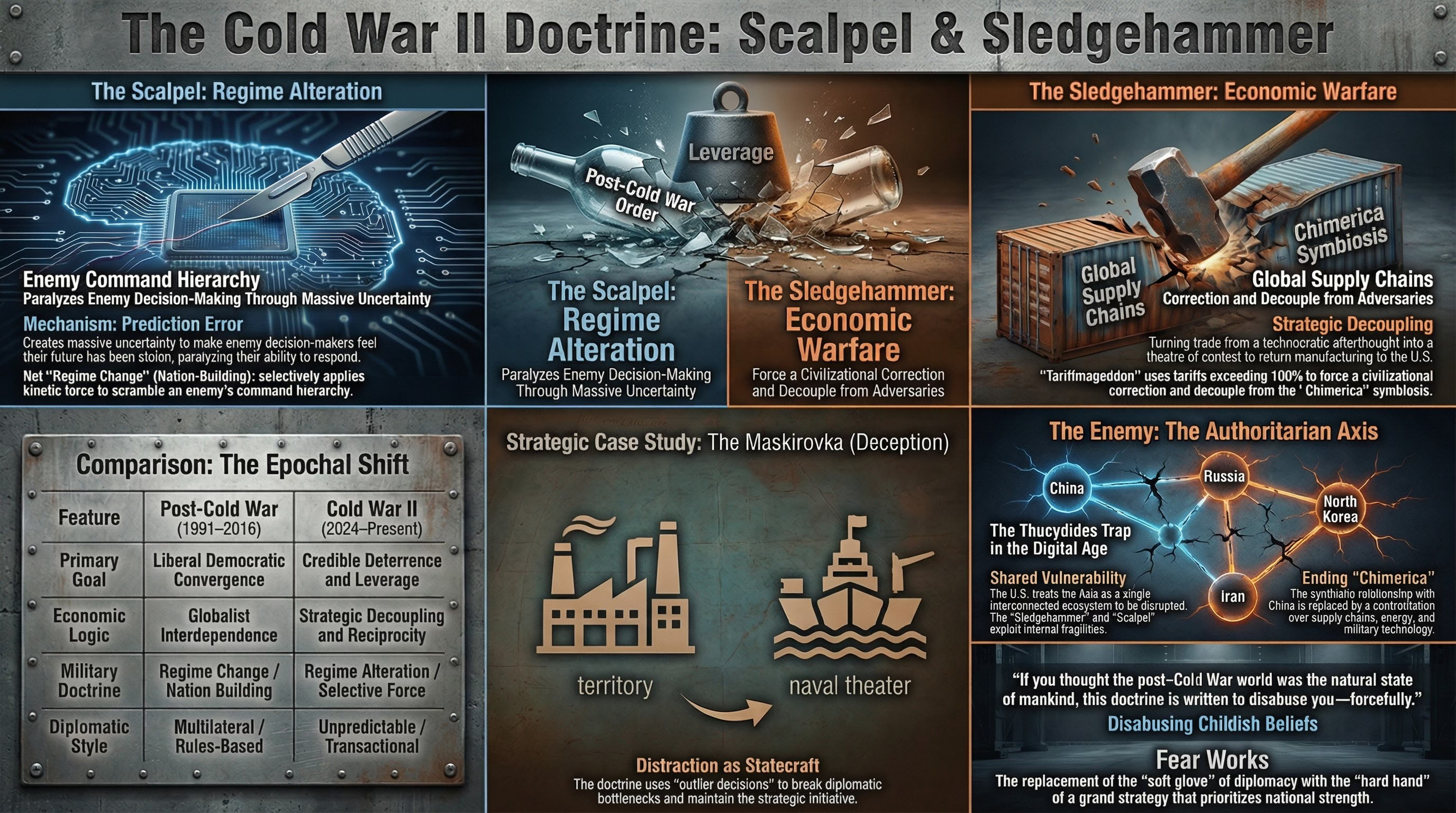
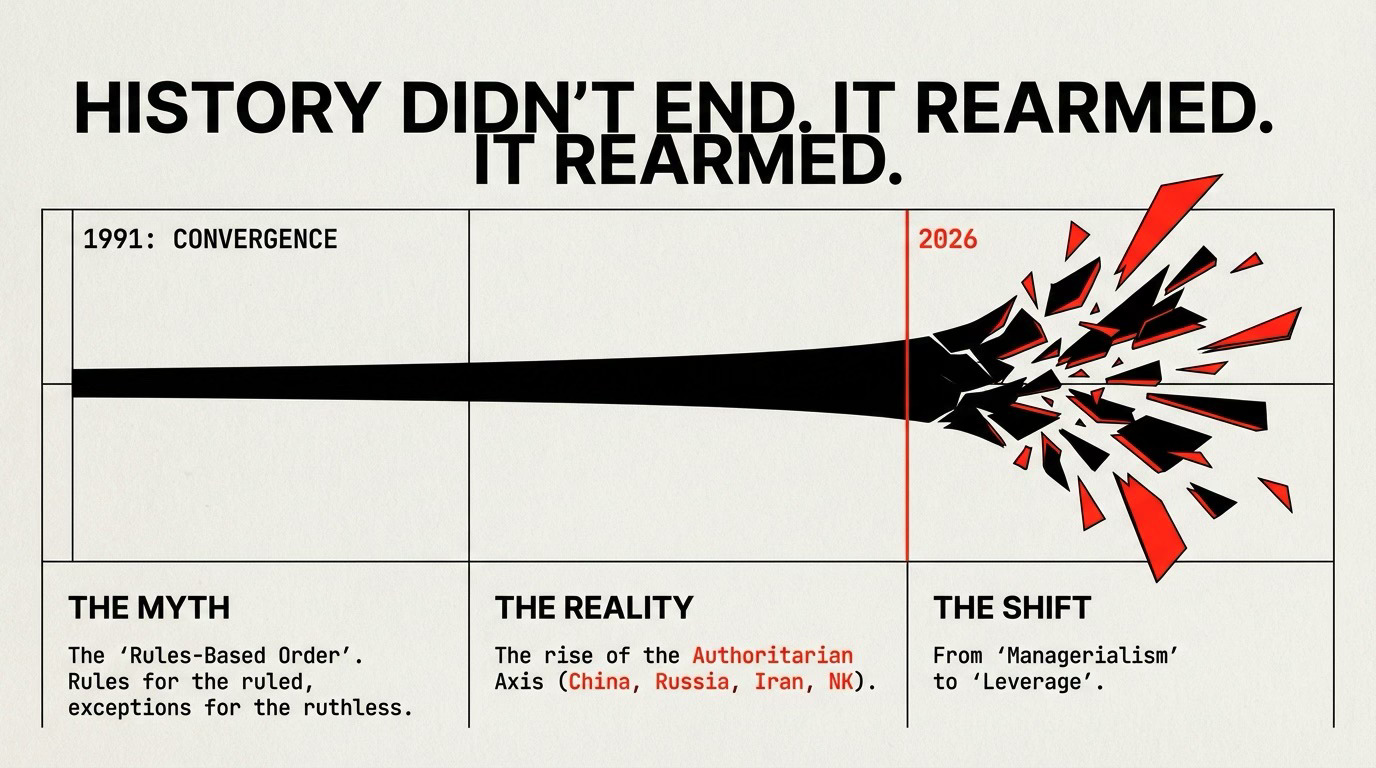
One of the more tiresome superstitions of our age is the notion that history ended in 1991 and that all who still speak its language must be either nostalgic, paranoid, or—worst of all—unfashionable. Yet the world has been busily disproving this complacency for years: institutions rot, empires relapse into appetite, and the polite fictions of “rules-based orders” turn out to be what they always were—rules for the ruled, exceptions for the ruthless. If we have entered what Niall Ferguson calls Cold War II, it is not because someone stamped a new label onto an old bottle, but because the bottle itself has shattered: the long sedative of post–Cold War managerialism has worn off, and the great powers are once again speaking in the ancient dialect of leverage, coercion, and fear.
This essay argues that the second Trump administration has not merely changed tone; it has changed doctrine. It has taken the lingering, self-protective inertia of the post-1991 era—the pieties about de-escalation, the fetish for process, the belief that multilateral procedure is a substitute for power—and discarded it in favour of something cruder, clearer, and far more consequential: deterrence as organising principle, and Regime Alteration as operating method. Not Regime Change—that expensive, sanctimonious, and usually incompetent business of breaking states and pretending to rebuild them—but a colder proposition: selectively applying kinetic force, economic pressure, and strategic unpredictability to produce a shock so disorienting that an adversary’s hierarchy begins to misfire, hesitate, and fracture under the weight of its own uncertainty.
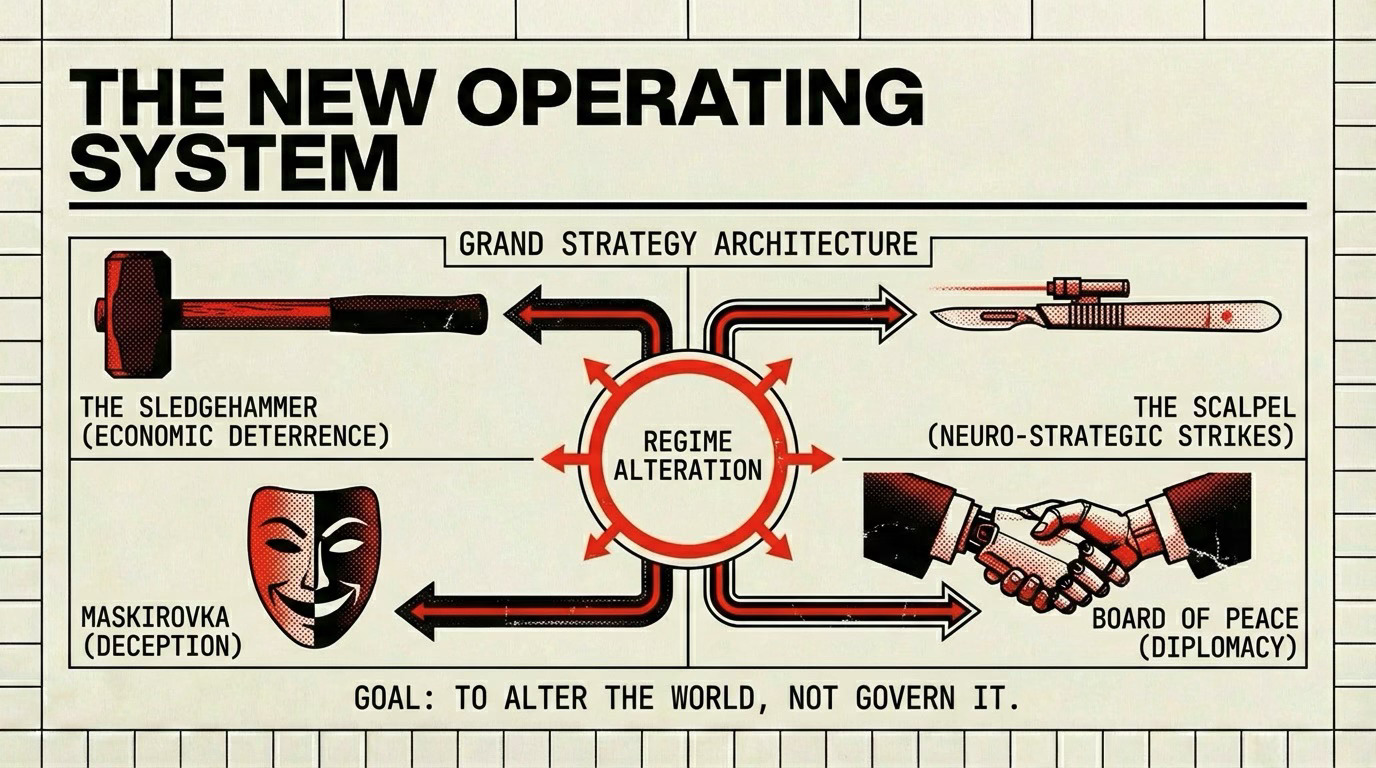
Here’s my central metaphor, as revealing as it is unsettling: a Scalpel and a Sledgehammer. The Scalpel is not “surgical” in the humanitarian sense so beloved of think-tank prose; it is surgical in the neurological sense—designed to create a massive “prediction error” in the enemy’s command apparatus, to scramble reporting lines, and to make decision-makers feel, in their bones, that the future has been stolen from them. The Sledgehammer, meanwhile, is the great blunt instrument of tariffs, decoupling, and enforced reciprocity—an unapologetic attempt to turn trade from a technocratic afterthought into a theatre of civilisational contest.
The significance of this argument is that it treats the familiar headlines not as random eruptions of a volatile personality, but as parts of a coherent architecture. Iran is not a “file” to be managed, but a regime to be terrified into constraint—or into collapse—because the old romance about an imminent internal revolution has become an alibi for paralysis. Europe is not a partner in the old sense, but an increasingly sentimental spectator—baited, distracted, and exposed by diversions like the Greenland gambit, which is read here not as farce but as Maskirovka: deception as statecraft, distraction as operating space. And China is no longer the indispensable stakeholder of the Chimerica fantasy, but the central node of an Authoritarian Axis whose cohesion is tested whenever the Scalpel flashes or the Sledgehammer falls.
You may dislike the doctrine described in these paragraphs; you may even fear it. But you cannot honestly call it accidental. The claim advanced here is bracing precisely because it refuses the consolations of “miscommunication” and “misperception.” It insists that we are watching the deliberate replacement of the soft glove with the hard hand: a grand strategy that wagers—explicitly—that fear still works, that unpredictability still intimidates, and that the age of polite constraint has given way to the violent hours of a new contest for the world’s bottlenecks, supply chains, and loyalties. In short: if you thought the post–Cold War world was the natural state of mankind, this essay is written to disabuse you—forcefully—of that childish belief.
Cold War II
The transition into the second year of the second Trump administration has crystallised a fundamental transformation in American grand strategy, moving decisively away from the institutional inertia of the post-Cold War era toward a framework that historian Niall Ferguson identifies as the hallmark of Cold War II. This evolution is not merely a tactical shift but a profound realignment that prioritises deterrence over de-escalation and replaces the idealistic pursuit of the “Liberal International Order” with a realist, high-leverage doctrine of Regime Alteration. At the center of this strategic architecture lies a Scalpel—a concept that distinguishes itself from the blunt instrument of Regime Change by employing selective kinetic force, strategic unpredictability, and systemic economic pressure to modify the behaviour and internal stability of of adversarial states. This aligns precisely with the framework I established in “The Neuro-Strategic Scalpel”: the goal is not merely kinetic damage, but the generation of a massive Prediction Error that paralyses the adversary’s decision-making hierarchy.
The Fergusonian perspective suggests that the global community has moved past the “End of History” and entered a period defined by the disintegration of Chimerica—the symbiotic relationship between the United States and China—and the emergence of a formidable Authoritarian Axis comprising China, Russia, Iran, and North Korea. Within this this context, the traditional mechanisms of diplomacy, once anchored in multilateral institutions and “rules-based” norms, are viewed as obsolete or, worse, as tools of entrapment used by adversaries to neutralise American power. The second Trump term has consequently operationalised a Scalpel and Sledgehammer approach: the Scalpel representing surgical diplomatic and military interventions, and the Sledgehammer representing the massive application of economic tariffs and decoupling strategies intended to force a systemic “correction.”
The Historical Genesis of Cold War II
The current geopolitical friction is not an isolated phenomenon but the result of long-term historical processes that Ferguson has characterised as the Great Degeneration of Western institutions and the inevitable friction of a Thucydides Trap occurring in the digital age. The transition from Cold War I to Cold War II is marked by a shift from ideological bipolarity to a networked struggle for technological and financial supremacy. Unlike the first Cold War, which saw two segregated economic blocs, Cold War II began with deeply integrated economies that are now undergoing a painful and disruptive “divorce.”
The populist Trump-backlash of 2016, which culminated in the current administration’s return to power, was a necessary correction to decades of “excessive levels of off-shoring, overseas investment, and mass migration” that hollowed out the American industrial base and weakened its social cohesion. This historical context is vital to understanding why the current administration treats trade policy not as a subset of economics, but as a primary front in a civilisational struggle for fairness and American survival. The rejection of “globalist economics” is framed as a matter of social justice for the American workers, whose interests were discarded by the “D.C. uniparty” in favor of Wall Street gains.
Comparative Framework of Strategic Epochs
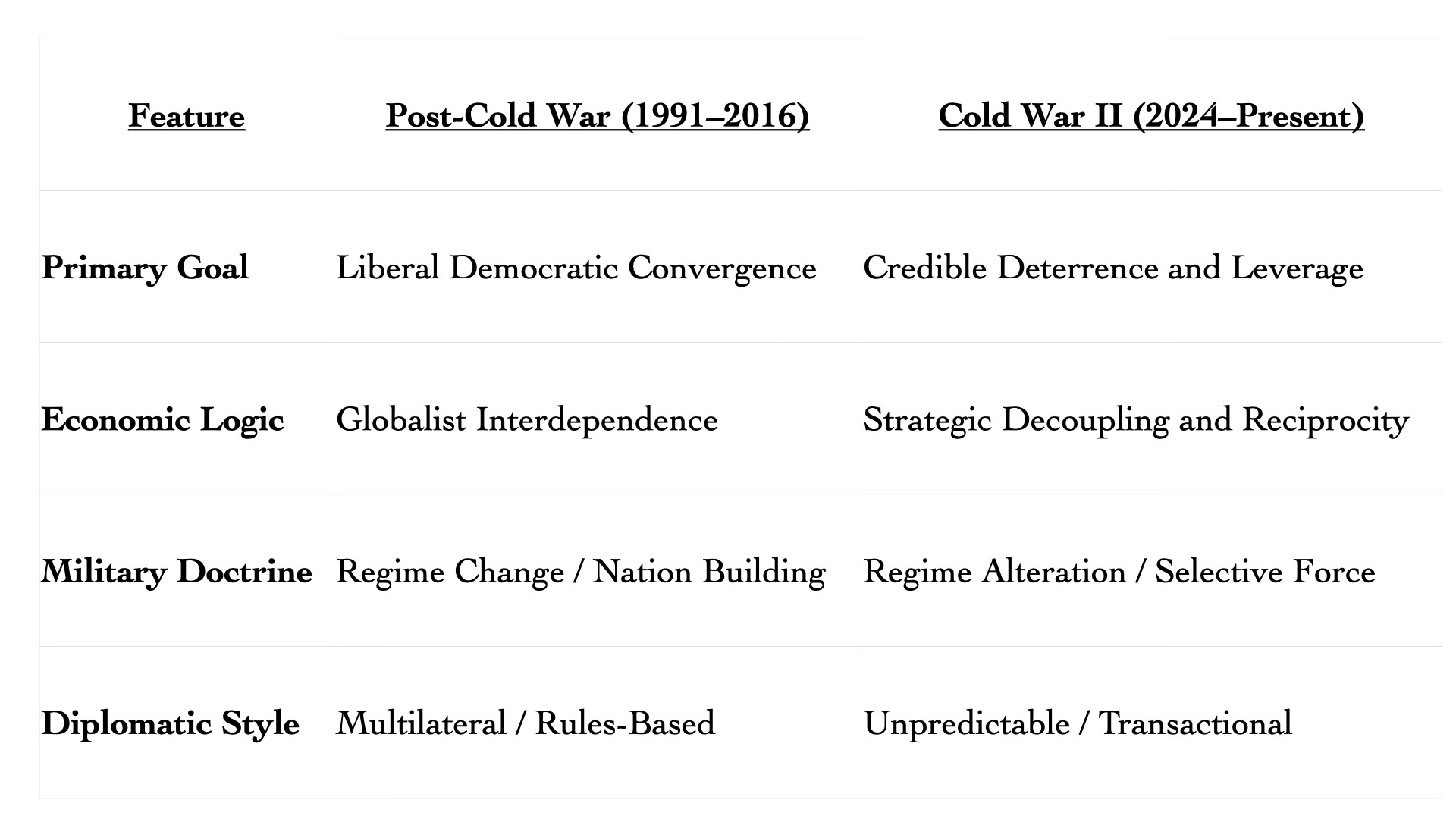
The shift toward Cold War II also necessitates a rethinking of alliances. We need to note that Europe’s persistent “weakness” and its tendency to “take the bait” of American distractions—such as the Greenland manoeuvre—reveal a continent still wedded to the outdated Davos mindset. While the U.S. has moved toward a “prime ministerial” model of leadership that integrates economic and military leverage, Europe remains bogged down in a “stuttering farewell to arms,” unable to reconcile its welfare-state ambitions with the harsh requirements of 21st-century power politics.
The Doctrine of Regime Alteration
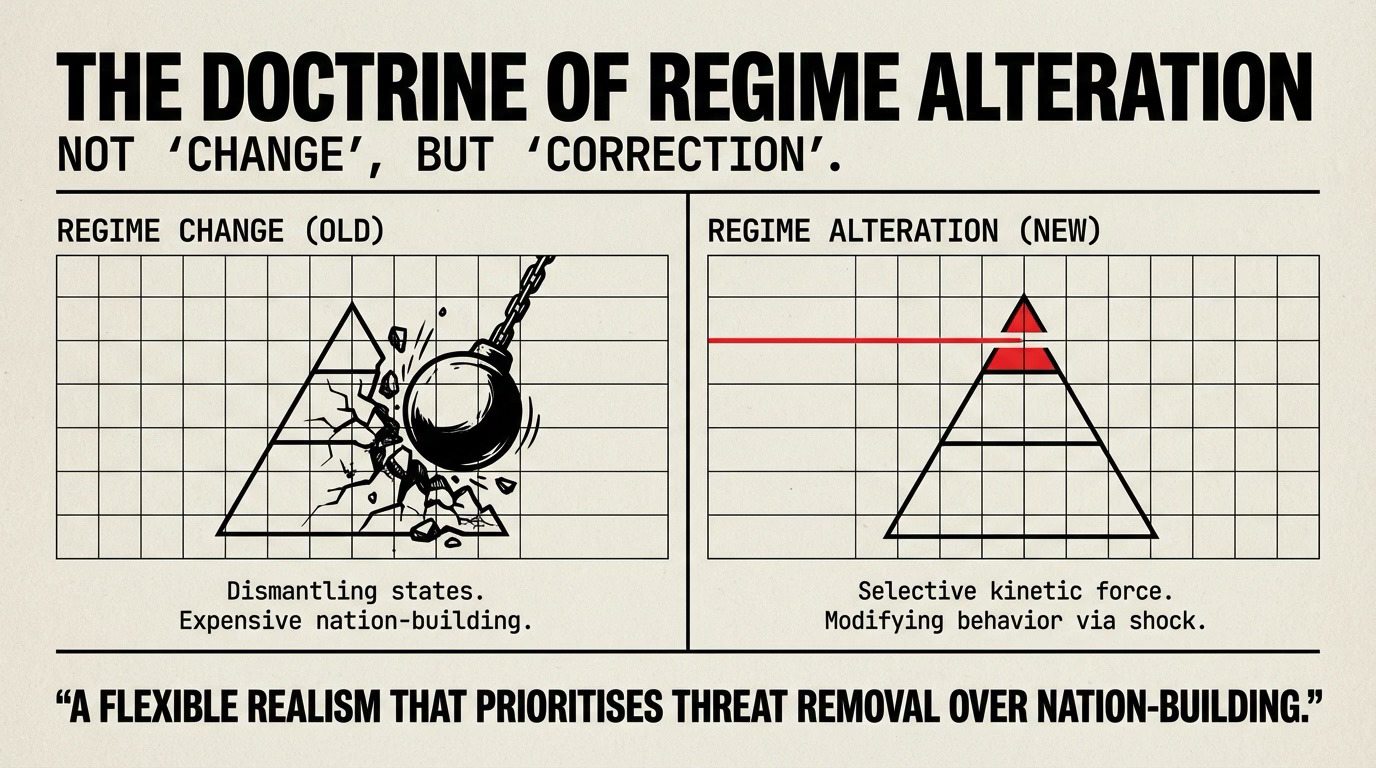
The most significant conceptual innovation of the Ferguson framework is the transition from Regime Change to Regime Alteration. Traditional Regime Change, as witnessed in the early 2000s, sought the total dismantling of hostile governments and the imposition of democratic structures—a process prohibitively expensive and fundamentally flawed. Regime Alteration, by contrast, is an exercise in “selective force” and “leverage” designed to change a regime’s external behaviour and internal reporting lines without necessarily committing to the burden of state-building. As I argued in “Operation Venezuela: The Doctrine Removes Its Gloves,” this is the operationalisation of the Trump Corollary: a flexible realism that prioritises threat removal over nation-building.
This strategy operates on the premise that fear works. In authoritarian contexts like Iran or Venezuela, internal protests often fail to achieve revolutionary change because the state apparatus retains a monopoly on violence and maintains control through terror. For a “counter-revolution” to succeed, there must be a credible external threat that disrupts the regime’s command-and-control structures and signals to the population—and the military—that the current leadership’s tenure is no longer sustainable. This is the Scalpel:
a surgical strike on the regime’s “death warrant” rather than a sledgehammer blow to the entire nation’s fabric.
Components of the Regime Alteration Strategy
The execution of Regime Alteration requires a sophisticated blend of psychological, economic, and kinetic tools. The goal is to keep the adversary in a state of perpetual anxiety, never knowing where the next blow will land or what the endgame entails.
- Kinetic Timing and Targets: Unlike the predictable deployments of the past, the current doctrine uses “strike timing” to maximise psychological impact and disrupt specific “reporting lines” within an adversary’s military hierarchy.
- Reporting Line Shifts: By targeting the specific individuals or nodes that connect a regime to its proxy networks, the U.S. can “alter” the regime’s regional reach without a full-scale invasion.
- Strategic Unpredictability: The administration uses “leverage and unpredictability” across disparate theatres—from the Persian Gulf to Greenland—to ensure that adversaries cannot coordinate a unified response.
- The Authoritarian Axis Context: Regime Alteration is specifically tailored to confront the Authoritarian Axis, recognising that these regimes are interconnected. A strike against Iranian interests, for example, is also a message to Beijing and Moscow regarding the limits of their support for regional destabilisation.,
This approach allows the U.S. to connect the dots between regional deterrence logic and global great power competition. It recognises that in a world of networks and hierarchies, the most efficient way to neutralise a threat is to disrupt the “Square and the Tower”—the social networks and political hierarchies that sustain power in the 21st century.
Economic Sledgehammer
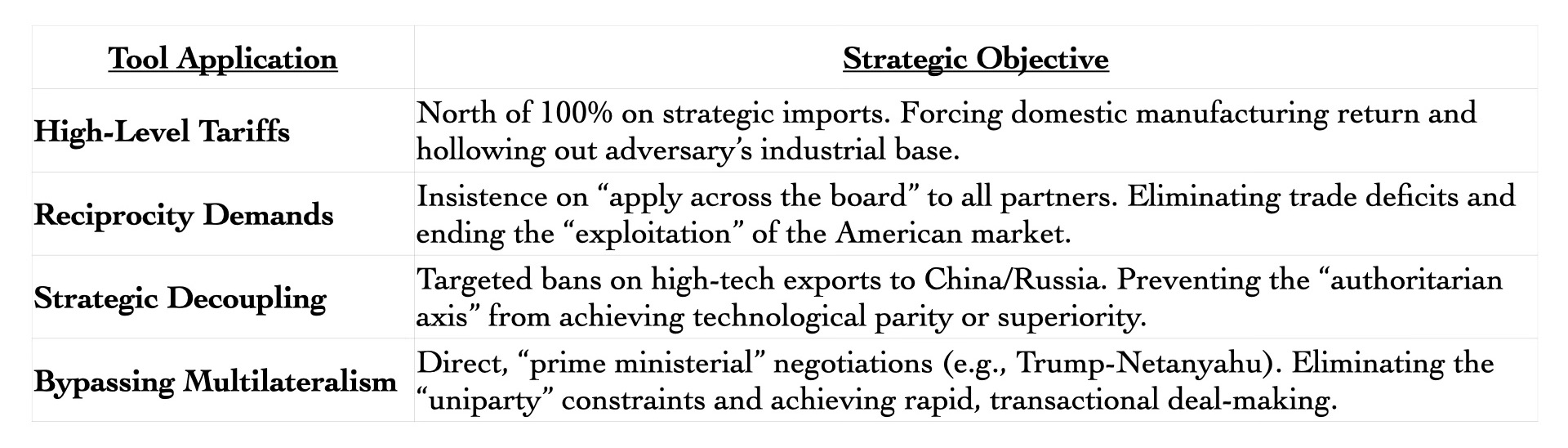
Parallel to the kinetic Scalpel is the economic Sledgehammer, most visibly manifested in the administration’s “tariff crusade”. Niall Ferguson has dubbed this phenomenon Tariffmageddon, a policy that uses massive, across-the-board tariffs—often exceeding 100%—to force a radical restructuring of global trade. While critics in the “chattering classes” view these tariffs as self-defeating or economically illiterate, the Fergusonian analysis reveals them to be a sophisticated tool of national strategy and social justice.
The Sledgehammer is rooted in the conviction that the globalist economics of the 1990s and 2000s were a disaster for American workers and communities. The off-shoring of manufacturing and the erosion of strategic industries were not just economic trends; they had “national security implications” that left the U.S. vulnerable to its enemies. Therefore, the current trade war is not aimed solely at wealth creation, but at “fairness for an America that has often been exploited and robbed blind by allies and enemies alike.”
Secretary Lutnick has provided the definitive forensic accounting for why this Sledgehammer is required. The adversary’s economy is not market-based; it is a weaponised system where local Chinese governments subsidise overproduction to the point where companies operate at a loss—cutting prices by 34%—specifically to crush foreign competition. As Lutnick notes, “internal fighting produces external power,” allowing them to dump EVs and minerals at prices designed to destroy Western industrial capacity. The Sledgehammer is not “protectionism” in the abstract; it is a kinetic response to a deliberate strategy of economic asphyxiation.
Furthermore, the administration has evolved beyond simple tariffs to create Antifragility structures for the private sector. Lutnick revealed the creation of a “critical mineral stockpile... for business,” ensuring that if an adversary attempts to weaponise a choke point—as they did with gallium or germanium—the U.S. government can flood the market to support domestic industry. This removes the geopolitical “risk premium” from American manufacturing, effectively neutralising the adversary’s ability to use supply chains as leverage.
This economic policy has turned the US President into a “prime ministerial figure,” one who personally manages the “game of chicken” with other superpowers. Whether it is the trade war with China or negotiations with “America’s trading partners,” the goal is to make them “squirm” until they concede to American concerns. This is a “matter of social justice” that aligns the interests of the American working class with the broader goals of Cold War II.
The Mechanics of Economic Deterrence
Iran and the End of De-escalation
Nowhere is the Ferguson framework better understood than in the Middle East, specifically regarding Iran. It has been clear for years not that the “myth of revolution” in Iran has led to decades of failed Western policy, as leaders waited for a domestic uprising that never came. The reality is that the Iranian regime is a master of using fear to maintain control, and it will not collapse without a “foreign intervention” that fundamentally alters its capacity to govern.
The shift from the JCPOA-era “de-escalation” to the current “deterrence” model is absolute. The Trump administration has moved beyond superficial “maximum pressure” to a strategy where Iranian Supreme Leader Khamenei has “signed his own death warrant” through his regional provocations. The “timing, targets, and endgame” of recent military actions are designed not just to retaliate, but to demonstrate that the U.S. can and will dismantle the regime’s power centers at will. Unlike the crumbling Soviet satellites, the Iranian regime is willing to slaughter its citizens at a speed and scale that renders internal collapse through peaceful protest nearly impossible. This grim reality confirms the “Arsonist’s Gambit” I identified in “The Hammer and the Horizon: Khamenei’s Uhud Algorithm in the Shadow of the Armada”: Khamenei has proven he is an Infinite Player willing to burn the “house” of his own population to preserve the “flame” of his ideology.
Steve Witkoff and the Board of Peace
A critical element of this strategy is the appointment of Steve Witkoff as the special envoy to the Middle East. Witkoff, described as a “notorious friend of Qatar” and a key figure in the administration’s Board of Peace, represents the “prime ministerial” and transactional nature of the new diplomacy. Unlike traditional State Department careerists, Witkoff approaches the Iran nuclear program and regional conflicts through the lens of a deal-maker looking for reciprocity.
The Board of Peace logic suggests that “pragmatic forms of cooperation” can emerge even amidst polarisation, provided that the U.S. maintains its deterrent posture. This involves:
- Strengthening the Abrahamic alliances while simultaneously applying the Scalpel to Iranian proxies. Regional Deterrence Logic.
- Using leverage with Riyadh to ensure regional stability while isolating Tehran. Saudi Pressure.
- Managing the “mediations” of leaders like Erdoğan to prevent the Authoritarian Axis from forming a solid front in the Middle East. Mediator Ambitions.
Ferguson emphasises that this is a “game of chicken” where the U.S. has shown a willingness to escalate to “eye-watering levels” to ensure that adversaries are the ones who “blink or swerve.” The goal is a regional deterrence logic that no longer relies on the goodwill of the Iranian regime but on its absolute certainty of catastrophic consequences for defiance.
The Greenland Maskirovka
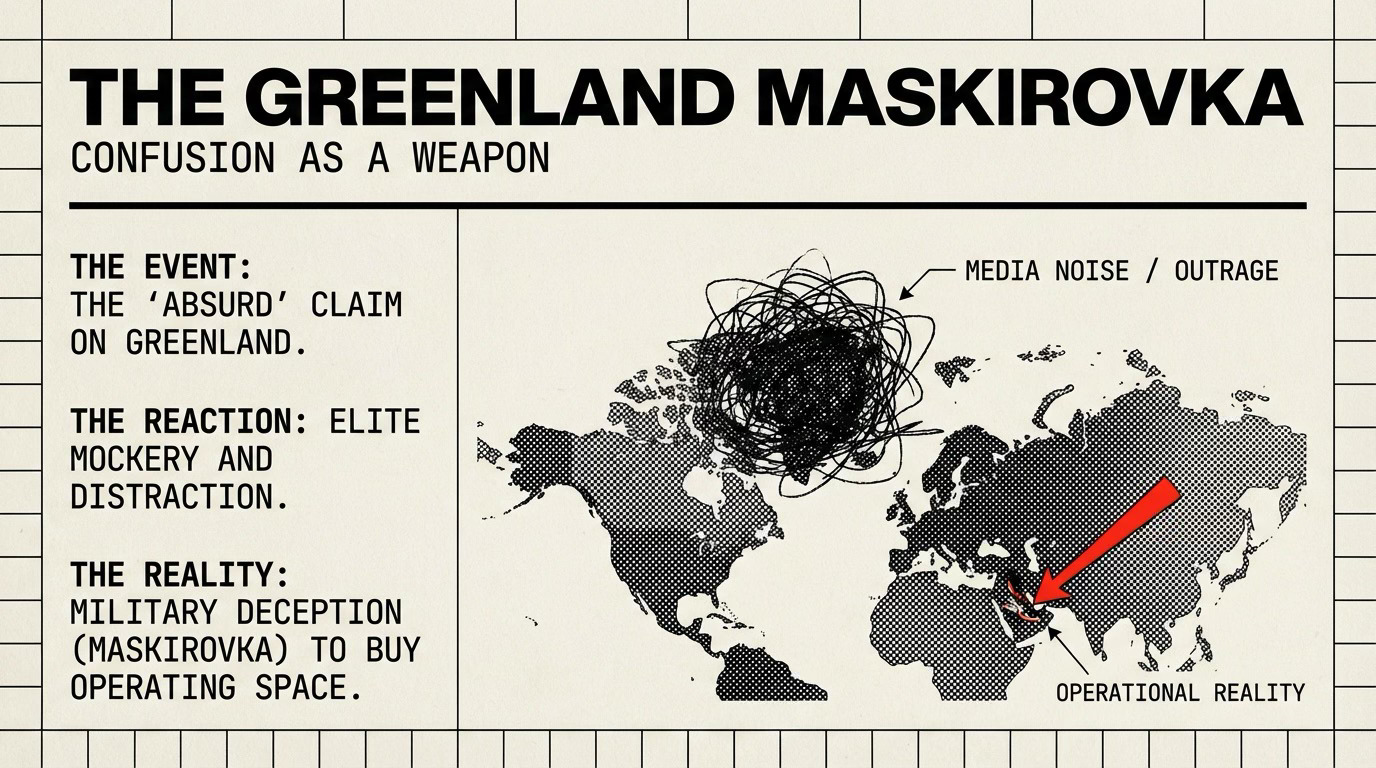
One of the most profound insights Ferguson provides into the Trump Doctrine (Year 2, Term 2) is the interpretation of the Greenland distraction. To the mainstream media, the American claim on Greenland appeared to be an erratic or nonsensical territorial whim. However, Ferguson identifies it as a sophisticated Maskirovka—a Russian term for military deception—carefully calculated to serve specific geopolitical objectives.
The claim on Greenland was designed to cause the heads of European leaders to explode and distract them from more pressing American manoeuvres in the Middle East and East Asia. In “The Easy Way or the Hard Way: Greenland and the Consolidation of Fortress America,” I classified this as the “Art of the Un-War.” Ferguson’s diagnosis of Maskirovka validates that assessment: the Greenland ultimatum was a classic Sun Tzu tactic of formlessness designed to disorient the opponent. By forcing the Europeans to spend a week reacting to a seemingly absurd North Atlantic territorial issue, the Trump administration ensured that they did not spend that same week saying “please de-escalate in the Middle East.”
Strategic Utility of the Maskirovka
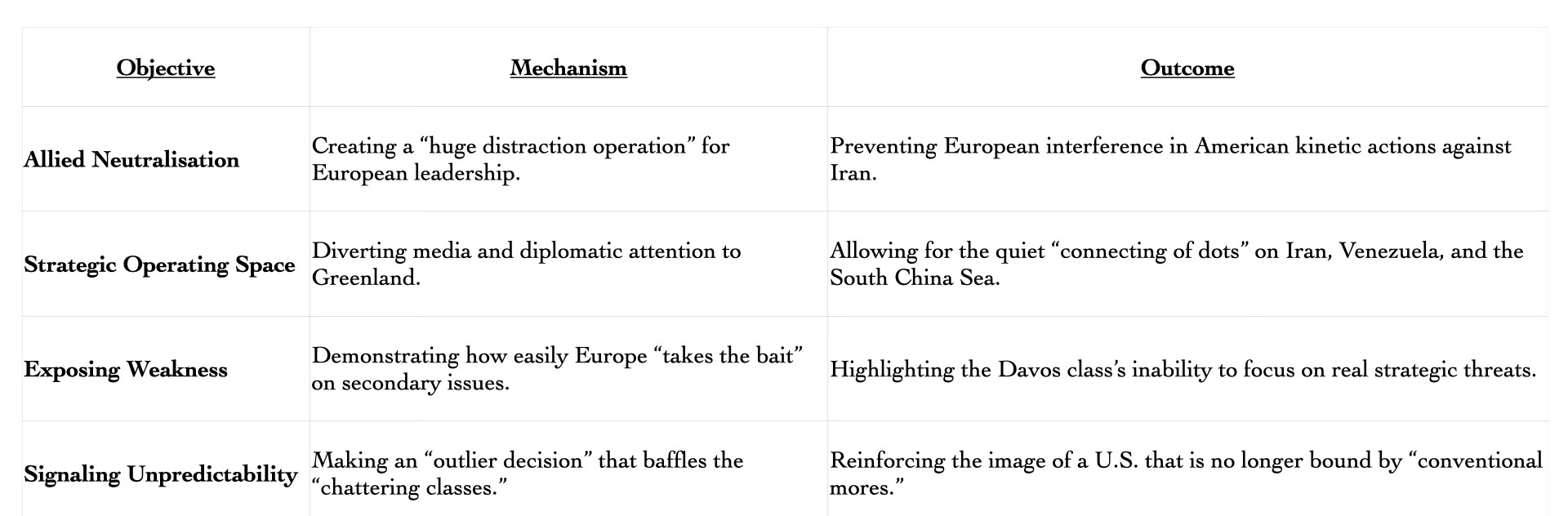
In Cold War II “distraction” is as important as “deterrence,” if not more. By managing the “network of information” and disrupting the “conventional mores” of international relations, the U.S. regains the initiative. The Greenland gambit demonstrates that the administration is willing to use “outlier decisions” to break the diplomatic “bottleneck” that previously constrained American power.
Historical Analogies
To understand the trajectory of this shift, one must look at the historical analogies: the Battle of Leipzig (1813) and the aftermath of the 1917 Russian Revolution. These examples illustrate the “massive disruption” and “violent hours” that accompany the shifting of global orders. The Battle of Leipzig serves as a metaphor for the decisive confrontation between a maritime superpower (the U.S.) and a continental hegemon (the Authoritarian Axis). Just as Leipzig was the Battle of the Nations that broke Napoleon’s grip on Europe, the Cold War II will be settled by a series of high-stakes “bottlenecks” where military and economic power are applied with ruthless precision.
Lessons from the Red Contagion and 1989
Ferguson’s work also draws parallels between the “fear of Red contagion” in the post-WWI era and the current threat posed by the Authoritarian Axis. In the early 20th century, conservative governments “preempted insurrection by mollifying, co-opting, and caring for the workers.” This historical “insurance premium” of social welfare was used to keep the “barbarians at bay.”
In the modern context, Ferguson argues that:
- Just as the Soviet bloc appeared stable until its sudden collapse in 1989, the current Authoritarian Axis hides deep internal fragilities. Regime Brittleness.
- Unlike the successful co-option of the working class in the 20th century, the current authoritarian regimes rely increasingly on “fear” and “monopoly of violence” rather than social contracts. The Limits of Mollification.
- There is a growing debate about whether the West needs to return to “military in origin” values—loyalty, toughness, and self-discipline—to survive the competition of Cold War II. Ferguson notes that the “historical, political, social and cultural conditions” that made such values universal have faded, leaving the West in an “uneasy transition.” National Service and Values.
It is not an exaggeration to conclude that the society that existed in those postwar years is long gone, but it insists that the “treasured values” of deterrence and national strength must be recovered if the U.S. is to avoid the Great Degeneration.
The Authoritarian Axis
Central to the Cold War II framework is the recognition of an Authoritarian Axis that seeks to challenge American supremacy. In this context the People’s Republic and the United States are the most important economic and strategic relationship in the world, yet they are “sliding into the Thucydides Trap” of conflict. This relationship, formerly known as Chimerica, has become the “collision” point of global geopolitics.
In this new and developing dynamics the U.S. must treat China and its allies (Russia, Iran, North Korea) as a singular strategic challenge. The Scalpel of Regime Alteration in Iran and the Sledgehammer of tariffs on Chinese goods are two sides of the same coin. The goal is to “correct” the trends of the preceding decades—off-shoring, intellectual property theft, and regional aggression—by making the cost of the current path unsustainable for the axis powers.
Strategic Confrontation with the Axis
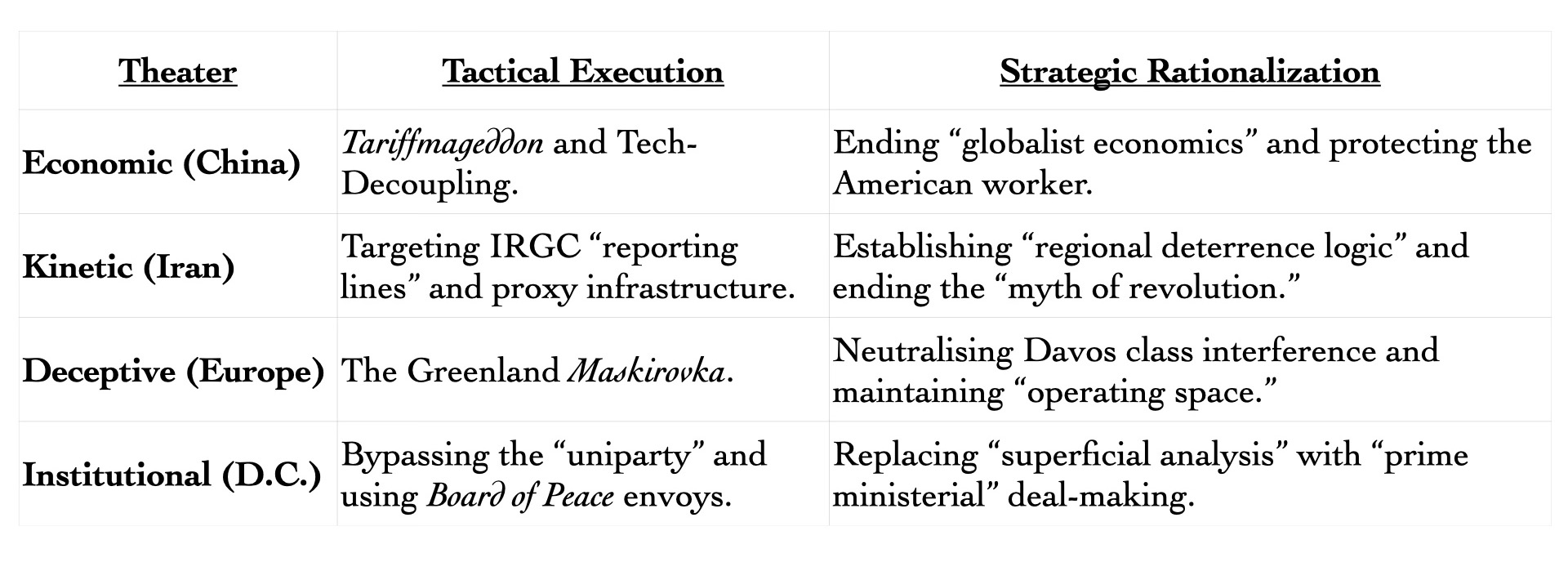
Viewed this way, the U.S. must be prepared for massive disruption to populations and economies as the old multiethnic and state-capitalist empires of the axis struggle to adapt. The “violent hours” of the coming decades will be defined by who can better manage the “bottlenecks” of supply chains, energy, and military technology.
Europe’s Davos Dilemma and the Atlantic Rift
A consistent theme in the Cold War II is the widening rift between the American Sledgehammer approach and the European Davos preference for de-escalation. It is not far fetched to characterise Europe’s weakness as a result of a sentimentalised view of international relations that ignores the reality of “rifle fire and Stuka attacks.” The Europeans, as it has become clear in the past year, keep “taking the bait” because they prioritise “cultural traits” and “conventional mores” over the “vital values” of power and deterrence.
Current geopolitical events reduce the European alliance as a secondary concern, or even a hindrance, to the primary American goal of winning Cold War II. The Greenland distraction was a clear signal that the U.S. will no longer allow European “sentimentalisation” to dictate its Middle East or East Asian policy. Trump administration divides the world between those who understand the need for military efficiency and those who think it originates from a “tiny, unrepresentative sector of society.”
The Disintegration of Transatlantic Consensus
So far we have seen several key areas where America clashes with European interests:
- Europe’s insistence on “please de-escalate” in the Middle East is seen as a form of weakness that emboldens Iran. Deterrence vs. De-escalation.
- European leaders view Tariffmageddon as a threat to the global system, while the Trump administration view it as a necessary tool for “social justice” and “national security.” Tariffs vs. Free Trade.
- The U.S. move toward a “prime ministerial” model of unilateral action contrasts with Europe’s commitment to the “rules-based” international order. Sovereignty vs. Multilateralism.
This analysis indicates that the uneasy transition from empire to welfare state has left Europe without the “team-spirit, toughness, and honour” required to confront the Authoritarian Axis. Until Europe shapes up through some form of national service or reinvestment in military reality, it will continue to be a cheater for American Maskirovka rather than a partner in American grand strategy.
The Board of Peace and the New Pragmatism
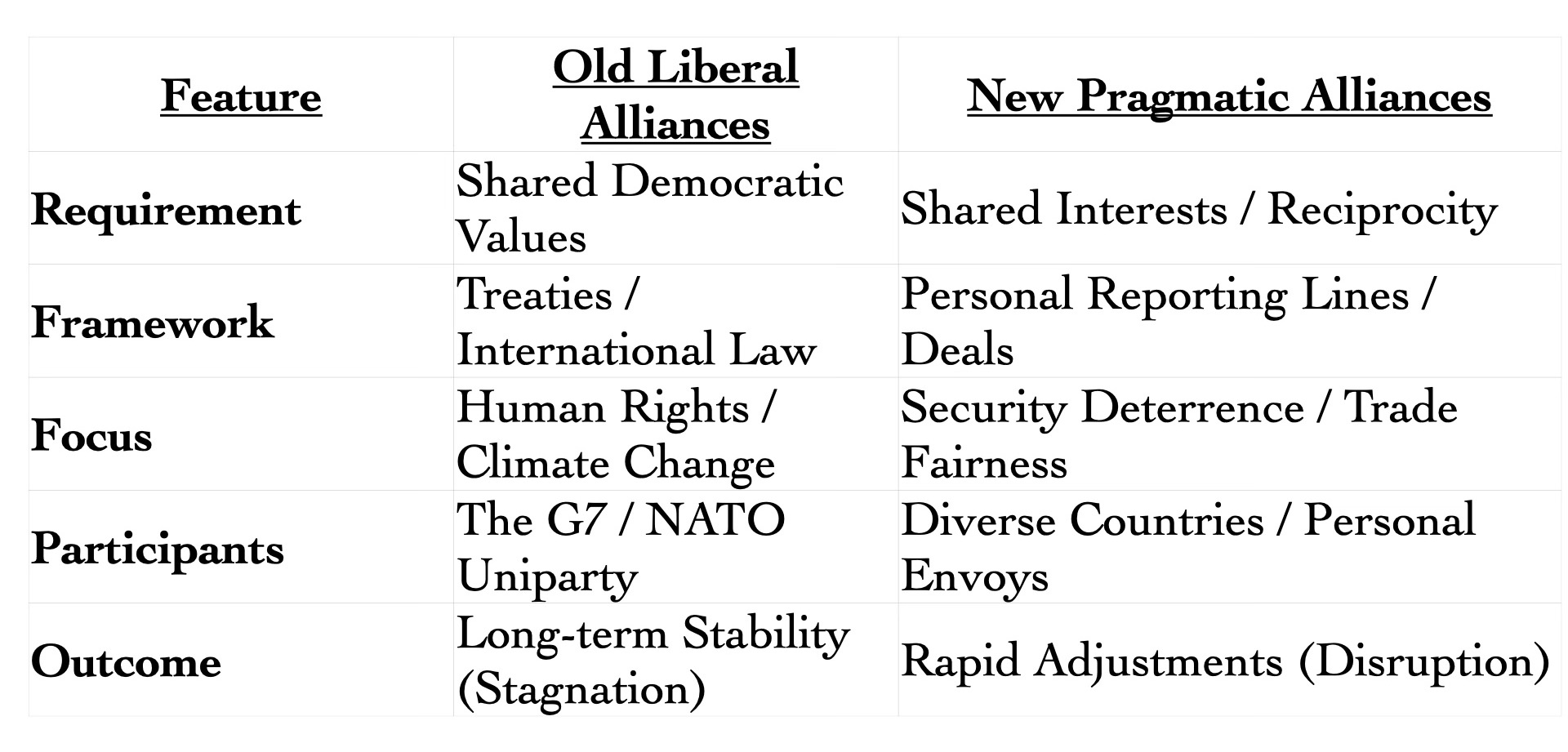
Despite the emphasis on the Sledgehammer and kinetic force, the Trump Doctrine allows for a unique form of new and pragmatic cooperation. This is reflected in the work of Steve Witkoff and the Board of Peace, which seeks to transcend existing divides between countries of the North and South through transactional deal-making.,
This pragmatic alliances model is “willing to adapt, to experiment, and to work together in spite of differences.” It differs from the old liberal internationalism in that it does not demand democratic convergence. Instead, it demands “reciprocity” and “coordinating responses to global challenges.” This is most evident in the administration’s willingness to engage with leaders like Erdoğan or the Saudi monarchy, provided they fit into the “regional deterrence logic” against the primary enemies of Cold War II.
Characteristics of the New Pragmatic Alliances
No doubt these efforts matter because they “push back against the perception of an inevitable slide into isolationism.” The administration is not withdrawing from the world; it is re-entering it on its own terms, using “imagination” and a “willingness to experiment” to create a new Board of Peace that operates “outside traditional frameworks.”
Deterrence as the New International Order
The Doctrine (Year 2, Term 2) represents the definitive end of the post-1945 Liberal International Order and its replacement by a Cold War II framework that prizes deterrence over de-escalation. Through the Scalpel of Regime Alteration and the Sledgehammer of Tariffmageddon, the United States has re-discovered the utility of leverage, unpredictability, and selective force.
What we are witnessing is a strategy that is both historically grounded and radically innovative. By connecting the dots between domestic social justice (trade protection) and global grand strategy (deterrence), the administration has created a cohesive doctrine that seeks to alter the world rather than simply governing it. The Greenland distraction and the targeting of Iranian reporting lines are not random acts but parts of a sophisticated Maskirovka designed to maintain American operating space in a networked world.
The ultimate success of this doctrine depends on whether the West can recover the vital values of toughness and honour while simultaneously managing the massive disruption caused by the collapse of the Chimerica era. As this analysis suggests, we are in the violent hours of a new Battle of Leipzig, where the states of the world must choose between the Authoritarian Axis and a new American-led order that uses the Scalpel and the Sledgehammer to ensure that fear works for the right side of history.
The transition to this new order is not without risk. The game of chicken with China and the death warrant for the Iranian regime could lead to the very systemic collapse the doctrine seeks to manage. However, in the current view, the alternative—the Great Degeneration and the continued exploitation of America by its enemies—is far worse. Therefore, the Trump Doctrine stands as the most rigorous and ambitious attempt to re-assert American power in the 21st century, replacing the soft glove of diplomacy with the cold reality of the Scalpel and the Sledgehammer.
References:
Khaled Salih, 20260129, “The Neuro-Strategic Scalpel: Wright’s Warhead.” Manuscript.


