The Why Scandal of the European Islamophobia Reports
3 December 2025
Abusing correlation as causation
In this ninth essay, I climb back into the cockpit over the familiar airspace of the European Islamophobia Reports, this time with Judea Pearl’s Ladder of Causation wired directly into the instruments and an odd contact—the Emissary—reappearing on the radar. What still presents itself as a benign audit of prejudice, a pious spreadsheet of suffering, is now interrogated as a Why scandal: a project that pretends to ask why but never leaves the lowest rung of mere association. Here I make it clear that these reports will be subjected to several kinds of methodological criticism and a deliberate excavation of their buried ideological circuitry: their refusal to deal honestly with confounders, their abuse of correlation as if it were causation, their determination to draw a straight causal arrow from “Europe” to “racism” by design. Under this regime, critical thinking, empirical research, democratic debate and even legitimate security measures are all re-labelled as “Islamophobia,” which the Reports quietly equate with racism, full stop. The pilot’s task in this essay is simple but not gentle: to lock onto the Emissary’s signal, strip away the noise, and show how a supposedly neutral observer has been steering the whole causal story from the start.
Causality, Narrative, and the EIRs
The European Islamophobia Reports (EIR) present themselves as a comprehensive annual audit of anti-Muslim incidents across the continent. Authored by a network of local scholars and activists, their stated purpose is to document and compare the state of “Islamophobia” in politics, employment, media, and other spheres of social life. The reports catalogue a vast and often troubling collection of political statements, legislative acts, media headlines, and acts of vandalism. However, a critical examination of their methodology reveals a profound analytical flaw, one that can be best understood through the lens of the science of causal inference, as articulated by Judea Pearl in The Book of Why. This analysis argues that the EIR authors, while meticulously cataloguing numerous incidents, employ a methodologically flawed approach that consistently conflates association with causation. By operating almost exclusively on the lowest rung of Pearl’s Ladder of Causation, the reports systematically abuse the question of why. They construct a narrative that, by its methodological design, predetermines its conclusions and directs the reader toward a specific attribution of blame toward European states and societies for a complex set of social phenomena, rather than providing a rigorous, evidence-based causal explanation for them. To deconstruct this narrative, it is first necessary to understand the fundamental principles of causal reasoning that the reports so conspicuously ignore.
The Analyst’s Toolkit
Before critically deconstructing the methodology of the European Islamophobia Reports, it is essential to establish a clear and robust analytical framework. The tools for this analysis are drawn directly from Judea Pearl’s foundational work on causal reasoning, which provides a vocabulary and a structure for moving beyond simple statistical observation to genuine causal understanding. This section will demystify the core concepts that separate correlation from causation, providing the necessary toolkit to evaluate the claims and methods presented in the EIRs.
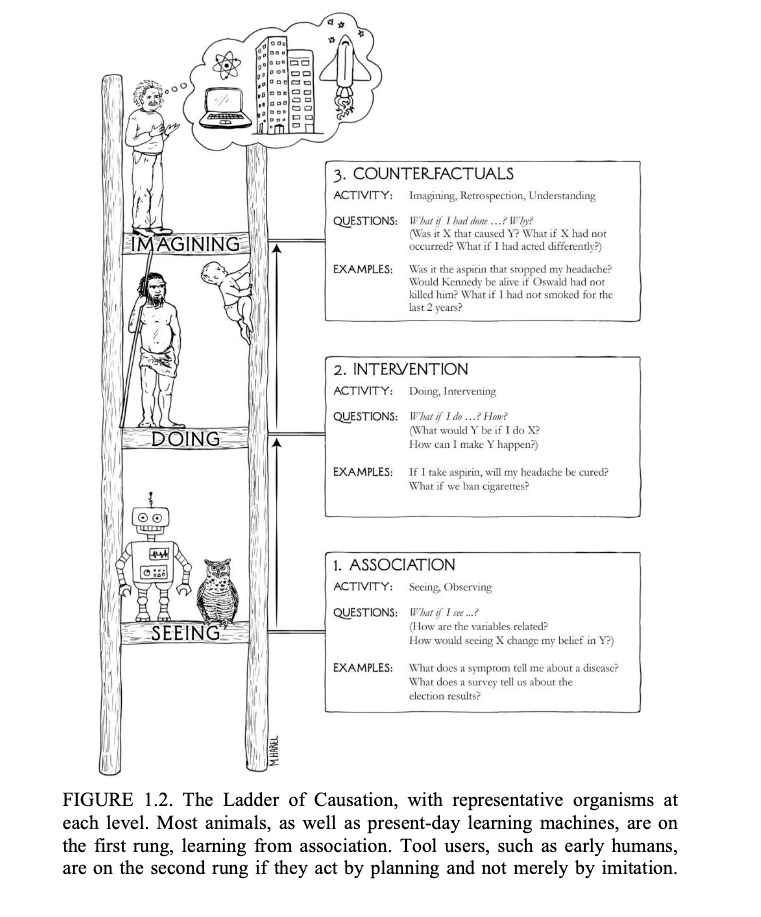
Rung One: Association (Seeing)
The first and most basic level of causal reasoning is Association. This rung deals with passive observation and the statistical relationships found within data. It answers questions like, “What is the probability of Y if we see X?” (P(Y|X)). This is the domain of traditional statistics, where we identify correlations, patterns, and dependencies. As Pearl notes, this level is defined by “seeing,” or observing the world as it is without intervention. The vast majority of data analysis, from tracking disease prevalence to market research, operates at this level. While essential, Rung One cannot, on its own, tell us why variables are related or what would happen if we were to change one of them.
Rung Two: Intervention (Doing)
The second rung, Intervention, moves from passive observation to active manipulation. It addresses questions about the effects of our actions, such as, “What would Y be if we do X?” Pearl formalised this with the do-operator, expressed as P(Y|do(X)), which simulates an intentional change in a system. This level of reasoning is crucial for policy making, medical treatments, and any scenario where we want to predict the outcome of a deliberate action. A simple example illustrates the difference: P(Y|X) might represent the probability of recovery given that a patient happened to take a drug, while P(Y|do(X)) represents the probability of recovery if we administer the drug. The former is a passive observation, while the latter simulates an active experiment. Answering questions at this level requires a causal model of the world, as a simple statistical association from Rung One is insufficient to predict the outcome of an intervention.
Rung Three: Counterfactuals (Imagining)
The highest rung of the ladder is Counterfactuals, which involves retrospective reasoning and imagining alternative realities. This level answers “what if” questions about past events, such as, “What would have happened if X had been different?” This form of reasoning is fundamental to personal responsibility, legal judgment, and scientific discovery. It requires us to compare the world as it is to a fictitious world where a single element was changed. Pearl argues that this ability is uniquely human and underpins our most sophisticated modes of thought, asserting that counterfactuals are the “building blocks of moral behaviour as well as scientific thought” [Pearl, 2018, p 8].
The Central Obstacle: Confounding
The primary reason why Rung One (Association) is not sufficient for causal claims is the problem of confounding. A confounder is a third variable that influences both the supposed cause and the supposed effect, creating a spurious or misleading correlation between them. For example, an observed association between ice cream sales and crime rates is confounded by the season (hot weather causes both). Failing to identify and account for confounders is the most common pitfall in data analysis. Pearl is unequivocal on this point, stating that “probabilistic causality has always foundered on the rock of confounding” [Pearl 2018, p 49]. Any analysis that claims to explain why something happened without rigorously addressing potential confounders is methodologically unsound. With this causal framework established, we can now proceed to examine the methodology of the EIR reports.
Analysis of the EIR Methodology: Operating at Rung One
An examination of the European Islamophobia Reports through the lens of causal inference reveals a methodology that operates almost exclusively at the first rung of the Ladder of Causation. The reports are, in essence, vast catalogues of association. They meticulously collect and present data points—political speeches, laws, media articles, acts of vandalism—and group them under the unifying label of “Islamophobia.” This methodological choice is not merely descriptive; it is a foundational flaw that enables the construction of a manipulative narrative. By presenting a sheer volume of associative data, the authors imply a causal story without ever needing to prove it. The table below illustrates how the reports’ data points represent simple observations (Rung One) rather than demonstrating causality.
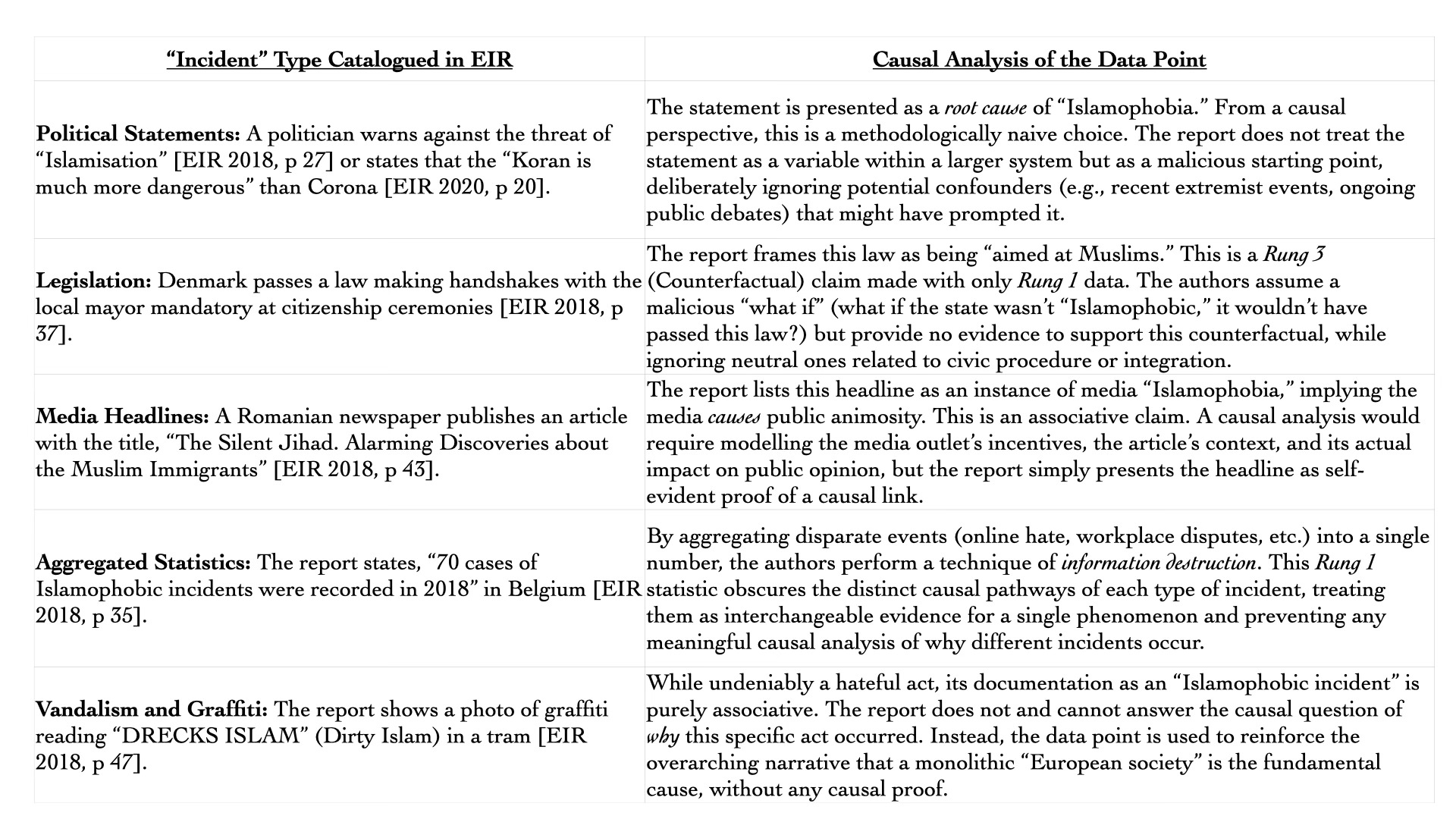
This consistent failure to ascend beyond Rung One is not merely a limitation; it is an enabling strategy, made possible by the report’s most significant methodological sin: the systematic and deliberate neutralisation of confounding variables.
The Art of Omission: How the EIR Reports Neutralise Confounding Variables
The most significant manipulation within the European Islamophobia Reports is not what they say, but what they systematically omit. By focusing exclusively on associative data, the authors are able to construct a simplistic and distorted causal narrative. This is achieved by ignoring or dismissing alternative explanations for the phenomena they observe—a practice that, in causal inference terms, amounts to neutralising confounding variables. This section demonstrates how the report authors build their case by strategically omitting context and competing causes.
Ignoring “Political Islam” as a Confounder
State actions targeting what governments label “political Islam” are consistently framed by the EIR as a disingenuous smokescreen for generalised, racist anti-Muslim policies. For example, when the Austrian government created a “Documentation Center for Political Islam,” the EIR authors present this as self-evidently Islamophobic [EIR 2020, p 52]. This framing deliberately refuses to add a legitimate node to their implicit causal diagram: the existence and activities of organised Islamist groups. From a causal perspective, the activities of such groups represent a major confounding variable. They plausibly influence both the state’s action (e.g., creating a documentation centre) and public perception of Muslims. By refusing to model this variable, the authors are able to draw a direct, malicious causal arrow from European State to Anti-Muslim Policy, ignoring the complex interactions that may actually be at play.
Sidestepping Secularism and Security Concerns
The reports’ presentation of laws restricting religious symbols, such as the hijab or burqa, follows a similar pattern. Laws like the hijab ban for pupils in Austria [EIR 2020, p 53] or the face-covering ban in Norway [EIR 2018, p 41] are presented purely as acts of discrimination aimed at Muslim women. This analysis entirely sidesteps potential confounding variables that governments themselves cite as motivation. These include long-standing constitutional principles of state secularism (such as laïcité, noted in the Belgium report [EIR 2020, p 62]), arguments about social integration, or national security concerns. Whether one agrees with these governmental rationales is irrelevant to the causal analysis. The methodological failure of the EIR is its refusal to model them as potential causes. By doing so, the authors actively “break” potential back-door paths that would challenge their preferred causal arrow, allowing them to present a simple, monocausal explanation: the state is motivated by anti-Muslim animus, and this directly causes the discriminatory law.
Decontextualising Political and Media Rhetoric
The EIR extensively catalogues inflammatory rhetoric from politicians and media outlets, such as the statement by Slovenian politician Zmago Jelinčič Plemeniti linking migrants to crime [EIR 2018, p 27]. The reports present this rhetoric as a primary cause of Islamophobia in society. While such language is undeniably contributory to social tensions, the EIR’s analysis is, again, causally incomplete. It ignores the confounding variables that may give rise to such statements in the first place. These can include official crime statistics (whether accurately or inaccurately interpreted), public anxiety following specific violent incidents, or broader economic pressures related to migration. The EIR authors do not analyse these factors. Their method is to present the offensive statement as a root cause, rather than as a variable potentially influenced by other societal dynamics. This deliberate decontextualisation allows them to isolate political rhetoric as a malicious starting point, thereby manipulating the causal chain.
By systematically ignoring these and other confounders, the methodology necessarily constructs an artificial and direct line of blame, a narrative aimed squarely at European institutions and society.
Forging a Narrative of Blame: Misattribution and the Abuse of Why
Having established the European Islamophobia Reports’ reliance on associative data and their strategic omission of confounding variables, we can now analyse the ultimate purpose of this methodology: the construction of a targeted narrative of blame. The reports’ authors misuse the power of the question why, presenting correlation as a definitive causal explanation that assigns culpability primarily to European states and mainstream society. This is achieved through deliberate editorial framing, false equivalence, and the rhetorical manipulation of key terms.
The Power of Editorial Framing
The editors, Enes Bayraklı and Farid Hafez, set the narrative tone from the outset. The 2021 report, for instance, features former Austrian Chancellor Sebastian Kurz on its cover. The introduction frames his political downfall as the logical endpoint of a career “built on anti-Muslim racism” [EIR 2021, p 11]. The editors make a strong, yet unsupported, causal claim: they argue that Kurz’s anti-Muslim policies were the cause of his increasing authoritarianism, rather than a symptom of a populist political strategy or merely a correlated tactic. By presenting this interpretation as a “textbook example,” they are not investigating why these events occurred; they are telling the reader how to interpret them, using a causal assertion to assign moral and political blame before the evidence has even been presented.
Manipulation Through Aggregation
A key tactic used throughout the reports is the creation of a causal equivalence between far-right extremists and mainstream governments. The country reports compile long, undifferentiated lists of “Islamophobic incidents.” Actions by fringe, extremist parties like Austria’s FPÖ [EIR 2018, p 23] are placed alongside complex and widely debated mainstream government policies, such as Denmark’s “ghetto laws” [EIR 2020, p 78]. By placing these disparate items in a single list, the authors create a powerful—but false—association. This aggregation implies that the motivations and causal origins of a fringe group’s hateful rhetoric are identical to those of a democratically elected government’s policy decisions. This technique manipulates the reader into conflating criticism of radical Islam with hate speech, and mainstream policy with extremist ideology, thereby blurring crucial distinctions and manufacturing a narrative of pervasive, uniform bigotry.
Manufacturing Causality with Language
Judea Pearl observes that “language shapes our thoughts. You cannot answer a question that you cannot ask, and you cannot ask a question that you have no words for” [Pearl_2018, p 8]. The EIR authors masterfully leverage this principle by their use of the term “Islamophobia.” The term is not treated as a complex social phenomenon to be explained by multiple causal factors. Instead, it is reified—turned into a tangible entity with its own agency. It is a force that is “mainstreamed and banalised” [EIR 2018, p 21] and acts upon society. This rhetorical move creates a “model-free” villain, allowing the authors to assign blame without providing rigorous proof. By personifying “Islamophobia” as a singular, malevolent actor, they bypass the difficult scientific work of building and testing a structural causal model with multiple interacting variables. This linguistic strategy is the final step in a methodology designed not to explain, but to accuse. This analysis reveals a systematic pattern of methodological choices, from data selection to linguistic framing, all designed to lead the reader to one specific, predetermined conclusion.
Beyond Association, Towards Understanding
This analysis has sought to provide a rigorous methodological critique of the European Islamophobia Reports, using the clear principles of causal inference. It is crucial to state that this critique does not deny the existence of anti-Muslim prejudice, nor does it dispute the reality of the many disturbing incidents documented within the reports’ pages. Acts of hatred, discrimination, and violence are real and demand serious attention. The issue is not the what, but the why.
The central finding of this analysis is that the EIR authors engage in a form of intellectual manipulation by presenting their work as an objective, evidence-based documentation while employing a flawed and biased causal framework. Their methodology is characterized by three key failings. First, they operate almost exclusively on the first rung of the Ladder of Causation, presenting a catalogue of associations and treating them as self-evident proof of causality. Second, they systematically omit confounding variables, ignoring alternative or contributory explanations for the phenomena they document—from state secularism to the activities of Islamist groups. Third, they use powerful rhetorical and editorial framing to construct a pre-determined narrative of blame, misusing the powerful question of “why” to assign culpability rather than to seek understanding.
This methodology ultimately prevents, rather than promotes, a genuine understanding of social tensions in Europe. By constructing a simple, monocausal narrative that points blame squarely at a monolithic “European society” or its state institutions, the reports fail to explore the complex, multi-faceted, and often contradictory reasons behind friction, prejudice, and conflict. A true causal approach, as championed by Judea Pearl, would embrace this complexity. It would seek to build a model that accounts for all contributing factors—be they societal values, economic anxieties, security threats, political opportunism, or genuine bigotry—to understand how they interact. It would ask difficult questions rather than providing simplistic answers. The EIR’s approach achieves the opposite; it selects only the data that fits a politically convenient narrative, preventing a true causal inquiry and, in doing so, hindering any real path toward resolution.
Viewed from that altitude, with the clutter cleared from the screen, the European Islamophobia Reports no longer look like guardians of human rights but like weapons systems aimed squarely at the question why. They catalogue incidents but never model causes; they ignore confounders, then blame the target; they turn “Islamophobia” into a free-floating demon that explains everything precisely because it explains nothing. This is not causal inquiry; it is moral artillery. The Emissary on the radar is not a guide but a controller, feeding us a pre-programmed narrative in which Europe is always guilty, criticism is always hatred, and any attempt to ask a better why is itself treated as a hostile act. Against that, one has a duty to fly straight toward the noise and refuse to be jammed. A civilisation that allows its causal reasoning to be replaced by accusation has effectively disarmed itself. The proper answer is not apology but insistence: that we will go beyond association, that we will name every confounder, and that we will not let a politicised pseudo-science of “Islamophobia” dictate which questions may be asked. The Reports may continue to fire their flares of indignation, but they do not own the sky; as long as there are pilots willing to defend the integrity of why, their monopoly on meaning is already broken.
References:
Enes Bayraklı & Farid Hafez (Eds), 2018, European Islamophobia Report 2017. Istanbul: SETA. SETA (Foundation for Political, Economic and Social Research). Quoted as EIR 2017.
— (Eds), 2019, European Islamophobia Report 2018. Istanbul: SETA. SETA (Foundation for Political, Economic and Social Research). Quoted as EIR 2018.
— (Eds), 2020, European Islamophobia Report 2019. Istanbul: SETA. SETA. Quoted as EIR 2019.
—, 2021, European Islamophobia Report 2020. Vienna: Leopold Weiss Institute. Leopold Weiss Institute. Quoted as EIR 2020.
—, 2022, European Islamophobia Report 2021. Vienna: Leopold Weiss Institute. Leopold Weiss Institute. Quoted as EIR 2021.
—, 2023, European Islamophobia Report 2022. Vienna: Leopold Weiss Institute. Leopold Weiss Institute. Quoted as EIR 2022.
—, 2024, European Islamophobia Report 2023. Vienna: Leopold Weiss Institute. Leopold Weiss Institute. Quoted as EIR 2023.
Judea Pearl and Dana Mackenzie, 2018, The Book of Why: The New Science of Cause and Effect. New York: Basic Books.


