The United Nations Has a Backspace Problem
When the General Debate Becomes a General Declaration
25 September 2026
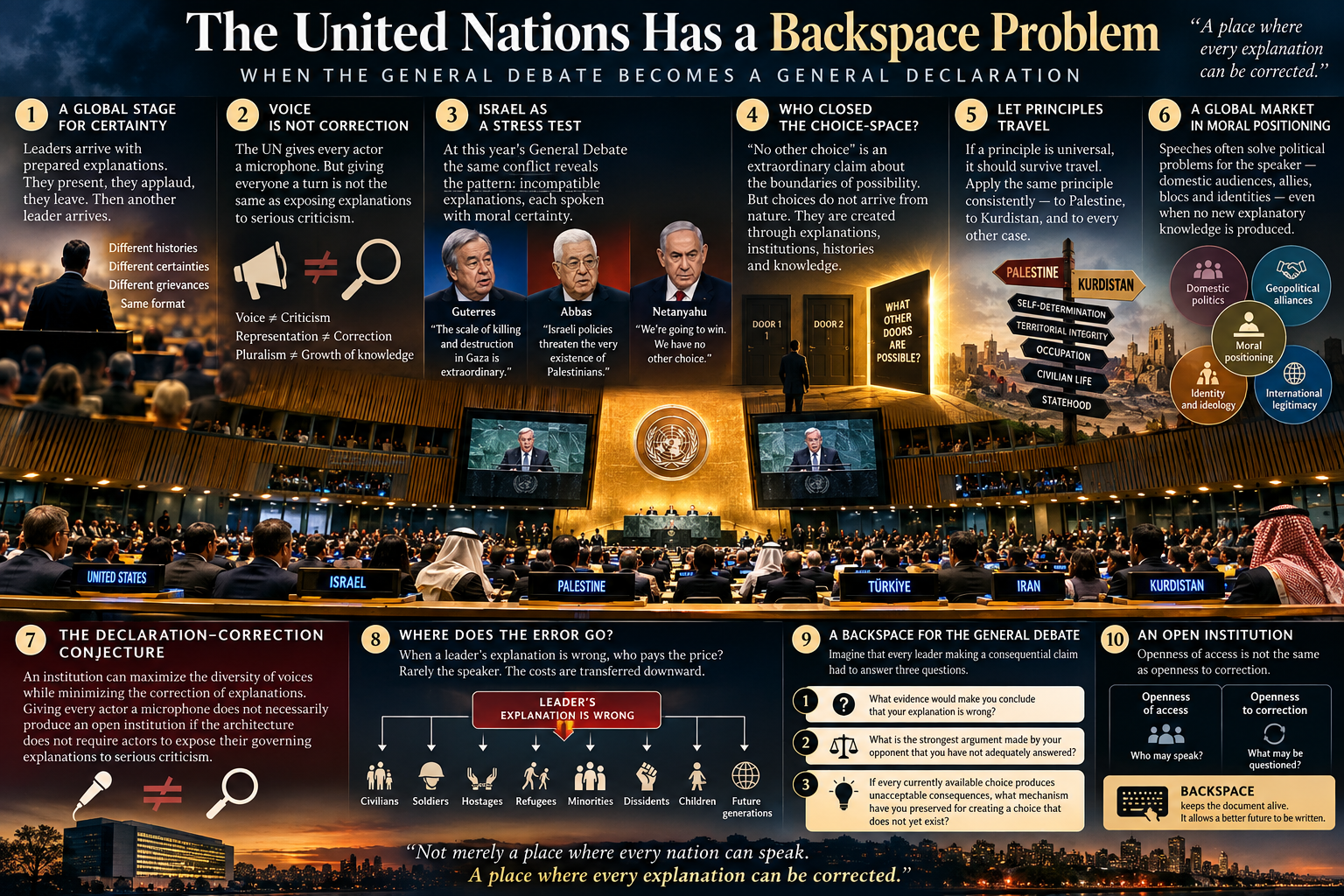
For several days, I have been watching what is officially called the General Debate of the United Nations General Assembly.
The name has begun to trouble me.
Not General.
Debate.
Where, exactly, is the debate?
Presidents, prime ministers and ministers arrive in New York carrying prepared speeches. They approach perhaps the most prestigious political podium in the world. They tell us what is wrong with the world, who caused it, which principles have been violated, which history should be remembered, which future must be created—and sometimes which future is impossible.
Then they leave.
Another leader arrives.
Another explanation.
Another history.
Another certainty.
The United Nations itself describes the General Debate as the occasion when leaders make statements outlining their countries’ “positions and priorities” amid interconnected global challenges. This year’s theme is “Restoring trust, managing transformation: A United Nations that delivers for all.”
That is an admirable ambition.
But I have been asking a different question while listening:
What happens if one of these leaders is wrong?
Not morally wrong.
Not on the wrong “side.”
Simply wrong about the explanation they have just presented to the world.
What happens to the error?
Where does it go?
That question has led me somewhere I did not expect.
Perhaps the United Nations does not primarily have a debate problem.
Perhaps it has a Backspace problem.
A Hall Full of Intelligence
Nobody could reasonably describe the United Nations General Assembly as suffering from a shortage of intelligence.
The room contains presidents, prime ministers, diplomats, foreign ministers, advisers, lawyers, economists, generals and experts. Behind them stand ministries, intelligence agencies, universities, think tanks and diplomatic services.
Almost every important political tradition on Earth is represented.
Almost every geopolitical interest is present.
Almost every major conflict enters the room.
The 2026 General Debate itself runs from 22 to 28 September alongside high-level meetings on climate action, sea-level rise, development and pandemic preparedness.
There is therefore an extraordinary concentration of intelligence in one building.
But intelligence is not rationality.
That distinction has become increasingly important to me.
Intelligence can construct arguments.
It can defend positions.
It can assemble historical evidence.
It can anticipate criticism.
It can find weaknesses in an opponent’s case.
It can produce extraordinarily sophisticated justifications for conclusions already reached.
Rationality requires something else.
It requires an explanation to remain vulnerable to correction.
And that is what I have been looking for while watching the General Debate.
Where is the Backspace Key?
Speech Is Not Correction
I want to make a conjecture.
The Declaration–Correction Conjecture
An institution can maximize the diversity of voices while minimizing the correction of explanations. Giving every actor a microphone does not necessarily produce an open institution if the architecture does not require actors to expose their governing explanations to serious criticism.
This distinction matters.
Voice is not criticism.
Representation is not correction.
Pluralism of declarations is not necessarily growth of knowledge.
A room can contain nearly every political perspective on Earth while each perspective remains protected inside itself.
That may be one of the strange characteristics of the General Assembly.
Everyone gets a turn.
But getting a turn is not the same thing as entering a process of error correction.
Israel as a Stress Test
Israel and Palestine make this unusually visible.
I do not want to begin by deciding which speaker is right. That would immediately return us to the architecture I am trying to examine.
Listen instead to the explanations.
Secretary-General António Guterres opened the General Debate by condemning the October 7 Hamas attacks while describing the subsequent scale of killing and destruction in Gaza in extraordinarily grave terms. He warned about violence, displacement and settlement expansion in the West Bank and argued that the path toward two states was being destroyed.
Mahmoud Abbas told the Assembly that Israeli policies now threaten not merely the two-state solution but the very existence of Palestinians on their land. He called for Palestinian self-determination and statehood alongside Israel, while presenting that outcome as a path toward wider regional peace.
Benjamin Netanyahu presented another explanatory world. He defended Israeli military action, rejected accusations made against Israel and framed the conflict in terms of national survival. He concluded with words that immediately caught my attention:
“We’re going to win. We have no other choice.”
There it was.
No other choice.
Whenever I hear those words, I become interested.
Not because the speaker must necessarily be wrong.
Because a claim about having no other choice is an extraordinary claim about the boundaries of possibility.
Who Closed the Choice-Space?
This is where my problem with the General Assembly becomes larger than Israel.
Political leaders constantly present choices as though reality itself had generated the menu.
Fight or surrender.
Statehood or permanent conflict.
Security or vulnerability.
Territorial integrity or chaos.
Recognition or injustice.
Victory or extinction.
Two states or perpetual war.
But choices do not arrive from nature already printed on a menu.
They emerge from explanations, institutions, histories, technologies and knowledge.
So before choosing between available doors, I have learned to ask:
Who built the doors?
And then:
Why are there only two?
This is what I call a Choice-Space Audit.
The question is not merely:
Which available choice is best?
It is:
What have we mistakenly treated as the complete set of choices?
And then the more Deutschian question:
What new knowledge would make possible a choice that does not yet exist?
This is why “no other choice” should never end political thinking.
It should begin it.
The UN Has Its Own Version
The irony is that this does not apply only to Netanyahu.
International institutions also speak in the language of closed choice-space.
Two states.
Internationally recognized borders.
Territorial integrity.
Sovereignty.
Self-determination.
Existing states.
Recognized peoples.
These concepts are indispensable to the present international order.
But indispensable does not mean final.
The danger begins when historically created arrangements become confused with the limits of political possibility.
The United Nations was itself created because people refused to accept the existing international architecture as final.
Why should the architecture created in 1945 be permitted to tell humanity what cannot be created in 2045?
There is no final menu.
And Then I Think About Kurdistan
Perhaps this is inevitable for me.
I hear world leaders invoke self-determination.
And I think about Kurdistan.
I hear them speak passionately about the right of a people to live freely on its own land.
I think about Kurdistan.
I hear appeals to history, identity, language, recognition and political agency.
Again, Kurdistan enters my mind.
Not because Palestine and Kurdistan are the same.
They are not.
Their histories are different. Their political architectures are different. Their relations with surrounding states are different.
The comparison matters precisely because they are different.
A principle claiming universality should survive travel.
So I want to perform a simple experiment.
Take the principle away from the identity of the people invoking it.
If self-determination is the principle, let it travel.
If territorial integrity is the principle, let it travel.
If inherited borders are sacred, explain why.
If inherited borders are criticizable, explain under what conditions.
If occupation is wrong, specify the mechanism and apply the criterion consistently.
If civilian life is inviolable, remove the nationality of the civilian and see whether the judgment changes.
If statehood is necessary for one stateless people to exercise political agency, explain why statehood becomes destabilizing when another stateless people asks whether it might need the same thing.
This is not an argument for identical outcomes.
It is a test of explanations.
I call it the Cross-Case Consistency Test:
When a political actor invokes a universal principle, ask whether the principle survives travel to a comparable case.
If the principle changes whenever the identity changes, perhaps we were not dealing with a universal principle at all.
Perhaps we were dealing with a political instrument wearing universal language.
The Strange Centrality of Israel
This brings me to another question.
Why does Israel-Palestine acquire such extraordinary symbolic power at gatherings like the General Assembly?
I want to be careful here.
Calling it simply an “obsession” explains nothing.
The conflict is real. The suffering is real. The political consequences are real. The legal questions are serious. October 7 was real. Gaza is real. Hostages are real. Palestinian displacement is real. Israeli insecurity is real.
The question is not whether the conflict deserves international attention.
Of course it does.
The interesting question is why this particular conflict can carry so many other political meanings simultaneously.
For different governments and movements, Israel can become a way of speaking about:
colonialism;
Western power;
American influence;
Islam;
Arab identity;
antisemitism;
Holocaust memory;
international law;
the Global South;
human rights;
anti-imperialism;
domestic constituencies;
and the legitimacy of the international order itself.
That suggests another conjecture.
The Symbolic-Magnification Conjecture
International attention is not allocated solely according to the magnitude or solvability of suffering. Some conflicts acquire exceptional symbolic value because they allow political actors to express multiple identities, grievances, loyalties and geopolitical alignments through a single issue.
Israel-Palestine may have become one of the world’s most powerful political symbols.
And once something becomes a symbol, there is a danger.
We may stop explaining it.
We begin using it to explain ourselves.
What Problem Is the Speaker Solving?
That gives me a question I wish I could ask every leader who approaches the UN podium:
What problem are you actually solving by giving this speech?
That is not the same as:
What problem are you talking about?
A leader may speak about Gaza while addressing a domestic electorate.
Another may speak about Israel while signaling membership in a geopolitical bloc.
Another may invoke international law while strengthening relations with particular states.
Another may defend Israel while speaking principally to voters at home.
Another may invoke Palestine as part of a broader anti-Western narrative.
The declared object of a speech and the political function of a speech need not be identical.
That is not necessarily hypocrisy.
Politics has multiple audiences.
But a framework concerned with explanation should distinguish them.
Otherwise symbolic performance can masquerade as problem-solving.
The General Assembly Performance Trap
Now return to the architecture.
A leader speaks.
There may be applause.
There may be a walkout.
There may be condemnation.
There may be headlines.
There may be viral clips.
Then comes the next speech.
What is missing?
A mechanism forcing the explanation back through criticism.
Imagine science conducted this way.
A scientist walks onto a stage.
She presents her theory.
Her supporters applaud.
Her opponents leave the room.
Another scientist presents the opposite theory.
His supporters applaud.
Everyone goes home.
A year later they return and repeat the exercise.
We would not call that science.
Why do we call the political equivalent a debate?
The problem is not disagreement.
Disagreement is indispensable.
The problem is that opposition and criticism are not the same thing.
An opponent wants to defeat my explanation.
A critic helps expose where it is wrong.
Those activities sometimes overlap.
But not always.
A Global Market in Moral Positioning
This suggests a more uncomfortable conjecture.
The General Assembly Performance Trap
When an institution rewards declaration more reliably than correction, participants can gain political value from displaying moral certainty even when no new explanatory knowledge is produced.
That would help explain some of the behaviour that can make international gatherings appear strangely juvenile despite the extraordinary intelligence of the participants.
Walkouts.
Applause designed as signals.
Moral denunciations.
National boasting.
Historical accusations.
Refusal to listen.
Competing claims to victimhood.
These behaviors should not simply be mocked.
We should ask what institutional incentives produce them.
Perhaps the problem is not immature leaders inside a mature institution.
Perhaps parts of the institutional architecture reward performative behaviour.
If applause, headlines, diplomatic signaling and domestic approval are the immediate rewards, why should we expect a speech to contain the sentence:
Here is where my government may be wrong?
Almost no political architecture rewards that sentence.
Yet it may be one of the most rational sentences a leader could utter.
Where Does the Error Go?
This returns me to the question that increasingly organizes how I look at institutions.
Suppose a leader’s explanation is wrong.
Where does the error go?
Does it travel upward into:
the policy?
the assumption?
the governing doctrine?
the intelligence assessment?
the institution?
the leader?
the constitutional architecture?
Or does it travel downward?
Into:
the enemy;
the dissident;
the minority;
the foreigner;
the traitor;
the civilian;
the population that supposedly failed to understand history?
This matters because the people delivering speeches at the United Nations rarely pay the full cost of their explanations.
Other people do.
Soldiers.
Civilians.
Hostages.
Refugees.
Minorities.
Dissidents.
Children.
Future generations.
The more consequential the explanation, the more important its Backspace Key becomes.
Imagine a Different General Debate
I do not want to end with another denunciation of the United Nations.
That would reproduce the problem I am criticizing.
The UN itself is a conjecture.
A remarkable one.
Human beings who had repeatedly settled international disagreements through war created an institution in which states could at least meet, speak, negotiate and preserve channels of communication.
That is an enormous civilizational achievement.
But achievements should remain criticizable precisely because we want to preserve them.
So let us create another choice.
What if the General Debate contained a small correction mechanism?
Imagine that every leader making a consequential claim had to answer three questions.
First:
What evidence would make you conclude that your explanation is wrong?
Second:
What is the strongest argument made by your opponent that your government has not adequately answered?
Third:
If every currently available choice produces unacceptable consequences, what mechanism have you preserved for creating a choice that does not yet exist?
Nothing requires leaders to agree.
Nothing asks them to abandon national interests.
Nothing abolishes sovereignty.
Nothing requires moral equivalence.
It simply inserts Backspace.
What Would Happen?
Imagine Benjamin Netanyahu having to explain what evidence would cause him to reconsider one of his central strategic assumptions.
Imagine Mahmoud Abbas doing the same.
Imagine the Iranian president doing it.
The American president.
The Turkish president.
The Russian president.
The Ukrainian president.
And then imagine applying the same requirement to a Kurdish leader.
Suddenly the interesting political distinction would no longer be:
Who delivered the strongest speech?
It would become:
Whose explanation remains most open to correction?
That would be a very different kind of international politics.
An Open Institution Is Not Merely One Where Everyone Can Speak
This may be the most important lesson I have taken from watching this week’s speeches.
I have long associated openness with freedom of speech, pluralism and representation.
All are indispensable.
But they may not be sufficient.
An institution can permit enormous diversity of speech while remaining poor at correction.
That leads me to a distinction I want to preserve:
Openness of access is not the same as openness to correction.
The first asks:
Who may speak?
The second asks:
What may be questioned?
And the deepest version asks:
Can the explanation governing the institution itself be replaced?
That is the harder test.
A General Assembly Without a Final Menu
The United Nations was created in a world profoundly different from ours.
Its categories reflect that world.
Its institutions reflect that world.
Its Security Council reflects that world.
Its understanding of sovereignty reflects centuries of political development preceding that world.
None of this means those institutions should simply be discarded.
It means they should remain conjectural.
The alternative to institutional preservation is not necessarily institutional destruction.
There is another possibility:
institutional correction.
That is why Backspace matters.
Backspace does not destroy the document.
It allows the document to continue being written.
The Question I Am Left With
I have spent much of this week listening to world leaders speak at the United Nations.
I expected disagreement.
That does not trouble me.
An open world should contain disagreement.
I expected hypocrisy.
Politics has always contained hypocrisy.
I expected national interest.
Governments exist partly to pursue it.
What increasingly troubles me is something else.
I hear extraordinarily intelligent people presenting extraordinarily consequential explanations with remarkably little institutional obligation to tell us how those explanations could be wrong.
Perhaps that helps explain why the same conflicts can return to the same hall, under the same flags, carrying much of the same vocabulary, generation after generation.
The United Nations was built partly because humanity discovered the catastrophic cost of settling disagreement through force.
That was an extraordinary achievement.
Perhaps the next achievement has still to be created.
Not merely a place where every nation can speak.
A place where every explanation can be corrected.
Until then, the United Nations may possess a General Assembly, a General Debate, interpreters for almost every political language, and a podium from which virtually every conception of the world can be declared.
What it still needs is a Backspace Key.
Because the purpose of an open institution cannot merely be to give every explanation a microphone.
It must preserve the possibility that tomorrow we may discover that today’s explanation was wrong—and still possess the means to correct it.


