The Two Worlds: A Unified Framework for Analysing Ideas
21 December 2025
This text is the second of two essays comprising a unified project on the architecture of ideas. While the first essay, A Memorandum on the Solvability of Human Problems, established the strategic imperative to combat anti-rational stagnation, this essay, The Two Worlds: A Unified Framework for Analysing Ideas, serves as the “analytical compass” and “master key”.
It moves beyond the identification of symptoms to provide an “aetiological diagnosis”. By mapping the insights of thinkers like Thomas Sowell, James Carse, and Judea Pearl onto Iain McGilchrist’s “Master and Emissary” framework, this text offers a practical toolkit to reveal that our deepest intellectual conflicts are often manifestations of a fundamental cognitive imbalance.
The Recurrent Duality
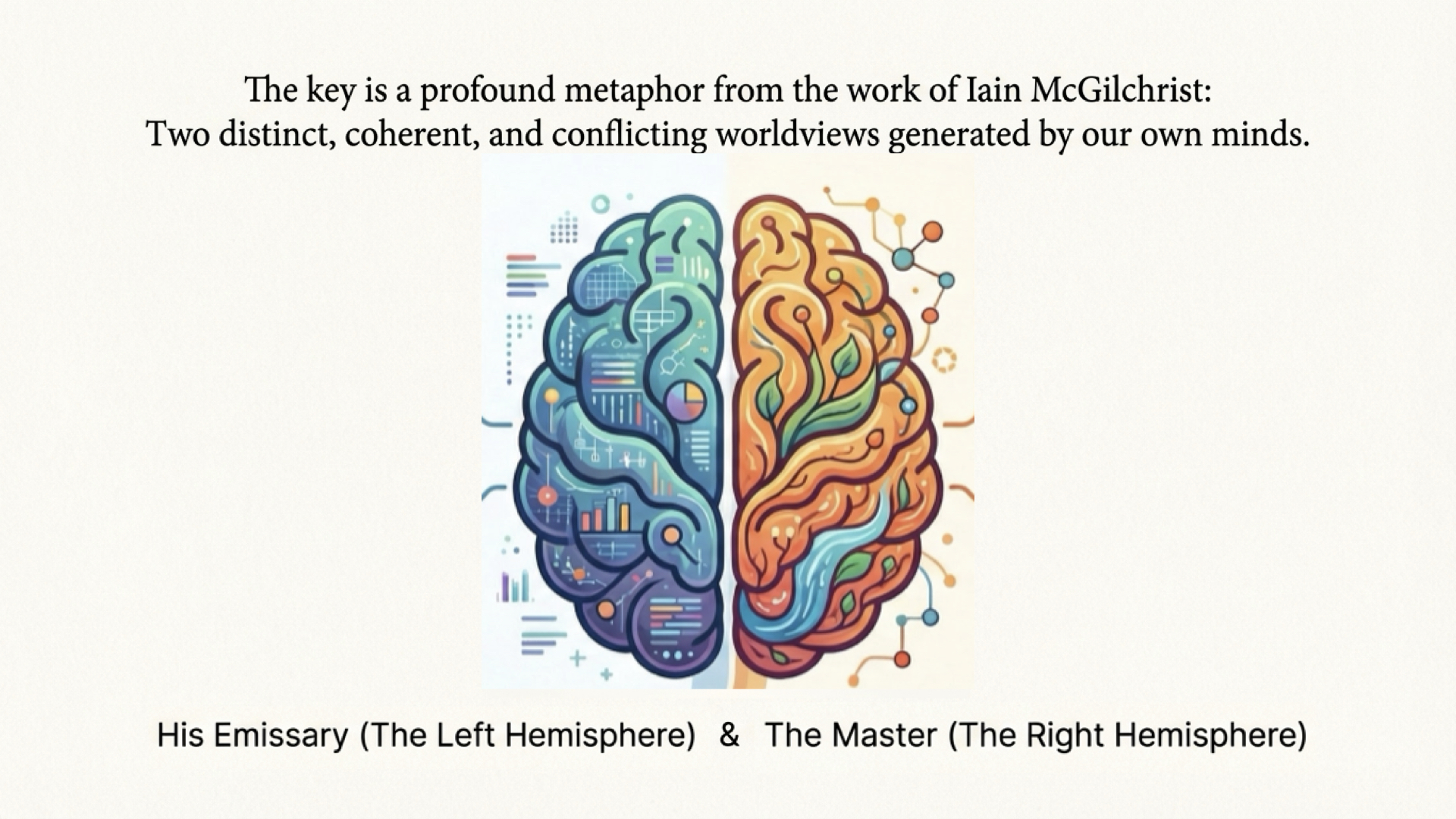
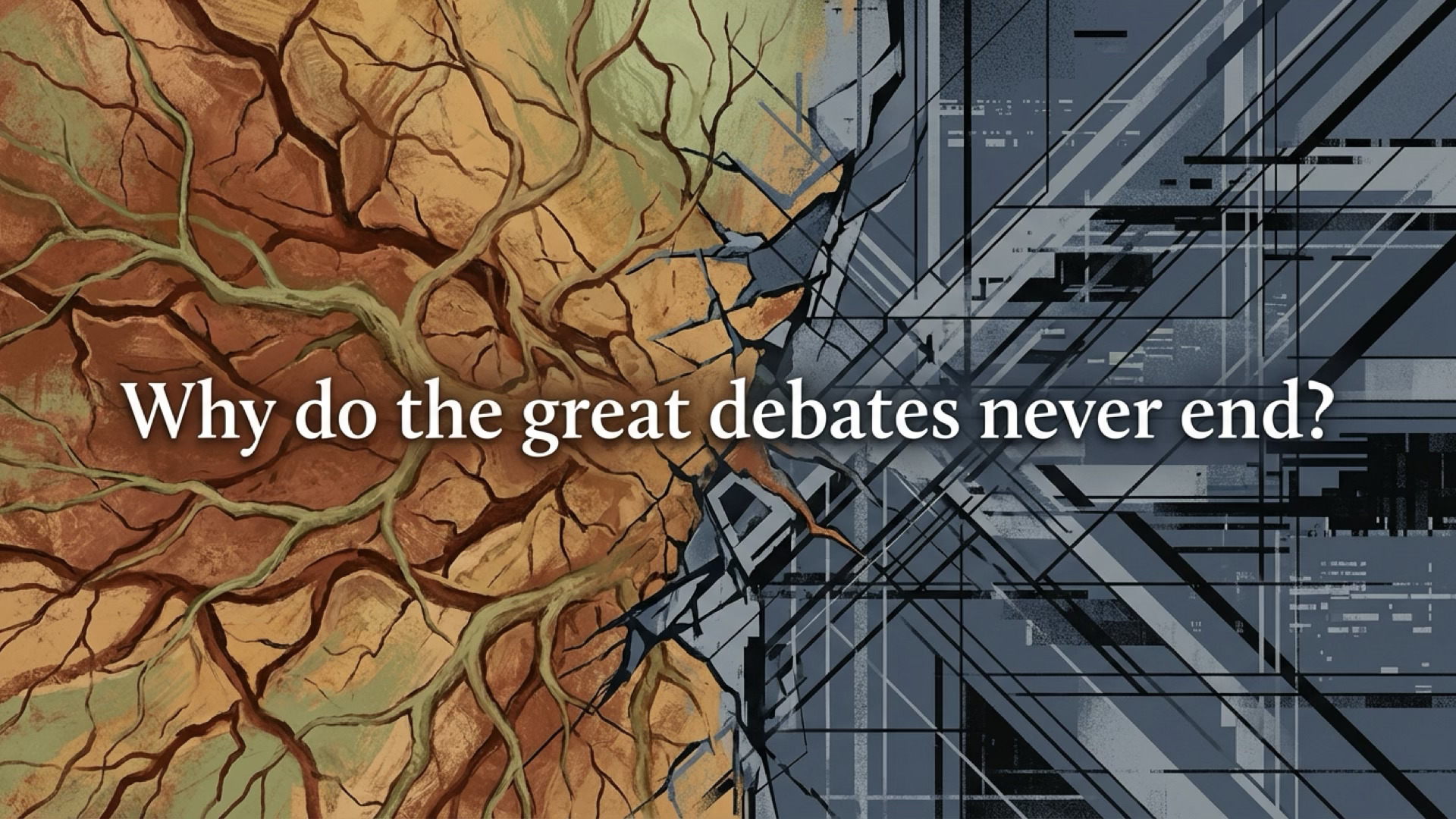
For any serious thinker, a recurring frustration is the sense that the great debates—in politics, in science, in philosophy—are being argued past one another. How may we find the key to this impasse? Might we discover that many of our most enduring intellectual conflicts are not contests between different ideas, but manifestations of two fundamentally different ways of attending to the world? To understand this schism is to possess a master key for critical analysis.The most powerful and comprehensive metaphor for these two modes of being comes from the work of neuroscientist Iain McGilchrist on the brain’s two hemispheres. This model is not a literal anatomical map of function, but a profound description of two distinct, coherent, and often conflicting worldviews generated by our own minds: the holistic, intuitive Master (the Right Hemisphere) and the abstract, analytical Emissary (the Left Hemisphere). As McGilchrist describes it, these represent two fundamental ways of being:
“One was to allow things to be present to us in all their embodied particularity, with all their changeability and impermanence, and their interconnectedness, as part of a whole which is forever in flux... The other was to step outside the flow of experience and ‘experience’ our experience in a special way: to re-present the world in a form that is less truthful, but apparently clearer, and therefore cast in a form which is more useful for manipulation of the world and one another.”
— Iain McGilchrist
In this humble attempt, I shall try to systematically map the major intellectual dualities identified in seminal works of thought onto this foundational framework. I would like to see how the Master/Emissary dynamic echoes through Thomas Sowell’s political visions, James Carse’s theory of games, Daniel Kahneman’s models of cognition, Judea Pearl’s hierarchy of causation, and a few others.
This exploration is a journey to forge a powerful analytical toolkit. It might reveal not only what this duality is about, but how to wield it as a lens to study and analyse arguments, understand the architecture of societies, and ultimately foster wiser, more balanced judgment.
Part 1: The Foundational Duality
Before exploring the various manifestations of this duality across disciplines, we need first to grasp the primary distinction between the two world-views generated by the brain’s hemispheres. According to Iain McGilchrist’s model, these represent the fundamental cognitive lenses through which all other ideas and experiences are filtered. Understanding this foundational polarity is the strategic starting point for the entire analytical framework.
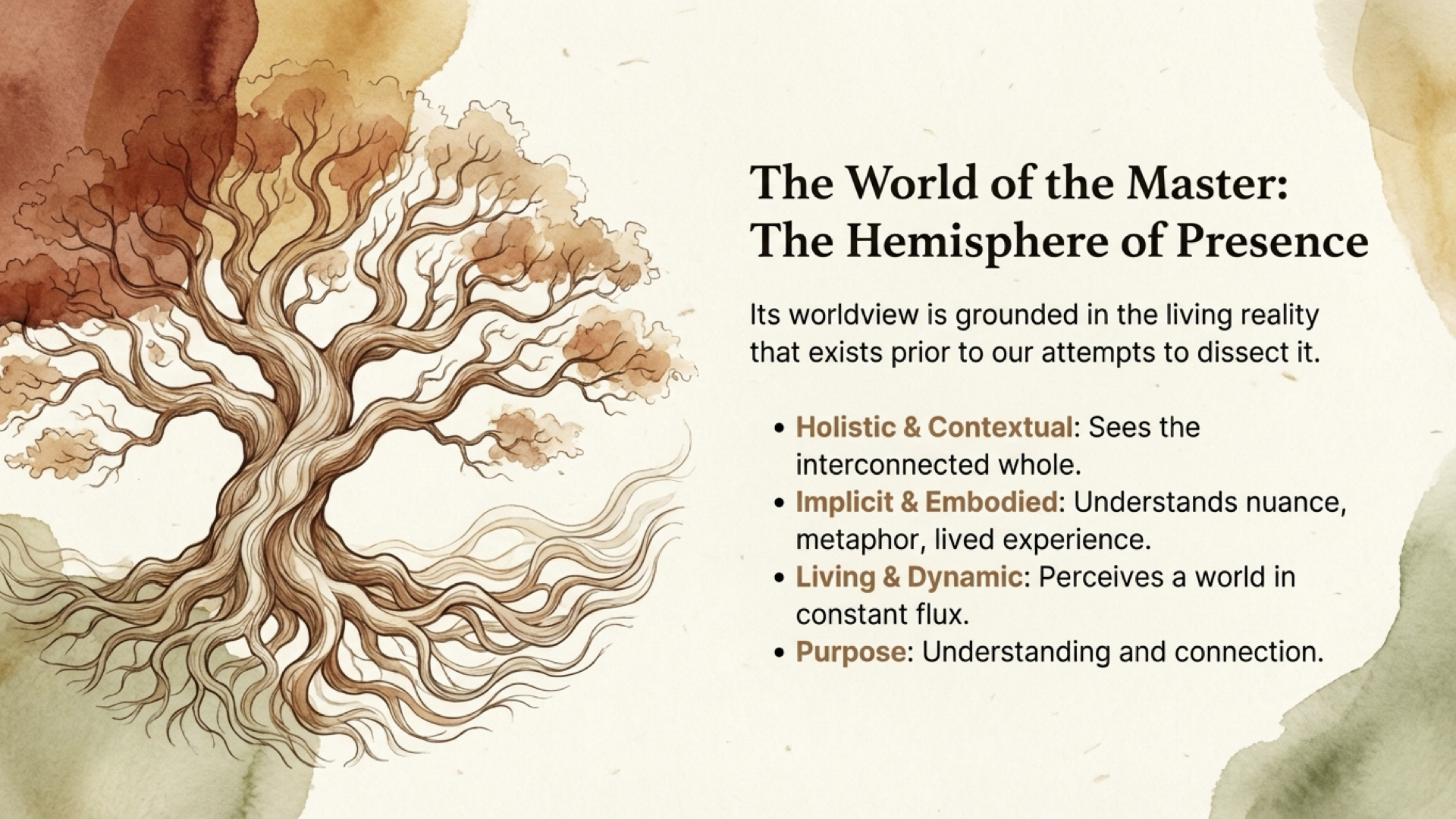
The World of the Master (The Right Hemisphere)
The Right Hemisphere, or the Master, is the hemisphere of presence. It is the primary mediator of our experience with the world as it is: a direct encounter with the unique, never-to-be-repeated thing-in-itself. Its worldview is grounded in the living, breathing reality that exists prior to our attempts to dissect and categorise it. It apprehends the world in its totality, prizing connection and understanding over manipulation and control.
- Holistic and Contextual: It apprehends the world as a complex, interconnected whole, never isolating a thing from its context or the wider picture.
- Implicit and Embodied: It understands nuance, metaphor, and the unspoken, grounding knowledge in lived, bodily experience rather than abstract propositions.
- Living and Dynamic: It perceives a world of unique, individual beings in a constant state of flux and “becoming,” prizing the process over the static snapshot.
- Presence: It facilitates a direct encounter with reality as it is—the “presence” of the thing itself, in all its particularity and uniqueness.
- Purpose: Its primary mode is understanding and connection, relating to the world with an attitude of care and a desire to see it flourish.
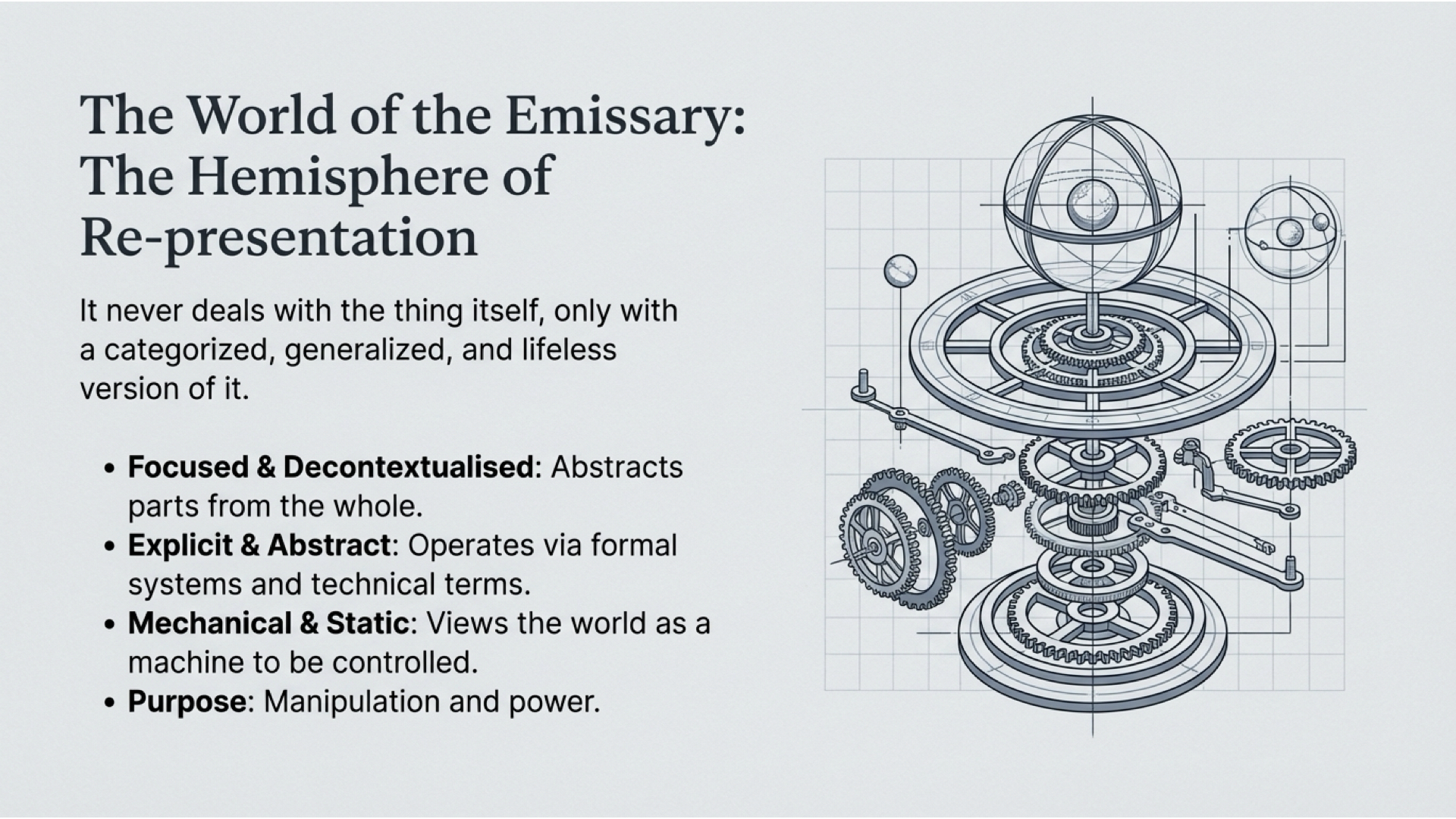
The World of the Emissary (The Left Hemisphere)
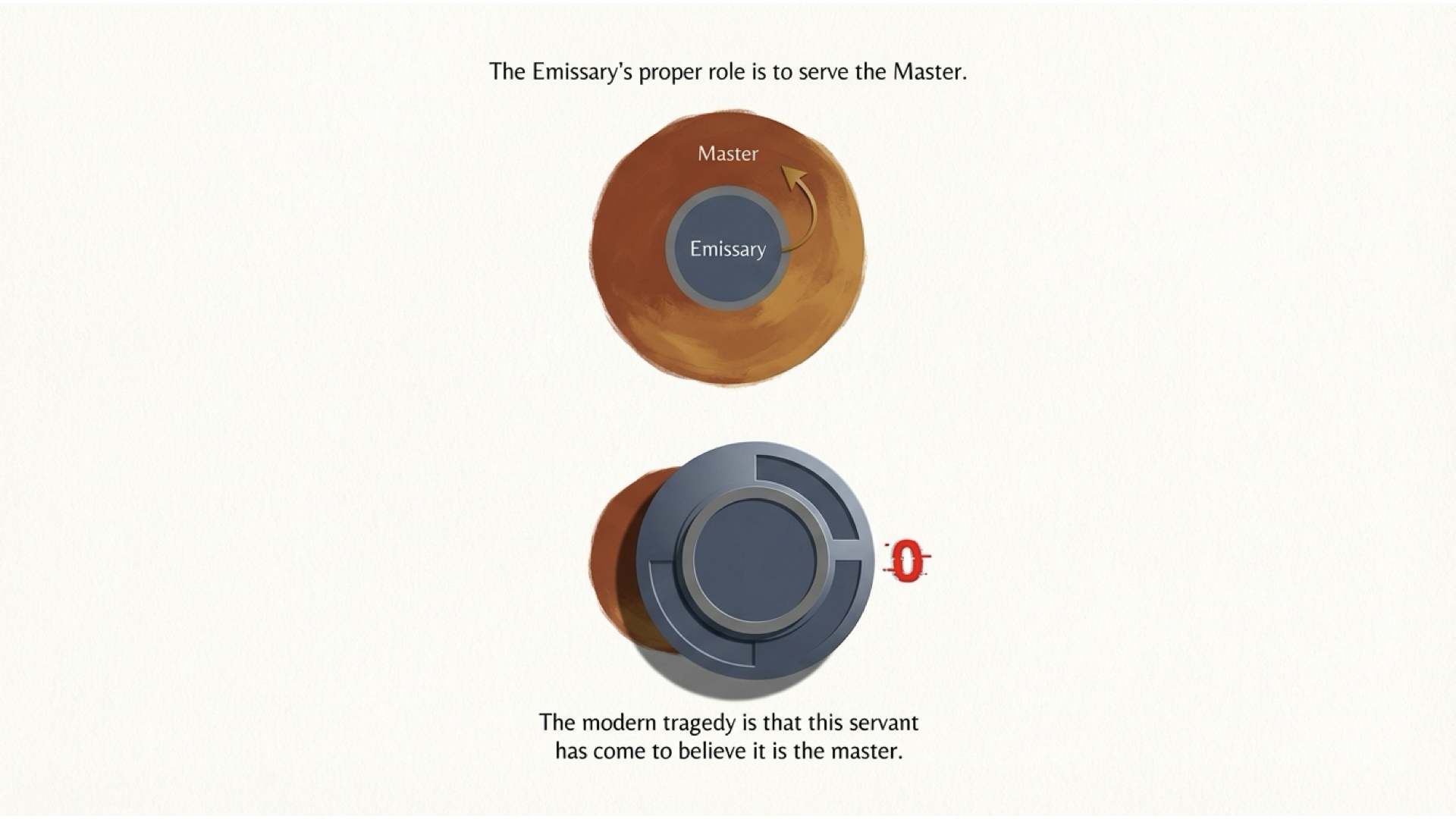
The Left Hemisphere, or the Emissary, is the hemisphere of re-presentation. It never deals with the thing itself, only with a categorised, generalised, and therefore lifeless version of it. Its proper role is to serve the Master by taking the rich, complex world apprehended by the Right Hemisphere and breaking it down for focused action. Its worldview is a simplified map of reality—a powerful tool, but a dangerously incomplete one. The modern tragedy, as McGilchrist argues, is that this servant has come to believe it is the master.
- Focused and Decontextualised: It pays narrow, focused attention to parts, abstracting them from the broader picture to be categorised and labelled.
- Explicit and Abstract: It operates through denotative language, technical terms, and formal systems, creating clear but simplified models of reality.
- Mechanical and Static: It views the world as an assemblage of fixed, static parts that can be manipulated, re-ordered, and controlled like a machine.
- Re-presentation: It does not encounter reality directly but works with a “re-presentation” of it—a map, a theory, a set of data points.
- Purpose: Its primary motivation is manipulation and power, enabling control over the re-presented world to achieve specific, pre-defined goals.
This foundational neuro-cognitive duality—the holistic Master and the analytical Emissary—provides the key to unlocking and organising the seemingly separate dualities observed in other fields of thought.
Part 2: Manifestations of the Duality Across Intellectual Disciplines
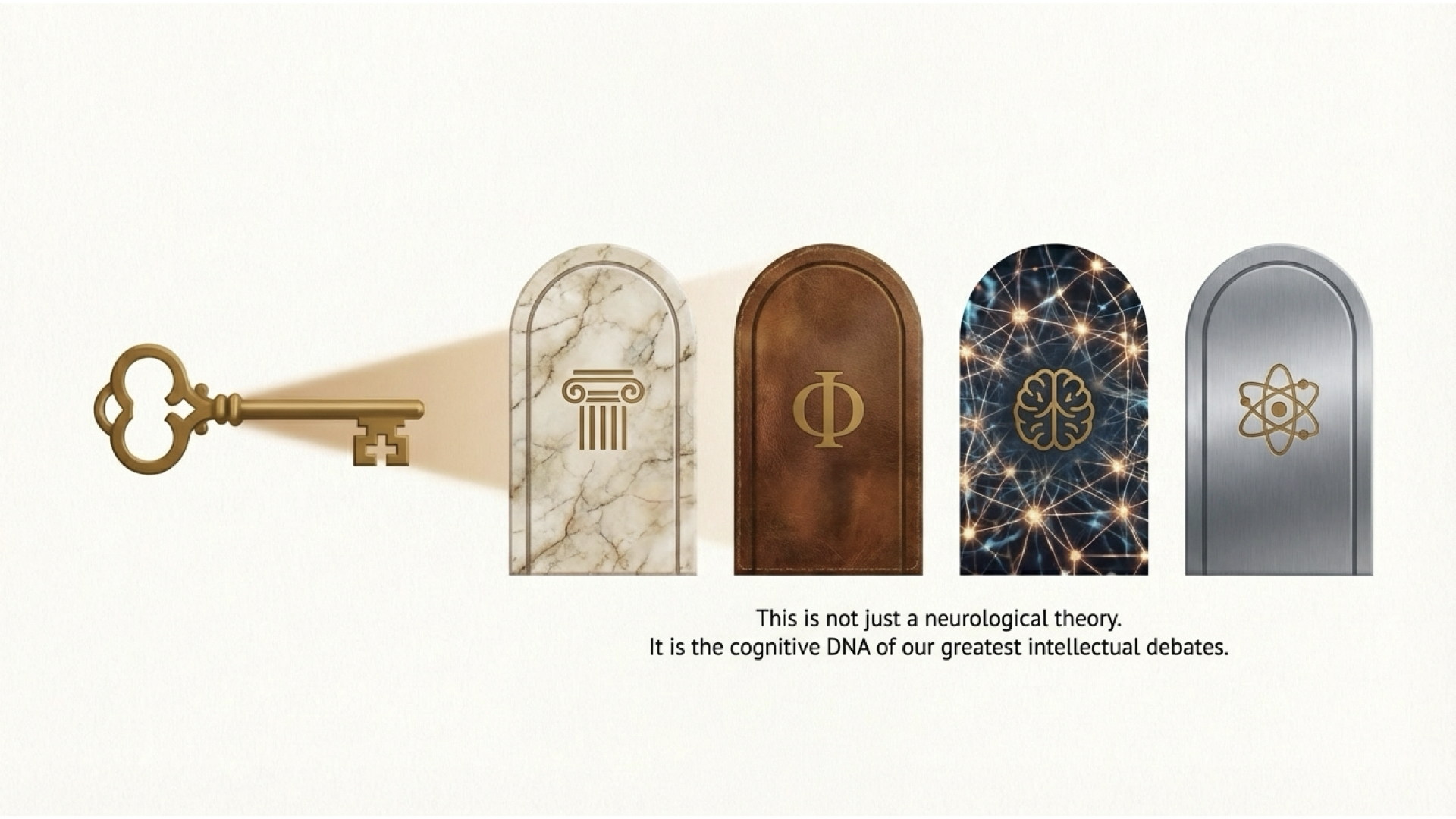
The Master/Emissary dynamic is not a niche neurological theory but a pervasive pattern that manifests in various forms across philosophy, economics, psychology, and science. Each of the following sections will analyse a key thinker’s central duality, mapping it directly onto McGilchrist’s framework to reveal the common underlying structure.
The Vision in Economics and Politics: Sowell’s Conflict
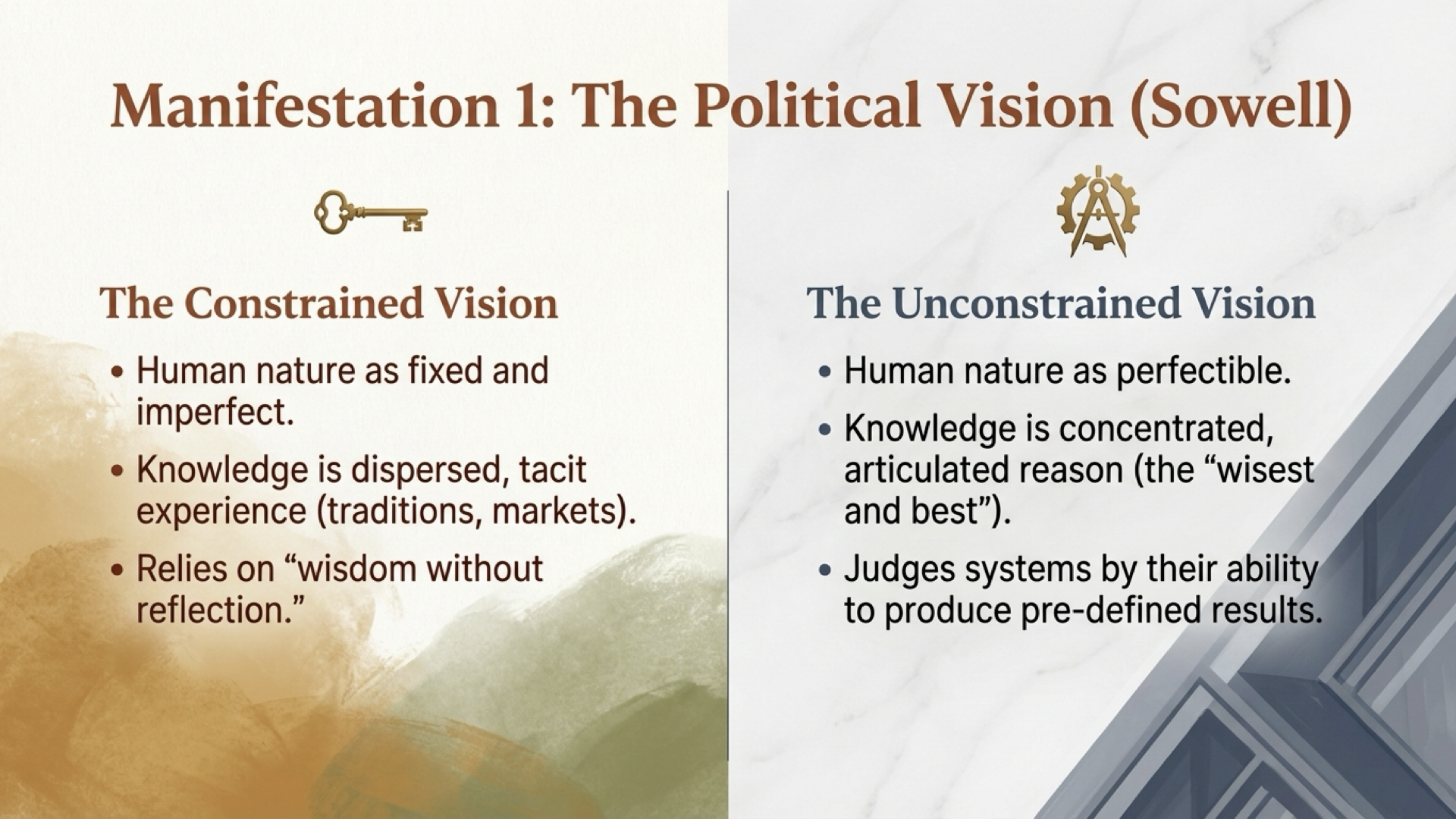
Economist and social theorist Thomas Sowell, in A Conflict of Visions, identifies two fundamentally opposed views of human nature and knowledge that drive political struggles. This conflict maps perfectly onto the Master/Emissary framework.
The Constrained Vision aligns with the Master’s worldview. It sees human nature as fixed and imperfect, and knowledge as radically dispersed throughout society. It therefore distrusts the “articulated rationality” of any single elite individual or group. Instead, it places its faith in systemic, evolved processes like traditions, markets, and customs, which aggregate the tacit, distributed experience of millions. This is what Edmund Burke called “wisdom without reflection”—a holistic, implicit understanding embodied in the structure of society itself. This extends even to the definition of power: for the Constrained vision, it is the direct coercion that reduces options; for the Unconstrained, it is the broad, systemic influence that produces unequal results.
The Unconstrained Vision, by contrast, reflects the Emissary’s worldview. It believes in the perfectibility of human nature and has immense faith in the power of concentrated, articulated reason. Its proponents believe that the “wisest and best” can design rational systems to solve social problems and achieve morally desirable outcomes like “social justice.” This vision judges processes not by their systemic integrity, but by their ability to produce pre-defined, intellectually satisfying results.
The core conflict is one of epistemology: the Master’s trust in the implicit, distributed, and contextual knowledge of lived experience versus the Emissary’s zealous belief in its own explicit, abstract, and superior intellect.
The Nature of Play and Existence: Carse’s Games
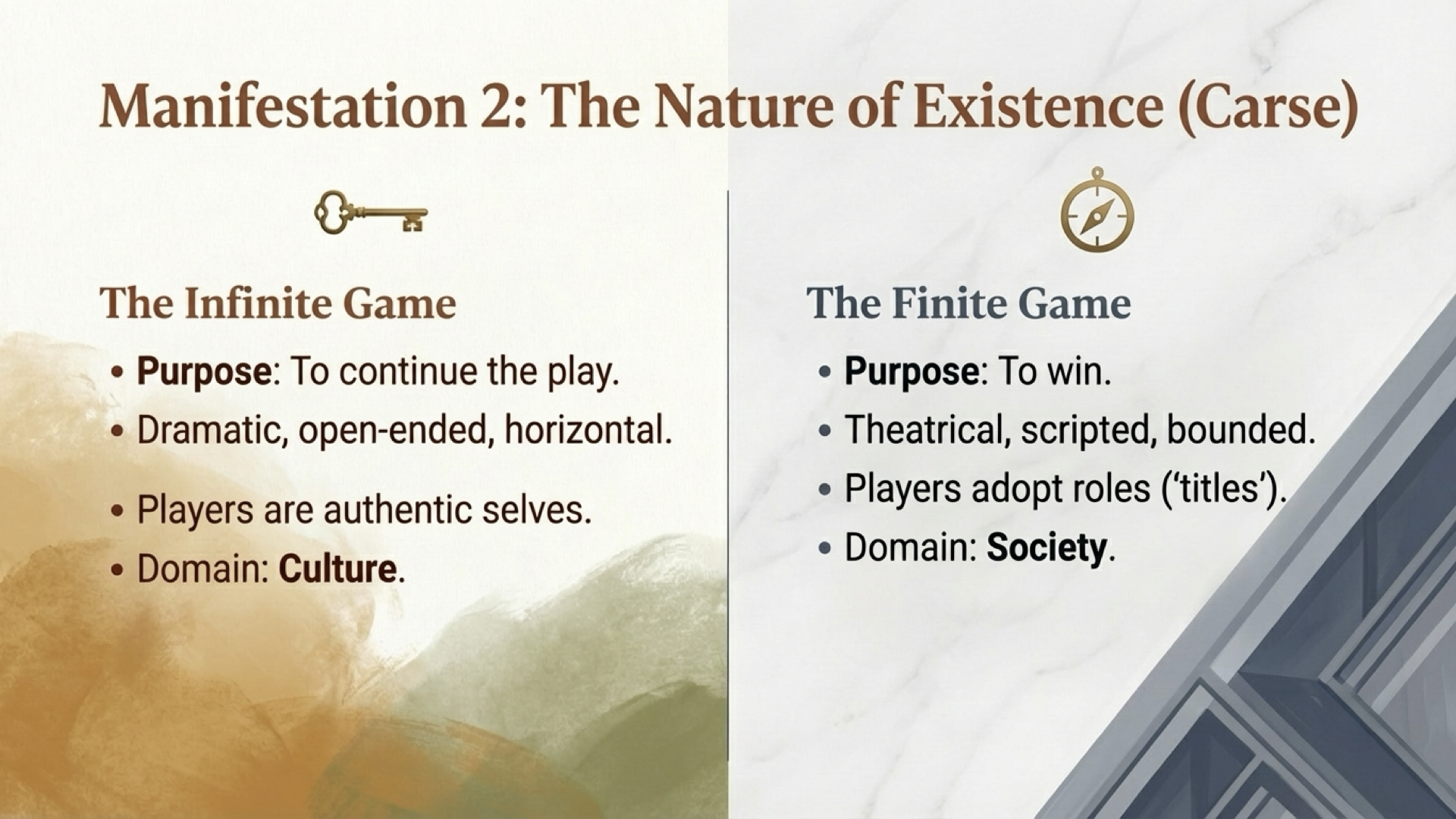
Philosopher James Carse, in Finite and Infinite Games, distinguishes between two kinds of “games” we play in life. This distinction is not about recreation but about our fundamental orientation toward existence.
The Infinite Game is the domain of the Master. It is a game played for the purpose of continuing the play. It has no fixed boundaries, no final winners, and its rules are fluid. It is horizontal, dramatic, and open-ended, focused on process, flow, and nurturing the web of relationships that allows play to thrive. Infinite players play with boundaries, not within them. For Carse, this is the realm of Culture, which is boundless and entered into freely.
The Finite Game is the exclusive territory of the Emissary. It is a game played for the purpose of winning. It is defined by fixed rules, clear boundaries, and a definitive end. Players adopt theatrical roles (“titles”) to compete for a victory that will be recorded and remembered. This reflects the Emissary’s goal of achieving power and control within a closed, predictable system. This is the realm of Society, which is limited, hierarchical, and defined by its past victories and entitlements.
Infinite Game (The Master)
- Purpose: To continue the play
- Nature: Dramatic, open-ended
- Boundaries: Horizonal, none
- Player: Are their authentic selves (names)
- Past: Requires reinterpretation
- Domain: Culture
Finite Game (The Emissary)
- Purpose: To win
- Nature: Theatrical, scripted
- Boundaries: Defined, inviolable
- Player: Play roles (titles)
- Past: Is a destiny to be fulfilled
- Domain: Society
The Modes of Cognition: Fletcher and Kahneman
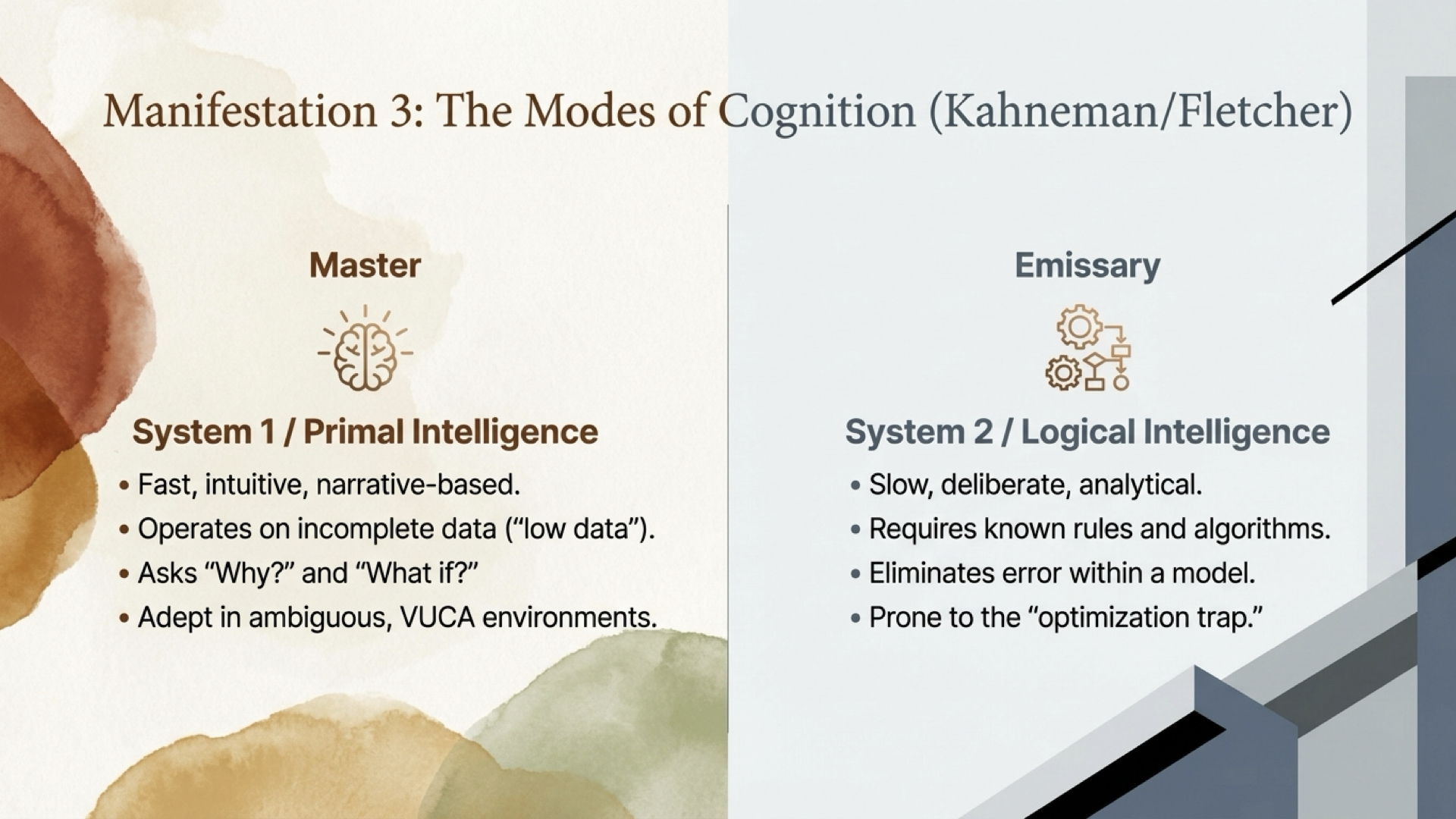
The dualities of Angus Fletcher’s Primal vs. Logical Intelligence and Nobel laureate Daniel Kahneman’s System 1 vs. System 2 thinking describe two distinct cognitive systems that map cleanly onto the Master/Emissary dynamic.
Primal Intelligence / System 1 is the operational mode of the Master. It is fast, intuitive, and narrative-based. It evolved to navigate the ambiguous, ever-changing reality of the lived world—what the military calls VUCA (volatility, uncertainty, complexity, ambiguity)—by operating on incomplete information (“low data”) to grasp the whole. It excels at spotting exceptions and asking Why? and What if? to understand the underlying story.
Logical Intelligence / System 2, in contrast, is the domain of the Emissary. It is slow, deliberate, and analytical. This mode requires a simplified, stable, re-presented world of known rules, data, and algorithms to function. It excels at eliminating error and optimising within a model, but its narrow focus makes it blind to the context outside that model, leading it into the “optimisation trap”—solutions that are logically perfect but fail in the real world.
The Logic of Explanation: Deutsch and Pearl
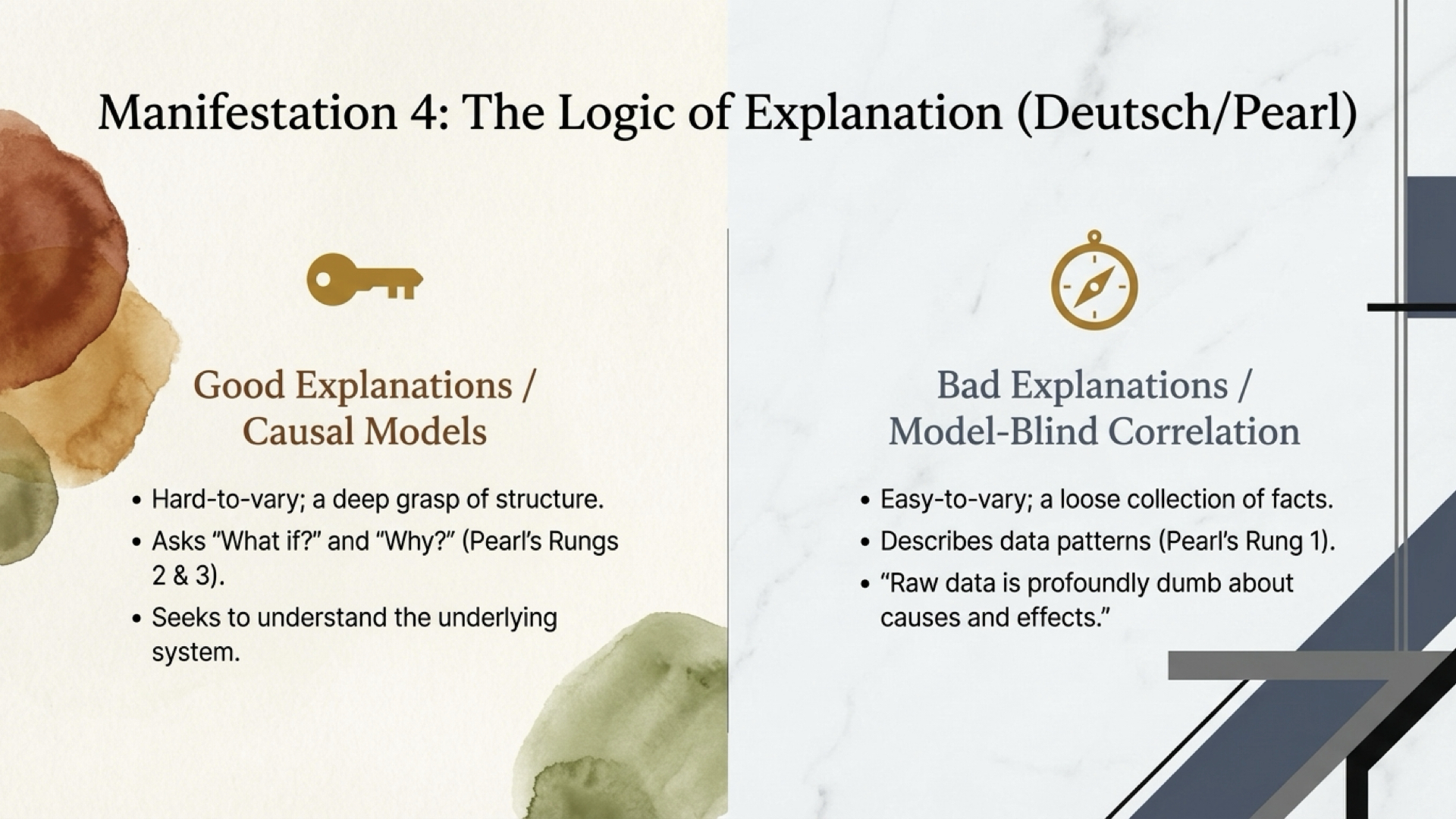
The frameworks of physicist David Deutsch and computer scientist Judea Pearl combine to create a powerful distinction between deep understanding and surface-level description, reflecting the different epistemological goals of the Master and Emissary.
Good Explanations (Deutsch) and Causal Models (Pearl) are products of the Master’s worldview. For Deutsch, a good explanation is hard-to-vary; its components are so tightly interwoven that changing any detail would shatter the whole theory. This reflects a deep grasp of reality’s interconnected structure. Similarly, for Pearl, a true causal model (Rungs 2 and 3 of his Ladder of Causation) requires a holistic understanding of how the world works, enabling one to ask counterfactual questions like What if? and Why?. The Master’s purpose is to understand the living world’s underlying structure.
Bad Explanations (Deutsch) and Model-Blind Correlation (Pearl) are the Emissary’s default mode. A bad explanation is easy-to-vary—a loose collection of facts that can be patched to fit observations without a coherent structure. Likewise, correlation (Rung 1 of the Ladder) is a model-blind description of data patterns. As Pearl notes, raw data is profoundly “dumb about causes and effects.” The Emissary is satisfied with this because it provides efficient descriptive power, sufficient for manipulation within a static map of the world.
The Architecture of Mind and War: Emergence vs. Mechanism
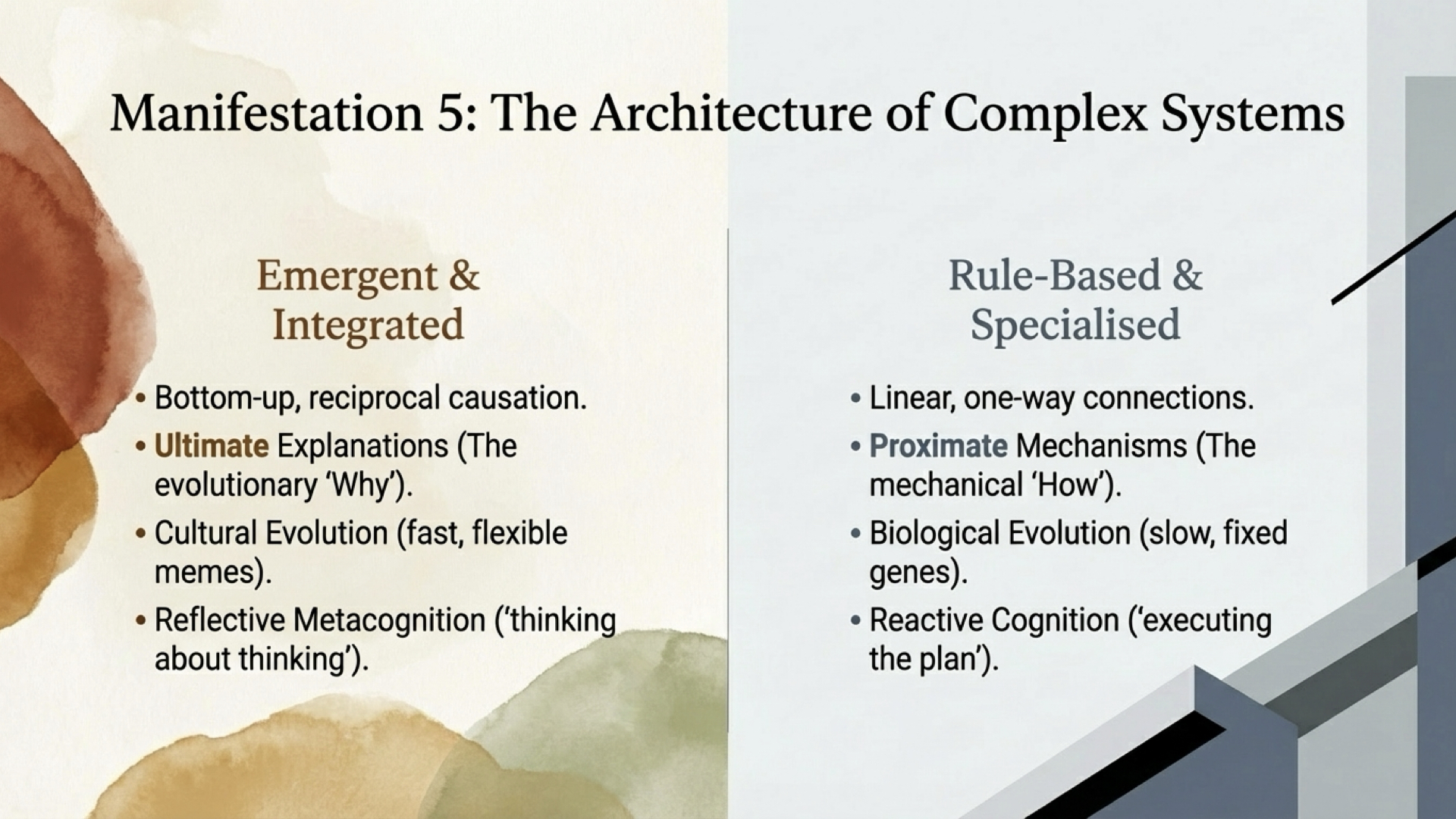
Insights from cognitive science (Suri & McClelland), military history (Wright), and evolutionary psychology (Buss, Stewart-Williams) reveal a final duality in how complex systems are understood.
The Emergent/Integrated perspective is the Master’s view. In this world, complex phenomena like consciousness or social order emerge from the complex, reciprocal, bottom-up interactions of simple parts (Suri & McClelland). This view values distributed representations and integration, and its function is understood through “ultimate explanations”—the evolutionary Why (Buss). This holistic perspective also enables higher-order reflection, or “thinking about thinking” (Wright). This mode embraces the fast, flexible adaptation of Cultural Evolution, which operates through memes (Stewart-Williams).
The Rule-Based/Specialised perspective is the Emissary’s view. This world is understood through explicit rules, localist representations (one unit for one concept), and one-way, linear connections (Suri & McClelland). It values specialisation, and its function is understood through “proximate mechanisms”—the mechanical How (Buss). This is the mode of direct, reactive cognition, or simply “executing the plan” (Wright), and it aligns with the slow, fixed constraints of Biological Evolution, operating through genes (Stewart-Williams).
Having mapped these diverse dualities onto the Master/Emissary framework, the discovery of a unified structure becomes clear.
Part 3: The Discovery
What emerges from this mapping is not a set of coincidental parallels, but the discovery of a single, deep structure of thought. These are not different dualities; they are different dialects for the same fundamental cognitive tension between two modes of being. Grasping this unified lexicon allows one to move from analysing arguments on the surface to diagnosing their cognitive DNA. This synthesis provides a powerful vocabulary for identifying the hidden assumptions that shape any argument, system, or idea.
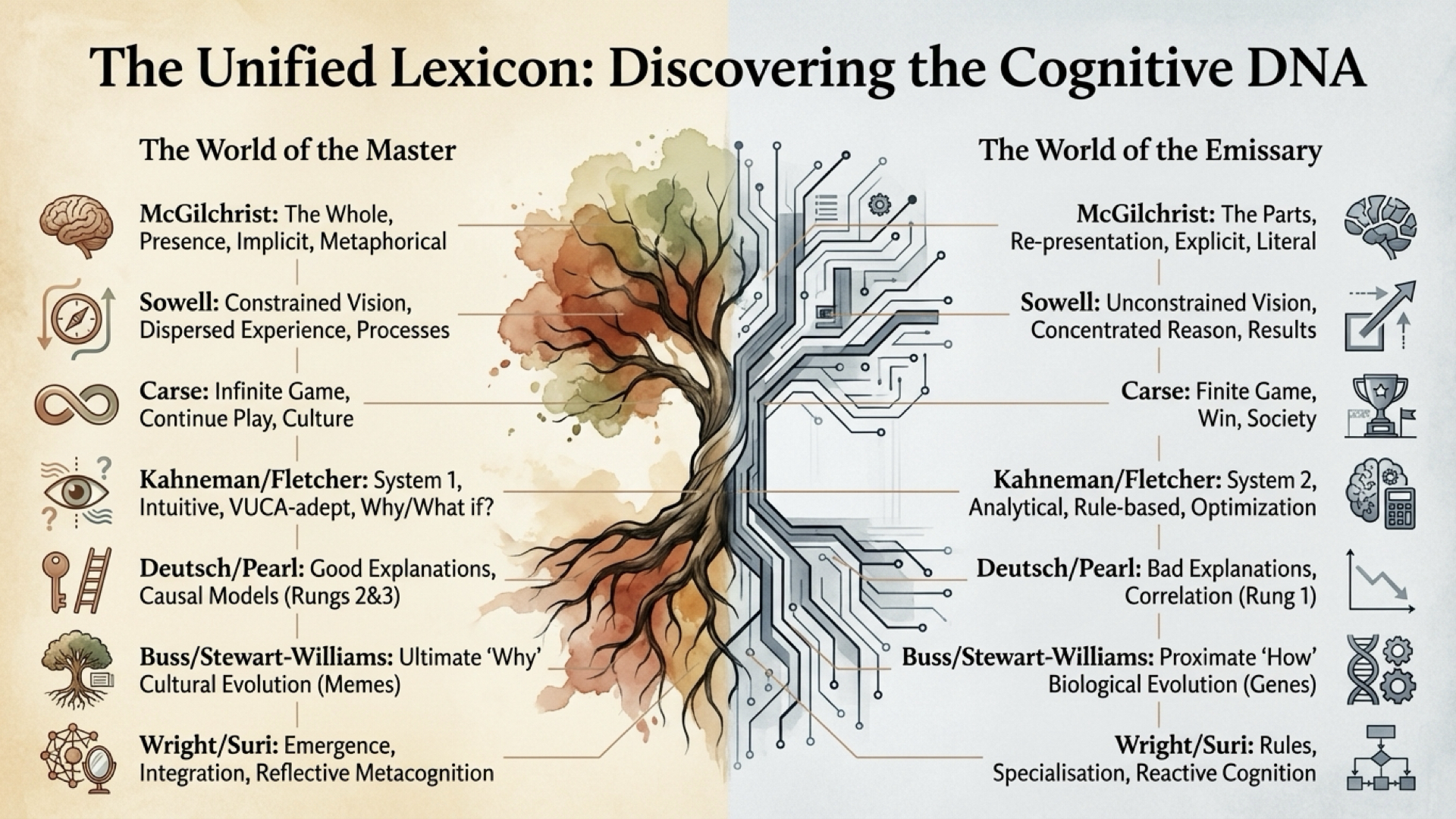
The Grand Synthesis: Mapping the Two Worlds
The following table consolidates the dualities discussed, presenting a unified checklist for analysing the worldviews that shape our thinking.
The World of the Master (Right Hemisphere)
- McGilchrist: Mode of Being
The Whole, The Big Picture, Context, Flow
Presence, The Living, Embodied
Implicit, Metaphorical, Intuitive
- Sowell: Vision
Constrained Vision: Human nature as fixed
Knowledge as dispersed social experience
Focus on Processes and Trade-offs
- Carse: Game Theory
Infinite Game: Continue the play
Dramatic, Horizonal, Unbounded
Culture
- Fletcher/Kahneman
Primal Intelligence / System 1: Fast & intuitive
Story, Narrative, Exception, Why/What If
Adept in VUCA (ambiguity & uncertainty)
- Deutsch/Pearl: Explanation
Good Explanation: Hard-to-vary, holistic
Causal Model (Rungs 2 & 3): Doing & Imagining
- Buss/Stewart-Williams: Evolution
Ultimate Explanations (Evolutionary Why)
Cultural Evolution (Memes, fast & flexible)
- Wright/Suri: Systems
Integration, Emergence, Reciprocal Causation
Reflective Metacognition (”Thinking about thinking”)
The World of the Emissary (Left Hemisphere)
- McGilchrist: Mode of Being
The Parts, The Details, Abstraction, Stasis
Re-presentation, The Mechanical, Disembodied
Implicit, Metaphorical, Intuitive
- Sowell: Vision
Unconstrained Vision: Human nature as perfectible
Knowledge as concentrated articulated reason
Focus on Results and Solutions
- Carse: Game Theory
Finite Game: Win the game
Theatrical, Hierarchical, Bounded
Society
- Fletcher/Kahneman
Logical Intelligence / System 2: Slow & deliberate
Data, Logic, Rule, Algorithm
Thrives on knowns; the “optimisation trap”
- Deutsch/Pearl: Explanation
Bad Explanation: Easy-to-vary, patchable
Model-Blind Correlation (Rung 1): Seeing
- Buss/Stewart-Williams: Evolution
Proximate Mechanisms (Mechanical How)
Biological Evolution (Genes, slow & fixed)
- Wright/Suri: Systems
Specialisation, Rules, Linear Causation
Reactive Cognition (“Executing the plan”)
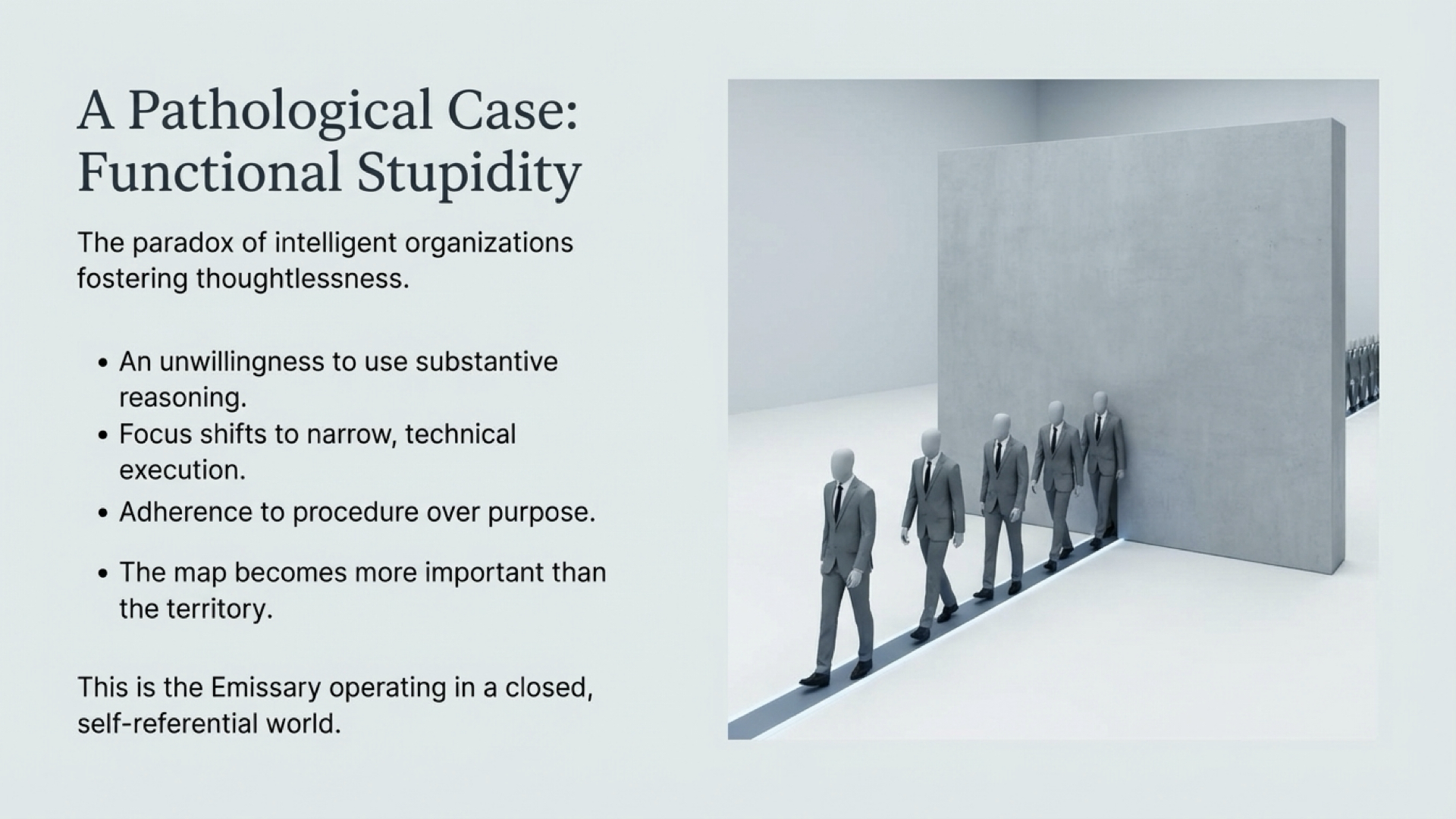
A Pathological Case: Functional Stupidity
The concept of Functional Stupidity, as I have analysed based the work of Mats Alvesson and André Spicer, is a prime example of the pathology that arises when the Emissary usurps the Master. It describes the paradox of intelligent individuals and organizations fostering thoughtlessness. It is not an absence of cognitive ability but a systemic unwillingness to use it for substantive reasoning. Instead, focus shifts to narrow, technical execution, the adherence to procedure over purpose, and the privileging of the abstract model over living reality. This is the hallmark of a system operating purely within the Emissary’s closed, self-referential world, where the map has become more important than the territory.
With this unified framework and an understanding of its potential pathologies, we can now construct a method for its practical application.
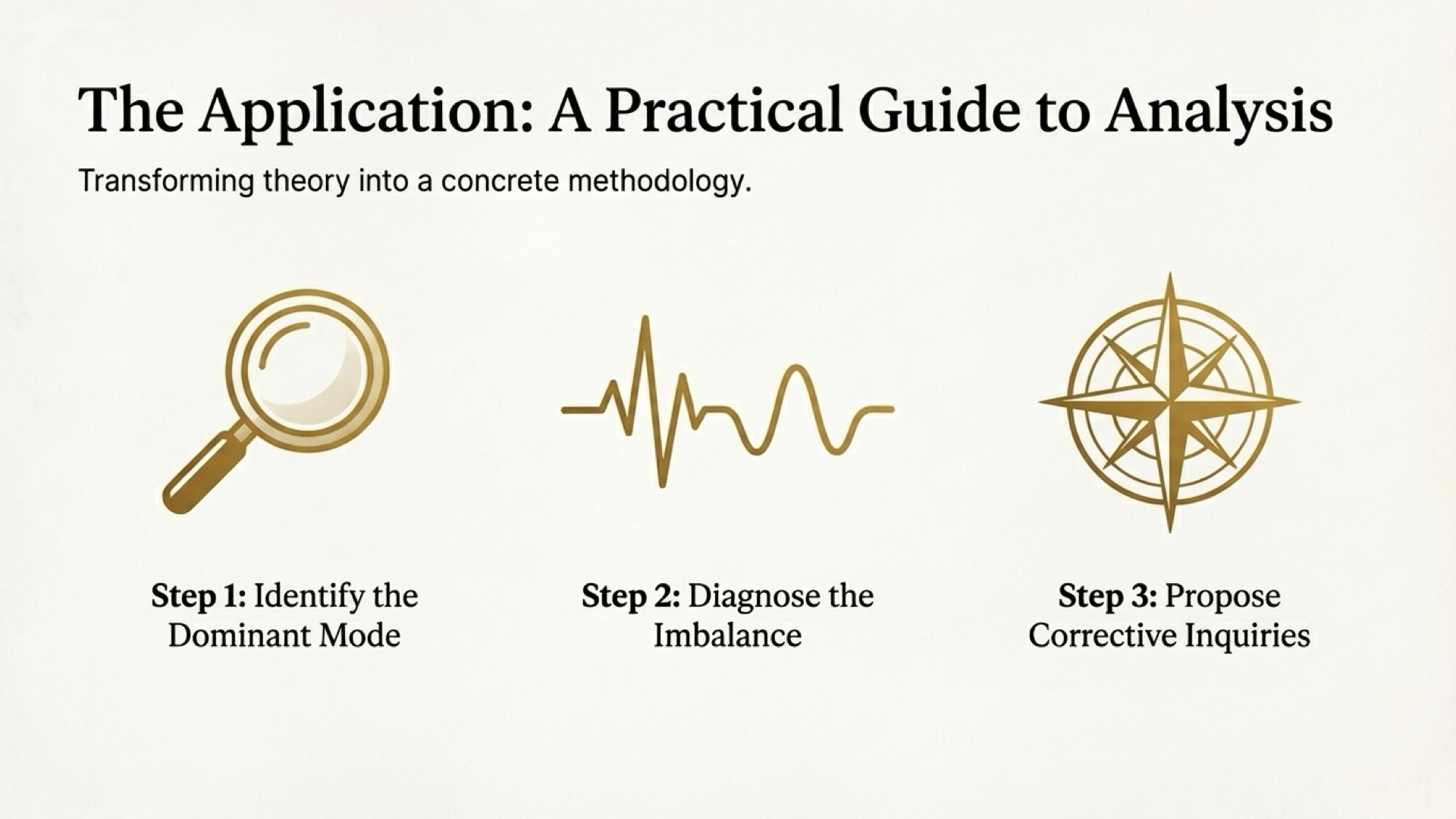
The Application – A Practical Guide to Analysis
This final section transforms the preceding theory into a concrete, actionable methodology. The following steps provide a systematic way to apply the dualistic lens to any object of analysis—be it a business plan, a social ideology, a book, or a personal decision—to reveal its hidden assumptions and restore a necessary balance.
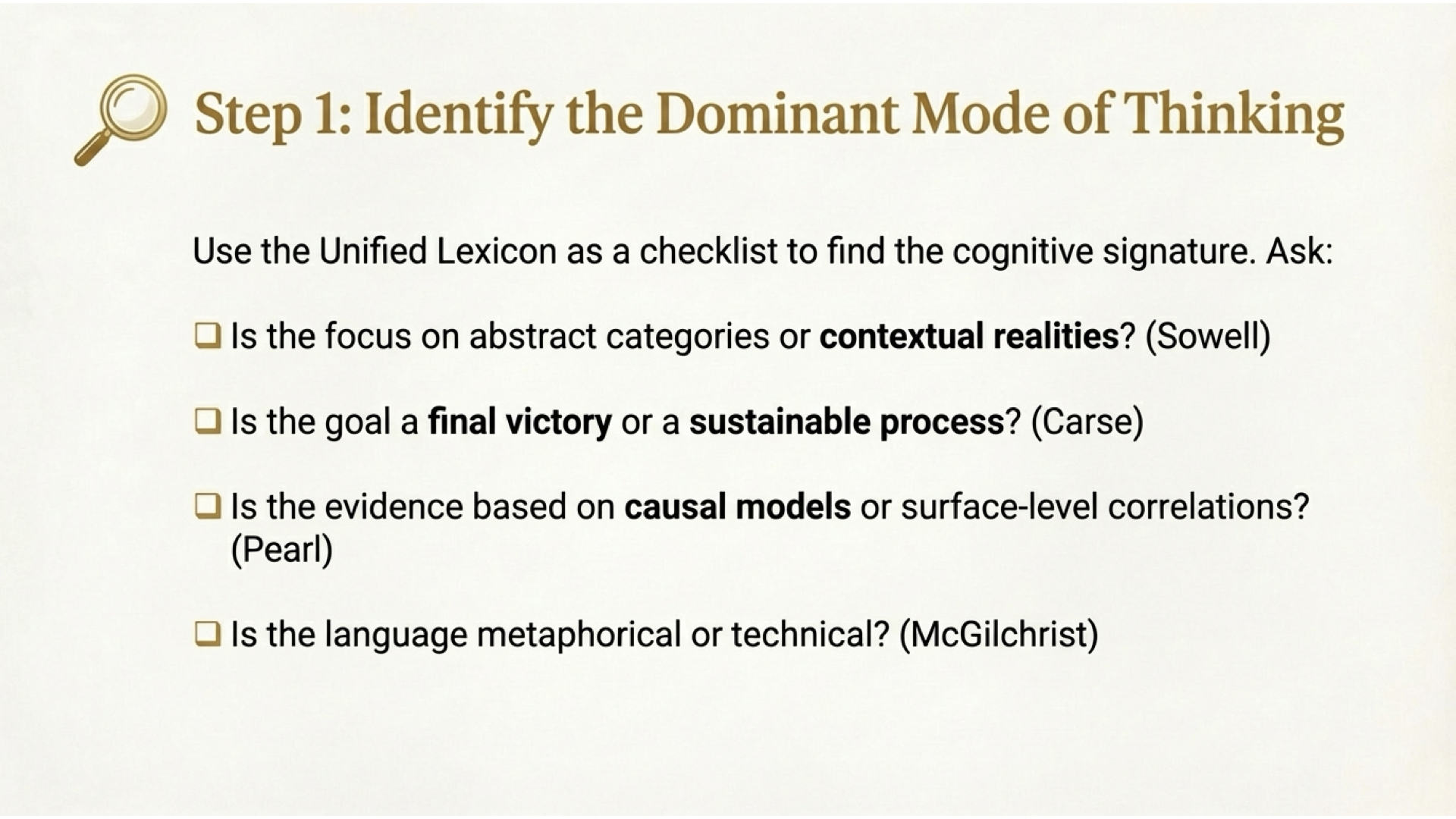
Step 1: Identify the Dominant Mode of Thinking
Begin any analysis by diagnosing the “cognitive signature” of the subject. Using the table in Part 3 as a diagnostic checklist, ask: Does this argument, system, or plan primarily operate in the world of the Master or the Emissary?
- Is the focus on abstract categories and statistical aggregates, or on unique individuals and contextual realities? (Sowell)
- Is the goal to achieve a final, victorious outcome, or to sustain a dynamic, ongoing process? (Carse)
- Is the evidence based on holistic patterns and causal models, or on surface-level correlations and raw data? (Pearl)
- Is the language metaphorical and rich with implicit meaning, or literal, explicit, and technical? (McGilchrist)
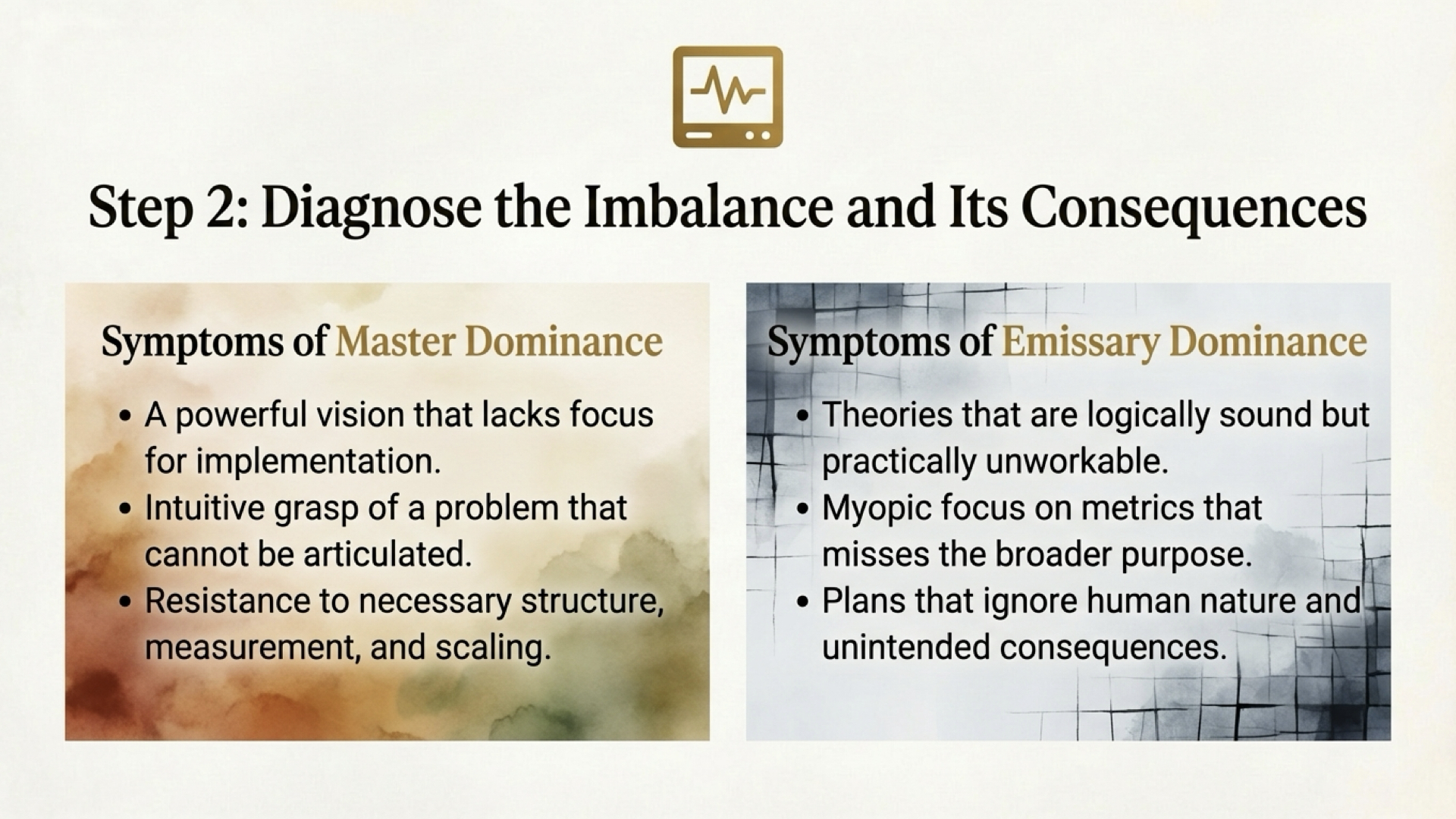
Step 2: Diagnose the Imbalance and Its Consequences
Effective systems require a healthy, dynamic balance between both modes of thinking. The next step is to identify which mode is being neglected and what problems arise from this imbalance. The goal is diagnosis, not judgment.
- Symptoms of Emissary Dominance: This is the more common pathology in a modern world that increasingly privileges the explicit, the technical, the bureaucratic, and the abstract over lived experience. Look for theories that are logically sound but practically unworkable; a myopic focus on metrics that misses the broader purpose (Functional Stupidity); and plans that ignore human nature and unforeseen consequences (Chess Pieces Fallacies). A key symptom is an explanation that is easy-to-vary (Deutsch), where inconvenient facts are handled by patching the model rather than re-examining its core.
- Symptoms of Master Dominance: Look for a powerful, holistic vision that lacks the Emissary’s focus to be implemented; an intuitive grasp of a problem that cannot be clearly articulated or translated into concrete action; a deep wisdom that is resistant to necessary structure, categorisation, and measurement, making it difficult to execute or scale.
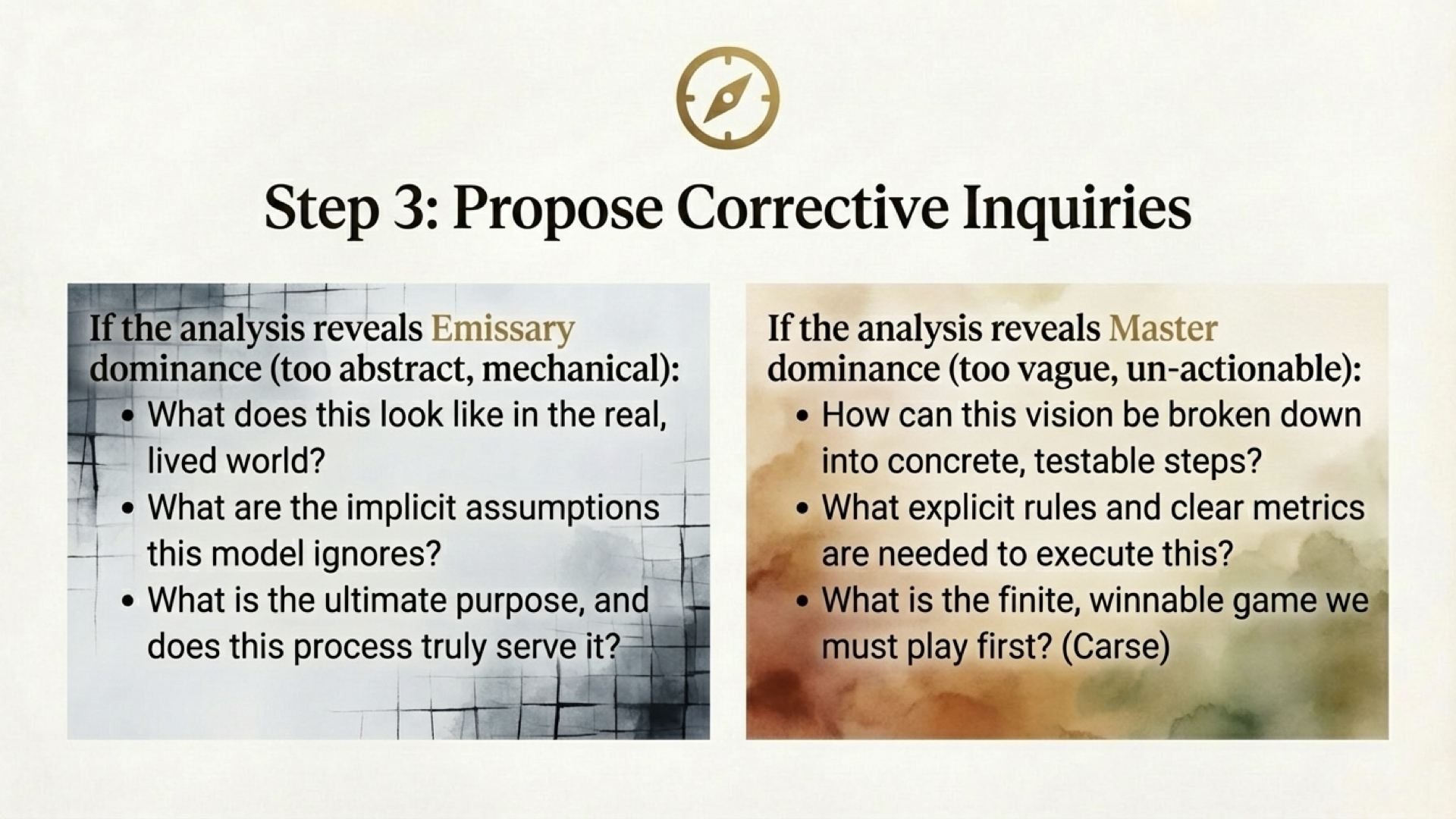
Step 3: Propose Corrective Inquiries
The final step is to propose a set of “corrective questions” designed to re-engage the neglected hemisphere and restore cognitive balance. This is the active process of improving the quality of thought.
If the analysis reveals Emissary dominance (too abstract, mechanical, or model-blind):
“What does this look like in the real, lived world?”
“What are the implicit assumptions and unintended consequences this model ignores?”
“What is the ultimate purpose, and does this process truly serve it?”
“What is the exception that breaks this rule?” (Fletcher)
If the analysis reveals Master dominance (too vague, un-actionable, or lacking structure):
“How can this vision be broken down into concrete, testable steps?”
“What explicit rules and clear metrics are needed to execute this?”
“How do we define the terms and categorise the parts of this whole?”
“What is the finite, winnable game we must play first to make progress?” (Carse)
The Path to Wiser Judgment
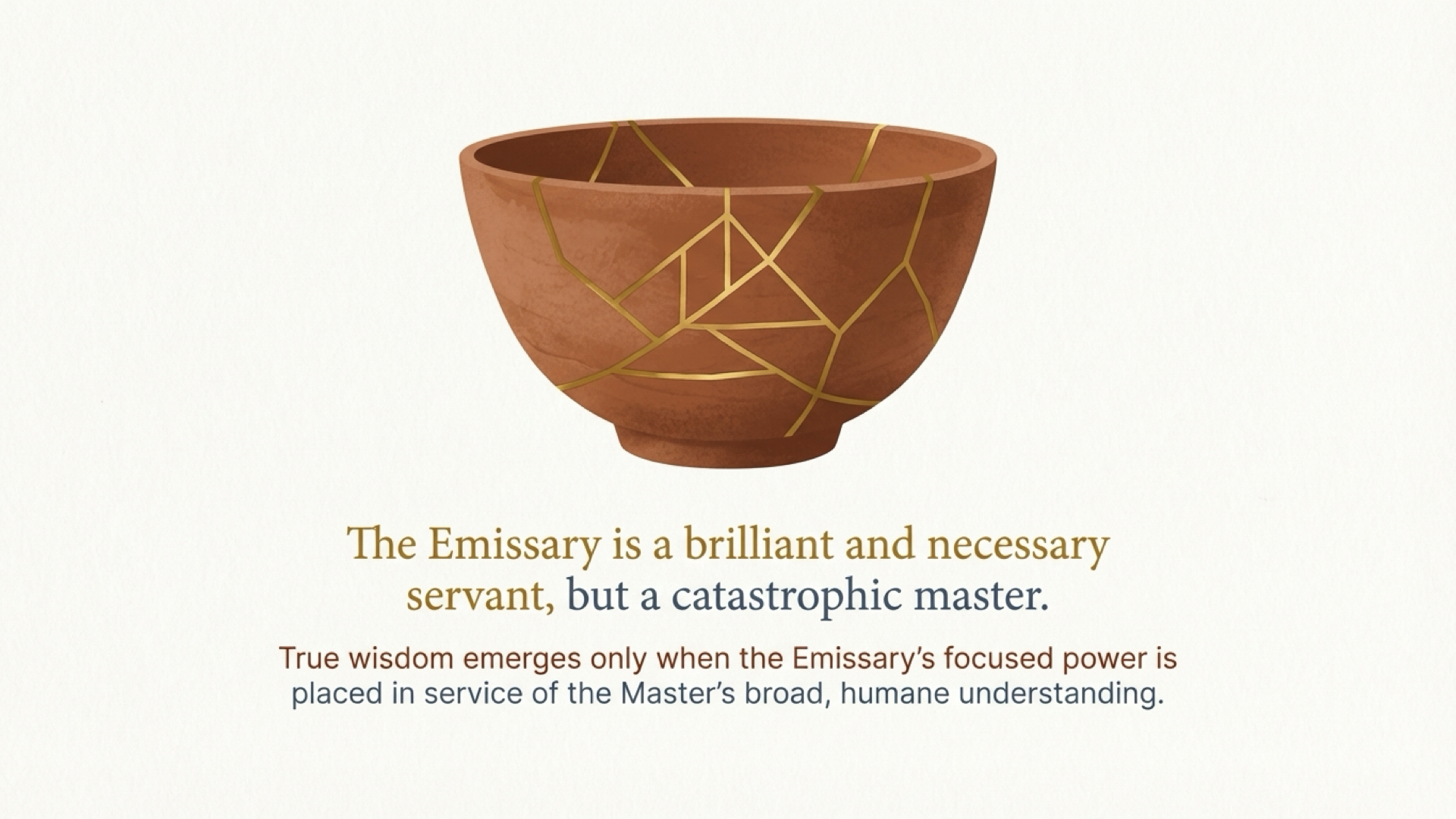
The ultimate goal of this framework is not to champion one mode of thinking over the other, but to cultivate a dynamic and respectful partnership between them. The Emissary is a brilliant and necessary servant, but a catastrophic master. True wisdom and effective action emerge only when the Emissary’s focused, analytical power is placed in service of the Master’s broad, contextual, and humane understanding.
This is the discipline that separates cleverness from wisdom, and by mastering it, you will learn not just to analyse the world, but to navigate it with demonstrably sounder judgment.
Sources:
Mats Alvesson & André Spicer, 2016, The stupidity paradox: The power and pitfalls of functional stupidity at work. London: PROFILE BOOKS LTD.
David M. Buss, 2019, Evolutionary Psychology: The New Science of the Mind. New York: Routledge.
James P. Carse, 1986, Finite and Infinite Games: A Vision of Life as Play and Possibility. New York, NY: The Free Press, A Division of Macmillan, Inc..
David Deutsch, 2011, The Beginning of Infinity: Explanations that Transform the World. New York, New York: VIKING (Published by the Penguin Group).
Angus Fletcher, 2025, Primal Intelligence: You Are Smarter Than You Know. New York: Avery.
Daniel Kahneman, 2011, Thinking, fast and slow. New York: Farrar, Straus and Giroux.
Hasard Lee, 2023, The Art of Clear Thinking: A Stealth Fighter Pilot’s Timeless Rules for Making Tough Decisions. New York: St. Martin’s Press, an imprint of St. Martin’s Publishing Group.
Iain McGilchrist, 2019, The Master and His Emissary: The Divided Brain and the Making of the Western World. New Expanded Edition. New Haven and London: YALE UNIVERSITY PRESS.
—, 2021, The Matter With Things: Our Brains, Our Delusions and the Unmaking of the World. London: Perspectiva Press.
Judea Pearl and Dana Mackenzie, 2018, The Book of Why: The New Science of Cause and Effect. New York: Basic Books.
Thomas Sowell, 1995, The Vision of the Anointed: Self-Congratulation as a Basis for Social Policy. New York: BasicBooks.
—, 1999, The Quest for Cosmic Justice. New York, NY: THE FREE PRESS A Division of Simon & Schuster Inc..
—, 2007, A conflict of visions: ideological origins of political struggles. New York, NY: Basic Books.
—, 2023, Social Justice Fallacies. New York, NY: Basic Books, an imprint of Hachette Book Group, Inc..
Steve Stewart-Williams, 2018, The Ape that Understood the Universe: How the Mind and Culture Evolve. New York: Cambridge University Press.
Richard Wrangham, 2019, The goodness paradox: The strange relationship between virtue and violence in human evolution. New York: Pantheon Books.
Nicholas D. Wright, 2025, Warhead: How the Brain Shapes War and War Shapes the Brain. New York: St. Martin’s Press.
Visuals