The Tragedy of the Gaza Selfies
Feeling good, not doing good
By Khaled Salih
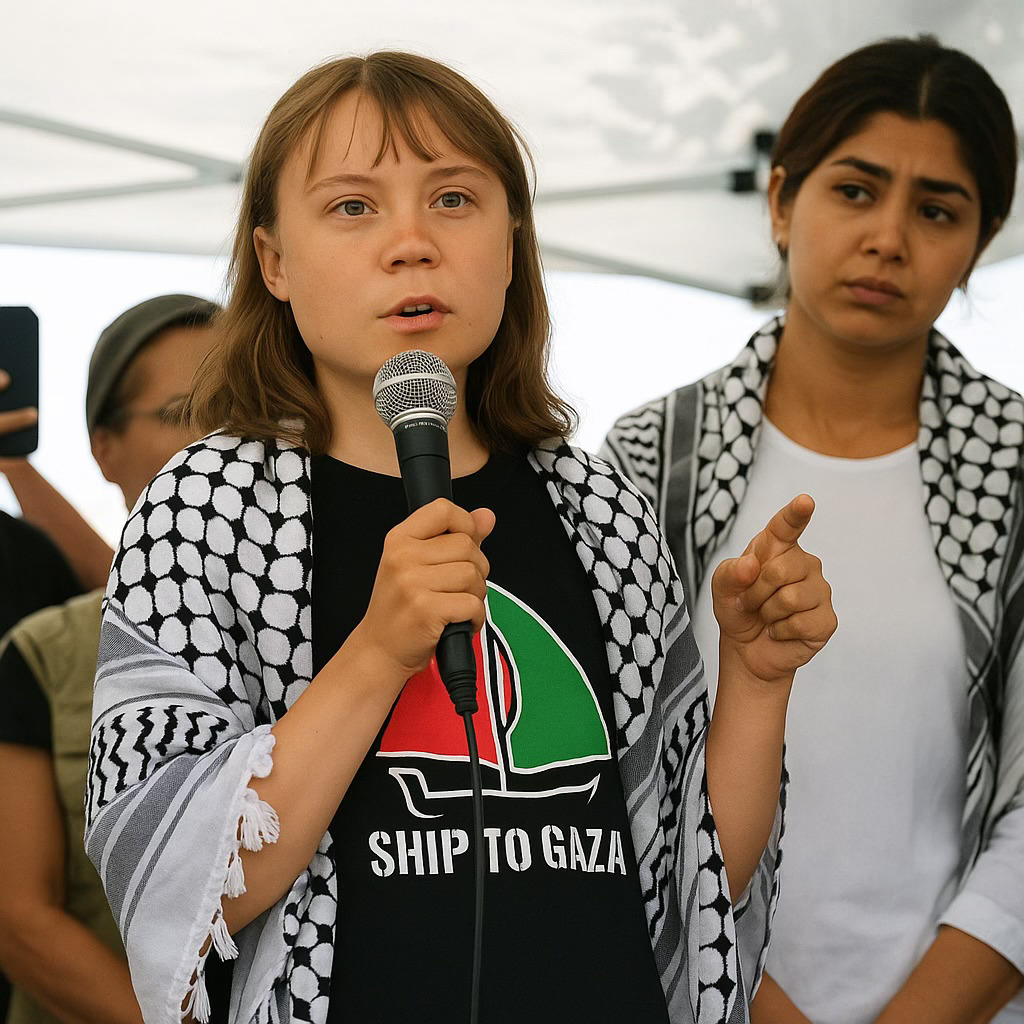
AI generated image: Greta admired by Rima!
This post was inspired by Ariel Beery’s article: “Gaza has been Palestined.”
There’s a photo making the rounds lately—Greta Thunberg in a keffiyeh, holding a mic under a tarp, flanked by activists. Beside her stands Rima Hassan, a French-Palestinian jurist and newly minted Member of the European Parliament. They’re part of the “Ship to Gaza” protest effort—a civilian attempt to break Israel’s military blockade on the Gaza Strip.
At first glance, it looks righteous. Powerful, even. Two young women, defiant, visibly moved, standing for justice.
But look again. Strip away the sentiment, the symbolism, the viral framing—and what remains?
Nothing.
No ships reached Gaza. No lives were saved. No policy shifted. No real consequence followed. What this protest did produce—abundantly—were photographs, Instagram reels, press write-ups, and a new round of likes, shares, and comment-section outrage.
That’s the tragedy. Not the cause, but the futility.
From Climate Crusader to Protest Performer
Greta Thunberg was once the urgent voice of “a planet on fire.” She distorted global discourse on climate change. She walked out of school and into the halls of power, “carrying” science in one hand and waving “moral clarity” in the other.
But now? She’s pivoted. Gaza has replaced CO₂. Hashtags have replaced the IPCC. Outrage has replaced policy.
And while climate change barrels forward unchecked—ocean temperatures breaking records, fossil fuel subsidies soaring—Greta’s attention is elsewhere. Not because Gaza is unimportant (it isn’t), but because Gaza offers something the climate crisis never could: moral simplicity and visual virality.
There’s no ambiguity. No graphs. No boring acronyms. Just keffiyehs, flags, and a cause that makes people feel, instantly, that they are on the right side. The choice is clear: feeling good rather than doing good.
But feelings do not move history. Strategy does. And here, Greta is out of touch with the reality of conflict, war and diplomacy.
Rima’s Silence
And what of Rima Hassan? She stands in the background of this photo—silent, reverent, admiring. A lawyer, a refugee made citizen, now a Member of the European Parliament.
She has access to policy, to lawmakers, to votes.
But here, she’s not legislating. She’s not arguing before European committees. She’s not even leading the demonstration.
She’s watching Greta.
And that is heartbreaking. Because what should have been an assertion of leadership becomes a portrait of deference—a parliamentarian deferring to a failed influencer, because performance now outpaces power.
Symbolism Over Substance
What is “Ship to Gaza,” really? A flotilla of civilian boats meant to challenge a military blockade enforced by one of the world’s most advanced navies. Everyone involved knew the outcome before it began.
• The ships would be intercepted.
• The media would cover it.
• Protesters would return with stories and scars—and content.
And that’s what happened.
No food crossed the blockade. No medicine reached the wounded. No siege was broken. The only thing that got through was narrative.
Narrative is powerful—but only when it leads somewhere. In this case, it didn’t.
The Politics of Self-Promotion
This isn’t to deny the sincerity of those involved. But in our age, sincerity isn’t enough.
We are living through a crisis of activism as branding. What used to be the long, exhausting labor of policy work, grassroots organising, coalition building—has been replaced by a camera-ready moral theatre.
People still suffer. But now they do so as background to a protester’s curated feed.
We take selfies at protests like we take them at concerts. We wear the right symbols, say the right words, tag the right causes—and then we move on.
Gaza Deserves Better
The people of Gaza do not need more pictures of Greta Thunberg. They do not need Rima Hassan’s silence. They do not need flotillas that never land.
This image, viral as it is, represents a profound failure—not of values, but of method.
It is a picture of posture without policy, protest without power.
And in our time, when tragedy itself has become a performance, that is perhaps the most tragic thing of all.


