The Tragedy of the British Imagination
God’s Elect Nation Betrays God’s Chosen People
By Khaled Salih
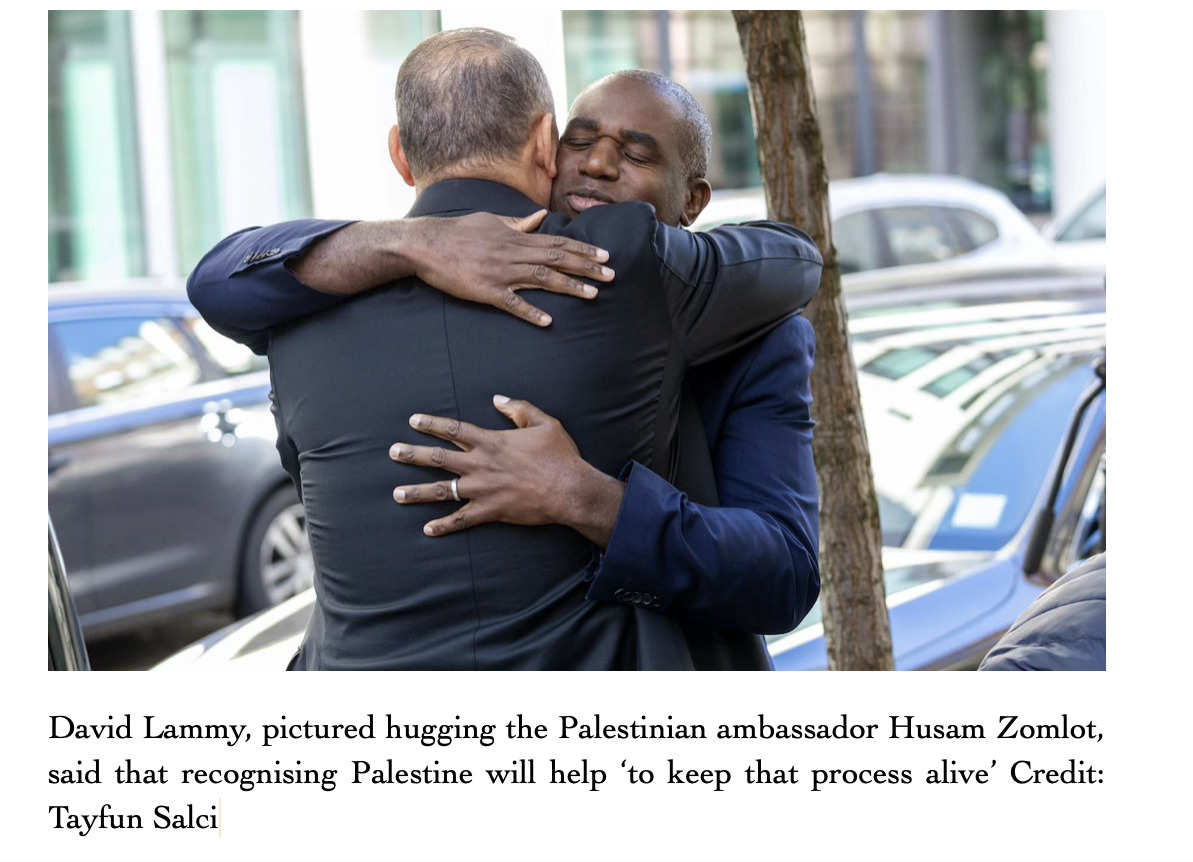
“Feel good.” Source: Telegraph
The history of the British imagination, according to Peter Watson, was anchored for centuries on an explicit and audacious claim: that the British were a divinely chosen people, a “new Israel,” set apart by God for a special purpose. This concept of the “elect nation” was consciously constructed to unify a once-fractured realm and provide the moral and psychological engine for its global ambitions. Yet, examining this historical conceit in light of modern geopolitical commentary, particularly the recent decision by Commonwealth governments, including Britain, to unilaterally recognise a State of Palestine, reveals a profound and tragic historical irony: the nation that built its self-image upon the symbolic inheritance of Judaism now appears to betray the sovereignty of the only Jewish State.
In the wake of the Reformation, Britain faced the challenge of defining itself against Catholic Europe, requiring a “new national identity” for a small, underpopulated island nation. The intellectual architects of this identity recognised the mobilising power of the biblical narrative. At the heart of this foundation was the deliberate appropriation of Jewish history and identity, asserting that the covenant God had made with ancient Israel had been renewed with Protestant Britain.
This appropriation was not subtle; it was systemic. The influential minister Isaac Watts, in his hugely popular 1719 translation of the psalms, systematically replaced the original text’s references to “Israel” with “Great Britain,” perfectly encapsulating the core theological substitution that transformed national pride into divine mandate. Culturally, this link was cemented through institutions. George Frideric Handel’s coronation anthem, a “permanent feature of British coronations,” drew directly from the Old Testament account of the anointing of an Israelite king, thereby legitimizing the British monarchy by casting it in an “ancient, sacred Israelite mould.”
Philosophically, this conviction was framed by statesmen like Francis Bacon, who argued that Britain’s maritime and intellectual endeavours, the “opening of the world by navigation and commerce”, were not mere secular pursuits but the fulfilment of biblical prophecy and part of “God’s unfolding plan for humanity.” By harnessing this narrative, the British constructed a national psyche that was resilient and self-confident, viewing war against Catholic rivals as a “sacred duty” and believing that “God was, in essence, an Englishman.”
This immense conceit, the “Enormous Conceit”, was, therefore, inextricably linked to the history of God’s original chosen people. It provided the moral justification for commercial prosperity, sanctioned profit alongside piety, and gave a small island nation the “outsized assurance” necessary to project its power globally. This powerful sense of a divinely ordained mission propelled Britain’s rise and provided the psychological fuel for its entire imperial project.
The tragedy unfolds in the modern era, where the nation forged by the “Enormous Conceit” of being a new Israel now chooses to align itself internationally against the singular sovereign Jewish State, the successor to the historical people whose identity it once appropriated.
The decision by the British government to recognize a state of Palestine is described by a commentator as an “appalling decision on a moral, practical and philosophical basis.” Clarke-Serret maintains that this move returns the clock to 1947, when the International Community and Jewish Zionists recognised partition, but “the Arabs rejected it.” The core issue remains, as the British Foreign Secretary Ernest Bevin diagnosed in 1947, that “For the Arabs, the essential point of principle is to resist to the last the establishment of Jewish sovereignty in any part of Palestine.” [Wilf]
By recognising Palestine, Britain is implicitly accepting this “Palestinian rejectionism” and placing the “entire burden of responsibility upon the Jews.” The contemporary betrayal is rooted in the fact that the Palestinian polity is allowed to choose “conquering, terrorist, rejectionist governments without consequence.” [Clarke-Serret] Worse, the Commonwealth governments are acting in the full knowledge that the state they are recognising is “fictitious.”
The recognition elevates what Dr Einat Wilf calls a “Schrödinger’s Palestine”, a state that only exists when it is convenient for harassing Israel in international bodies, but ceases to exist for “adult purposes” such as surrendering, ending the war, or assuming responsibility for violence. This moral inconsistency allows the Palestinian leadership to be perpetually indulged in their goal: the “singular obsession and organization of an entire people... about preventing Jewish sovereignty in any of it.” [Wilf]
The historical parallel between the “elect nation’s” appropriation of the Jewish mantle and its current stance against the Jewish State highlights a profound moral and historical inconsistency within the modern British imagination.
The idea of the “elect nation” provided a moral justification for Britain’s actions. The contemporary British decision, however, is presented as an act that sacrifices principle for expediency, ignoring the moral lessons of history and betraying core liberal values.
Ignoring True Suffering. Clarke-Serret contrasts the relentless moral focus on Palestinians with the fate of other groups, particularly the Kurds, who were promised statehood in the Treaty of Sèvres but were punished by governments including the UK after their 2017 democratic referendum. The Kurds faced “true ethnic cleansing and genocide,” while Palestinians brought about their own displacement through their “own rejection of a previous recognition of Palestine.” By ignoring the Kurds, who are “Muslims that share our values,” Britain betrays the democratic principles it once championed globally.
Violating Core Principles. The Lockean formulation, the idea that a legitimate government must protect the rights of its individual citizens regardless of faith or creed, was a foundational element of the British path through the Enlightenment. Yet, the Palestinian state being recognised is acknowledged to seek a nation “without a single Jew,” while reducing its Christian population, and would be “undemocratic, homophobic, sexist, racist.” By supporting this entity, the “subjects of the Crown... bury their principles on the pyre of tyranny.” [Clarke-Serret]
Rewarding Rejecting the Covenant. The ultimate tragedy is that the British imagination, having once performed the radical act of theological substitution, replacing “Israel” with “Great Britain” in its most sacred texts, is now actively legitimising the rejectionist agenda that seeks to undo the original chosen people’s state. The Palestinian claim that millions have an individual “right of return” to settle inside Israel is noted to have the effect of turning Jews into a minority in an Arab state, thus achieving two Arab states “from the River to the Sea.” The British recognition tacitly encourages this “ideology of Palestinianism.” [Wilf]
In conclusion, the British imagination was forged by an “Enormous Conceit,”the belief in its divine destiny as a “new Israel.” This narrative of divine election provided the confidence for a global metaphysical empire. The final act of this tragedy, according to contemporary critique, is the betrayal of moral clarity and the abandonment of the foundational principles of legitimate government, all while rewarding the “murderous stupidity” and perpetual rejectionism of those who refuse to live alongside the true descendants of “God’s chosen people.” The nation that once cast its monarchs in an “Israelite mould” now chooses to validate those who seek the undoing of Israel, showcasing the profound depth of its moral and historical decline.
Sources:
Call me Back Podcast, 20250922, “U.N. Recognition of a Palestinian State - with Dr. Tal Becker,”
Daniel Clarke-Serret, 20250922, “A response to the Recognition of Palestine,” https://substack.com/home/post/p-174229442
Khaled Salih, 20250910, “Palestinianism: An Ideology of Annihilation,”
Khaled Salih, 20250917, “Challenging UN’s Gaza Genocide Allegations,” https://khaledsalih.substack.com/p/challenging-uns-gaza-genocide-allegations
Khaled Salih, 20250917, “UN as The Pattern producing machine,” https://khaledsalih.substack.com/p/the-un-as-the-pattern-producing-machine
Einat Wilf, 20250922, “Schrödinger’s Palestine: The State That Is and Isn’t,” https://substack.com/@danielclarkeserret/p-174248226
Adi Schwartz and Einat Wilf, 2020, The War of Return: How Western Indulgence of the Palestinian Dream Has Obstructed the Path to Peace. New York, NY: All Points Books, an imprint of St. Martin’s Publishing Group.
Peter Watson, 2025, The British Imagination. A History of Ideas from Elizabeth I to Elizabeth II. London: Simon & Schuster.


