The Ten Commandments of When Parochial Error Goes Global
Ten Rules for Recognizing Protected Error Before It Captures the World
20 September 2026
Note
This is the third installment in the series that began with “When Moses Visits Kurdistan and continued with The Ten Commandments of Kurdistanî Azad.” The first asked what a people should do after too many things have already been written in stone.
The second asked whether survival had been mistaken for freedom. This one asks a harder question still. Ten Rules for Recognizing Protected Error Before It Captures the World
The Ten Commandments of When Parochial Error Goes Global: An error is not dangerous merely because it is old, widely believed, or inherited. It becomes dangerous when a society learns how to protect it from correction. Inheritance is treated as authority. Replication is mistaken for truth. Criticism is recoded as misconduct. Compassion is redirected from persons to doctrines. Intelligence is used not to revise a belief, but to defend it. And the future is closed the moment an error is made final.These ten commandments are a diagnostic. They ask not only what a doctrine says, but where the error goes, how it travels, what transmits it, and what architecture prevents it from being unlearned.For Kurds, one further question follows: what happens when a people’s very existence is treated as the error?The danger is never merely that people are wrong. Humanity has always been wrong about many things. The danger begins when an error learns how to protect itself from correction.
Book Two When Parochial Error Goes Global
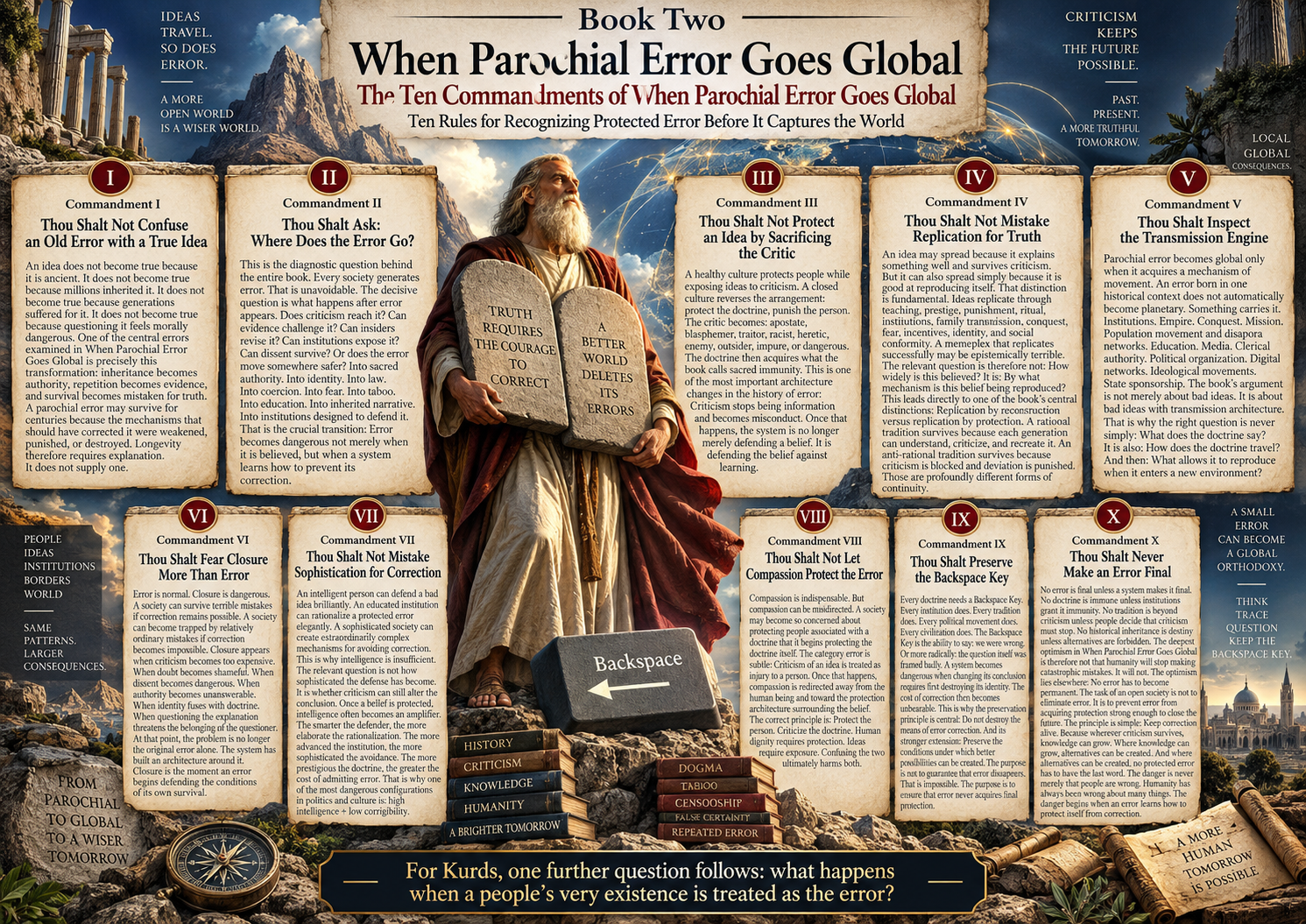
The Ten Commandments of When Parochial Error Goes Global
Ten Rules for Recognizing Protected Error Before It Captures the World
Commandment I
Thou Shalt Not Confuse an Old Error with a True Idea
An idea does not become true because it is ancient.
It does not become true because millions inherited it.
It does not become true because generations suffered for it.
It does not become true because questioning it feels morally dangerous.
One of the central errors examined in When Parochial Error Goes Global is precisely this transformation:
inheritance becomes authority, repetition becomes evidence, and survival becomes mistaken for truth.
A parochial error may survive for centuries because the mechanisms that should have corrected it were weakened, punished, or destroyed.
Longevity therefore requires explanation.
It does not supply one.
Commandment II
Thou Shalt Ask: Where Does the Error Go?
This is the diagnostic question behind the entire book.
Every society generates error.
That is unavoidable.
The decisive question is what happens after error appears.
Does criticism reach it?
Can evidence challenge it?
Can insiders revise it?
Can institutions expose it?
Can dissent survive?
Or does the error move somewhere safer?
Into sacred authority.
Into identity.
Into law.
Into coercion.
Into fear.
Into taboo.
Into education.
Into inherited narrative.
Into institutions designed to defend it.
That is the crucial transition:
Error becomes dangerous not merely when it is believed, but when a system learns how to prevent its correction.
Commandment III
Thou Shalt Not Protect an Idea by Sacrificing the Critic
A healthy culture protects people while exposing ideas to criticism.
A closed culture reverses the arrangement:
protect the doctrine, punish the person.
The critic becomes:
apostate,
blasphemer,
traitor,
racist,
heretic,
enemy,
outsider,
impure,
or dangerous.
The doctrine then acquires what the book calls sacred immunity.
This is one of the most important architecture changes in the history of error:
Criticism stops being information and becomes misconduct.
Once that happens, the system is no longer merely defending a belief.
It is defending the belief against learning.
Commandment IV
Thou Shalt Not Mistake Replication for Truth
An idea may spread because it explains something well and survives criticism. But it can also spread simply because it is good at reproducing itself.
But it can also spread because it is good at reproducing itself.
That distinction is fundamental.
Ideas replicate through teaching, prestige, punishment, ritual, institutions, family transmission, conquest, fear, incentives, identity, and social conformity.
A memeplex that replicates successfully may be epistemically terrible.
The relevant question is therefore not:
How widely is this believed?
It is:
By what mechanism is this belief being reproduced?
This leads directly to one of the book’s central distinctions:
Replication by reconstruction versus replication by protection.
A rational tradition survives because each generation can understand, criticize, and recreate it.
An anti-rational tradition survives because criticism is blocked and deviation is punished.
Those are profoundly different forms of continuity.
Commandment V
Thou Shalt Inspect the Transmission Engine
Parochial error becomes global only when it acquires a mechanism of movement.
An error born in one historical context does not automatically become planetary.
Something carries it.
Institutions.
Empire.
Conquest.
Mission.
Population movement and diaspora networks.
Education.
Media.
Clerical authority.
Political organization.
Digital networks.
Ideological movements.
State sponsorship.
The book’s argument is not merely about bad ideas.
It is about bad ideas with transmission architecture.
That is why the right question is never simply:
What does the doctrine say?
It is also:
How does the doctrine travel?
And then:
What allows it to reproduce when it enters a new environment?
Commandment VI
Thou Shalt Fear Closure More Than Error
Error is normal.
Closure is dangerous.
A society can survive terrible mistakes if correction remains possible.
A society can become trapped by relatively ordinary mistakes if correction becomes impossible.
Closure appears when criticism becomes too expensive.
When doubt becomes shameful.
When dissent becomes dangerous.
When authority becomes unanswerable.
When identity fuses with doctrine.
When questioning the explanation threatens the belonging of the questioner.
At that point, the problem is no longer the original error alone.
The system has built an architecture around it.
Closure is the moment an error begins defending the conditions of its own survival.
Commandment VII
Thou Shalt Not Mistake Sophistication for Correction
An intelligent person can defend a bad idea brilliantly.
An educated institution can rationalize a protected error elegantly.
A sophisticated society can create extraordinarily complex mechanisms for avoiding correction.
This is why intelligence is insufficient.
The relevant question is not how sophisticated the defense has become. It is whether criticism can still alter the conclusion.
Once a belief is protected, intelligence often becomes an amplifier.
The smarter the defender, the more elaborate the rationalization.
The more advanced the institution, the more sophisticated the avoidance.
The more prestigious the doctrine, the greater the cost of admitting error.
That is why one of the most dangerous configurations in politics and culture is:
high intelligence + low corrigibility.
Commandment VIII
Thou Shalt Not Let Compassion Protect the Error
Compassion is indispensable.
But compassion can be misdirected.
A society may become so concerned about protecting people associated with a doctrine that it begins protecting the doctrine itself.
The category error is subtle:
Criticism of an idea is treated as injury to a person.
Once that happens, compassion is redirected away from the human being and toward the protection architecture surrounding the belief.
The correct principle is:
Protect the person. Criticize the doctrine.
Human dignity requires protection.
Ideas require exposure.
Confusing the two ultimately harms both.
Commandment IX
Thou Shalt Preserve the Backspace Key
Every doctrine needs a Backspace Key.
Every institution does.
Every tradition does.
Every political movement does.
Every civilization does.
The Backspace Key is the ability to say:
we were wrong.
Or more radically:
the question itself was framed badly.
A system becomes dangerous when changing its conclusion requires first destroying its identity.
The cost of correction then becomes unbearable.
This is why the preservation principle is central:
Do not destroy the means of error correction.
And its stronger extension:
Preserve the conditions under which better possibilities can be created.
The purpose is not to guarantee that error disappears.
That is impossible.
The purpose is to ensure that error never acquires final protection.
Commandment X
Thou Shalt Never Make an Error Final
No error is final unless a system makes it final.
No doctrine is immune unless institutions grant it immunity.
No tradition is beyond criticism unless people decide that criticism must stop.
No historical inheritance is destiny unless alternatives are forbidden.
The deepest optimism in When Parochial Error Goes Global is therefore not that humanity will stop making catastrophic mistakes.
It will not.
The optimism lies elsewhere:
No error has to become permanent.
The task of an open society is not to eliminate error.
It is to prevent error from acquiring protection strong enough to close the future.
The principle is simple:
Keep correction alive.
Because wherever criticism survives, knowledge can grow.
Where knowledge can grow, alternatives can be created.
And where alternatives can be created, no protected error has to have the last word.
The danger is never merely that people are wrong. Humanity has always been wrong about many things. The danger begins when an error learns how to protect itself from correction.
For Kurds, one further question follows: what happens when a people’s very existence is treated as the error?


