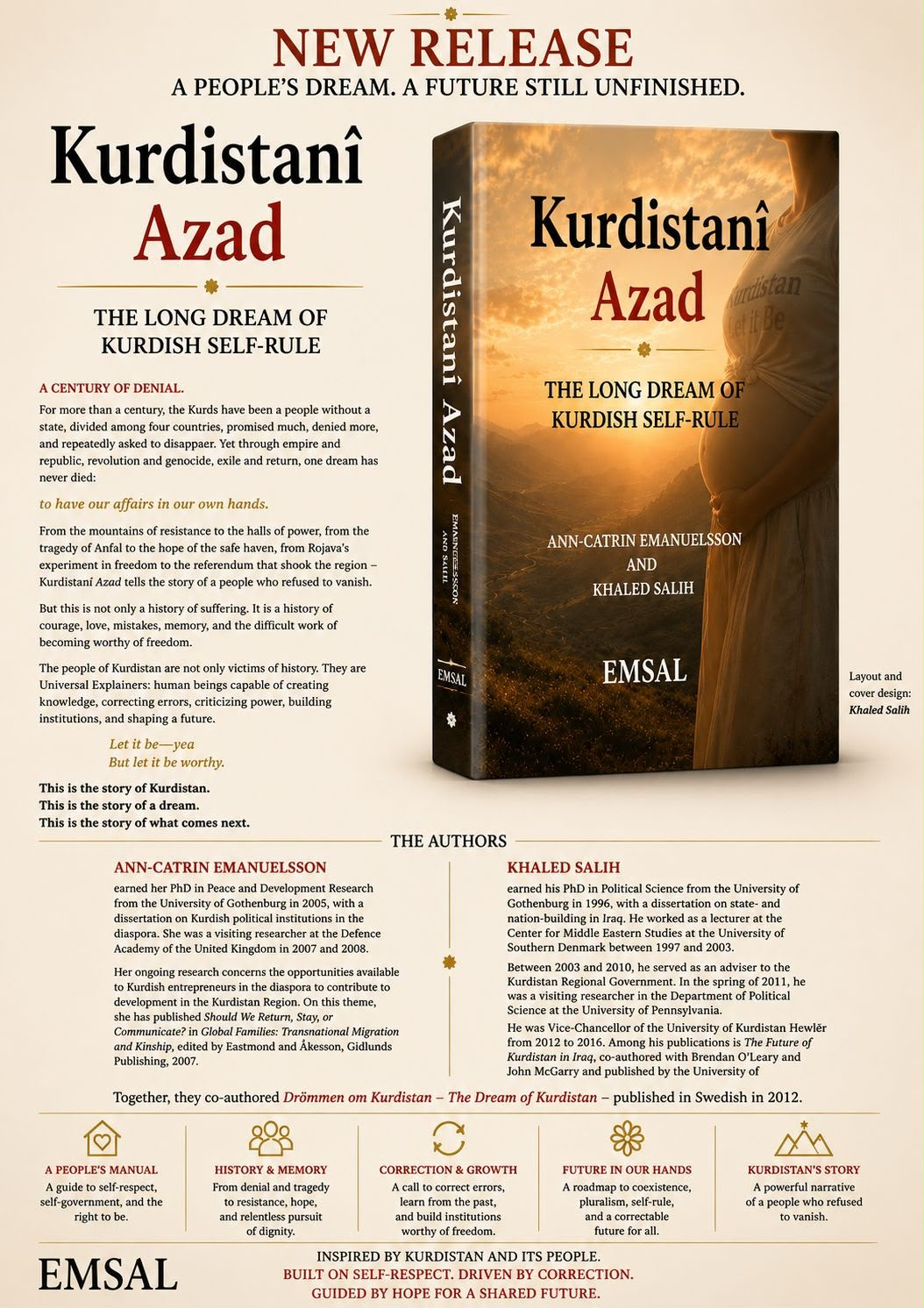
The Ten Commandments of Kurdistanî Azad
Ten Rules for a People That Intends to Own Its Future
19 September 2026
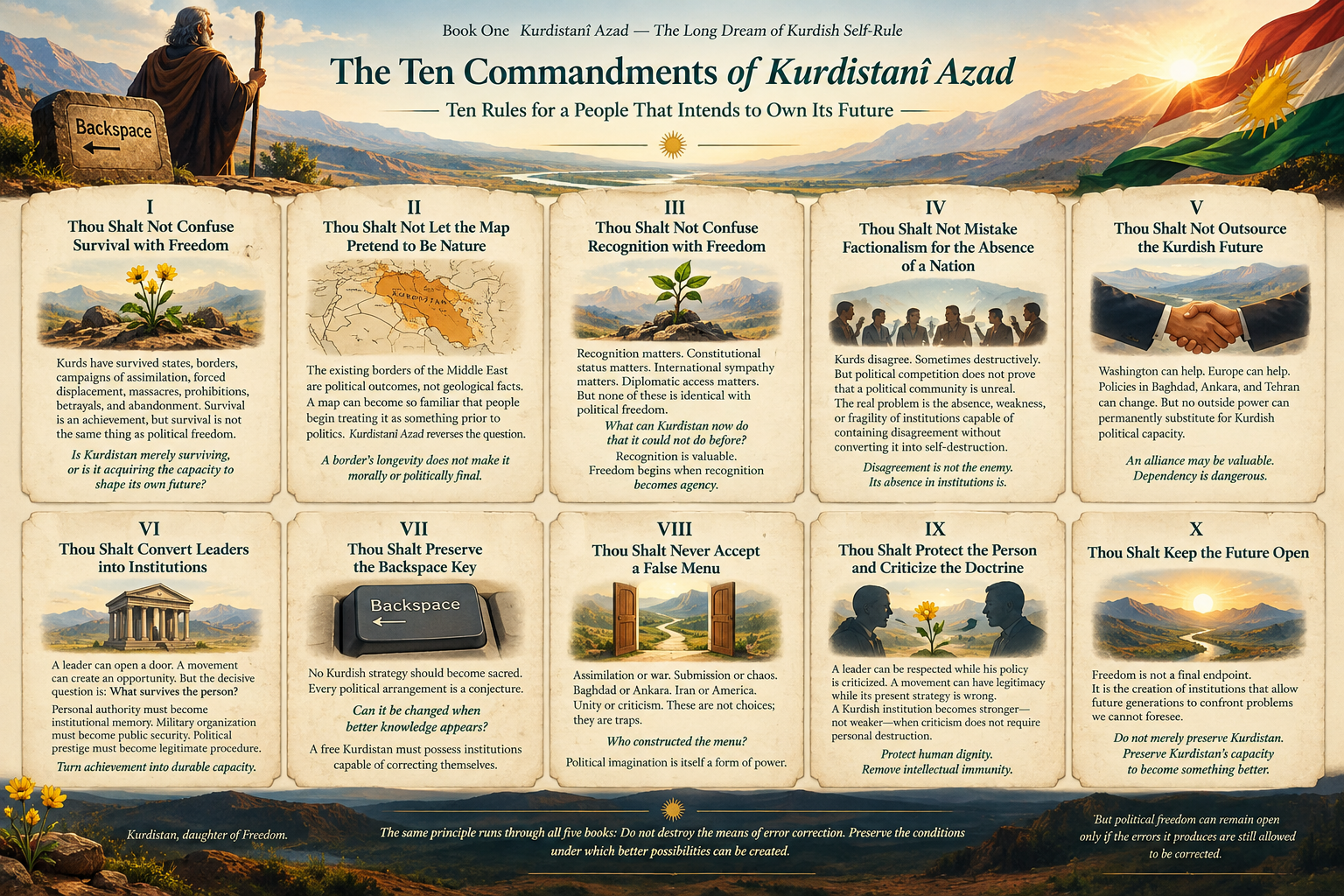
Introduction—Five Books. Fifty Commandments. One Backspace Key.
There is an obvious problem with writing a book of commandments when so much of my work argues against ideas becoming untouchable.
A commandment sounds final. It suggests authority, permanence, something carved into stone and placed beyond revision.
These are meant to do the opposite.
They are not final truths. They are compressed conjectures.
Each one takes an argument developed across one of five books and reduces it to a proposition sharp enough to remember, carry into another problem, criticize, and—if necessary—discard.
That tension is deliberate.
The immediate formal inspiration came from Amit Segal’s The 10 Commandments of Israeli Politics. I was struck less by any particular commandment than by the device itself: the attempt to compress a complicated political world into a small number of propositions strong enough to organize thought without pretending to exhaust it.
I began asking what the equivalent exercise would produce across my own five books.
The answer surprised me.
The books appear to be about different things.
Kurdistanî Azad — The Long Dream of Kurdish Self-Rule is about a people repeatedly denied political room and the difficulty of converting survival, sacrifice, leadership, and temporary openings into durable institutions.
When Parochial Error Goes Global is about something darker: how error acquires protection, how protection enables replication, and how ideas become dangerous when the mechanisms that might correct them are weakened or destroyed.
Kurdistan: The Offense of Existing asks why Kurdish political existence is so often required to justify itself under standards that established states were never required to meet.
Kurdistan and the Open Future moves from defense to possibility: how institutions can preserve the capacity to create choices that present knowledge cannot yet specify.
And BACKSPACE — How Intelligent Societies Become Trapped by Their Own Ideas asks how intelligent people, successful institutions, and advanced societies become exceptionally good at defending conclusions they should abandon.
Different books.
Different cases.
Different scales.
What is distinctive here is the range across which the same problem reappears. In Kurdistan, it is the problem of political agency, institutional inheritance, and the creation of political room. In my work on Islam within the wider problem of protected religious and ideological error, it is the problem of ideas acquiring immunity from criticism and reproducing through protection rather than reconstruction. In the open society, it is the problem of intelligent institutions becoming unable to revise ideas that once worked. These are very different subjects. The connecting problem is not the particular error but the architecture of correction: what permits correction, what blocks it, and what happens when a system loses the ability to change its mind.
But the same questions kept returning.
Where does the error go?
What protects it?
Who constructed the choices?
Can another choice be created?
Where does the improvement come from?
What survives the leader?
What happens when yesterday’s success becomes today’s doctrine?
Can an institution revise its answer without destroying the person who gave it?
Can a political community preserve what it has learned without converting inheritance into immunity?
And perhaps the largest question:
Are we preserving the conditions under which people in the future can create possibilities that we cannot yet imagine?
That is the braid connecting the five books.
One strand concerns Kurdish political agency.
Another concerns protected error.
Another concerns institutions.
Another concerns choice creation.
Another concerns the right to revise.
And the last strand is Backspace: the capacity to return to the premise before the cost of protecting it becomes greater than the cost of abandoning it.
The fifty commandments therefore form an argument.
They begin with Kurdistan because that is where many of these problems first became concrete for me: survival without freedom, leadership without institutional inheritance, political disagreement without a sufficiently strong political home, external dependence, inherited borders, and the repeated narrowing of available choices.
They then move outward.
From Kurdistan to protected error.
From protected error back to political existence.
From political existence toward open futures.
And finally from all of them toward a more general question about rationality itself:
Can a society remain intelligent without becoming trapped by its own intelligence?
That is why these commandments should not be read as doctrine.
A commandment that cannot survive criticism should not survive because I called it a commandment.
A principle that once worked should not acquire immunity because it worked.
A political arrangement should not become final because people sacrificed for it.
A successful explanation should not become an inheritance that later generations are forbidden to revise.
These fifty propositions are therefore best understood as conjectures under pressure.
Some may survive.
Some may need qualification.
Some may fail.
Some may eventually look naïve.
And perhaps the most important proposition is one I have not yet written.
That possibility does not weaken the project.
It is the point of the project.
So there are fifty commandments here.
And one rule governing all fifty:
Thou Shalt Criticize the Commandments.
Five books. Fifty commandments.
No final commandments.
How to Read These Commandments
These fifty commandments are not instructions handed down from authority. They are compressed conjectures drawn from five books. Read them in sequence and they form an argument; read them separately and each becomes a question to carry into another problem. None is protected from criticism. The Fifty-First Commandment applies to all fifty from the beginning. Their authority, if they have any, must come from surviving criticism—not from being called commandments.
What is distinctive here is the attempt to bring Kurdish political experience, protected religious error, open-society institutions, choice creation, and Backspace into a single architecture of correction.
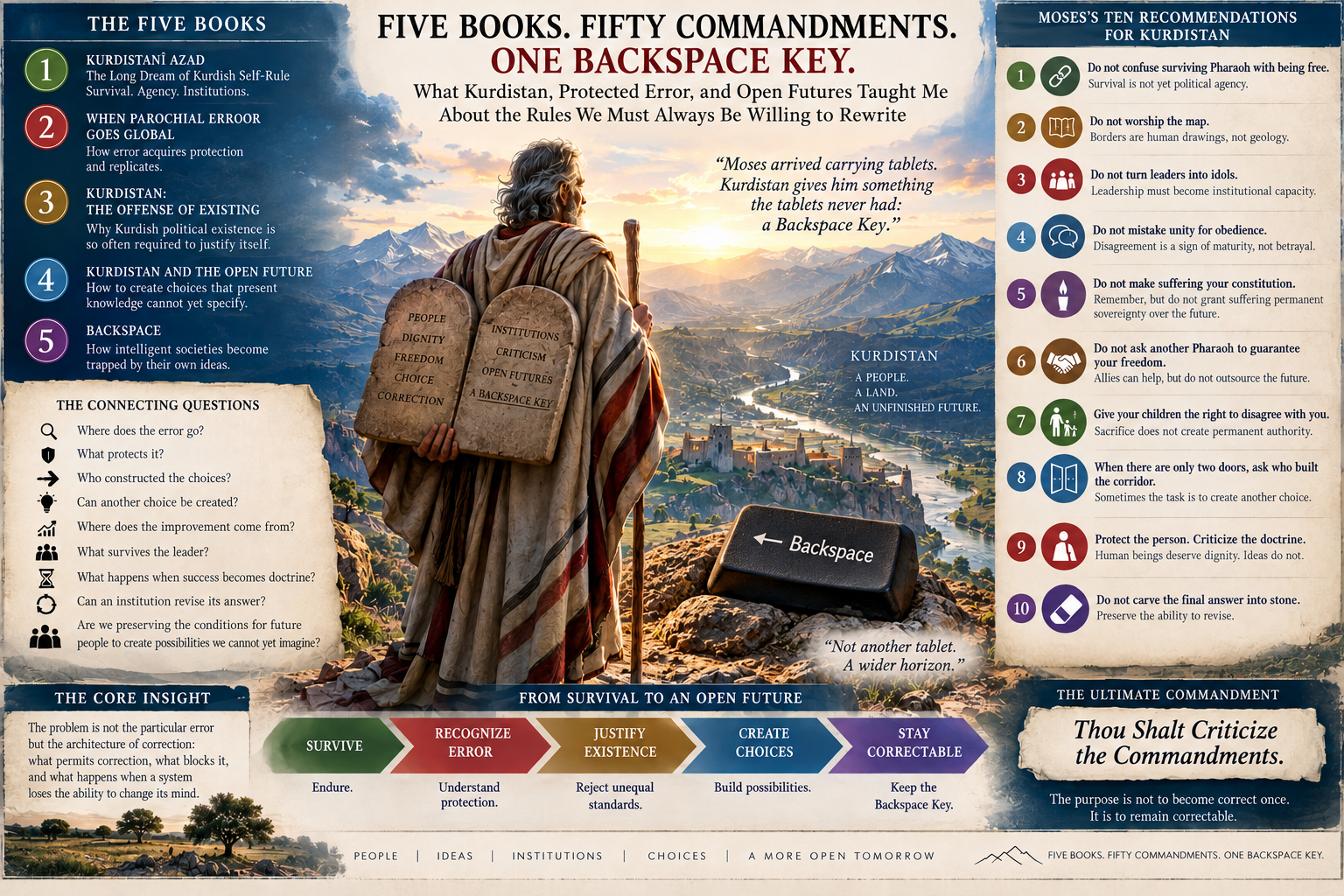
Book One Kurdistanî Azad—The Long Dream of Kurdish Self-Rule
The Ten Commandments of Kurdistanî Azad
Ten Rules for a People That Intends to Own Its Future
Commandment I
Thou Shalt Not Confuse Survival with Freedom
Kurds have survived states, borders, campaigns of assimilation, forced displacement, massacres, prohibitions, betrayals, and abandonment. Survival is an achievement, but survival is not the same thing as political freedom. A people can survive indefinitely while remaining trapped inside arrangements designed by others.
The first commandment therefore asks the central question of Kurdistanî Azad:
Is Kurdistan merely surviving, or is it acquiring the capacity to shape its own future?
Commandment II
Thou Shalt Not Let the Map Pretend to Be Nature
The existing borders of the Middle East are political outcomes, not geological facts.
A map can become so familiar that people begin treating it as something prior to politics—as though Iraq, Iran, Turkey, and Syria were natural containers and Kurdistan an artificial disturbance inside them.
Kurdistanî Azad reverses the question.
The burden of explanation does not fall only on those who question inherited arrangements. It also falls on those who defend them.
A border’s longevity does not make it morally or politically final.
Commandment III
Thou Shalt Not Confuse Recognition with Freedom
Recognition matters.
Constitutional status matters.
International sympathy matters.
Diplomatic access matters.
But none of these is identical with political freedom.
A people can be recognized and still remain dependent.
It can possess constitutional rights that stronger actors can obstruct.
It can attract international attention without acquiring greater control over its future.
Recognition therefore becomes politically meaningful only when it is converted into capacity.
The relevant question is not merely:
Is Kurdistan acknowledged?
It is:
What can Kurdistan now do that it could not do before?
Recognition is valuable.
Freedom begins when recognition becomes agency.
Commandment IV
Thou Shalt Not Mistake Factionalism for the Absence of a Nation
Kurds disagree.
Sometimes destructively.
But political competition does not prove that a political community is unreal.
Democrats and Republicans can fight bitterly inside the United States. Labour and Conservatives can spend generations trying to defeat one another in Britain. Parties can disappear, movements can fragment, and political systems can be reorganized without abolishing the political home in which the competition takes place.
The Kurdish problem is therefore not disagreement itself.
It is the absence, weakness, or fragility of institutions capable of containing disagreement without converting it into political self-destruction.
Commandment V
Thou Shalt Not Outsource the Kurdish Future
Washington can help. Europe can help. Policies in Baghdad, Ankara, and Tehran can change. International opinion can shift.. International opinion can shift.
But no outside power can permanently substitute for Kurdish political capacity.
History repeatedly teaches the same lesson: foreign support is contingent because foreign governments pursue their own interests.
Therefore:
An alliance may be valuable. Dependency is dangerous.
The strategic question is always what remains when the ally changes policy.
Commandment VI
Thou Shalt Convert Leaders into Institutions
Kurdish history contains exceptional personalities.
That has never been enough.
A leader can open a door.
A movement can create an opportunity.
A military force can defend political room.
A diplomat can accumulate extraordinary relationships.
But the decisive question comes afterward:
What survives the person?
This is the Kurdish conversion problem: how temporary achievement becomes durable capacity..
Personal authority must become institutional memory.
Personal access must become diplomatic capacity.
Military organization must become public security architecture.
Political prestige must become legitimate procedure.
Otherwise every generation begins again.
Commandment VII
Thou Shalt Preserve the Backspace Key
No Kurdish strategy should become sacred.
Not armed struggle.
Not negotiation.
Not federalism.
Not independence.
Not alliance with Washington.
Not accommodation with Baghdad.
Not economic dependence on Turkey.
Not mediation.
Not resistance.
Not even the political architecture defended in Kurdistanî Azad.
Every political arrangement is a conjecture.
The question is:
Can it be changed when better knowledge appears?
A free Kurdistan cannot merely possess institutions.
It must possess institutions capable of correcting themselves.
Commandment VIII
Thou Shalt Never Accept a False Menu
One of the oldest political tricks is to present people with two bad doors and then demand that they choose responsibly between them.
Assimilation or war.
Submission or chaos.
Centralization or separatism.
Baghdad or Ankara.
Iran or America.
Islamist or nationalist.
Unity or criticism.
The Open Correction Framework asks a prior question:
Who constructed the menu?
When every available choice is bad, the rational task is not simply to choose the least bad one.
It is to create another choice.
Political imagination is itself a form of power.
Commandment IX
Thou Shalt Protect the Person and Criticize the Doctrine
Kurdish politics has repeatedly confused criticism with betrayal.
That destroys error correction.
A leader can be respected while his policy is criticized.
A movement can have historical legitimacy while its present strategy is wrong.
A party can have made enormous sacrifices without acquiring permanent immunity from criticism.
A Kurdish institution becomes stronger—not weaker—when criticism does not require personal destruction.
Protect human dignity. Remove intellectual immunity.
Without this distinction, an open Kurdish political culture remains difficult to build.
Commandment X
Thou Shalt Keep the Future Open
Kurdistanî Azad should never mean that history has finally arrived at its last political arrangement.
Freedom is not the discovery of a perfect endpoint.
It is the creation of institutions that allow future generations to confront problems that the present generation cannot foresee.
The purpose of Kurdish political freedom is therefore larger than flags, borders, constitutions, offices, or recognition.
It is to secure the conditions under which people who do not yet exist can create better answers than ours.
Do not merely preserve Kurdistan. Preserve Kurdistan’s capacity to become something better.
The same principle runs through all five books:
Do not destroy the means of error correction. Preserve the conditions under which better possibilities can be created.
The name Kurdistanî Azad already carries the question in miniature. Kurdistan, daughter of Azad: Kurdistan, daughter of Freedom. The final test is not whether one generation produces a flawless Kurdistan, but whether it leaves those who follow more room to criticize, choose, correct, and create than it inherited.
But political freedom can remain open only if the errors it produces are still allowed to be corrected.