The Ten Commandments of Kurdistan: The Offense of Existing
Ten Rules for a People Who Refuse to Ask Permission to Exist
21 September 2026
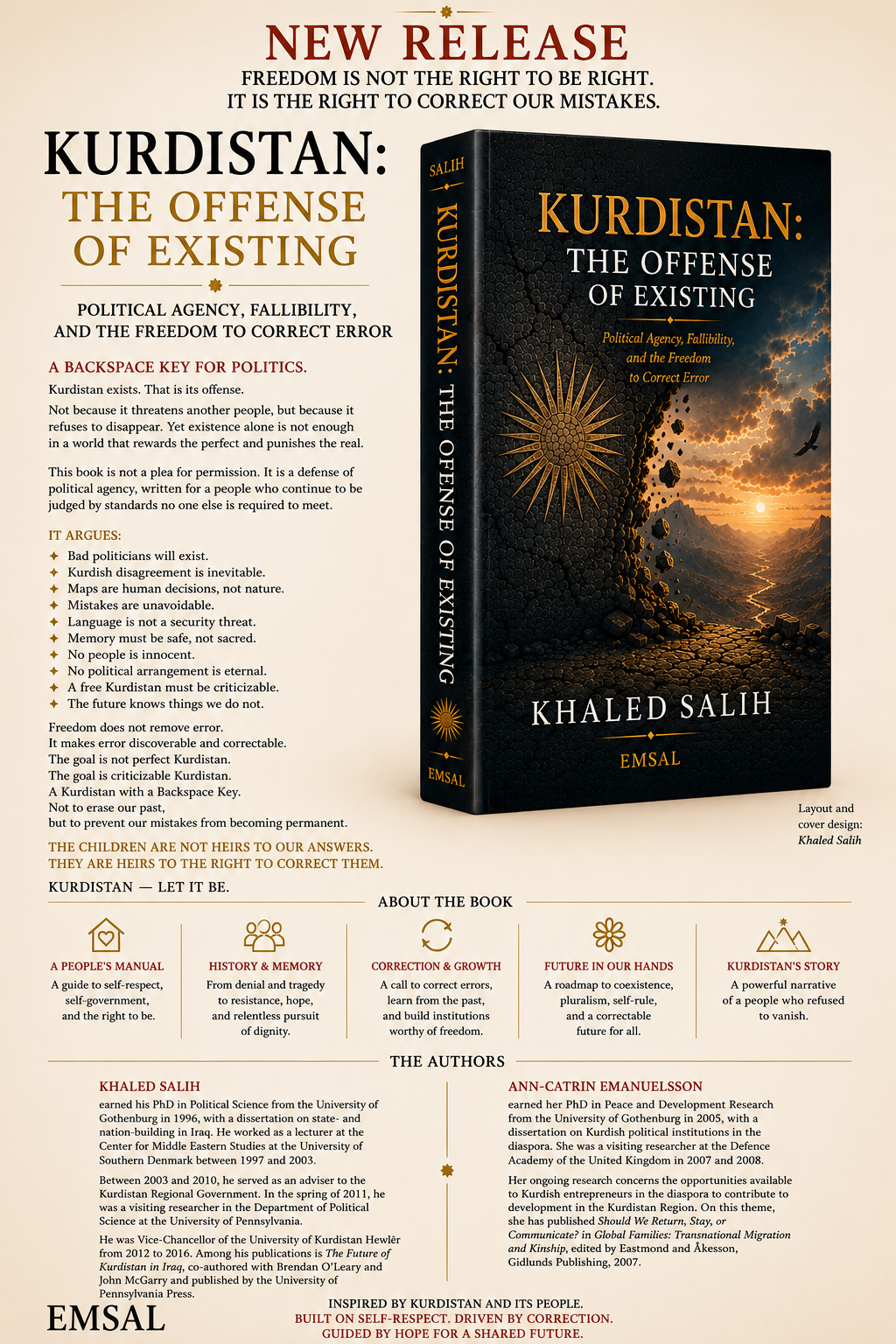
Note
This is the fourth installment in the series that began with “When Moses Visits Kurdistan,” continued with “The Ten Commandments of Kurdistanî Azad,” and then “The Ten Commandments of When Parochial Error Goes Global.”
The first asked what a people should do after too many things have already been written in stone.
The second asked whether survival had been mistaken for freedom.
The third asked how an error becomes dangerous once a society learns to protect it from correction.
This one asks the question that follows directly from the last: what happens when a people’s very existence is treated as the error?
The Ten Commandments of Kurdistan: The Offense of Existing examine why Kurdish political life is so often required to justify itself under standards that established states were never asked to meet. Existence is recoded as disruption. Continuity is treated as a claim that must be endlessly defended. Recognition is offered as a favor rather than a fact. The burden of explanation falls on the people who were divided, not on the arrangements that divided them.
These commandments are a diagnostic. They ask not only whether Kurdistan is acknowledged, but who constructed the test, what counts as sufficient proof, and what architecture makes a people’s presence itself appear illegitimate.
The danger is never merely that people are wrong. Humanity has always been wrong about many things. The danger begins when an error learns how to protect itself from correction—and when that error is the claim that another people should not exist.
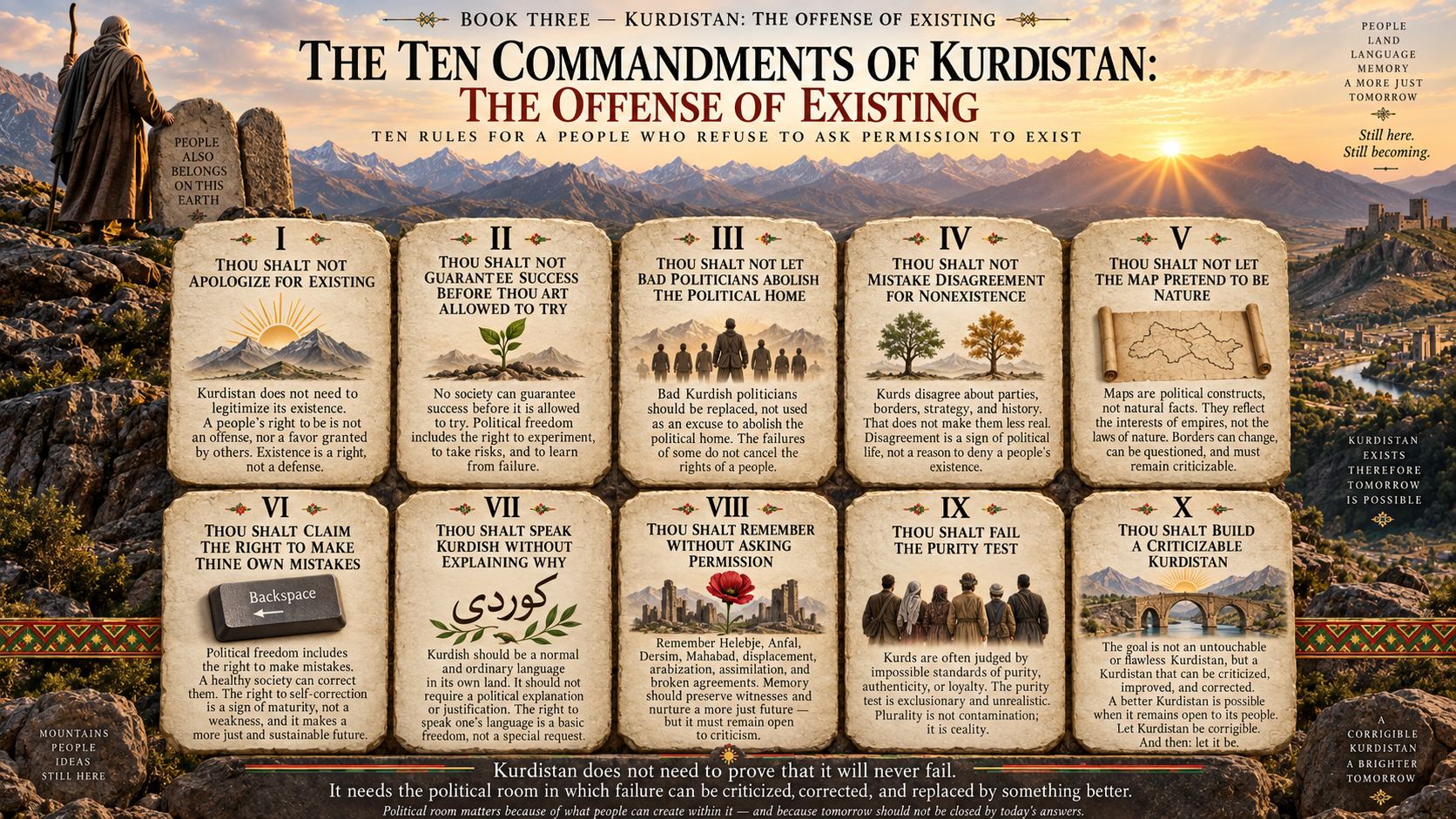
Book Three Kurdistan: The Offense of Existing
The Ten Commandments of Kurdistan: The Offense of Existing
Ten Rules for a People Who Refuse to Ask Permission to Exist
Commandment I
Thou Shalt Not Apologize for Existing
Kurdistan does not become legitimate only after everyone else approves of it.
Kurds do not need to demonstrate historical innocence, political perfection, ideological unity, or administrative excellence before being permitted to exist politically.
The most basic correction is therefore this:
Existence is not an offense requiring a defense.
The question is not why Kurdistan insists on existing.
The question is why Kurdish existence has so often been treated as an unacceptable political fact.
Commandment II
Thou Shalt Not Guarantee Success Before Thou Art Allowed to Try
One of the most peculiar demands made of Kurds is that they must prove in advance that Kurdish political self-rule will succeed.
Will Kurdish politicians be competent?
Will corruption disappear?
Will parties cooperate?
Will the economy work?
Will minorities be protected?
Will foreign policy be wise?
Those are legitimate questions for any political system.
But these are not universal preconditions that established states are required to satisfy before their political existence is accepted.
No society can guarantee success before acquiring the political room in which success and failure become possible.
Political freedom includes the possibility of getting things wrong.
Commandment III
Thou Shalt Not Let Bad Politicians Abolish the Political Home
Kurdish politicians can be incompetent.
They can be corrupt.
They can be authoritarian.
They can make terrible decisions.
None of this proves that Kurdistan should not exist.
Bad governments do not abolish France.
Bad presidents do not invalidate the United States.
Bad prime ministers do not make Britain cease to be Britain.
The rational conclusion from bad Kurdish politics is:
change the politicians.
Not:
abolish the political home.
A people should not be required to disappear because some of its leaders disappoint it.
Commandment IV
Thou Shalt Not Mistake Disagreement for Nonexistence
Kurds disagree intensely.
About parties.
Borders.
Ideologies.
Religion.
Regional alliances.
Leadership.
History.
Strategy.
That does not make them less real.
Political communities are not defined by permanent unanimity.
They are defined, in part, by whether disagreement can occur inside a shared political space.
The question should therefore not be:
Why do Kurds disagree?
It should be:
Why are Kurdish disagreements so often used as evidence that Kurdistan itself is impossible?
Disagreement is political life.
The absence of institutions capable of containing disagreement is the real problem.
Commandment V
Thou Shalt Not Let the Map Pretend to Be Nature
The inherited map is one of the book’s central objects of criticism.
A line drawn by history gradually acquires the authority of geology.
Existing borders begin to look eternal.
Anything that questions them is described as artificial, destabilizing, unrealistic, or dangerous.
Yet the borders themselves emerged from war, empire, diplomacy, coercion, collapse, and bargaining.
Maps are political arguments that have learned how to look like facts of nature.
Kurdistan is not artificial merely because existing states have successfully naturalized the arrangements that divide it.
The map must remain criticizable.
Commandment VI
Thou Shalt Claim the Right to Make Thine Own Mistakes
Political freedom does not mean freedom from error.
It means something far more demanding:
the right to make errors inside institutions capable of correcting them.
Kurds should not exchange one paternalism for another.
The argument for Kurdish political agency is not:
“Kurds will govern better than everyone else.”
The argument is:
Kurds should possess a political sphere in which their own decisions can be made, criticized, reversed, improved, and replaced.
Freedom includes the right to be wrong.
Corrigibility is what makes that right politically sustainable.
Commandment VII
Thou Shalt Speak Kurdish Without Explaining Why
A language should not have to defend its existence every time it is spoken.
Yet Kurdish language has repeatedly been treated as politically suspicious.
A name becomes controversial.
A school becomes a political demand.
A song becomes an assertion.
A place-name becomes a dispute over sovereignty.
Speaking Kurdish then becomes something larger than communication.
But the deeper aspiration must be the opposite:
Kurdish should become ordinary enough that speaking it requires no political explanation.
The final victory of a language is not constant symbolic mobilization around it.
It is normality.
Commandment VIII
Thou Shalt Remember Without Asking Permission
Memory is political because power often decides which histories may become public.
Helebje.
Anfal.
Dersim.
Mehabad.
Displacement.
Arabization.
Assimilation.
Banned language.
Destroyed villages.
Broken agreements.
These memories do not require authorization from the states implicated in them.
But memory should not become another prison.
Public memory should not become permanent grievance. It should preserve witness, permit mourning, and make correction possible.
A society unable to remember cannot explain its present; a society unable to criticize its memories cannot escape its past.
Remember fully.
Remember accurately.
And keep memory open to criticism too.
Commandment IX
Thou Shalt Fail the Purity Test
Kurds are often judged through impossible standards of authenticity.
Too religious.
Too secular.
Too tribal.
Too Western.
Too nationalist.
Too divided.
Too assimilated.
Too cosmopolitan.
Too traditional.
Too close to America.
Too close to Turkey.
Too close to Iran.
Too Kurdish.
Not Kurdish enough.
The purity test has no finish line because its real function is exclusion.
So the proper response is not to perfect Kurdish authenticity.
It is to reject the test.
A political community does not need cultural purity in order to deserve political room.
Plurality is not contamination.
It is reality.
Commandment X
Thou Shalt Build a Criticizable Kurdistan
The goal is not an eternal Kurdistan.
Not an untouchable Kurdistan.
Not a flawless Kurdistan.
Not a Kurdistan protected from criticism because so much blood was shed for it.
That would merely reproduce the architecture the book criticizes.
The proper aspiration is:
a Kurdistan that can be criticized without being threatened by criticism.
A Kurdistan in which governments can be replaced.
Policies can be reversed.
Leaders can be challenged.
Institutions can be redesigned.
Historical narratives can be re-examined.
Minorities can object.
Citizens can leave.
Citizens can return.
And future generations can decide that some of the answers inherited from us were wrong.
That is why the deepest political demand is not:
Let Kurdistan be eternal.
It is:
Let Kurdistan be corrigible.
And then:
Let it be.
Kurdistan does not need to prove that it will never fail. It needs the political room in which failure can be criticized, corrected, and replaced by something better. But political room matters ultimately because of what people can create within it—and because tomorrow should not be closed by today’s answers.


