The Ten Commandments of Kurdistan and the Open Future
Ten Rules for Leaving Tomorrow Unfinished
22 September 2026
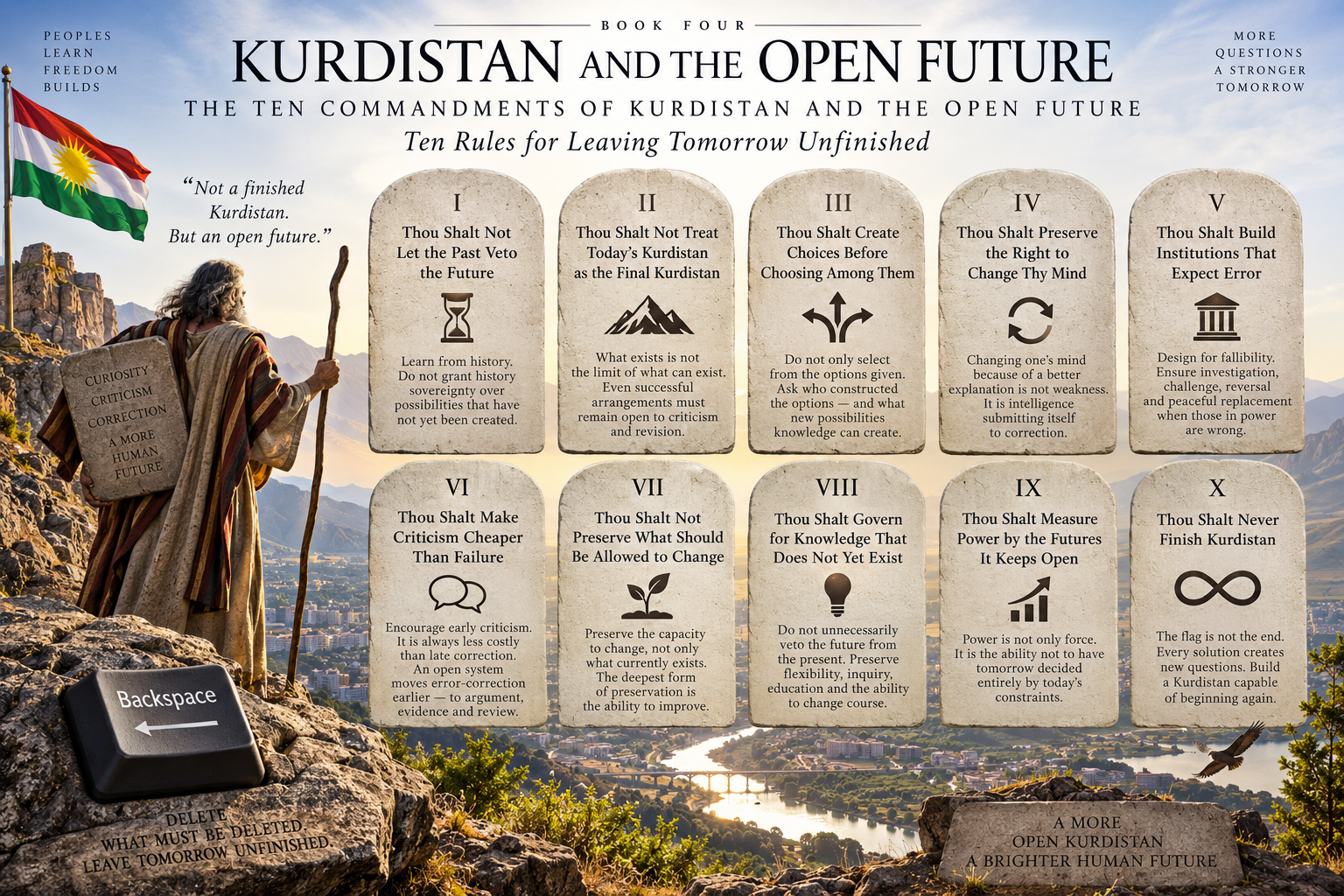
Note
This is the fifth installment in the series that began with “When Moses Visits Kurdistan,” continued with “The Ten Commandments of Kurdistanî Azad,” then “The Ten Commandments of When Parochial Error Goes Global,” and then “The Ten Commandments of Kurdistan: The Offense of Existing.”
The first asked what a people should do after too many things have already been written in stone.
The second asked whether survival had been mistaken for freedom.
The third asked how an error becomes dangerous once a society learns to protect it from correction.
The fourth asked what happens when a people’s very existence is treated as the error.
This one asks the question that follows: after a people has been forced to defend the fact of being alive, how does it keep tomorrow unfinished—so that memory, institutions, and identity do not become a second partition?
Book Four: Kurdistan and the Open Future
The Ten Commandments of Kurdistan and the Open Future
Ten Rules for Leaving Tomorrow Unfinished. The previous installment examined why Kurdish political life is so often required to justify itself under standards that established states were never asked to meet. Existence was recoded as disruption. Continuity was treated as a claim that had to be endlessly defended. Recognition was offered as a favor rather than a fact. That diagnosis is not the end of the argument. If existence itself has been made to look illegitimate, the next danger is that Kurdistan will answer by trying to finish itself too soon: to freeze a constitution, a party map, a doctrine, a generation’s sacrifice, or a single interpretation of Kurdishness and call that completion. An open future is the refusal of that freeze. It is not amnesia. It is the decision that no error, no leader, no institution, and no inherited arrangement should be allowed to veto possibilities that have not yet been created. These commandments are therefore not a program for a final Kurdistan. They are rules for preserving the capacity to begin again.
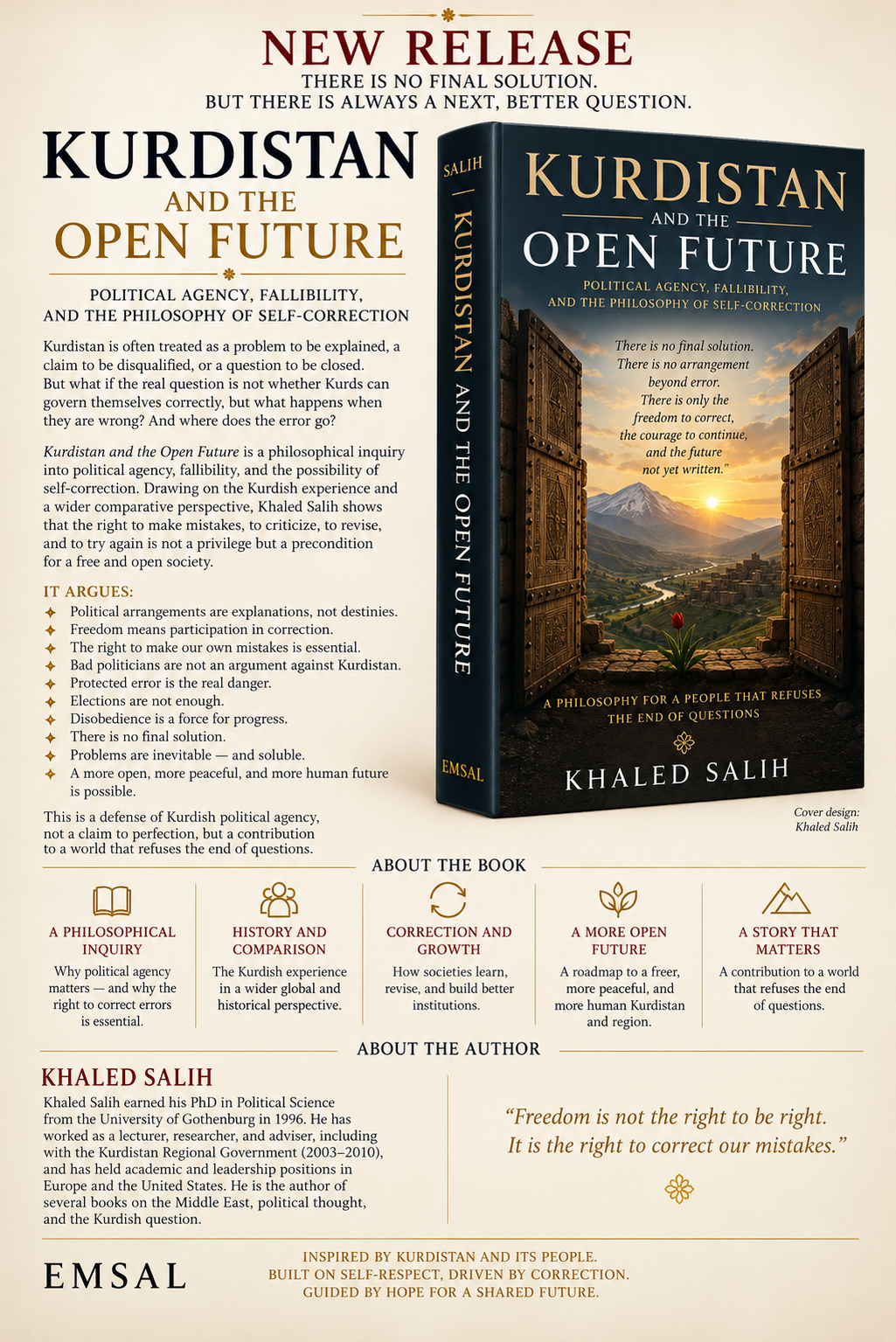
Book Four Kurdistan and the Open Future
The Ten Commandments of Kurdistan and the Open Future
Ten Rules for Leaving Tomorrow Unfinished
Commandment I
Thou Shalt Not Let the Past Veto the Future
Kurdistan carries an enormous historical inheritance.
Anfal. Helebje. Mehabad. Dersim. Betrayal. Partition. Assimilation. Revolt. Survival.
Those experiences matter. They help explain present fears, institutions, loyalties, and political reflexes.
But explanation must not become imprisonment.
A people can become so determined never to repeat the past that it begins allowing the past to govern the future.
The first commandment is therefore:
Learn from history. Do not grant history sovereignty over possibilities that have not yet been created.
Memory should inform choice.
It should not abolish choice.
Commandment II
Thou Shalt Not Treat Today’s Kurdistan as the Final Kurdistan
Institutions, constitutions, party systems, external relationships, and administrative arrangements may endure for long periods. None should be treated as beyond peaceful criticism or revision.
Even successful arrangements must remain open to criticism.
The danger begins when temporary solutions acquire the prestige of inevitability.
What exists is not the limit of what can exist.
The Kurdistan of the future need not resemble the Kurdistan imagined by the present generation.
That is not a threat.
That is what an open future means.
Commandment III
Thou Shalt Create Choices Before Choosing Among Them
Politics usually arrives as a menu.
Federalism or independence.
Baghdad or Ankara.
Washington or Tehran.
Unity or pluralism.
Security or liberty.
Tradition or modernity.
But one of the deepest lessons of choice creation is that the visible alternatives may themselves constitute the problem.
Before asking:
Which option should Kurdistan choose?
ask:
Who constructed the options?
And then:
What knowledge could create an option that does not yet exist?
A free political culture is not merely good at selecting answers.
It is good at creating new questions and new possibilities.
Commandment IV
Thou Shalt Preserve the Right to Change Thy Mind
Political maturity is often mistaken for consistency.
A leader announces a position.
A party adopts a doctrine.
A generation sacrifices for an objective.
Then changing course begins to look like betrayal.
That is how error acquires protection.
An open Kurdistan should institutionalize the opposite principle:
Changing one’s mind because a better explanation has appeared is not weakness. It is intelligence submitting itself to correction..
A strategy that cannot be reconsidered has ceased to be a strategy.
It has become an identity.
That is why every Kurdish institution needs a protected capacity for revision.
Commandment V
Thou Shalt Build Institutions That Expect Error
Do not design Kurdistan on the assumption that good people will always govern it.
They will not.
Do not assume leaders will always be wise.
They will not.
Do not assume parties will place public interest above factional interest.
They will not always do so.
The rational institution begins from fallibility.
It asks:
What happens when the person in power is wrong?
Can the press investigate?
Can parliament challenge?
Can courts intervene?
Can citizens organize?
Can experts contradict authority?
Can governments replaced peacefully?
Can bad policy be reversed before the damage becomes irreversible?
The strength of an institution is not demonstrated when everybody behaves well.
It is demonstrated when somebody does not.
Commandment VI
Thou Shalt Make Criticism Cheaper Than Failure
Closed systems make criticism expensive.
The dissenter loses access.
The official loses promotion.
The intellectual loses belonging.
The journalist loses protection.
The party member is branded disloyal..
So the error survives until reality imposes correction at a much higher price.
An open political system reverses that architecture.
Criticism should arrive before catastrophe.
The cheapest correction is often criticism before implementation. More expensive corrections may require administrative reversal, judicial intervention, electoral replacement, or institutional redesign. More expensive still is correction imposed by breakdown or violence.
One purpose of an open Kurdistan should therefore be to move correction steadily earlier—to argument, evidence, institutional review, elections, and peaceful replacement.
Commandment VII
Thou Shalt Not Preserve What Should Be Allowed to Change
There is a dangerous conception of sustainability:
Find the right arrangement.
Protect it.
Keep it stable.
Prevent disruption.
But societies are not museums.
Institutions survive by adapting to problems, not by avoiding them.
Languages develop.
Cities change.
Economies transform.
Identities evolve.
Political coalitions disappear.
Technologies make old institutions obsolete.
The correct principle is not static sustainability.
It is dynamic sustainability.
Preserve the capacity to change, not merely the things that currently exist.
The deepest form of preservation is preserving the ability to improve.
Commandment VIII
Thou Shalt Govern for Knowledge That Does Not Yet Exist
Future generations will know things we do not know.
They will face technologies we cannot imagine.
They will encounter political arrangements we have no vocabulary for.
They will discover errors in ideas we currently consider obvious.
Therefore the present generation must be extraordinarily careful when making irreversible decisions on behalf of future people who may possess knowledge unavailable to us.
This creates a new political principle:
Do not unnecessarily veto the future from the present.
Preserve institutional flexibility.
Preserve educational openness.
Preserve scientific inquiry.
Preserve criticism.
Preserve the capacity to change constitutional arrangements peacefully.
Backspace is institutional respect for future knowledge.
Commandment IX
Thou Shalt Measure Power by the Futures It Keeps Open
Military power matters.
Economic power matters.
Diplomatic access matters.
Energy matters.
Alliances matter.
But none is the final measure of political power.
A state can possess formidable coercive power while trapping itself inside bad choices.
A smaller political entity can possess fewer material resources while steadily expanding its room for action.
So ask of every Kurdish strategy:
Does this alliance increase future choices?
Does this institution create knowledge?
Does this economic policy reduce dependency?
Does this security arrangement remain reversible?
Does this diplomatic relationship open other relationships?
Does this settlement preserve possibilities for peaceful improvement?
Then power acquires a different meaning:
Power is partly the ability not to have tomorrow decided entirely by today’s constraints.
Commandment X
Thou Shalt Never Finish Kurdistan
There should never be a final Kurdistan.
Not because Kurdistan should remain incomplete politically.
But because no successful society is ever epistemically complete.
The flag is not the end.
The constitution is not the end.
Recognition is not the end.
Independence, if it ever comes, would not be the end.
Federalism is not the end.
Prosperity is not the end.
Democracy itself is not an achieved possession that can simply be stored.
Every solution creates new problems.
Every advance exposes new ignorance.
Every generation inherits questions that the previous one could not answer.
That is why the deepest aspiration should not be:
Build the final Kurdistan.
It should be:
Build a Kurdistan capable of beginning again.
A Kurdistan in which no error is final.
No leader is final.
No institution is final.
No interpretation of Kurdishness is final.
No generation possesses the right to close possibilities for all those that follow.
That is the meaning of an open future.
The task is not to hand the future a finished Kurdistan. It is to hand Kurdistan an unfinished future. That requires one final capacity: the ability to delete even the ideas that once helped us advance.


