The Ten Commandments of BACKSPACE
Ten Rules for Escaping an Idea Before It Becomes a Prison
23 September 2026
Note
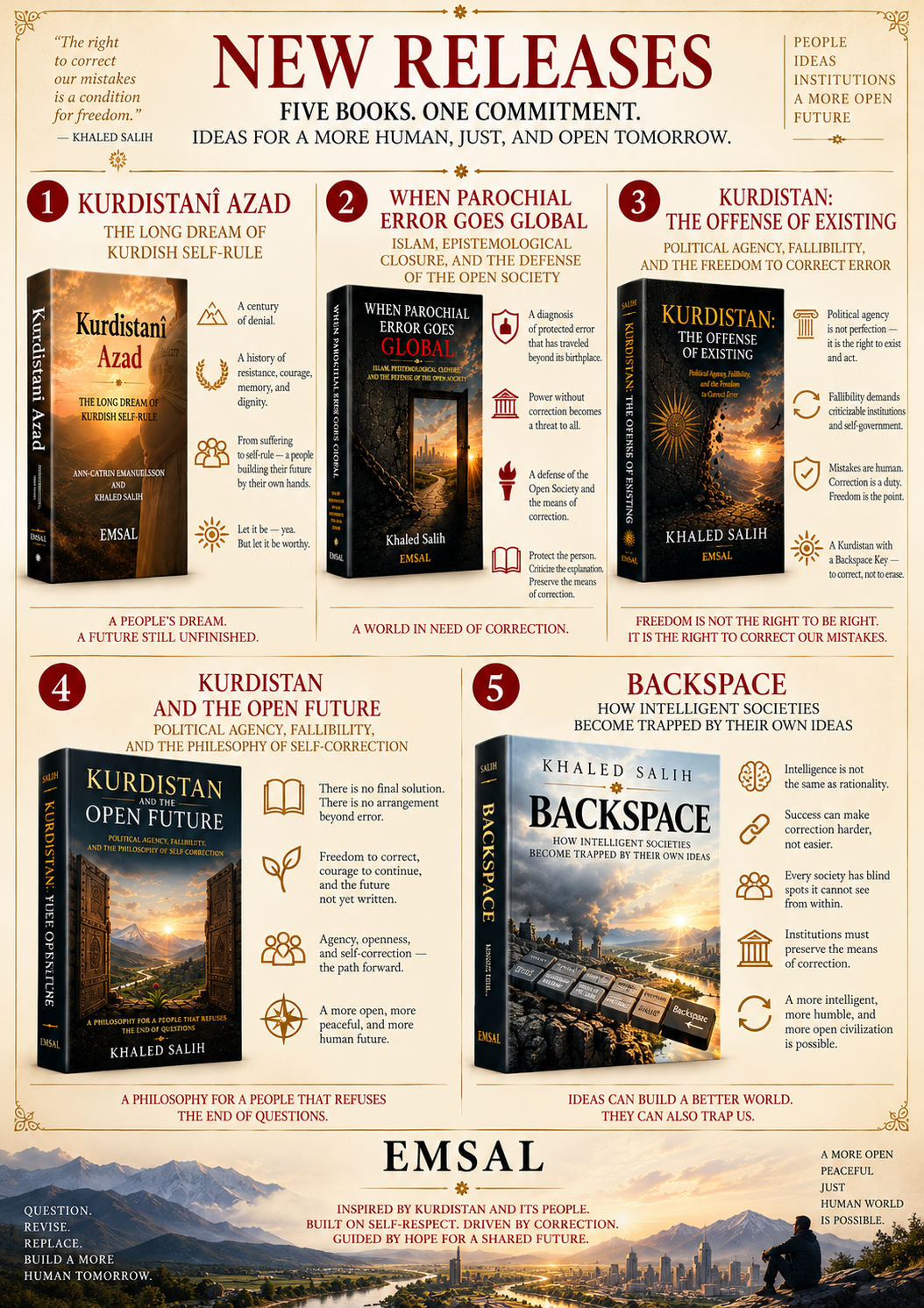
This is the sixth and final note in the series that began with “When Moses Visits Kurdistan,” continued with “The Ten Commandments of Kurdistanî Azad,” then “The Ten Commandments of When Parochial Error Goes Global,” then “The Ten Commandments of Kurdistan: The Offense of Existing,” and then “The Ten Commandments of Kurdistan and the Open Future.”
The first asked what a people should do after too many things have already been written in stone.
The second asked whether survival had been mistaken for freedom.
The third asked how an error becomes dangerous once a society learns to protect it from correction.
The fourth asked what happens when a people’s very existence is treated as the error.
The fifth asked, after a people has been forced to defend the fact of being alive, how it keeps tomorrow unfinished—so that memory, institutions, and identity do not become a second partition.This one asks the question underneath all the others: can a society still change its mind after it has invested intelligence, identity, prestige, institutions, and sacrifice in being right?Book Five
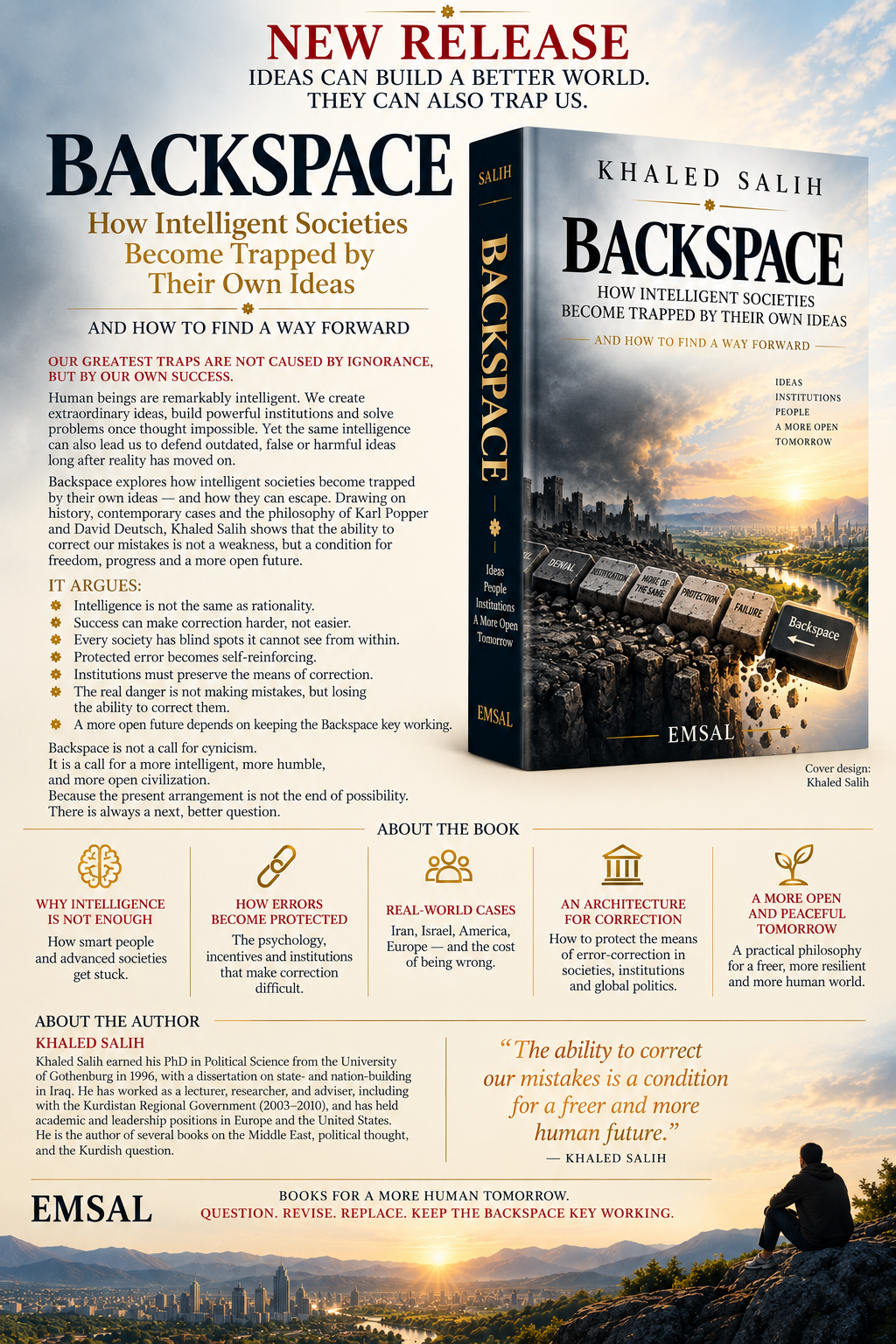
BACKSPACE — How Intelligent Societies Become Trapped by Their Own Ideas
The Ten Commandments of BACKSPACE
Ten Rules for Escaping an Idea Before It Becomes a PrisonThe previous installment refused the freeze. It argued that Kurdistan should not answer the offense of existing by trying to finish itself too soon: not by locking a constitution, a party map, a doctrine, a generation’s sacrifice, or a single interpretation of Kurdishness and calling that completion. An open future was the refusal of that freeze.That argument is incomplete without its mechanism. Openness is not a mood. It is an architecture. A people can inherit an unfinished future and still lose it—not because it is unintelligent, but because intelligence itself can be used to protect the idea that should have been abandoned. The name of that architecture is Backspace: the institutionalized capacity to reconsider a premise before paying the full cost of protecting it.These commandments are therefore not a program for the last correct idea. They are rules for escaping an idea before it becomes a prison.
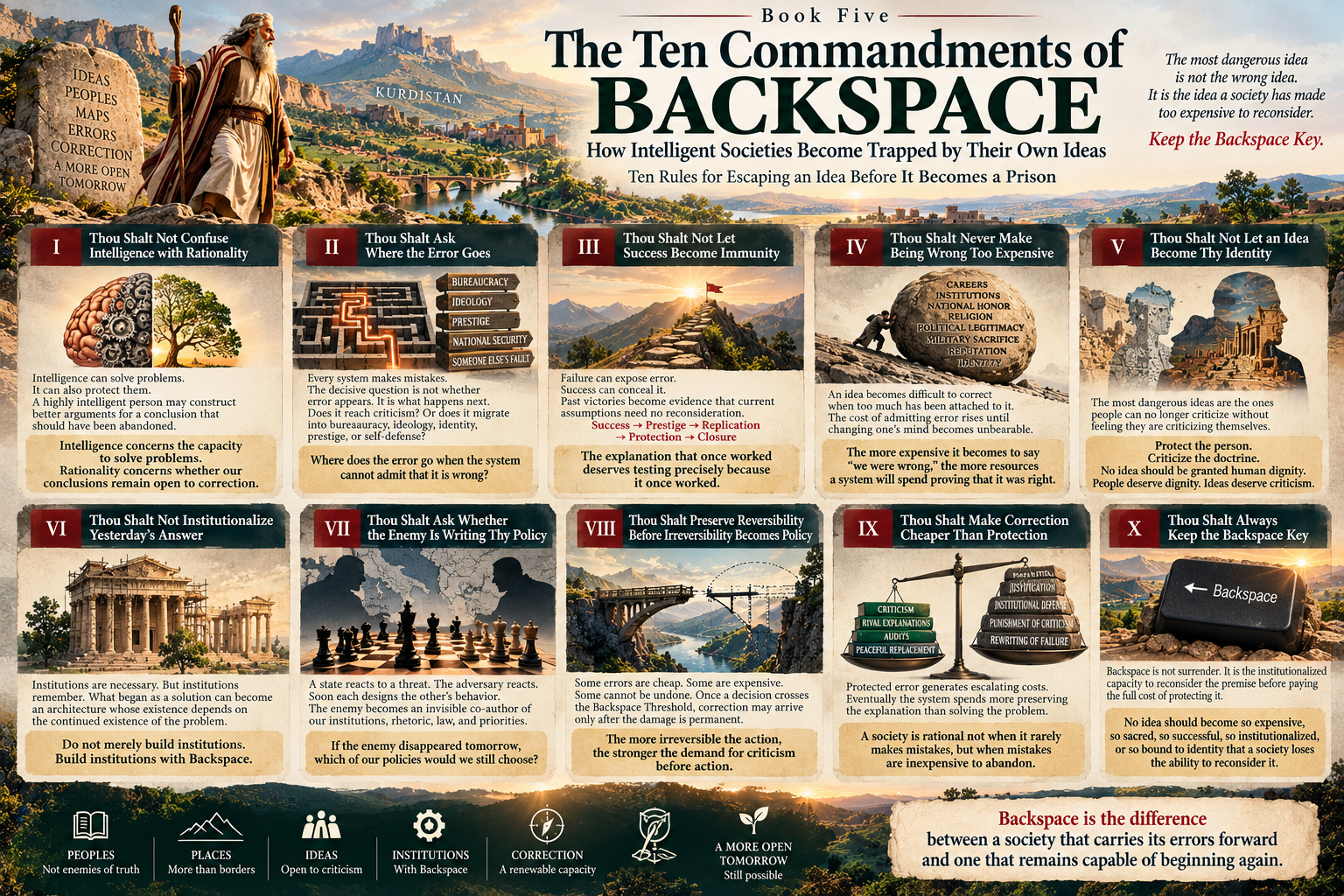
Book Five BACKSPACE — How Intelligent Societies Become Trapped by Their Own Ideas
The Ten Commandments of BACKSPACE
Ten Rules for Escaping an Idea Before It Becomes a Prison
Commandment I
Thou Shalt Not Confuse Intelligence with Rationality
Intelligence can solve problems.
It can also protect them.
A highly intelligent person may construct better arguments for a conclusion that should have been abandoned years earlier.
A sophisticated bureaucracy may create elaborate explanations for why its own failure proves that it needs more power.
An advanced society may accumulate expertise without accumulating corrigibility.
That is the first danger.
Intelligence concerns the capacity to solve problems. Rationality concerns whether our conclusions remain open to correction.
The distinction is decisive.
The greater the intelligence, the greater the danger when Backspace disappears.
Commandment II
Thou Shalt Ask Where the Error Goes
Every system makes mistakes.
The decisive question is not whether error appears.
It is what happens next.
Does the error reach criticism?
Does criticism reach decision-makers?
Can a failed assumption be abandoned?
Or does the error migrate?
Into bureaucracy.
Into ideology.
Into identity.
Into national security.
Into prestige.
Into institutional self-defense.
Into explanations of why the failure was someone else’s fault.
The critical question is therefore:
Where does the error go when the system cannot admit that it is wrong?
If the answer is “somewhere safer,” the trap has already begun.
Commandment III
Thou Shalt Not Let Success Become Immunity
Failure can expose error.
Success can conceal it.
A society that succeeds repeatedly may begin treating the explanation of yesterday’s success as a law governing tomorrow.
Institutions built under one set of conditions acquire authority under another.
Past victories become evidence that current assumptions need no reconsideration.
The sequence is dangerous:
Success → Prestige → Replication → Protection → Closure
The problem is not success itself.
The problem is what success does to criticism.
The explanation that once worked deserves testing precisely because it once worked.
Success can create knowledge. It can also create intellectual immunity.
Commandment IV
Thou Shalt Never Make Being Wrong Too Expensive
An idea becomes difficult to correct when too much has been attached to it.
Careers.
Institutions.
National honor.
Religious identity.
Political legitimacy.
Military sacrifice.
Academic reputation.
Personal biography.
The cost of admitting error rises until changing one’s mind becomes psychologically, politically, or institutionally unbearable.
At that point the system begins protecting the idea because abandoning it would expose everything invested in it.
The more expensive it becomes to say “we were wrong,” the more resources a system will spend proving that it was right.
A rational society must therefore keep the cost of correction lower than the cost of protection.
Commandment V
Thou Shalt Not Let an Idea Become Thy Identity
The most dangerous ideas are not necessarily the most false.
They are the ones people can no longer criticize without feeling that they are criticizing themselves.
Once doctrine and identity fuse, argument becomes existential.
A criticism of policy becomes an attack on the nation.
A criticism of religion becomes an attack on believers.
A criticism of a movement becomes betrayal.
A criticism of an institution becomes disloyalty.
The Backspace Key becomes almost impossible to press because deleting the proposition feels like deleting the person.
The correction is simple in principle and difficult in practice:
Protect the person. Criticize the doctrine.
No idea should be granted human dignity.
People deserve dignity.
Ideas deserve criticism.
Commandment VI
Thou Shalt Not Institutionalize Yesterday’s Answer
Institutions are necessary.
But institutions remember.
They accumulate procedures, incentives, categories, professional identities, budgets, and vested interests.
What began as a solution can eventually become an architecture whose continued existence depends on the continued existence of the problem.
The danger is especially acute when institutions become highly competent.
They can become very good at solving the problem they were designed for long after that problem has changed.
Or worse:
they can become very good at preventing anyone from asking whether the original problem still exists in the same form.
The task is therefore not merely to build institutions.
It is to build institutions with Backspace.
Commandment VII
Thou Shalt Ask Whether the Enemy Is Writing Thy Policy
Enemies influence one another.
A state reacts to a threat.
The adversary reacts to the reaction.
The first state then changes again.
Soon each begins designing the other’s behavior.
The enemy becomes an invisible co-author of domestic institutions, rhetoric, military doctrine, surveillance, law, identity, and political priorities.
This creates a dangerous recursive loop:
Threat → Reaction → Enemy Reaction → Stronger Reaction → Institutionalization
Eventually a society may become something it would never have chosen independently.
The test is:
If the enemy disappeared tomorrow, which of our policies would we still choose?
If the answer is unclear, the enemy may already be co-authoring part of the system.
Commandment VIII
Thou Shalt Preserve Reversibility Before Irreversibility Becomes Policy
Some errors are cheap.
Some are expensive.
Some cannot be undone.
War.
Mass killing.
Demographic engineering.
Institutional destruction.
Permanent constitutional closure.
Irreversible technological deployment.
Once a decision crosses what I call the Backspace Threshold—the point beyond which meaningful reversal becomes impossible or prohibitively costly—correction may arrive only after the damage has become permanent.
The rational rule is therefore:
The more irreversible the action, the stronger the demand for criticism before action.
Uncertainty should not automatically mean paralysis.
But it should change the architecture of decision-making.
Experiment where possible.
Stage commitments.
Preserve exit routes.
Avoid destroying the mechanisms that would allow later correction.
The ability to reverse is itself a political asset.
Commandment IX
Thou Shalt Make Correction Cheaper Than Protection
Protected error generates escalating costs.
First comes explanation.
Then justification.
Then institutional defense.
Then punishment of criticism.
Then rewriting of failure.
Then new investments designed to make the original error look less mistaken.
Eventually the system spends more preserving the explanation than solving the problem.
That is the protection trap.
The alternative is an architecture in which saying:
“This did not work”
is cheaper than constructing another layer of defense around it.
That requires:
open criticism,
rival explanations,
peaceful replacement,
recorded predictions,
post-failure audits,
independent institutions,
and political cultures in which leaders can survive being corrected.
A society is rational not when it rarely makes mistakes, but when mistakes are inexpensive to abandon.
Commandment X
Thou Shalt Always Keep the Backspace Key
Backspace is not surrender.
It is not indecision.
It is not relativism.
It is not weakness.
It is the institutionalized capacity to reconsider the premise before paying the full cost of protecting it.
A society with Backspace can say:
We misunderstood the problem.
The enemy changed.
The institution outlived its purpose.
The successful strategy became obsolete.
The theory has stopped explaining reality.
The policy is producing the opposite of what we intended.
The identity we built around this idea is making correction impossible.
And then it can change course without first requiring catastrophe.
That is the core principle:
No idea should become so expensive, so sacred, so successful, so institutionalized, or so bound to identity that a society loses the ability to reconsider it.
Backspace is therefore not merely a metaphor for correction.
It is a constitutional principle.
An epistemological principle.
A political principle.
A civilizational principle.
And ultimately:
Backspace is the difference between a society that carries its errors forward and one that remains capable of beginning again.
The most dangerous idea is not the wrong idea. It is the idea a society has made too expensive to reconsider.
Keep the Backspace Key.
Conclusion The Fifty-First Commandment
Five books.
Fifty commandments.
One Backspace Key.
At first glance, the form suggests certainty.
Commandments sound final. They sound carved into stone. They sound like propositions intended to survive unchanged.
But that would be the wrong lesson to take from these five books.
Almost everything I have tried to argue points in the opposite direction.
Kurdistanî Azad asks how political openings can become institutions without turning institutions into prisons.
When Parochial Error Goes Global asks what happens when ideas acquire protection from criticism.
Kurdistan: The Offense of Existing argues that a people should not have to prove perfection before being allowed political room—and that political freedom includes the right to make correctable mistakes.
Kurdistan and the Open Future asks us to preserve possibilities for people who will know things we do not yet know.
And BACKSPACE asks the question underneath all the others:
Can we still change our minds after we have invested intelligence, identity, prestige, institutions, and sacrifice in being right?
So the series needs one final commandment.
Commandment LI: Thou Shalt Criticize the Commandments
Not because principles are useless. Quite the opposite: principles help us see.
They compress difficult arguments. They expose recurring errors. They give us something firm enough to test.
But the moment a principle becomes protected because it is ours, the architecture begins to reverse.
A conjecture becomes doctrine.
A useful distinction becomes identity.
A successful explanation becomes inheritance.
Inheritance becomes authority.
Authority becomes immunity.
And eventually the tool built to expose error becomes another mechanism for protecting it.
That is precisely what these books warn against.
So the fifty commandments should remain what they were intended to be:
conjectures under pressure.
Some may survive for a long time.
Some may need qualification.
Some may turn out to be wrong.
Some may be replaced by better formulations.
And perhaps future problems will reveal that the most important commandment is one I failed to write.
That possibility should not weaken the project.
It is the point of the project.
Because an open society is not a society that finally discovers the correct set of commandments.
It is a society that preserves the conditions under which even its most cherished commandments can be challenged without destroying the people who challenge them.
The same is true of Kurdistan.
The goal is not to produce a final answer to the Kurdish question.
Not the final border.
Not the final constitution.
Not the final party system.
Not the final diplomatic strategy.
Not even the final meaning of Kurdistanî Azad.
The goal is to create political room in which better answers can continue to be discovered.
That is why the recurring questions across these five books ultimately reduce to a small number:
Where does the error go?
What protects it?
Can it still be criticized?
Who constructed the choices?
Can another choice be created?
Where does the improvement come from?
What survives the leader?
What happens when success becomes doctrine?
Does this decision preserve future correction?
And finally:
Are we leaving those who come after us more possibilities than we inherited?
If our best surviving answers remain criticizable, if they preserve the means of correction, and if they leave room for better answers to be created, then for now we have reason to continue.
Not toward perfection.
Not toward finality.
Toward something better:
corrigibility.
The purpose is not to become correct once. It is to remain correctable.
The ability to discover error.
The freedom to criticize it.
The courage to abandon it.
The institutions to replace it.
And the imagination to create possibilities that were invisible before.
That is the thread running through all five books.
That is why one word governs all fifty:
Backspace.
Because no error should be final.
No doctrine should be final.
No institution should be final.
No political settlement should be immune from peaceful revision.
No generation should have the authority to close the future for all those that follow. Moses began with commandments carved in stone. This project ends by refusing to leave them there.
So keep the commandments.
Test them.
Use them.
Criticize them.
Rewrite them.
Delete them when better explanations appear.
And preserve the conditions that make all of it possible: the means of error correction and the freedom to create something better.
Five books. Fifty commandments. One Backspace Key.