The Software of Stagnation: How Anti-Rational Ideas Capture Universal Explainers
30 April 2026
To David Deutsch, Karl Popper and Henny (Karl Popper’ s wife, Josephine Anna Henninger)
For almost thirteen billion years, this region of the universe was silent.
Stars burned. Galaxies collided. Planets formed and died. Matter transformed endlessly under the blind pressure of physical law. But nowhere, at least in this small corner of the cosmos, did matter understand itself. There were processes, but no explanations. There was motion, but no meaning. There was change, but no knowledge of change.
Then, very recently, on one small planet orbiting an ordinary star, something unprecedented happened.
A biological species crossed a threshold.
Its brain became capable not merely of reacting to the world, but of explaining it. Human beings became universal explainers: creatures able, in principle, to model any physical process permitted by the laws of nature and to compute anything that is computable.
With this came a new force in the universe: explanatory knowledge.
Human beings create knowledge from nothing but conjecture and criticism. We guess, test, fail, correct, and guess again. We build models of stars we have never touched, particles we have never seen, and futures that do not yet exist. Through this process, matter began to understand matter.
But this magnificent fact raises a disturbing question.
If human beings possess the capacity to detect error, criticize falsehood and improve their ideas, why does progress ever stop?
Why do entire civilizations freeze?
Why do societies capable of creativity, science and open-ended problem-solving sometimes lock themselves into centuries of stagnation?
This is not a minor historical puzzle. It is one of the deepest anomalies in the story of humanity.
If the human mind is universal in reach, then its limits should come only from the laws of physics. Yet history shows us societies that halt their own development, suppress criticism, sanctify inherited errors and treat new explanations as crimes.
Something, therefore, must be interfering with the mind’s error-correcting machinery.
Open societies are built on a simple but revolutionary principle: let ideas die instead of people.
Karl Popper understood this with extraordinary clarity. In the rest of the biosphere, error is often paid for in blood. Animals perish when their inherited adaptations fail. But human beings discovered a different path. We can allow our theories to fail before we do. We can criticize a belief, discard it, and survive the correction.
That is the moral miracle of reason.
A civilization that protects criticism protects life itself. It gives human beings permission to be wrong without being destroyed. It transforms failure from a death sentence into an engine of discovery.
As long as errors can be corrected, no problem is inherently insoluble. This is our objective significance as a species. We are not important because we are large, ancient or centrally placed in the cosmos. We are important because we can create explanations.
And yet, again and again, civilizations have chosen paralysis.
Modern secular analysts often explain this by pointing to material causes: poverty, scarcity, trauma, colonialism, resource shortages, economic instability or historical grievance. These factors matter. But they do not explain the central phenomenon.
They do not explain why some minds refuse criticism even when criticism would help them.
They do not explain why bad ideas can survive obvious failure.
They do not explain why human beings sometimes defend the very systems that imprison their own creativity.
This is the inductivist fallacy: the assumption that beliefs are merely passive reflections of material conditions. Fix the environment, we are told, and the ideology will dissolve.
But ideas are not shadows cast by bank accounts.
The physics of information tells a different story. Physical resources do not create explanations. Wealth does not automatically produce criticism. Poverty does not disable the mind’s capacity to detect contradiction. Human beings act not merely from conditions, but from the ideas they hold about those conditions.
To understand civilizational stasis, we must therefore look beyond the material environment. We must examine the abstract replicators that have taken control of human minds.
Jacob Bronowski grasped the horror of this at Auschwitz.
Standing in the mud where human beings had been turned into ash by an ideology claiming absolute certainty, he saw that catastrophe does not begin merely with poverty or administrative failure. It begins with dogma. It begins with the arrogant claim to possess final knowledge. It begins when human beings aspire to the certainty of gods while abandoning the humility of scientists.
The greatest danger is not ignorance.
Ignorance can be corrected.
The greatest danger is false certainty protected from correction.
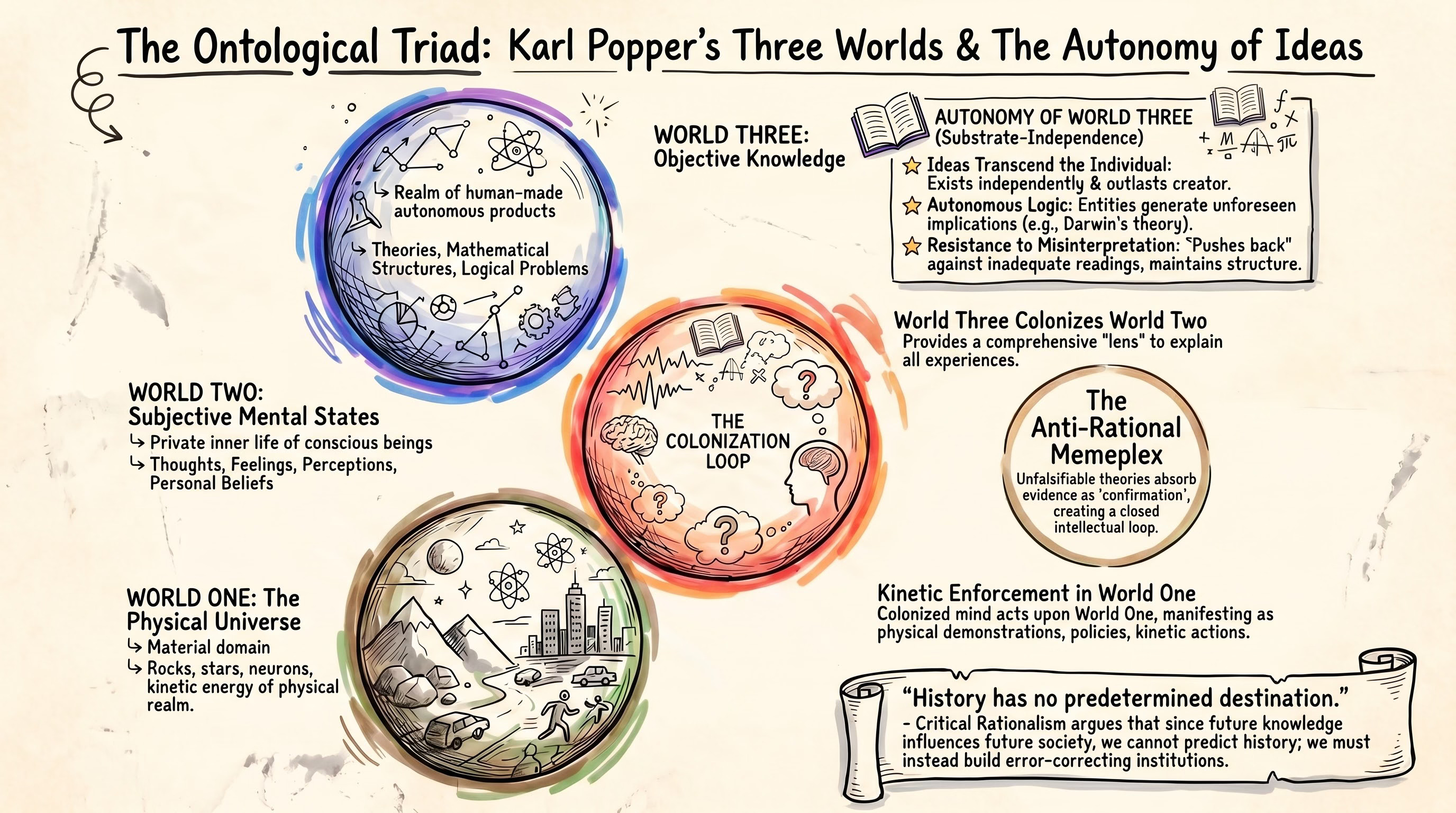
Popper’s three-world ontology helps us understand why this matters.
World 1 is the physical universe: stones, stars, bodies, neurons, weapons, prisons and books.
World 2 is subjective experience: fear, love, pain, memory, desire and consciousness.
World 3 is the realm of objective knowledge: theories, arguments, proofs, stories, doctrines, ideologies and memeplexes.
World 3 entities are strange. They are not physical in the ordinary sense, yet they act upon the physical world. A theory can sit in a book for centuries, enter a mind, reorganize perception, direct behavior, inspire institutions and move armies. An idea can cross from ink into neurons, from neurons into action, and from action into history.
Ideas are not ghosts.
They are causal structures.
When a mind adopts an idea, that idea begins to shape what the person can see, what questions may be asked, what doubts are permitted and what criticisms are forbidden. Some ideas open the mind to correction. Others close it.
This is the decisive distinction.
Rational ideas survive by exposing themselves to criticism. They improve because they can be challenged. Their loyalty is not to self-preservation, but to truth-seeking.
Anti-rational ideas do the opposite.
An anti-rational memeplex is a blind replicator whose survival depends on disabling the very faculties that might expose it as false. It does not win by solving problems. It wins by forbidding the questions that would reveal the problem. It binds itself to identity, morality, loyalty and sacred duty until criticism feels not like thought, but like betrayal.
The host is not persuaded merely to believe.
The host is trained to protect the belief from examination.
This is how a universal explainer becomes captured.
The tragedy is immense. A human mind capable of infinite creativity is redirected toward the maintenance of its own prison. Intelligence does not disappear. It is conscripted. Brilliant people become expert defenders of closed systems. Their ingenuity is spent not on discovering the future, but on repairing the walls around the past.
This is epistemological closure.
A static loop forms. New conjectures are treated as moral threats. Doubt becomes sin. Criticism becomes treason. The mind, capable of open-ended problem-solving, is reduced to a replication engine for inherited dogma.
This capture is not biological.
It is not racial.
It is not geographic.
It is not caused by some defect in the hardware of the human brain.
Captured individuals possess the same universal capacity for explanation as anyone else. The tragedy is precisely that pristine universal explainers are being suppressed by external abstractions. Their own creativity is turned against them. Their minds are used to maintain the very system that prevents their liberation.
This is why open societies are vulnerable.
They are built to tolerate disagreement. They extend rights, protections and good faith even to those who reject the principles that make good faith possible. This is noble, but dangerous when misunderstood.
Through the inductivist fallacy and what might be called suicidal empathy, secular analysts mistake anti-rational replicators for ordinary participants in rational discourse. They assume that all doctrines are merely identities, all closed systems are merely cultures, and all criticism of anti-rational ideas is a threat to pluralism.
But Popper’s paradox of tolerance warns us that unlimited tolerance can destroy tolerance itself.
An open society cannot survive by extending rational protections to systems designed to abolish rational criticism. If it fails to recognize the disabling mechanism, it allows its own greatest achievement — the tradition of criticism — to be weaponized against it.
History gives us brutal examples.
The Ottoman Empire’s long resistance to the printing press was not merely a technical delay or bureaucratic hesitation. It was a throttling of new ideas in order to preserve authoritative stasis. The danger of the printing press was not paper. It was replication without permission. It was criticism escaping control.
Static societies understand this instinctively. They treat conjecture as contamination. They treat open inquiry as rebellion. They know that once criticism enters the system, the walls begin to crack.
But the story does not end in despair.
Civilizational stagnation is a software problem, not a hardware limitation.
The human mind remains capable of infinite creativity. The paralysis is produced by information, and therefore it can be dismantled by better information. An anti-rational memeplex is, in the end, only an idea. And every idea, however ancient, sacred or intimidating, is vulnerable to criticism.
The moment a person begins to ask, “What if this is false?” the prison trembles.
The moment a mind stops seeking justification and starts seeking explanation, the static loop weakens.
The moment criticism is no longer experienced as betrayal, freedom becomes possible.
This is the principle of optimism articulated by David Deutsch: all evils are caused by insufficient knowledge. Not because all problems are easy. Not because suffering is imaginary. But because there is no cosmic law requiring our errors to be permanent. If a problem is soluble, the missing ingredient is knowledge.
And humans can create knowledge.
When the universal explainer reenters the tradition of criticism, the future reopens. The mind stops replicating the past and begins constructing what has never existed before.
Socratic confrontation is therefore not cruelty. It is civilizational medicine.
It gives people the tools to let their bad ideas die in their place. It teaches them that criticism is not humiliation, but liberation. It restores the most precious human capacity: the ability to improve without being destroyed.
Progress is humanity’s infinite adventure.
Each solved problem reveals deeper and better problems. Each correction expands the horizon of the possible. The story of our species is not one of predetermined fate, tribal destiny or eternal return. It is the story of creative minds breaking out of prisons made of ideas.
For almost thirteen billion years, the universe waited for matter that could explain itself.
Now that such minds exist, the question is no longer whether our problems are soluble.
The question is whether we will defend the tradition that makes solutions possible.
Will we allow anti-rational replicators to disable our greatest gift?
Or will we reclaim criticism, error correction and open-ended knowledge creation as the birthright of every universal explainer?
The hardware has always been ready.
The software — the ideas we choose to live by — will decide whether we remain trapped in civilizational stasis or step into humanity’s boundless future.
The universe has waited thirteen billion years for minds like ours.
The question is not whether we can solve our problems.
It is whether we will choose to begin.


