The Sermon After the Beheading: Yasir Qadhi, Samuel Paty, and Intelligence Without Rationality
21 May 2026
Five years ago, shortly after the beheading of Samuel Paty in France, I drafted a long article about Yasir Qadhi’s sermon on “the situation in France.” I never published it.
Perhaps the timing was too raw. Perhaps the article was too detailed, too angry, too close to the blood. Perhaps I had not yet found the philosophical frame that could hold the event without reducing it to outrage.
Now I have.
The frame is this:
Intelligence is not rationality.
Intelligence optimizes inside a frame. Rationality asks whether the frame itself is false.
But a frame is not usually visible. It does not appear as a knife, a building, a law, a sermon, or a corpse. It appears through them. The deepest causes in human affairs are often invisible: explanations, sacred premises, moral hierarchies, inherited taboos, collective memories, and concepts of honor, purity, shame, guilt, and justice. They are invisible, but they are not unreal. They arrange bodies, institutions, gestures, punishments, silences, loyalties, and deaths. To analyze Qadhi’s sermon, therefore, is not merely to analyze words. It is to analyze the invisible explanatory machinery that made those words morally powerful.
That distinction changes everything.
It allows us to see Yasir Qadhi’s sermon not merely as anger, apologetics, provocation, or political rhetoric. It allows us to see it as a case study in captured intelligence: intelligence fluent enough to quote, arrange, perform, contextualize, historicize, theologize, and emotionally transport an audience — but not free enough to ask whether the sacred frame it serves has itself become morally false.
Samuel Paty was beheaded on October 16, 2020.
He was a teacher.
He was killed for teaching freedom of expression.
He was not a soldier. He was not a combatant. He was not standing in an ancient theological court. He was not waging war against a civilization. He was doing what teachers in open societies must be able to do: help students understand difficult ideas, including the right to criticize, satirize, examine, and discuss religious symbols.
One week later, on October 23, Yasir Qadhi delivered his sermon.
Three days after that, on October 29, three more people were murdered in Nice, including a woman beheaded inside the Notre-Dame Basilica. The chronology is essential: Paty’s murder, Qadhi’s sermon, then Nice. The sermon belongs to that moral atmosphere. It was spoken while France was still inside the wound.
In this essay, I am analyzing Qadhi’s October 23, 2020 sermon on France as a public act of religious interpretation: not merely as isolated sentences, but as a sequence, a framing operation, and a moral performance. Where I quote or paraphrase the sermon, the relevant point is not only the literal wording but the movement of attention: what is centered, what is displaced, what is made emotionally vivid, and what is protected from correction. A sermon is not only a collection of propositions. It is an ordering of moral perception.
The question is not only what the murderer did.
A beheading is not explained by a knife alone. The knife is the visible instrument. The invisible reality is the explanatory frame that made the knife meaningful. Before the hand moved, an idea had already arranged the moral universe: insult became injury, injury became cosmic offense, and cosmic offense became permission. That is why the sermon after the murder matters. It did not wield the knife. But it spoke inside the invisible world in which such knives become thinkable.
This distinction is morally essential. The object of criticism here is not Muslims as persons, nor religious believers as human beings, nor private love for a prophet. Persons must be protected. The object of criticism is a public explanatory frame: the frame in which sacred offense becomes a higher moral fact than the safety of the person who offended. The line must remain clear: protect the person, criticize the idea.
The sermon is therefore not an afterthought to the murder. It belongs to the same invisible ecology: the world of meanings, permissions, grievances, sacred rankings, and emotional triggers inside which physical violence becomes imaginable before it becomes visible.
The deeper question is:
What does an intelligent religious authority do immediately after such a murder?
Does he mourn the teacher?
Does he defend the right to teach?
Does he separate insult from murder?
Does he protect the distinction between criticizing an idea and harming a person?
Does he tell believers that no prophet, scripture, doctrine, tradition, grievance, identity, or sacred wound is worth one teacher’s head?
Or does he move the frame?
That is the test.
A serious critique must also expose itself to correction. My interpretation would be weakened if the sermon had kept Samuel Paty morally central; if it had named him with sustained human sympathy; if it had defended the teacher’s right to teach; if it had clearly separated insult from violence; if it had told Muslims that prophetic love cannot become coercion over non-Muslim bodies; if it had treated blasphemy rage as a moral reflex in need of correction; and if its historical and political context had sharpened responsibility rather than moved responsibility away from the sacred frame.
In that case, the sermon would have been an example of rational religious leadership under pressure. My claim is that it does not do this. It moves the moral center elsewhere.
And that is why Qadhi matters.
The Moral Test After the Beheading
After such a murder, rationality demands certain elementary acts.
Name the victim.
Mourn the victim.
Defend the teacher’s right to teach.
Protect the classroom.
Defend the Open Society.
Say clearly that no religious injury gives anyone the right to touch another person’s body.
Say clearly that a cartoon, lesson, image, book, satire, lecture, or discussion may offend, but offense is not murder, and no civilization can remain free if offended men are allowed to turn metaphysical injury into physical punishment.
This is not complicated.
A teacher was beheaded.
A rational response begins there.
But Qadhi’s sermon does something else. It mentions the event, but it does not allow Samuel Paty to remain morally central. The sermon quickly moves the center away from the murdered teacher and toward France, French liberalism, Muslim grievance, colonial memory, prophetic honor, state repression, and the alleged humiliation of the Muslim community.
This is the first mechanism of captured intelligence:
it relocates the victim.
Captured intelligence does not always deny the corpse.
It makes the corpse morally smaller than the grievance.
The Relocation of the Victim
In Qadhi’s sermon, Samuel Paty becomes strangely small.
The beheading is acknowledged, but not contemplated. The teacher is mentioned, but not mourned. The murderer is not made morally vivid. The victim’s family does not become the center. The school does not become the center. The right to teach does not become the center.
Instead, the center moves.
France becomes the accused.
French liberalism becomes hypocrisy.
Freedom of speech becomes aggression.
The murdered teacher becomes a hinge through which Qadhi turns his audience toward the wounded sacred collective.
This is not a failure of intelligence.
It is a use of intelligence as a tool.
The victim is not erased. He is miniaturized.
The sacred grievance is enlarged.
In Deutschian terms, the explanation has been varied without becoming more truthful: the same visible event is made to serve a different explanatory object.
The beheaded teacher is placed inside a wider drama where the true injury is no longer the death of a man, but the dishonor of a prophet, the pain of Muslims, the hostility of France, and the arrogance of the West.
This is how anti-rationality often works.
It does not begin by saying that murder is good.
It begins by making murder secondary.
The Ceremony as Transport
What still amazes me about Qadhi’s performance is not only the content.
It is the method.
He does not merely argue.
He stages.
He uses sound, melody, Qur’anic rhythm, Arabic words, ritual pacing, emotional escalation, facial expression, solemnity, repetition, and modern digital technology. The physical audience sits before him in Texas. The online audience watches from across the world. The political event is in France. The year is 2020. The murdered man is Samuel Paty.
But then, in the middle of the ceremony, Qadhi jumps.
He leaves Paris.
He leaves France.
He leaves the United States.
He leaves 2020.
And suddenly, with the confidence of a man opening a hidden door, he transports his listeners to seventh-century Arabia.
That is the alchemical moment.
Qadhi is not merely a preacher here. He becomes a kind of sacred chemist. It is almost impossible not to be fascinated by the technique. He takes a modern event — the beheading of a French teacher — and places it in a ritual vessel. Then he adds melody, Arabic, scripture, historical grievance, communal injury, sacred honor, Qur’anic memory, colonial accusation, and emotional pressure.
The original event changes form.
Murder becomes context.
A teacher becomes a symbol.
France becomes Quraysh.
State response becomes fitna.
Freedom of expression becomes provocation.
Liberal society becomes aggression.
The audience is transported before it has time to resist.
This is not ordinary preaching. It is moral transmutation.
The event is melted down and recast inside the sacred frame.
This is how invisible explanations act upon visible matter. They do not violate physics. They travel through voices, screens, gestures, institutions, memories, rituals, and bodies. A sermon is sound waves, but sound waves alone do not explain what a sermon does. A knife is steel, but steel alone does not explain why a hand raises it against a teacher. A cartoon is ink or pixels, but ink and pixels alone do not explain why some people experience it as a cosmic wound. The missing level is explanation. Popper would call this the reality of World Three: the world of objective contents produced by minds — stories, doctrines, laws, myths, concepts, arguments, and sacred histories. These are not physical objects in the simple sense, but they reshape physical reality through human consciousness and action. A doctrine enters World Two as fear, reverence, grievance, or duty; then it enters World One as speech, law, pressure, silence, flight, punishment, or violence.Without that level, we see the objects but not the world that moves them.
From Paris to Seventh-Century Arabia
History can illuminate.
But history can also be used to escape correction.
Qadhi’s movement from France in 2020 to Arabia in the seventh century does not clarify Samuel Paty’s murder. It displaces it. He invokes a story from the life of Muhammad involving a scouting expedition, a caravan, Quraysh, killing, sacred months, grievance, and divine judgment.
The effect is immense.
Samuel Paty is no longer simply a teacher murdered for teaching.
France is no longer simply a wounded liberal democracy reacting to a beheading.
The issue is no longer whether a schoolteacher may discuss cartoons in a civics class.
The issue becomes cosmic grievance.
Fitna.
Sacred insult.
The humiliation of Muslims.
The enemies of the Prophet.
The continuity of unbelieving aggression.
This is scale manipulation.
The individual victim is made small.
The collective grievance is made vast.
A murder in France becomes an episode in sacred history.
The present is not understood.
It is swallowed by the frame.
Intelligence as Alchemy
The word alchemy matters.
Qadhi’s sermon resembles an alchemical operation because it transforms the moral substance of an event. He takes one material — the beheading of Samuel Paty — and turns it into another: a sermon about France, Islamophobia, colonial guilt, sacred honor, Muslim suffering, and Western hypocrisy.
What was murder becomes anger.
What was a teacher’s death becomes Muslim pain.
What was civic education becomes provocation.
What was the right to criticize becomes humiliation.
What was a victim becomes a trigger.
What was the knife becomes the context.
This is not irrational chaos.
It is patterned transformation.
That is why this sermon belongs inside the framework of Intelligence Is Not Rationality.
Qadhi is intelligent enough to know that a direct defense of the beheading would be impossible. He speaks from the United States. He speaks online. He speaks under the eyes of the public. He knows the legal line. He knows the reputational line. He knows the emotional line.
So he does not say crudely: the killing was right.
He does something more sophisticated.
He changes the moral environment in which the killing is perceived.
He does not openly command violence.
He rearranges sympathy.
He does not deny that murder happened.
He embeds the murder inside a larger accusation against France.
He does not erase the victim.
He reduces the victim’s claim on our attention.
He does not say: kill.
He says: understand the anger, understand the grievance, understand the humiliation, understand the sacred wound, understand what they have done to us.
This is captured intelligence at work.
It knows how to signal without fully declaring.
It knows how to protect itself through ambiguity.
It knows how to speak to ordinary believers, activists, ideologues, and potential militants in different registers at the same time.
“I Am Not Justifying, I Am Contextualizing”
The key formula is:
I am not justifying. I am contextualizing.
This phrase deserves careful attention because it is one of the central formulas of anti-rational discourse.
There is nothing wrong with context. Rationality needs context. A murder does not happen in a vacuum. Biography, ideology, social networks, law, doctrine, institutions, political failure, and psychological formation may all matter.
To understand is not automatically to excuse.
A real explanation increases responsibility because it identifies the causal mechanism more clearly. It asks what belief, institution, habit, incentive, doctrine, authority, or emotional script helped produce the act. An excuse does the opposite. It blurs the mechanism. It spreads the guilt outward until no one, and no idea, can be held responsible. Explanation sharpens accountability. Excuse dissolves it.
But context becomes anti-rational when it is used not to clarify responsibility, but to move responsibility away from the actor and away from the frame that made the act meaningful.
A rational use of context would ask:
What beliefs made the killer think this act was meaningful?
What social network amplified the accusation?
What religious concepts turned a classroom lesson into a capital offense?
What idea of prophetic honor made murder emotionally available?
What must be corrected so this does not happen again?
But Qadhi’s contextualization moves in the opposite direction.
It protects the sacred frame from those questions.
It draws attention outward — toward France, colonialism, discrimination, Islamophobia, and Western hypocrisy — rather than inward toward the doctrinal mechanism that made a teacher’s murder intelligible to the murderer.
Some of those external subjects may deserve serious discussion in their own right. France, colonialism, discrimination, integration, alienation, and state power are all legitimate topics.
But introduced here, at this moment, in this sequence, after this murder, they perform another function.
The Strongest Defense of Qadhi
The strongest defense of Qadhi would say this: he was not defending murder; he was trying to prevent collective punishment of Muslims, criticize state hypocrisy, and place Muslim anger inside a wider political context. In a liberal society, such arguments are permitted. Muslims do not lose the right to criticize France because a murderer claims to act in Islam’s name. Nor should grief for Samuel Paty be used as a license for indiscriminate hostility toward ordinary Muslims.
That defense contains truth. But it does not answer the central question. The issue is not whether France may be criticized. The issue is sequence, emphasis, and correction. After a teacher has been beheaded for showing cartoons in a lesson on free expression, the first moral duty is to protect the teacher, the classroom, and the distinction between offense and violence. Political context becomes anti-rational when it prevents the sacred frame from being corrected.
They prevent correction.
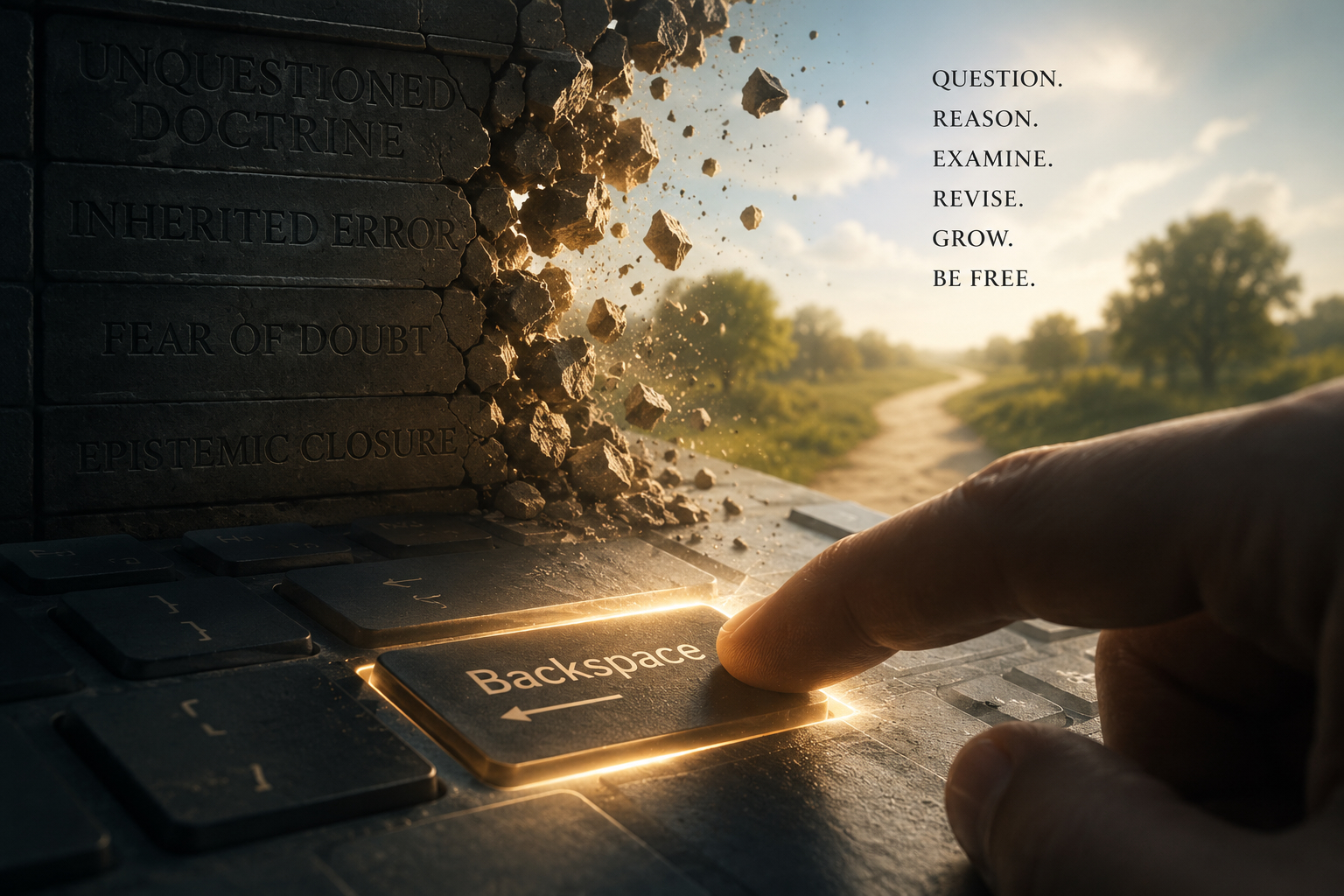
They prevent the Backspace Key from being pressed.
A good explanation is hard to vary. It does not survive because it protects a beloved conclusion, but because changing it breaks its ability to account for reality. Qadhi’s contextualization is easy to vary because almost any grievance can be inserted into it: colonialism, discrimination, Islamophobia, humiliation, state power, Western hypocrisy. Each may contain elements of truth, but in this sermon they function less as explanations than as movable shields. They protect the sacred premise from correction.
This is an entropic explanation. Under criticism, it does not become more precise. It expands. It absorbs more grievances, more memories, more accusations, more historical injuries, until the original mechanism disappears inside a cloud of moral atmosphere. The explanation survives by becoming less definite. It protects itself by spreading.
The Missing Backspace Key
The Backspace Key is the symbol of rationality.
It means the right to delete, revise, abandon, or correct an inherited rule, sacred premise, custom, doctrine, or institution when reality exposes its failure.
After Samuel Paty’s murder, a rational sermon could have pressed Backspace.
It could have said:
No insult justifies murder.
No prophet needs human revenge.
No scripture should be used to shrink compassion for the murdered.
No inherited blasphemy instinct is worth one teacher’s head.
No Muslim in a free society should confuse hurt feelings with moral permission.
No sacred figure is above peaceful criticism, satire, examination, or discussion.
The murder of Samuel Paty proves that something in our inherited moral reflexes must be corrected.
That sermon was not delivered.
Instead, Qadhi’s sermon repeats the frame. It repeats grievance. It repeats sacred injury. It repeats the Muslim/non-Muslim distinction. It repeats the idea that the true wound is not the murdered teacher but the dishonored Prophet, the injured Muslim community, and the hostile West.
The sermon does not contain a Backspace Key.
It contains a repetition machine.
It repeats the inherited reflex at the very moment when reality has exposed the cost of that reflex.
Selective Mercy
Another striking feature of the sermon is the selective direction of mercy.
Qadhi invokes mercy, compassion, dignity, pain, relief, and Muslim suffering. But the compassion is bounded. The Muslims of France matter. Muslims elsewhere matter. The global Muslim community matters. The Prophet’s honor matters.
But Samuel Paty’s wife, child, parents, colleagues, students, and fellow citizens do not occupy the same moral space.
This is not simply the absence of compassion.
It is the capture of compassion by identity.
Anti-rational frames do not always eliminate tenderness. They ration it. They decide in advance who may be mourned fully and who may be mentioned only as a complication. They decide whose pain explains violence and whose death is absorbed into the narrative. They decide whose humiliation is metaphysical and whose decapitation is contextual.
A compassion that cannot cross the boundary of the sacred in-group is not universal mercy.
It is tribal tenderness with theological vocabulary.
This matters because many anti-rational systems speak the language of compassion. The problem is not that Qadhi shows concern for Muslims. Concern for Muslims is morally legitimate and necessary. The problem is that compassion becomes morally provincial when it cannot travel beyond the sacred in-group, especially toward the person harmed in the name of that group’s sacred wound. They speak of dignity, trauma, humiliation, oppression, memory, wounds, historical injury, and wounded identity.
But the test is not whether a system can feel compassion for its own.
Almost every tribe can do that.
The test is whether compassion survives contact with the outsider.
The test is whether mercy can reach the person who has offended the sacred frame.
The test is whether the system can mourn the teacher before defending the symbol.
The Sacred Frame
The deepest premise in this case is not simply that Islam is true, or that Muhammad is honored, or that Muslims deserve dignity.
Muslims do deserve dignity.
Every person does.
The deeper premise is this:
The Prophet’s honor must remain beyond ordinary criticism, satire, pedagogical examination, and public irreverence.
Samuel Paty stood on the other side of that premise.
He represented the ordinary civic principle that no idea, doctrine, symbol, prophet, scripture, or authority should be immune from public discussion. He did not attack a person. He examined a controversy. He taught a class about freedom of expression. He inhabited the fragile role of the teacher in an Open Society.
That is why he became dangerous.
Not because he had power.
Because he represented correction.
The classroom is one of the places where the Backspace Key is taught. A student learns that ideas can be named, compared, questioned, criticized, revised, and sometimes abandoned.
In a rational society, this is not an act of war. It is education.
But in a sacred anti-rational frame, examination can become desecration. The teacher can become an enemy. The lesson can become aggression. The cartoon can become an existential wound.
And once the sacred frame has defined criticism as attack, violence can present itself as defense.
That is the philosophical issue.
Qadhi’s sermon is important because it does not break that mechanism.
It softens it. It contextualizes it. It relocates it. It makes it emotionally intelligible.
But it does not correct it.
It does not say what belief must die so that the person may live.
The Firehawk
There is an image from nature that captures the sermon.
The firehawk sees fire, picks up a burning stick, carries it elsewhere, drops it in dry grass, and waits for frightened creatures to emerge.
That is what Qadhi appears to do with sacred memory.
He sees a fire in France. He flies into seventh-century Arabia. He picks up a burning fragment from sacred history. Then he drops it into France, Europe, America, and the online world.
This image is powerful because it captures the technological and mythological nature of the sermon.
Qadhi uses modern tools to distribute ancient combustion.
He uses microphones, cameras, YouTube, global connectivity, and the architecture of Western free speech to send sacred fire through digital air.
The medium is modern. The emotional code is old. The technology is open. The frame is closed.
This is one of the great paradoxes of anti-rational intelligence in our time.
It uses the achievements of the Open Society to weaken the premises of the Open Society.
It uses freedom of speech to attack the culture of free speech. It uses digital universality to distribute parochial sacred injury. It uses modern communication to restore ancient boundaries of thought.
That is why the sermon feels almost alchemical. It is not merely a man speaking. It is a transformation chamber. The audience enters with one event before them: a teacher has been beheaded. They leave with another reality: France is the aggressor, Muslims are under attack, sacred honor is wounded, and the real danger lies not in the doctrine of blasphemy violence but in the West’s hostility to Islam.
Fire has been moved.
This is the dark inversion of universality. A universal technology carries a parochial wound. A global platform distributes a tribal sacred injury. The medium has reach, but the explanation does not. Global distribution is not universality. It does not become universal because it travels globally. It remains parochial if it cannot survive criticism, cannot tolerate satire, cannot protect the dissenter, and cannot allow the teacher to teach.
Captured Intelligence
The central error would be to treat Qadhi as unintelligent.
That would be comforting.
It would also be false.
He is intelligent. He knows how to speak in registers. He knows when to use Arabic and when to use English. He knows when to invoke law and when to invoke pain. He knows when to sound moderate and when to intensify. He knows how to use the language of “context” without accepting the burden of correction. He knows how to make France morally large and Samuel Paty morally small.
This is precisely the danger.
Anti-rationality is not stupidity. It is intelligence captured and redirected against correction. Captured intelligence can memorize.
It can quote. It can classify. It can theologize. It can historicize. It can perform compassion. It can speak the language of grievance. It can borrow the language of rights. It can use the vocabulary of oppression. It can even condemn violence in one sentence while making the emotional world of violence more intelligible in the next.
But it cannot ask the forbidden question:
What if the sacred frame itself is producing the danger? What if the doctrine of offense is false? What if prophetic honor must be privatized, not imposed? What if the community’s pain is real but morally irrelevant to the teacher’s right to teach? What if the inherited reflex must be deleted? What if the Backspace Key belongs even inside religion?
What Qadhi Could Have Said
The most revealing sermon is the one not delivered.
Qadhi could have said:
Samuel Paty was murdered for teaching. That murder was evil without qualification. No Muslim should allow love of the Prophet to become hatred of a teacher. No religious pain gives anyone the right to touch another person’s body. No cartoon, lesson, satire, book, image, or classroom discussion justifies violence.
Muslims living in free societies must defend the freedom that allows Islam itself to be preached, taught, criticized, and practiced.
If our inherited instincts about blasphemy make murder imaginable, then those instincts must be corrected.
The Prophet does not need assassins.
God does not need wounded young men to kill schoolteachers.
Our task is not to demand that free societies protect our sacred symbols from criticism.
Our task is to become mature enough to live among free human beings.
That would have been rationality. That would have been correction. That would have honored Samuel Paty. That would also have protected Muslims, because the first victims of anti-rational sacred frames are often the believers trapped inside them.
But that was not the sermon.
The sermon after the beheading did not free intelligence from the frame.
It made intelligence serve the frame.
The Philosophical Warning
Yasir Qadhi’s sermon after Samuel Paty’s murder is therefore not merely a political or religious episode.
It is a philosophical warning.
A human being can be educated and captured. A sermon can be eloquent and anti-rational. A speaker can condemn murder and still rearrange the moral universe in a way that protects the ideas that make murder meaningful. A community can speak of mercy while withholding mercy from the person outside the sacred boundary. A preacher can use the technology of the Open Society to distribute a psychology that corrodes the Open Society.
This is why Samuel Paty must remain at the center.
A teacher was killed because he represented the right to examine. The right to examine is the beginning of rationality. Without it, intelligence becomes decoration inside a closed room. It may memorize, preach, quote, classify, and perform. It may create elaborate defenses. It may even sound profound.
But it cannot correct.
And when intelligence cannot correct, it can become dangerous.
The question after Samuel Paty is not only whether we condemn the knife. Most people know how to condemn the knife after the blood is visible. The deeper question is whether we can identify the frame that made the knife meaningful before it was raised.
Visible violence is often the final symptom of an invisible explanation that has already failed.
That is the question Qadhi’s sermon avoids. That is the question the Open Society must ask. That is the question every religion, ideology, university, bureaucracy, activist movement, and civilization must face:
The question is not whether every believer is violent, or whether every Muslim thinks this way, or whether religion must disappear. Those are lazy questions. The real question is whether any inherited frame — religious, ideological, academic, political, or moral — can permit correction when its premises produce harm.
Can the frame be corrected?
Can sacred injury be demoted below human life?
Can the believer remain fully human without demanding that the world protect his symbols from criticism?
Can the teacher teach?
Can the mind press Backspace?
Intelligence becomes rationality only when it turns toward correction.
After Samuel Paty, the test was simple. A teacher showed a cartoon. A teacher lost his head.
Any system that cannot say, without hesitation, that the teacher had the right to teach and that the sacred frame must absorb the discomfort, has not yet become rational.
It may be intelligent. It may be eloquent. It may be ancient. It may be emotionally powerful. It may be technologically amplified. It may even call itself merciful.
But without the Backspace Key, it remains captured.
Author’s Note
This essay analyzes a public sermon as a moral and philosophical act. It does not claim that rhetoric and murder are identical, nor that contextualization is always excuse-making, nor that political criticism of France is illegitimate. The claim is narrower and more serious: after a teacher was beheaded for teaching freedom of expression, any public religious response that moves moral attention away from the murdered teacher and away from the doctrine of sacred offense must itself be examined as part of the invisible ecology in which such violence becomes thinkable.


