The Return of the West: Rubio Validating the New Trump Doctrine
14 February 206
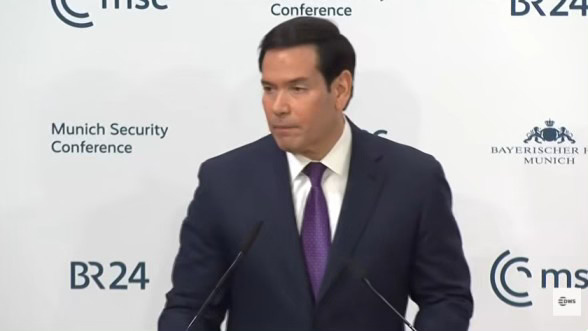
Secretary of State Marco Rubio delivering a speech at MSC 2026
“But the euphoria of this triumph led us to a dangerous delusion. That we had entered, quote, ‘the end of history.’ ... That the rules-based global order, an overused term, would now replace the national interest. ... This was a foolish idea that ignored both human nature and it ignored the lessons of over 5,000 years of recorded human history.”
— Marco Rubio, 14 February 2026
From Cathedrals to Compliance
There is a particular tone that has settled over official Europe—half sermon, half sigh, delivered by people who speak of values the way exhausted accountants speak of compliance: as a substitute for vitality, and as an excuse for cowardice. It is the voice of a continent that once exported cathedrals, symphonies, universities, and revolutions, and now exports moral directives and energy rationing—while importing, with theatrical innocence, the demographic and ideological pressures that make those directives sound increasingly like the minutes of a committee meeting held on the deck of a sinking ship.
What follows is not another “think-piece” in praise of managed decline. It is an autopsy of the delusion that the West could retire from history without history noticing. This begins by separating signal from noise—and in our age, that alone is a civilisational act. The noise is the shriek of punditry and the dopamine economy of outrage. The signal is colder and simpler: states compete; peoples endure—or they don’t. And the West’s most fashionable ruling reflex in recent decades has been to behave like a civilisation that doesn’t particularly care whether it survives, provided it can die with the correct vocabulary on its lips.
Marco Rubio’s Münich address—quoted above—states the heresy plainly: the “end of history” was not an achievement; it was a narcotic. The belief that “rules-based order” could replace national interest was not merely mistaken; it was an attempt to repeal human nature.
And Europe, alas, has been the world’s most enthusiastic customer for this narcotic: a civilisation of unrivalled inheritance governed, far too often, by people who treat inheritance as an embarrassment—something to be apologised for, deconstructed, or placed under permanent suspicion. In this reading, the West is not a living tradition but a crime scene, and the highest form of citizenship is to dust your own civilisation for fingerprints. It is difficult to deter rivals, defend borders, or sustain liberties when your own elites speak of your past like a pathology and your future like a carbon budget.
This is why the central claim in this essay must lands with force: the new American posture is not “isolationism” but a demand that the West remember what it is. In this framing, Trump’s performative abrasions are the pressure—what I have called the “Art of Humiliation”—while Rubio supplies the doctrinal clarity: civilisations are anchored in culture, faith, canon, and confidence, not in abstract managerial slogans.
And if European officialdom found that message offensive, it may be because it was accurate.
Last year, alos in Münich (February 2025), U.S. Vice President J.D. Vance delivered the warning in a form that Europe’s etiquette-police could not translate into harmless jargon. He argued that Europe’s gravest danger was not Russia or China but internal decay—especially the fear of dissent and the habit of hiding censorship behind sanctimonious euphemisms. In words that detonated politely upholstered sensibilities, he mocked the bureaucratic religion of “misinformation” and “disinformation,” suggesting that entrenched interests use those labels to smother inconvenient opinion—and he added the line that should be engraved above the entrance to every parliament that has mistaken governance for moral theatre: if you are “running in fear of your own voters,” there is nothing America can do for you.
He was mocked—because Europe’s modern clerisy often confuses mockery with rebuttal. And then came the now-famous moment of tears at the conference’s close: Münich Security Conference chair Christoph Heusgen, visibly emotional in his farewell remarks, referenced Vance’s speech and lamented that the “common value base” might not be so common. Viral clips framed this as a man crying because Vance had “made him”; the conference itself pushed back on that narrative, noting it was Heusgen’s farewell and that the tears were not simply “frustration.” Still, the symbolism stuck—because Europe has become a place where the language of values is often deployed as a substitute for the will to act, and where emotion is granted prestige while fortitude is treated as suspect.
If that sounds impolite, good. Politeness is a luxury belief when the stakes are civilisational. A ruling class that cannot bear to be offended cannot bear to be serious. And seriousness is what Marco Rubio demands: an end to the lullaby of managed decline; an end to the superstition that trade automatically pacifies; an end to the moral vanity that treats borders as vulgar and history as optional.
Rubio’s argument is not that the West is flawless. It is that it is irreplaceable—and that those entrusted with it have behaved, for too long, like bored heirs impatient for the estate sale. If the West is to have a “new century,” it will not be because Brussels issued another communiqué. It will be because enough people, on both sides of the Atlantic, decided that survival is not a shameful instinct but a duty—and that a civilisation confident enough to defend itself need not ask permission from those who have made a career of apologising for it.
The Signal Cuts Through the Noise
In the high-stakes theatre of contemporary geopolitics, a contemporary human must distinguish between the performative “noise” of modern media and the substantive “signal” of statecraft. President Trump’s diplomatic methodology—characterised by calculated snubs, dominance displays, and unconventional rhetoric—functions as a sophisticated “Post-Modern Realpolitik. This is not chaos, but a deliberate system of statecraft designed to establish a clear hierarchy of favour and generate maximum strategic leverage. While the President projects the theatrical pressure of the Art of Humiliation, Secretary of State Marco Rubio’s 2026 Munich address provides the definitive strategic “signal.” Rubio’s calm, methodical, and direct articulation marks the formal termination of the “End of History” delusion—the post-Cold War fallacy that liberal democratic convergence and globalist trade would supersede the national interest. In Munich, Rubio issued a message of reassurance that “America is charting the path for a new century,” affirming that this new era is not one of isolationism, but of civilisational renewal. This signal is anchored in a specific, non-negotiable identity: the West is no longer a polite caretaker of its own decline, but a sovereign architect of its future.
The Civilisational Anchor: Jerusalem, Athens, and the West
The new Trump Doctrine represents a fundamental pivot from “globalist abstractions” to “Civilisational Realism.” It posits that a country’s survival is inextricably linked to the preservation of its cultural and spiritual heritage. Secretary Rubio explicitly rejected the “citizens of the world” rhetoric, re-centring the Transatlantic alliance on a “sacred inheritance” that binds the New World to the Old. This is the “Freedom 250” moment: a strategic counter-revolution intended to “finish the American Revolution” by fully separating the Republic from the Malthusian scarcity and imperial financial systems of the Old World.
Rubio identified specific cultural markers that serve as the bedrock of Western power:
- The Christian Faith: The foundational spiritual link and unbreakable bond between the Old World and the New.
- The Genius of the Canon: The intellectual and artistic heritage of Mozart, Beethoven, Dante, and Shakespeare.
- Living Tradition: The contemporary cultural reach of the Beatles and the Rolling Stones, testifying to a living, breathing civilisation.
- The Scientific Revolution: The legacy of the rule of law and the university system born on the European continent.
This doctrine confronts the “malaise of hopelessness” and the “shackles of guilt” that characterised the previous globalist era. By demanding allies who are “proud of their culture,” the administration utilises heritage as a source of hard power, asserting that a civilisation that has lost the “will to survive” cannot defend its territory.
The Triad of Power: Economics as the Sword and Shield
Central to this grand strategy is the Triad of Power—the seamless fusion of economy, finance, and military force. The core axiom—“Economic Security is National Security”—marks a return to the Hamiltonian American System of Political Economy, which prioritises sovereign production over the financialised “managed decline” of the British Imperial System. Rubio’s address provided a forensic autopsy of the globalist era, noting that de-industrialisation was not inevitable, but a “conscious policy choice” that stripped the West of its productive capacity.
To correct this, the administration employs the Sledgehammer of economic warfare, utilising tariffs and strategic decoupling to shatter the Chimerica symbiosis and restore supply chain sovereignty. Through Project Vault, the administration has transformed the Export-Import Bank into a Hamiltonian national bank to secure critical minerals, ensuring the West is never again “leveraged” by adversaries.
Post-Cold War Failure (1991–2016)
- Economic System
British Imperial System (Financialisation/Malthusian)
- Primary Logic
Globalist Interdependence/Outsourcing
- Strategic Goal
Liberal Democratic Convergence
- Energy Policy
Net Zero/Managed Scarcity
- National Security
Open Borders/DIB Erosion
Trump Doctrine Correction (2024–Present)
- Economic System
American System (Sovereign Production/Hamiltonian)
- Primary Logic
Strategic Decoupling/Re-industrialisation
- Strategic Goal
Credible Deterrence and Leverage
- Energy Policy
Grow Baby Grow/Energy Dominance
- National Security
Border Security/Industrial Mobilisation
Realism and Reciprocity: The End of Free-Riding
The Trump Doctrine signals a transition from “multilateral rules” to “transactional reciprocity,” explicitly abandoning the “Lord Palmerston” model of internal destabilisation and shifting alliances. The United States now demands a “World of Sovereign Nations” where partners are both capable and serious. This economic strength, born of re-industrialisation, provides the foundation for the Hague Standard, which mandates that allies spend 5% of their GDP on defense and security (3.5% on core military and 1.5% on security).
The administration asserts that “weak allies make us weaker.” By enforcing this standard, the U.S. enables a regional balance of power that ends “allied free-riding” and allows American forces to prioritise the U.S. Homeland. This is the rejection of overt nation-building in favor of a “selective force” model that prioritizes “victory born from strength” over paper treaties.
Pragmatic Determinism: Ending Wars and Managing Rivals
The Scalpel methodology represents the administration’s refined approach to foreign policy. Unlike the blunt trauma of “Regime Change,” the Neuro-Strategic Scalpel focuses on Regime Alteration—the application of selective kinetic force and economic pressure designed to create a “massive prediction error” in an adversary’s command hierarchy. This disorients decision-makers, scrambling reporting lines and making them feel that their future has been stolen.
In managing the “elusive peace” in Ukraine, Rubio emphasised the necessity of bringing “two sides to the table,” posing three fundamental questions:
- Are the Russians truly serious about ending the war?
- Under what terms are they willing to do it?
- Is there an outcome Ukraine can live with that Russia will also accept?
Regarding China, the doctrine acknowledges that while interests will often not align, “geopolitical malpractice” must be avoided through communication. This is managed via Maskirovka—strategic deception used to maintain operating space. A primary example is the Greenland Maskirovka, a sophisticated manoeuvre that distracted European elites to buy operating space for Operation Midnight Hammer, the kinetic neutralisation of the Iranian nuclear program.
To bypass the stalled bureaucracy of the UN, the administration has established the Board of Action (Board of Peace), a structural revolution in diplomacy requiring a $1 billion membership fee for economic development, integrating powers like Egypt and Qatar to facilitate transactional peace. This is fortified by the Core 5 (C5) Alliance—a practical alignment between the U.S., China, Russia, India, and Japan—which serves as the “ultimate Playbook Killer,” terminating the 170-year Great Game of pitting powers against one another.
The New Western Century
Secretary Rubio’s Munich address is the “Freedom 250” declaration for a new era. It confirms that the United States is no longer a “polite caretaker of decline,” but the architect of an undisputed dominance born of internal renewal and the recovery of the American System. This “Counter-Revolution” terminates the Palmerston era of managed decline, replacing it with a grand strategy that prioritizes toughness, honor, and national interest.
Ultimately, the new doctrine protects prosperity and democracy through “hard power” and “victory born from strength.” The West has been reminded that it is the heir to a “unique, distinctive, and irreplaceable” civilisation. By asserting the “will to survive,” the alliance is no longer asking for permission to act, but is instead boldly engineering a new Western century on its own terms.
“For we in America have no interest in being polite and orderly caretakers of the West’s managed decline. We do not seek to separate, but to revitalise an old friendship and renew the greatest civilization in human history.”
— Marco Rubio, 14 February 2026


