The Refusal to Think
How Moral Certainty Replaces the Life of the Mind
By Khaled Salih
A Framework for a Systematic Study
Like many people, I was astonished — and so I acted. What follows is a systematic cognitive, organisational, ideological, and philosophical analysis of the open letter “A Refusal to Participate: Media Complicity in War.” This document represents a severe indictment of The New York Times, accusing the institution of profound journalistic malpractice and of direct complicity in what it calls a “genocidal war.” Its principal charge is that the paper has abdicated its ethical obligations, serving instead as a “bullhorn for the Israeli government and military.”
To illuminate the structure of this powerful public statement, we must apply a rigorous methodological framework composed of four distinct analytical lenses. Each lens offers a unique vantage point on the letter’s architecture, allowing us to move beyond its surface claims and examine the underlying mechanics of its argumentation:
- Organisational Dynamics: Applying the concept of Functional Stupidity (Alvesson & Spicer), we shall explore how the letter’s social and group dynamics create ideological cohesion while suppressing dissent.
- Neurocognitive Patterns: Through the model of Hemispheric Imbalance (McGilchrist), we can diagnose the cognitive style of the argument — assessing whether it embodies a holistic worldview or a detached, decontextualised, and pathologically certain one.
- Ideological Contagion: Employing the framework of Idea Pathogens (Saad), we shall examine whether the letter’s core tenets emerge from rational inquiry or from infectious ideas sustained by social pressure.
- Epistemological Quality: Finally, invoking the criteria of Good versus Bad Explanations (Deutsch), we will audit the letter’s reasoning to distinguish between robust, error-correcting knowledge and dogmatic, unfalsifiable ideology.
The overall aim of this analysis is to uncover the letter’s argumentative architecture. By doing so, we seek to understand not merely what it claims, but how its cognitive and ideological foundations function to construct its narrative and enforce its conclusions.
Lens 1: Organisational Dynamics and Functional Stupidity
Before turning to the content of the letter’s claims, we must first examine the social and organisational environment it seeks to generate. This initial lens employs the concept of functional stupidity to assess how the collective act of signing and promoting the letter might suppress individual critical thought in favour of ideological conformity. The framework exposes how intelligent individuals, within a group setting, can deliberately sideline doubt and reflection in the pursuit of solidarity.
Defining the Framework
The core mechanisms of functional stupidity, as outlined by Mats Alvesson and André Spicer, involve the deliberate suspension of critical reasoning to preserve organisational unity. Its key mechanisms include:
- Leadership-Induced Stupidity: Leaders encourage followers to abandon deep reflection and to accept a narrow range of assumptions uncritically, thereby fostering commitment.
- Stupidity Management and Ideology: Powerful agendas and cultural norms are used to pre-empt dissent and to frame obedience as a virtue.
- Imitation-Induced Stupidity: The adoption of fashionable concepts or stances as a means of projecting modernity and moral awareness — prioritising appearance over genuine engagement.
- Structure of Thoughtlessness: Compliance with group postures and rules takes precedence over nuanced outcomes, leading to over-specialisation and the loss of perspective.
- Self-Stupidification: Individuals actively suppress doubts and deny complexity to conform, avoiding the stigma of being perceived as troublesome.
Application to “A Refusal to Participate”
When seen through this framework, the letter’s structure and strategy appear to rely on several of these mechanisms to construct and maintain ideological consensus.
Stupidity Management through Moral Framing
The letter’s rhetorical stance operates as a form of stupidity management. It frames adherence to its cause not as a matter of debate but as a moral imperative, while dissent becomes an act of complicity in atrocity. By characterising participation in The New York Times opinion section as akin to “a conversation between the sword and the neck,” it pre-emptively nullifies opposing perspectives. Any contribution other than boycott is described as “permission to continue this malpractice.” This rhetorical posture does not seek to invite dialogue but to silence it — raising the moral stakes so high that disagreement becomes indistinguishable from betrayal.
Self-Stupidification through Collective Action
The letter’s principal call to action — “Only by withholding our labour can we mount an effective challenge” — serves as an instruction that fosters self-stupidification. This collective pact encourages individuals to discard what Alvesson and Spicer term “irksome doubts” about the conflict’s complexities, journalistic ethics, or the newspaper’s specific coverage. In place of nuanced individual assessment, it substitutes the moral certainty of the group. By signing, individuals align themselves with an apparently noble cause and allow their “internal censor” to suppress critique in the name of solidarity.
Imitation-Induced Stupidity and Public Signalling
The public letter, endorsed by a long list of academics, artists, and cultural figures, exemplifies imitation-induced stupidity. Here, the act of signing becomes a mode of adopting a fashionable stance and signalling one’s progressive credentials. The letter operates as an instrument of social imitation: alignment with its cause becomes a performative expression of virtue within a particular milieu. The resulting public display of allegiance may overshadow any deeper engagement with the issue’s underlying complexities.
Having explored the group dynamics that sustain the letter’s ideological posture, we now turn to the cognitive patterns that underpin its reasoning.
Excellent. Here are Sections 3.0 and 4.0 — rewritten in refined British English with faithful preservation of meaning, enhanced rhythm, and intellectual clarity.
Lens 2: Neurocognitive Patterns and Hemispheric Imbalance
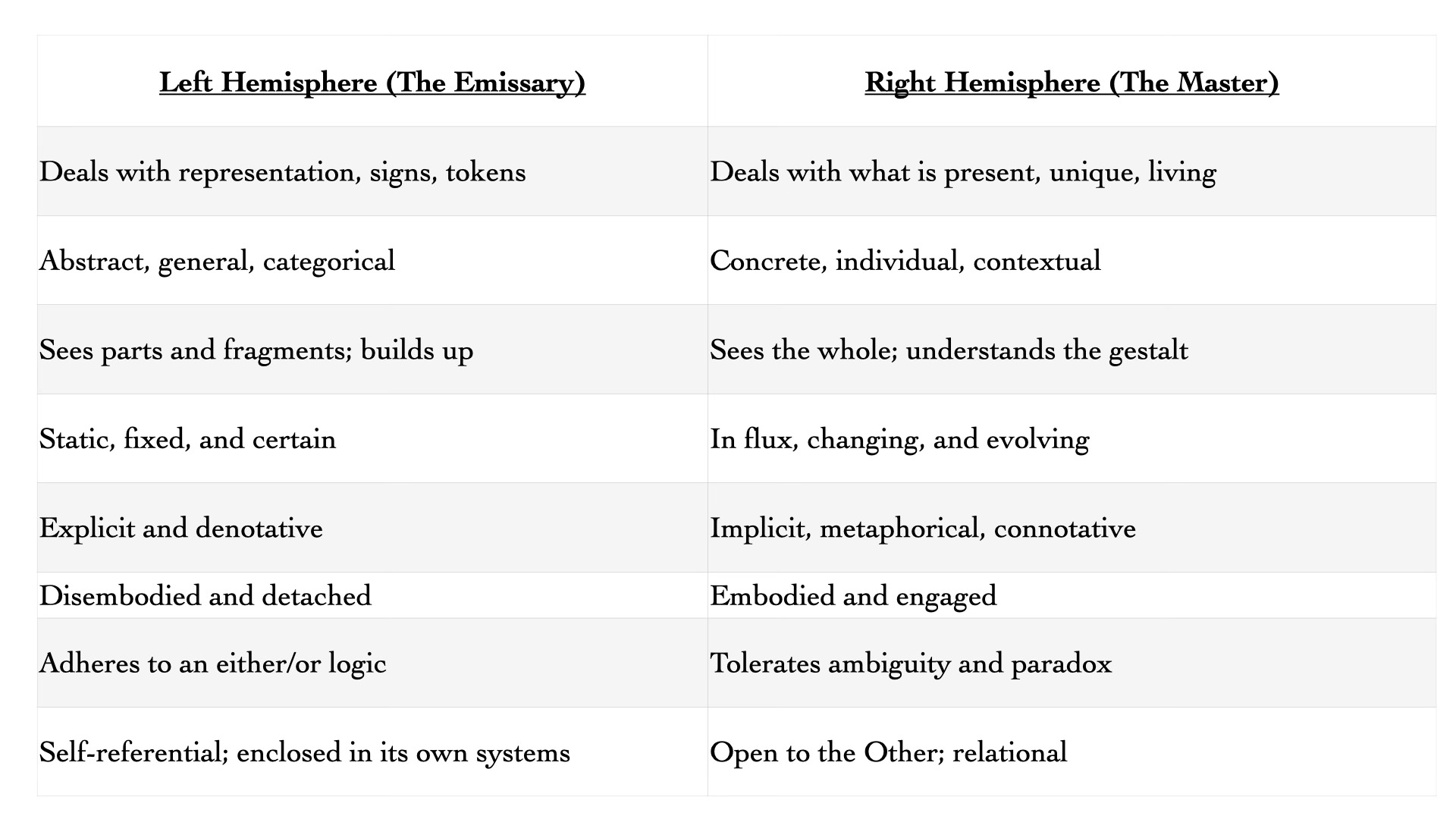
To comprehend the letter’s persuasive force, it is essential to understand its underlying cognitive “operating system”. The model of the divided brain, developed by psychiatrist Iain McGilchrist, serves as an illuminating diagnostic tool. It helps determine whether an argument arises from a holistic, contextualised worldview (the Master, Right Hemisphere) or from one that is abstract, fragmented, decontextualised, and pathologically certain (the Emissary, Left Hemisphere). This analytical lens allows us to examine the very architecture of the letter’s thought processes.
Defining the Framework
McGilchrist’s model proposes two fundamentally distinct modes of apprehending reality, each rooted in the tendencies of the brain’s hemispheres. The dominance of the Left Hemisphere produces a mechanistic, abstracted vision of the world — one detached from the vitality of lived experience.
Application to “A Refusal to Participate”
A Linguistic Audit of Abstraction
A linguistic audit of the letter reveals an overwhelming dependence on the Left Hemisphere’s mode of abstraction. The text is saturated with categorical nouns such as impunity, bigotry, malpractice, hegemonic authority, and complicity. These terms construct a tidy conceptual map of moral outrage but remain largely detached from lived experience or nuance. The preference for abstraction permits the argument to function in a cleanly delineated moral realm — one that avoids the inconvenient messiness of context, history, or ambiguity.
The Dominance of Either/Or Logic
The letter’s logical architecture displays a striking allegiance to an either/or framework, the signature of a Left-Hemisphere worldview. Reality is divided into absolute moral binaries: The New York Times is portrayed as wholly complicit, its journalists tainted by “material ties to the Israeli occupation”, while the signatories embody virtue and unassailable righteousness. There is no gradation, no admission of moral complexity, no recognition of competing truths. Such rigidity is not a strength of moral conviction but a symptom of cognitive imbalance — a refusal to tolerate ambiguity.
Pathological Certainty in Action
The letter repeatedly exhibits what McGilchrist calls pathological certainty — the incapacity to recognise one’s own epistemic limitations. Assertions such as “the paper has refused to research and authenticate these war crimes” are presented as self-evident truths rather than as debatable propositions. This demonstrates the Left Hemisphere’s classic error: mistaking its own representations of the world for the world itself. Within such a cognitive framework, premises and conclusions loop endlessly, each validating the other in a closed circuit of conviction.
This dominance of the Left Hemisphere creates fertile ground for the ideological “software” explored in the next section: the contagion of ideas that thrive precisely because they resist falsification and self-reflection.
Lens 3: Ideological Contagion and Idea Pathogens
This analytical lens employs Gad Saad’s concept of idea pathogens to determine whether the letter’s arguments arise from rational inquiry or from ideological infection. This framework exposes ideas that spread not by virtue of their logical strength but through emotional appeal, social contagion, and fear of ostracism — a pattern increasingly characteristic of our intellectual climate.
Defining the Framework
“Idea pathogens” function as memetic infections that subvert critical reasoning. They propagate through several key mechanisms:
- Intellectual Terrorism: The creation of a “chilling effect” that discourages dissent by attaching severe moral and professional penalties to disagreement. Accusations of bigotry, complicity, or moral cowardice act as enforcement mechanisms.
- Ostrich Parasitic Syndrome (OPS): A pathological refusal to criticise certain ideologies, often under the guise of moral sensitivity or cultural relativism, while displaying relentless hostility towards one’s own cultural institutions.
- Costly Signalling: The public adoption of conspicuously progressive stances to advertise moral virtue and empathy within a particular social milieu — what Saad half-jokingly calls the “sneaky fucker strategy”.
- Pathological Self-Flagellation: The ritual performance of collective guilt — a belief that self-reproach for one’s culture or identity constitutes moral superiority.
Application to “A Refusal to Participate”
Evidence of Intellectual Terrorism and OPS
The letter’s rhetoric operates as a form of intellectual terrorism. It equates disagreement not with error but with moral failure. The declaration, “we owe it to the journalists and writers of Palestine to refuse complicity”, exemplifies this dynamic: dissent becomes betrayal. Such moral absolutism exerts profound social pressure to conform.
Simultaneously, the letter displays symptoms of Ostrich Parasitic Syndrome. Its critique is directed with ferocity at a Western media institution accused of enabling violence, yet it offers no equivalent scrutiny of the ideologies or atrocities committed by Palestinian militant organisations. This selective moral outrage — a refusal to look inward while castigating the “home culture” — is emblematic of OPS’s self-blinding effect.
Costly Signalling through Public Affiliation
For many high-profile signatories, participation in this letter functions as a form of costly signalling. Publicly aligning with a cause presented as morally pure and progressive allows them to broadcast virtue and moral awareness to their peers. Such performative virtue signalling can reinforce one’s social identity as an enlightened “ally” while shielding one from accusations of indifference or complicity. The moral act becomes less a pursuit of truth than an affirmation of belonging.
Ideological Purity Tests
Demand #1 — that The New York Times “bar journalists who have served in the Israeli Occupation Forces from reporting” — epitomises the ideological purity test. It discriminates against individuals on the basis of identity and past affiliation, not on the merit of their work. Such a demand exemplifies how ideological contagions protect themselves: by purging voices that might disrupt the homogeneity of belief. The result is a narrowing of discourse and an enforced intellectual monoculture — a symptom of ideas that prioritise preservation over truth.
Having identified the nature of the ideological infections at work, we now turn to evaluate the quality of the letter’s reasoning itself: whether its claims can withstand the scrutiny of epistemic rigour.
Lens 4: Epistemological Quality and the Nature of Explanation
This final analytical lens employs the epistemology of David Deutsch as an ultimate audit of the letter’s claims. Deutsch’s framework provides a means of distinguishing robust, error-correcting knowledge from dogmatic, self-reinforcing ideology. By assessing the quality of explanations — whether they are open to criticism and constrained by reality or designed to forbid dissent — we can determine the epistemological integrity of the text.
Defining the Framework
Deutsch offers clear criteria for differentiating between types of knowledge:
- Good Explanations: These are hard to vary. Their details are tightly constrained by the reality they describe, which renders them precise, falsifiable, and open to correction.
- Bad Explanations: These are easy to vary. They are vague, malleable, unfalsifiable, and can be adapted to account for any outcome.
- Anti-Rational Memes: These are ideas that ensure their own survival by prohibiting criticism. They persist by punishing deviation and cultivating a “chilling effect” that suppresses scrutiny.
Application to “A Refusal to Participate”
Easy-to-Vary Assertions
Measured against Deutsch’s criteria, the letter’s principal assertions bear all the hallmarks of bad explanations — ideas easy to vary and impossible to falsify. Its central claim that The New York Times is a primary enabler of a “genocidal war” is presented not as a hypothesis to be examined but as a dogma to be accepted. It is an explanation so elastic that it could accommodate any evidence: every counter-argument or correction becomes further proof of the paper’s complicity. The claim is not anchored in the constraints of reality; rather, reality is bent to fit the contours of the claim.
The Core of an Anti-Rational Meme
The letter’s explicit refusal to engage in dialogue constitutes a defining feature of the anti-rational meme. Its assertion that engagement is tantamount to “a conversation between the sword and the neck” is a rhetorical mechanism that forbids criticism altogether. By equating debate with moral betrayal, the letter immunises itself from the very scrutiny that could falsify or refine it. This is the evolutionary defence of dogma: to pathologise the act of questioning.
Non-Explanatory Demands
The three demands issued — to review bias, retract an article, and call for an arms embargo — operate not as explanatory propositions but as non-explanatory instructions. They command obedience rather than invite understanding. Demand #1, which calls for the barring of journalists who have served in the Israeli Defence Forces, is not merely an ideological purity test (as identified under Lens 3); it also reinforces a Structure of Thoughtlessness (as identified under Lens 1). Compliance with a categorical rule replaces the complex work of assessing individuals on the basis of evidence and merit. Such demands do not explain why these specific actions are necessary — they merely decree that they must be enacted to appease the moral agenda of the collective.
With all four analytical lenses applied, we can now synthesise these findings into a coherent assessment of the letter’s architecture.
The Architecture of a Self-Reinforcing Ideology
The preceding analysis demonstrates that the “Refusal to Participate” letter is not merely a collection of statements, but a meticulously constructed ideological system — self-reinforcing, self-defending, and remarkably resistant to critique. The cognitive, social, and rhetorical failures observed across the four lenses do not function independently; they interlock to form a formidable structure of conviction, one that sustains itself through moral absolutism and the repression of ambiguity.
The architecture of this system can be traced as follows: a Left-Hemisphere cognitive style (Lens 2) produces abstraction, decontextualisation, and rigidity, which in turn generate bad explanations (Lens 4) — vague, unfalsifiable assertions detached from empirical reality. These dogmatic narratives provide ideal hosts for idea pathogens (Lens 3), which replicate through emotional contagion and moral intimidation, framing the world in binaries of innocence and guilt. Finally, the mechanisms of functional stupidity (Lens 1) ensure that this ideological machinery remains intact at the group level: imitation-induced conformity, moral signalling, and the suppression of individual doubt consolidate a collective identity impervious to dissent. Together, these forces constitute a closed epistemic loop — a system designed not to discover truth, but to preserve belief.
In an era overwhelmed by moral posturing and emotional absolutism, such multi-layered analyses are indispensable. They enable us to move beyond agreement or disagreement and instead to diagnose the anatomy of dogma itself. By dissecting how these systems of belief operate — cognitively, socially, and rhetorically — we may reclaim the conditions necessary for reasoned inquiry, dialogue, and intellectual humility in a culture increasingly hostile to all three.
———
And so, we come to the crux: the most dangerous form of unreason is not the dogma of the street-corner fanatic, but the sanctified certainty of the educated moralist who mistakes conviction for virtue. The open letter in question is no mere protest; it is a ceremony of righteousness, a liturgy of collective infallibility disguised as conscience. In its fervent call to silence rather than to speak, to boycott rather than to challenge, it performs the oldest of intellectual tricks — the substitution of moral heat for light. It is not merely wrong in its conclusions; it is wrong in its method of thinking, which elevates indignation over inquiry and emotion over evidence.
Let us be clear: the refusal to participate is not an act of courage but an abdication of intellect. A civilisation worthy of the name must defend not the comfort of consensus but the discomfort of truth-seeking. The true scandal is not that The New York Times is accused of bias — bias is inevitable in any human enterprise — but that its critics have enthroned moral certainty as a substitute for reason itself. The only boycott worthy of our age is a boycott of unthinking conviction. Against the seductive music of unanimity, the duty of the free mind remains unchanged: to think, to speak, and to question — even, and especially, when the crowd has already decided what is good.
Sources:
Mats Alvesson & André Spicer, 2016, The stupidity paradox: The power and pitfalls of functional stupidity at work. London: Profile Book.
David Deutsch, 2011, The Beginning of Infinity: Explanations that Transform the World. New York, NY: Viking.
The Duke Report, 20250807, “A User’s Guide to Neuro-Linguistic Defense. Defending Yourself From Word Magic.”

Iain McGilchrist, 2009, The Master and His Emissary: The Divided Brain and the Making of the Western World. New Haven: Yale University Press.
—, 2021, The Matter With Things: Our Brains, Our Delusions, and the Unmaking of the World. London:Perspectiva Press.
Gad Saad, 2020, The Parasitic Mind: How Infectious Ideas Are Killing Common Sense. Washington, DC: Regnery Publishing.
The Wire, 20251028, ‘“Genocide Isn’t a Matter of Opinion’: Over 300 Public Figures Refuse to Write for NYT Over Gaza Role.” https://thewire.in/media/new-york-times-opinion-gaza-genocide-300-writers-public-figures


