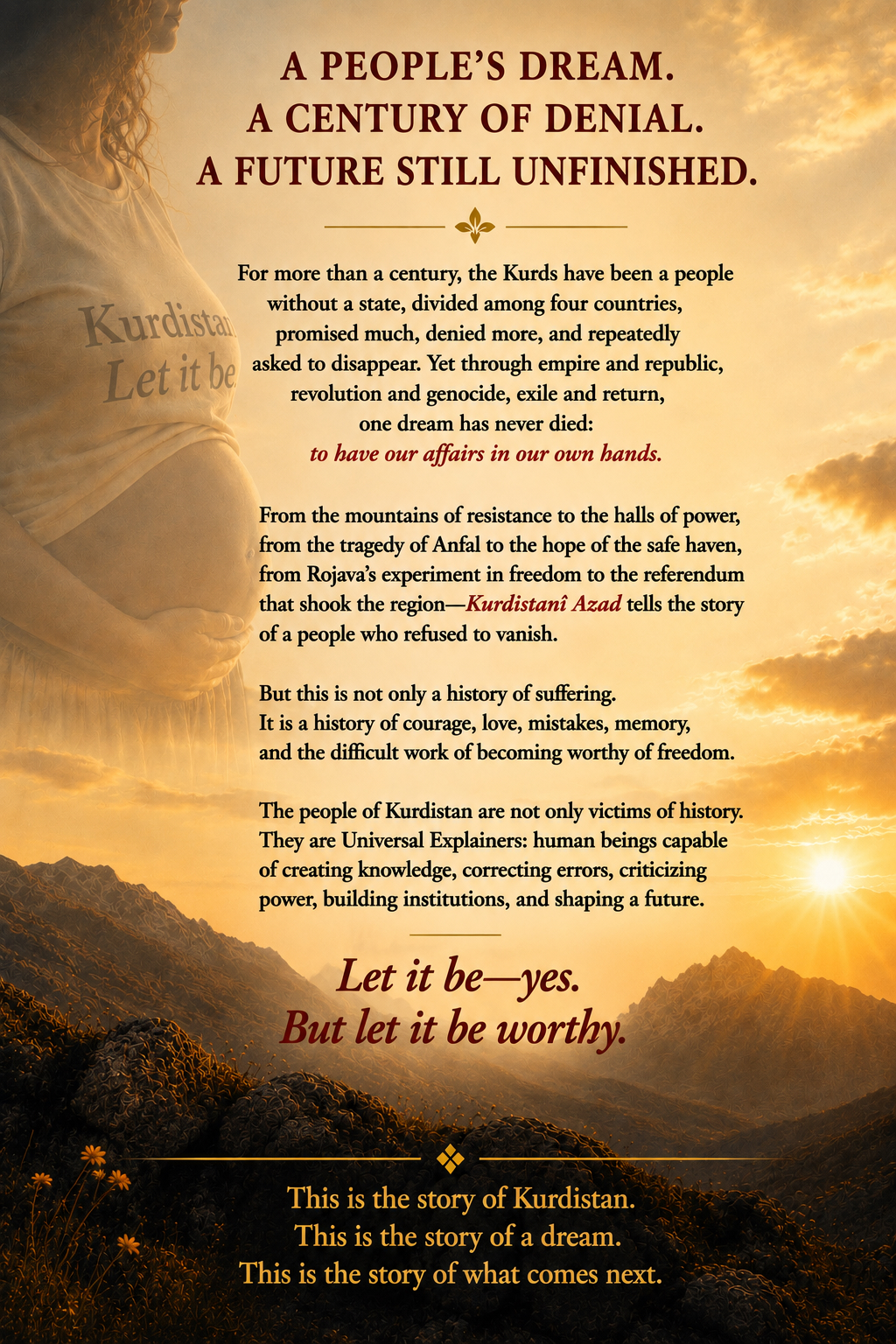
The Reading Begins: Part I of Kurdistanî Azad
By Ann-Catrin Emanuelsson & Khaled Salih
11 June 2026
The dream before the states
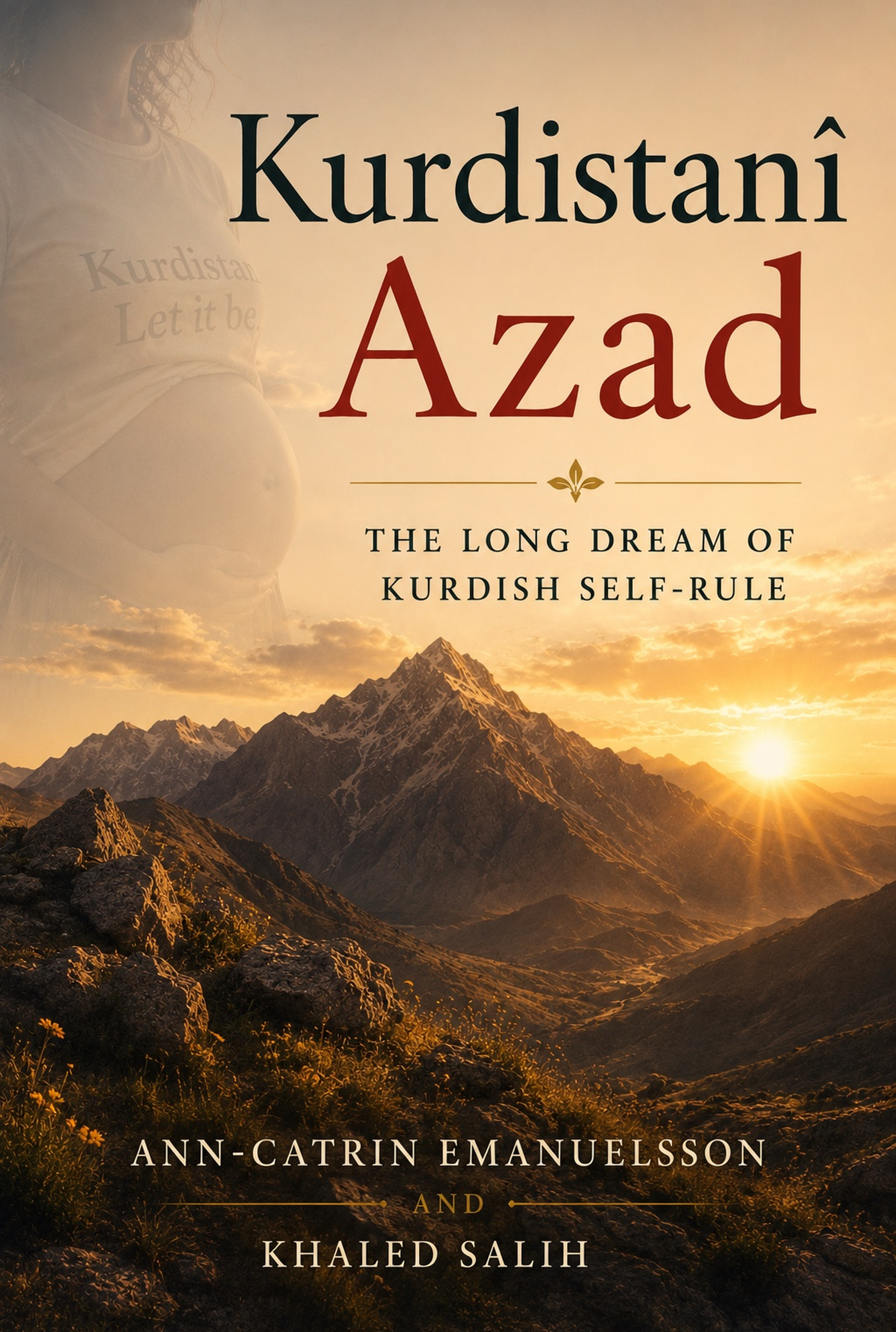
Yesterday we announced the serialization of Kurdistanî Azad: The Long Dream of Kurdish Self-Rule.
Tomorrow, the book itself begins.
The first part is called The Dream Before the States.
That title matters.
Much writing about Kurdistan begins too late. It begins with rebellion, terrorism, security, borders, oil, insurgency, refugees, or diplomatic crises. It begins after the state has already defined the terms of the question.
But Kurdistan did not begin as a security problem.
It did not begin as a minority problem.
It did not begin as an administrative inconvenience inside Turkey, Iraq, Iran, or Syria.
Before Kurdistan became a question for diplomats, border commissions, ministries, police files, intelligence services, armies, and international conferences, it was already a lived world.
It existed in mountains, villages, routes, dialects, religious networks, principalities, tribal confederations, cities, memories, songs, graves, and frontier bargains.
It was not a modern state. It did not have one parliament, one capital, one recognized border, or one seat among the nations.
But it was not nothing.
That is the first correction the book asks the reader to make.
The Kurdish question did not arise because Kurds suddenly appeared. It arose because modern states placed Kurdish life inside political structures that often treated Kurdish self-rule as a threat, Kurdish language as danger, Kurdish memory as disorder, and Kurdish existence as something to be managed, renamed, absorbed, or disciplined.
So Part I begins before the hard borders.
It begins with a name: Kurdistanî Azad.
The phrase means Free Kurdistan. But in the story that opens the book, Kurdistan is also a daughter, and Azad is her father. When someone asks the child, “Whose Kurdistan are you?” she answers:
Kurdistanî Azad.
Kurdistan of Azad.
Kurdistan of freedom.
Free Kurdistan.
This double meaning gives the book its first key. Kurdistan is not introduced first as a map. It is introduced as a child, a father, a voice, a wound, and a promise.
The political question is therefore also human:
What does it mean for a people to have their affairs in their own hands?
That question was expressed in 1880 by Sheikh Ubeidullah of Nehri with words that still carry the center of the Kurdish political experience:
“We want our affairs to be in our own hands.”
Part I follows that demand backward and forward.
Backward, into the older Kurdish world beside empires.
Forward, into the modern state system that would turn Kurdish self-rule into an “internal matter” of states whose borders had been drawn over Kurdish life.
The old Kurdish world should not be romanticized. Older Kurdish authority was often unequal, patriarchal, fragmented, violent, and hierarchical. It was not democracy. It was not modern freedom.
But a bad explanation turns the past into innocence.
A better explanation asks what function older structures performed, what injustices they contained, and what was lost when they were destroyed without being replaced by equal citizenship, protected self-rule, or institutions open to Kurdish correction.
That is why Part I is not nostalgia.
It is an inquiry into what existed before the state claimed the right to define everything.
Older Kurdish self-rule was incomplete, local, negotiated, and imperfect. But it gave Kurdish society room: room for language, memory, mediation, religious networks, local authority, and distance from imperial centers.
The modern state narrowed that room.
Empires often wanted obedience more than sameness. The modern “nation-state” wanted both.
It wanted standardized citizens, official languages, national histories, school systems, censuses, borders, armies, and identities strong enough to suppress the complexity beneath them.
For Kurds, this was decisive.
The state did not merely govern territory. It tried to produce a people.
And if Kurds did not fit the state’s preferred explanation of itself, then Kurdishness itself became suspicious.
This is why the passage from empire to state was irreversible in practice.
Sèvres briefly opened a door. Lausanne closed it. Mosul was attached to Iraq. Syria entered the French mandate. Turkey consolidated the republic. Iran continued its own centralizing project.
The Kurds did not move.
The borders moved over them.
A line on a map became a checkpoint, passport, military zone, school curriculum, court, prison, and diplomatic habit. By the time Kurds asked for correction, the state could answer that correction itself was rebellion.
That is the state form of anti-correction.
First the settlement is made.
Then it becomes a border.
Then it becomes citizenship law.
Then it becomes school curriculum.
Then it becomes military doctrine.
Then it becomes common sense.
Then the injured people are told that revision is impossible because reality has already been settled.
Part I asks the reader to see this mechanism before judging the later history.
It also introduces the standard by which the whole book should be read.
We have subjected this manuscript to a rigorous test drawn from the Deutschian idea of a hard-to-vary good explanation and the Popperian tradition of criticism.
That means we have not asked merely whether the book is moving, sympathetic, or politically useful.
We have asked whether its explanation does real work.
Can its parts be changed casually without weakening the whole?
Does the child named Kurdistan do necessary work?
Does Sheikh Ubeidullah’s sentence do necessary work?
Does the older Kurdish world explain something the modern state later damaged?
Do Sèvres and Lausanne explain how a political error becomes protected by institutions?
Does the movement from lived world to hard borders explain why later Kurdish politics became so difficult?
A good explanation should not hide from such questions. It should invite them.
In the Popperian sense, this book does not ask to be protected from criticism. It asks to be improved by criticism.
That is also the spirit of the book itself.
Kurdistanî Azad defends Kurdish self-rule, but it does not defend Kurdish self-rule as a closed doctrine. It asks whether Kurdish power, once gained, can remain open to correction.
A people that has survived denial must build institutions that do not deny.
A people that has survived erasure must protect memory without turning memory into prison.
A people that has survived domination must build institutions that prevent domination from returning in Kurdish hands.
So the book’s deepest question is not only:
Should Kurds govern themselves?
It is also:
Can Kurdish self-rule become a home where errors can be named, criticized, and repaired without fear?
This is why the serialization begins with the dream before the states.
Before we reach armed movements, genocide, safe haven, government, Rojava, ISIS, referendum, and the twenty-first century, we must first ask what was being enclosed.
What lived world was turned into an internal matter?
What names were made dangerous?
What languages were pushed indoors?
What borders became harder than the lives they divided?
What political error became common sense?
And what would it mean to correct it?
Part I begins there.
With a child’s name.
With an older world.
With a frontier.
With a broken passage from empire to state.
With a promise briefly seen and then withdrawn.
With the beginning of the modern Kurdish question.
The movement is:
lived world → imperial frontier → older self-rule → hard borders → modern Kurdish question
We invite readers to enter the book there — not at the point where the state has already named the problem, but at the point where Kurdish life existed before the state’s explanation became law.
Read it as history.
Read it as memory.
Read it as criticism.
Read it as an attempt to make the Kurdish question clearer, more humane, and more corrigible.
The dream is real.
But the book begins by asking what kind of explanation is worthy of it.