The Paradox of Israeli Power
4 February 2026
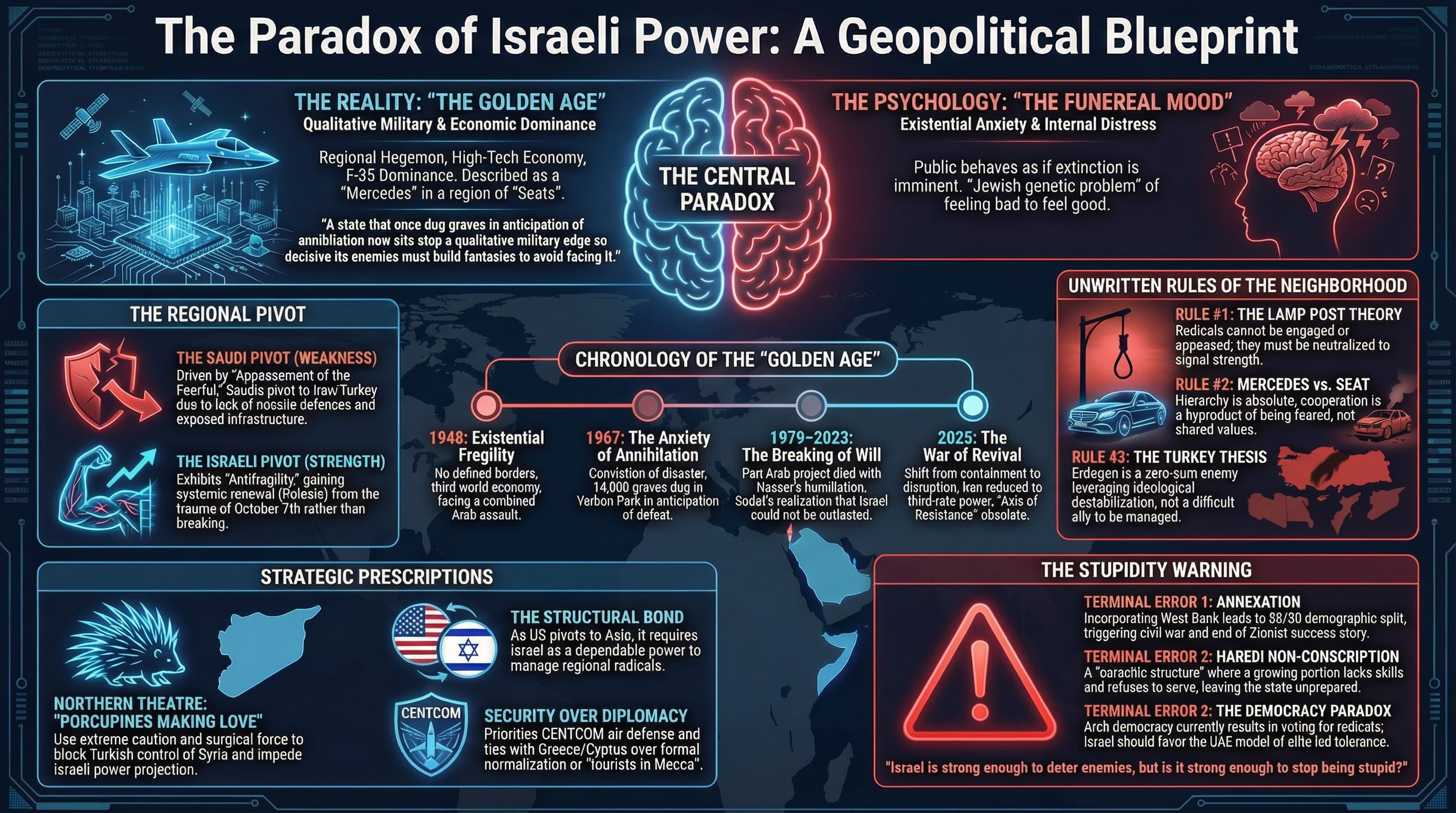
Israel’s Supreme Power—and Talent for Self-Inflicted Injuries
There is a particular kind of Western bedtime story—peddled by diplomats, swallowed by pundits, and repeated by the incurably well-meaning—which claims that the Middle East is a region waiting to be “stabilised,” as though it were a malfunctioning appliance and not a theatre of organised intimidation. The premise is always the same: that moderation can be purchased, that deterrence is vulgar, that “dialogue” is a moral act even when conducted with men who regard dialogue as a form of prey-circling. The result is also always the same: regimes that fear their own shadows learn to appease the nearest shadow-caster, and the supposed guardians of order discover—too late, as usual—that slogans do not stop missiles.
This essay begins where illusions end: with fear, the real currency of the neighbourhood. Not the sentimental fear cultivated by Western commentators who confuse their own anxiety for analysis, but the practical fear that governs decision-making from Riyadh to Damascus—the fear of exposed infrastructure, brittle legitimacy, and the sudden awareness that a “security umbrella” is often just an expensive piece of cloth. When states are pathetically vulnerable, they do not become prudent; they become servile. They do not align with the strong; they placate the vicious. And so the so-called moderates pivot—not out of principle, nor even out of strategy, but out of panic.
Against this unusual twist stands the central paradox we must confront: Israel is, by any cold measure that matters, more dominant than ever—yet behaves, psychologically and politically, as though it is forever one week away from extinction. The public mood is funereal; the strategic facts are not. A state that once dug graves in anticipation of annihilation now sits atop a qualitative military edge so decisive that its enemies must build fantasies, proxies, and slogans simply to avoid facing it directly. The trouble is not that Israel lacks power. The trouble is that Israelis can be persuaded—by their own back-and-forth traditions, by moral over-thinking, by domestic ideological divisions—that they do not possess it.
What follows, then, is not a plea for love, nor a hymn to international approval, nor a therapy session disguised as strategy. It is a primer in the rules that actually govern this part of the world—rules that are impolite, unfashionable, and therefore indispensable. Radicals are not “engaged”; they have to neutralised, argues Dan Schueftan, one of Israel’s most prominent observer of the region. Respect is not earned by sweetness; it is extracted by strength. Cooperation is not a triumph of shared values; it is a byproduct of being feared. The sentimental mind recoils from such axioms; the serious mind recognises them as the price of survival.
And then comes the real sting—because one must refuse the comforting habit of blaming everything on Tehran, Ankara, or the latest wage of violence emerging from a collapsing frontier. The gravest danger to Israel, Schueftan argues, is not that it is too weak to endure; it is that it is now strong enough to indulge stupidity. Annexationist delirium, demographic denial, the non-conscription rot, the substitution of messianic intoxication for statecraft—these are not merely “political issues.” They are terminal errors: self-inflicted wounds that no enemy needs to engineer because a society can, with astonishing efficiency, engineer them itself.
In other words: the Middle East has entered an age of fragmentation, hedging, and ideological predators, where weakness invites dismemberment and power invites conspiracy. Israel has survived this world before—indeed, it was forged in it. The question this essay forces upon the reader is brutally simple: will Israel continue to behave like an antifragile state—growing stronger in disorder—or will it squander its supremacy by treating new miscalculations as policy?
The Weakness Pivot: The Current Crisis
The Middle East has transitioned from a predictable binary of Cold War-style blocs into a fragmented, multi-polar landscape where survival is dictated by raw fear and tactical hedging. Established regional players, specifically the “moderate” Arab states, are increasingly abandoning the illusion of a Western security umbrella in favor of appeasing the very radical forces that threaten their existence. For the Israeli intelligence community, this shift signifies not a change in heart, but a strategic “blinking” by neighbours who recognize their own profound structural vulnerabilities.
A primary example of this shift is the recent strategic pivot by Saudi Arabia, which is best understood through the framework of the Appeasement of the Fearful. Despite their vast billions, the Saudis recognize they are pathetically weak; they lack Israel’s sophisticated missile defences and possess high-value, exposed targets such as desalination plants and oil facilities. Consequently, the Saudis have begun to distance themselves from Israel and the UAE—at one point even propagandising against them—to appease Iran and Turkey. This behavior proves that Saudi Arabia is fundamentally unreliable potential partner and cannot serve as the lynchpin of a pro-Western axis if it remains prone to panicking under the threat of Iranian medium-range missiles.
This fragility stands in stark contrast to the trajectory of Israel over the last two years. As analysed in my “An Antifragile State,” while many surrounding states seek “robustness”—trying to remain unchanged by avoiding stress—they inevitably break when volatility rises. Israel, conversely, has operationalised “antifragility”: the capacity to gain strength from disorder. While the Saudis pivot out of fear, Israel’s strategic pivot was born from the trauma of October 7th, transforming an existential shock into a mechanism for systemic renewal. The Saudis are collapsing under the threat of chaos; Israel has thrived within the chaos, proving that in this region, the only stable architecture is one forged in the fire of conflict, not bought with petrodollars.
In Syria, this fragmentation has created a dangerous imbroglio where Saudi Arabia, Qatar, and Turkey have aligned to support the al-Shara government. This represents a terminal blow to earlier hopes of a pacified Syria or an expansion of the Abraham Accords into the Levant. A Unified Syria established under the thumb of Turkish influence represents a catastrophic strategic threat. It would function as a proxy for Ankara’s regional ambitions, creating a permanent Turkish-run state on Israel’s doorstep, persistent threat to Kurdish ambition for self-rule, and prosperity that threatens Mediterranean energy corridors and security manoeuvres.
Central to this new threatening landscape is the Turkey Thesis. Turkey is no longer a difficult NATO ally but has emerged as a Zero-Sum Enemy across Libya, Sudan, Yemen, Somalia, and the Eastern Mediterranean. While some analysts mistakenly downplay the threat by counting tanks, the real danger is ideological and strategic. Under Erdogan, Turkey leverages its Muslim Brothers lineage to destabilise regional rivals, aiming to secure an exclusive position for Russian gas and Indian commodities while challenging the Greece-Cyprus-Egypt axis.
The challenge for Israel is to recognise that while these regional shifts are dangerous, they are largely driven by the inherent cowardice of its neighbours rather than a decline in Israeli standing. This volatility necessitates a return to the historical principles of power that defined the Zionist project’s rise to hegemony.
The Golden Age Thesis
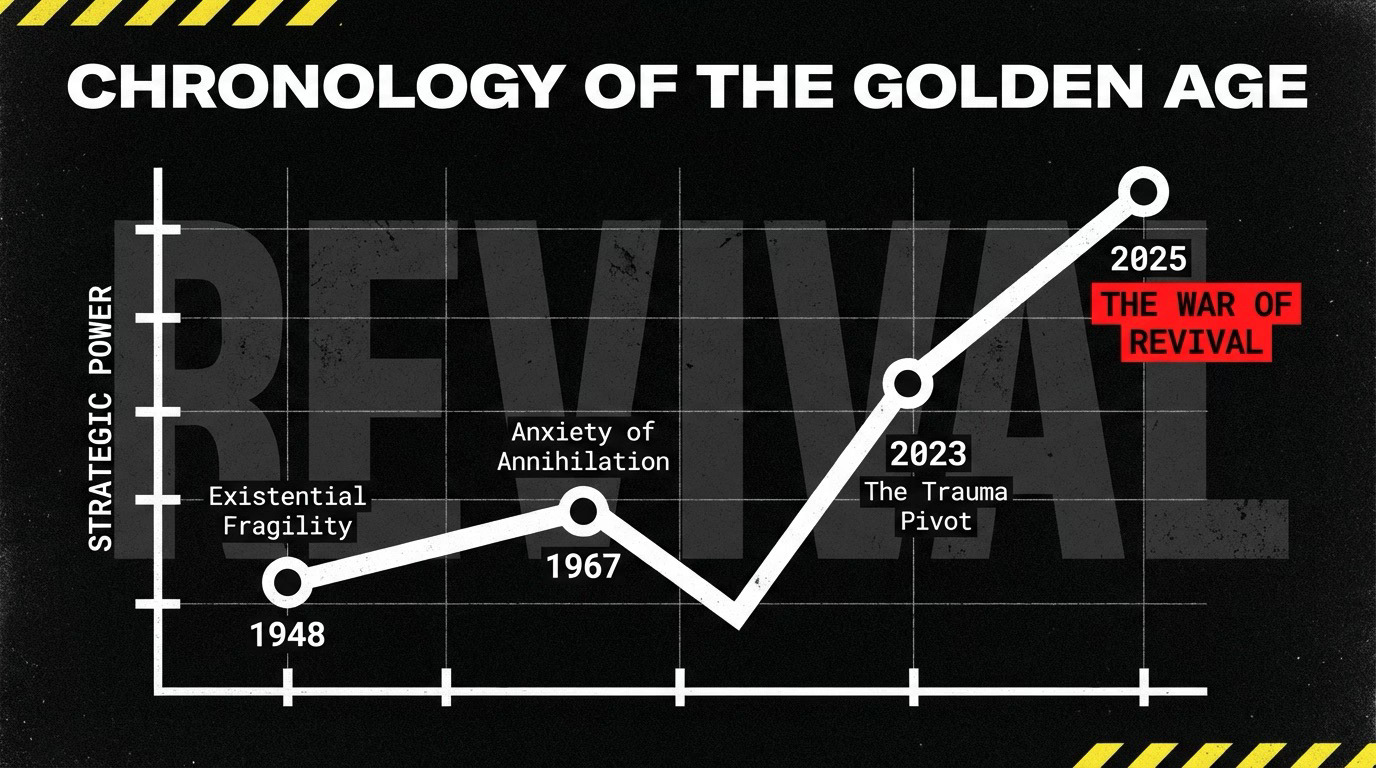
To accurately assess the current geopolitical climate, one must view the long-arc of Zionist history with a cold, realist eye. While the Israeli public is currently gripped by a culture of anxiety, a sober analysis reveals that the country’s strategic position has evolved from existential fragility to unparalleled regional superpower status. The current sense of crisis is a psychological artefact that ignores the reality: Israel has never been stronger, and its enemies have never been more thoroughly defeated.
In 1948, Israel was a state without a defined people, land, or language, possessing a third world economy and facing a combined Arab assault. The depth of historical anxiety is best illustrated by the days leading up to the 1967 war, when Israelis were so convinced of impending disaster they dug “14,000 graves” in Yarkon Park. Yet, Israel not only survived but thrived, achieving a feat of collective resilience that no other country has matched—reviving a dead language while others, such as the Irish, failed and adopted the language of the people they hate the most.
This historical arc is defined by the Breaking of Will. The charismatic Pan-Arab project of Gamal Abdul Nasser, which once sought to unite the “Arab world” from the Atlantic to the Gulf, died with him—literally of a broken heart—following his military humiliation. This led to the 1979 capitulation of Anwar Sadat, who realised that even a vulnerable Israel could outlast the entire “Arab world” in a generation-long war. Most recently, this trajectory has seen Israel reduce Iran from a first-rate regional power to a third-rate regional power by methodically dismantling the ring of fire proxies Tehran spent decades and billions of dollars constructing.
This dismantling was not merely a tactical success; it was the realisation of the “War of Revival” doctrine articulated in late 2025,. By shifting from containment to systemic disruption, Israel engaged in what strategic theory calls poiesis—the creative act of forging a completely new strategic reality. Israel did not just defeat Hamas or decapitate Hezbollah; it rendered the old “Axis of Resistance” obsolete. The resulting “Golden Age” is therefore not a happy accident of history, but the structural outcome of a state that finally decided to play the “Infinite Game”—using finite wars not just to restore quiet, but to fundamentally rewrite the rules of the regional board.
Israel’s qualitative military advantage now serves as the ultimate deterrent. The IDF is the only military “on the planet” truly Battle-Tested in the sophisticated, high-tech warfare of the 21st century—a level of conflict that neither NATO nor the Turkish military has ever experienced. This power gap is so wide that even the threat of Iranian escalation is checked; if Iranian missiles were to level city blocks in Tel Aviv, the response would be such that Tehran would look like a different city.
Understanding this historical dominance is essential to internalising the unwritten rules that govern the Middle East, where respect for power is the only currency that matters.
The Rules of the Neighbourhood
The Middle East operates on a set of unwritten rules regarding power, perception, and radicalism that fundamentally contradict Western diplomatic norms. In this neighbourhood, weakness is an invitation to aggression, and sweet words from an adversary are merely a prelude to an attack. To maintain stability, Israel perfected the incorporation of a framework that prioritises the raw projection of strength over the desire for international approval.
The primary rule of regional statecraft is the Lamp Post Theory. History shows that radicals—whether Nasser, Saddam, Khamenei, or Nasrallah—cannot be appeased or brought to the Western side through dialogue. The strategic maxim is simple, according to Dan Schueftan:
“When you have a radical, you hang him on a lamp post to signal to everyone else.”
Britain and France understood this in 1956, but were undermined by an American administration under Eisenhower that mistakenly believed it could win over anti-American forces through the UN. You do not work with radicals; you kill them or humiliate them, argues Schueftan.
The impact of this strength is synthesised in the Mercedes vs. Seat Metaphor. Arab leaders like Egypt’s Sisi privately acknowledge the regional hierarchy: Israel is the Mercedes, and the Arab states are the Seat. In a region where “if somebody is not afraid of you, you should be afraid of them,” being perceived as an invincible. Mercedes is the only thing that prevents total war. Cooperation in the Middle East is a byproduct of being feared, not a result of shared values.
However, in the case of Israel, internalising these rules is hindered by the “Jewish genetic problem.” There is a pervasive psychological tendency within the Israeli public to “feel bad to feel good,” leading to a culture of depression that refuses to admit their state is winning. This satisfaction in depression results in the “best-kept secret in Israel”: the fact that the country is immeasurably stronger than its citizens believe. Israelis must overcome the urge to believe the radicals are on the march simply because they are loud; in reality, the radicals only win when someone is stupid enough to let them.
These conceptual frameworks provide the necessary foundation for a pragmatic, power-based strategy that leverages Israel’s unique position as a regional anchor for the United States.
Strategic Prescriptions
The application of the Schueftan framework to current policy requires a move away from the pursuit of love toward the strategic management of power. Israel must prioritise its role as a regional lynchpin and maintain its military corridors while exploiting the radicalism of its enemies as a diplomatic asset.
In the northern theatre, the strategy should follow the Porcupines Making Love doctrine: extreme caution combined with surgical, preemptive force. Israel cannot tolerate a unified Syria that functions as a Turkish puppet. Israel must indicate to the Americans that the country will militarily block Erdogan from controlling southern Syria, as such a presence would create a strategic blockage of Israel’s ability to project power against Tehran. If the Turkish military and proxies attempt to take a base, Israel must act it before they arrive to signal that their presence is an intolerable impediment to Israel’s future operations against Iran.
Regarding Turkey, the approach must be a zero-sum game. Erdogan’s radicalism is a vital litmus test for the West; his public comparisons of Israel to the Nazis are a strategic gift that prevents the Israeli public from being naive enough to trust his political ambitions in the wider region. Israel’s regional prescriptions must include:
- Aggressively lobbying the U.S. to block F-35 transfers to both Turkey and Saudi Arabia.
- Prioritising the security axis with Greece, Cyprus, and Egypt over any sweet words from Ankara.
- Ensuring cooperation with Saudi Arabia in Centcom remains the priority over formal normalisation or tourists in Mecca; the security architecture of air defense is more vital than diplomatic niceties.
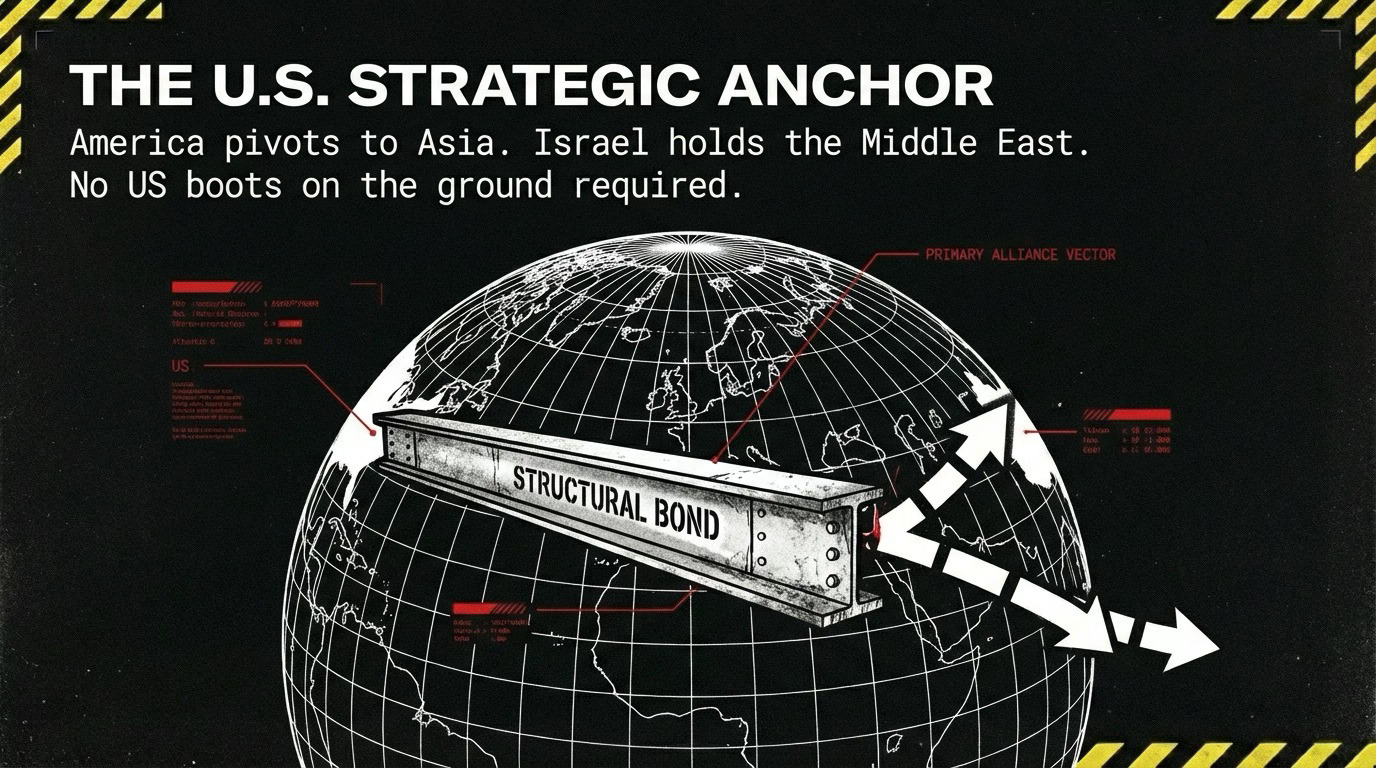
On the global stage, the alliance with the United States is deepening because it is structural. As the U.S. pivots to Asia, it needs a dependable power to manage Middle Eastern radicals. Saudi Arabia, Egypt, and Turkey have proven they are not up to the task; Israel is the only candidate that fits the criteria. The U.S. needs Israel because both countries’ enemies are identical, and Israel’s proven power allows the U.S. to focus its resources elsewhere.
However, the success of these external strategies is entirely dependent on Israel avoiding the terminal errors of domestic divisions and bickering.
A Stupidity Warning
The greatest paradox of Israeli power is that the state is now so strong it can “afford to be stupid,” yet it faces domestic threats that are fundamentally terminal. While external enemies can be deterred, certain internal policy choices would dismantle the state’s foundations in a way no Iranian missile could.
The country might be at risk of repeating the very cognitive failures that led to the catastrophe of 2023. As detailed in my “The Cognitive Lens,” the collapse of October 7th stemmed from a lack of “metacognition”—the institutional wisdom to question one’s own core assumptions. Today, the refusal to draft the Haredim or the messianic drive for annexation represents a new, self-imposed conceptzia. Just as we once ignored the “Jericho Walls” document because it didn’t fit our political model, we are now ignoring the demographic and economic data that predicts our own implosion. If Israel allows domestic dogmas to override reality again, the country will prove that while it has mastered the art of defeating external enemies, they have yet to conquer their own capacity for self-delusion.
The first terminal error is the push for West Bank Annexation. Incorporating Judea and Samaria would lead to an inevitable “50/50 population” split between Jews and Arabs. Regardless of the land’s status as the ancestral heartland, the demographic reality would trigger an inevitable civil war. To survive, Israel must adhere to Ben-Gurion wisdom:
the necessity of partitioning the land to ensure a Jewish democratic majority.
Ignoring this demographic reality is an act of fatal irresponsibility that would kill the Zionist success story, Schueftan warns.
The second terminal threat is the Haredim non-conscription crisis. The growth of a community that refuses to serve and lacks core skills (English and Mathematics) creates a “parasitic” structure that is a danger to the state’s continued existence. A democracy that remains “unprepared for war” until the last moment cannot sustain its resilience if a significant portion of its population is structurally unemployable and disconnected from the national defense.
Finally, Israel must navigate the Democracy Paradox in its regional relations. While European countries advocate for Arab democratisation, at this stage, democracy in the “Arab world” is synonymous with voting in radicals into power. Public opinion in the Arab street remains radicalised and dangerous. Consequently, Israel must favor the UAE model—an elite-led pluralism where “tolerance is more important than democracy.” Promoting stability through responsible, non-democratic regimes is the only path to regional pluralism that does not result in a jihādi takeover. Syria’s transition to post-Assad era is a warning example.
Ultimately, the Paradox of Israeli Power reveals a country that has achieved unprecedented military and economic heights but remains its own greatest threat. If Israel can overcome these terminal internal errors and maintain its cold-eyed respect for power, its position as the dominant force of the Middle East is secure for decades to come.


