The Palestinian Who Says October 7 Was a Catastrophic Error
The Third Essay in an October 7 Trilogy: Agency, Political Inaudibility, and Palestine’s Backspace Key
7 October 2026
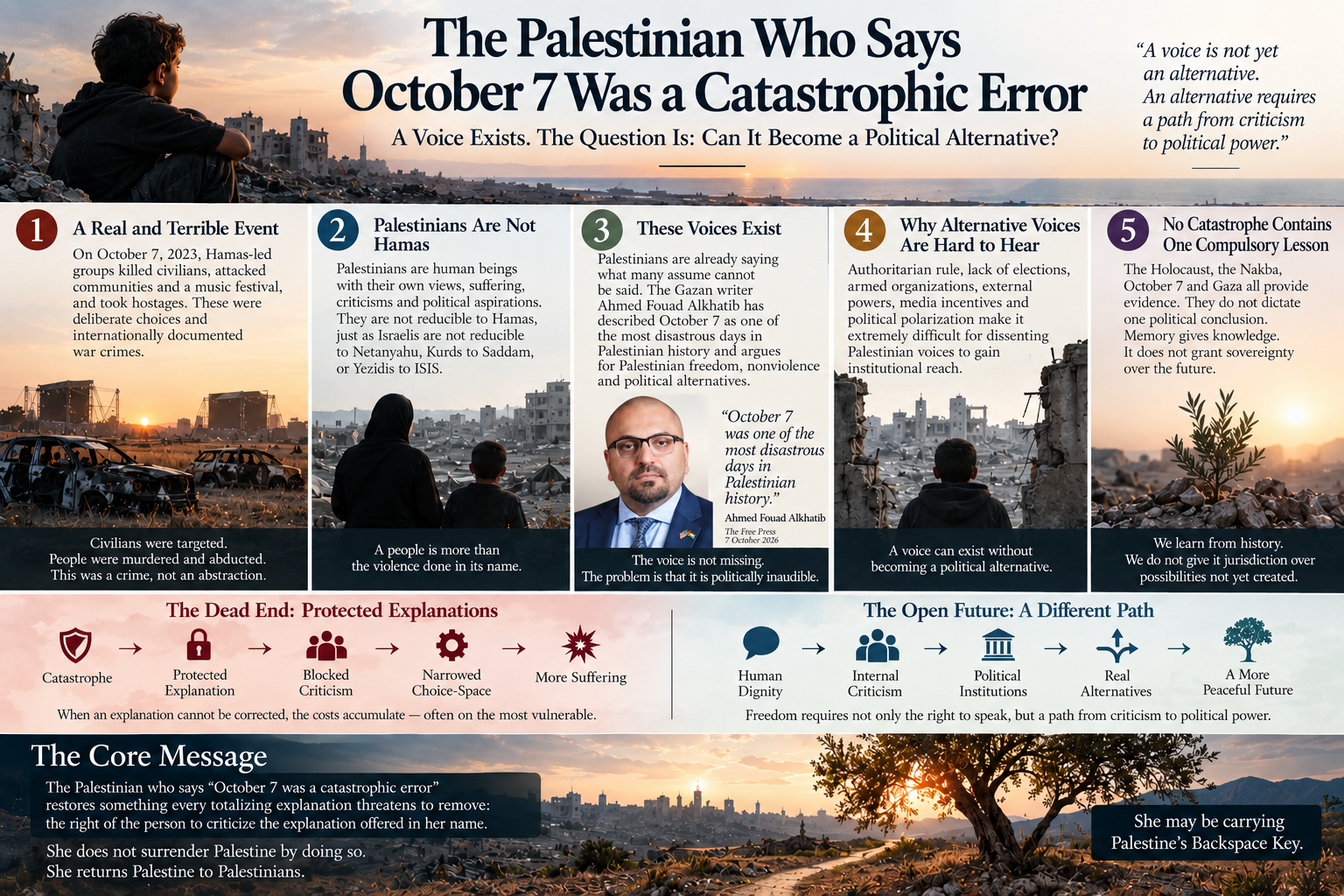
A voice is not yet an alternative. An alternative requires a path from criticism to political power.
This is the third essay in the sequence I have published around the third anniversary of October 7, 2023.
The first began inside the cockpit of Flight FZ1073 and asked how invisible explanations become physical reality - and whether criticism can still reach an error before it becomes irreversible.
The second turned inward. I asked what October 7 had done to my own explanations, and why the question that now follows me from Anfal to Shingal, from Israel to Gaza, is no longer simply who was right and who was wrong, but: where does the error go?
This third essay begins somewhere else.
It begins with a Palestinian.
When I first drafted it, I wrote that I was looking for the Palestinian who could say something politically and morally dangerous:
October 7 was a catastrophic error for my people.
I now need to correct that sentence before publication.
I do not need to invent that Palestinian. Palestinians are already saying versions of it. On this third anniversary, the Gazan writer Ahmed Fouad Alkhatib published an essay calling October 7 the beginning of the most catastrophic chapter in contemporary Palestinian history. He condemns Hamas, describes the devastation of Gaza in intensely personal terms, and still insists on Palestinian freedom and political agency.
He does not speak for “the Palestinians.” No individual does.
That is precisely the point.
The problem is no longer simply that the Palestinian critic is missing. The harder problem is that some Palestinian voices exist without acquiring the institutional, political, media, or symbolic reach that would make them visible as alternatives.
The Palestinian I thought I was looking for was not waiting to be invented. He or she was waiting to be heard.
I Have Spent Years Trying to Give the Kurd Back His Agency
Much of my writing about Kurdistan has been an argument against a strange form of sympathy: the sympathy that turns a people into an object.
Kurds become what Saddam Hussein did to them. What Turkey denied them. What Iran suppressed. What Syria excluded. What great powers promised and abandoned.
All of that history matters. But a people described only through what others have done to it has not yet been granted full political adulthood.
Kurds also chose. Kurds built institutions. Kurds made alliances. Kurds fought. Negotiated. Miscalculated. Created. Failed. Learned. Repeated errors. Protected errors. Corrected some and refused to correct others.
To restore Kurdish agency is not to weaken the Kurdish case. It is to take Kurds seriously enough to make Kurdish decisions criticizable.
I have increasingly tried to formulate the rule this way: Protect the Person, Preserve Agency, Criticize the Explanation.
That rule cannot stop at Kurdistan.
Palestinians Are Not Merely What Israel Has Done to Them
The Palestinian is often granted compassion at the price of agency.
Occupation explains the Palestinian. Dispossession explains the Palestinian. Blockade explains the Palestinian. Israeli power explains the Palestinian. The Nakba explains the Palestinian. Gaza explains the Palestinian.
These are causal contexts. Some are indispensable to understanding Palestinian history and political choice.
But an environment is not a mind. A structure is not a decision. A grievance is not an ideology. A history does not select one action by itself.
Palestinians also possess explanations about Palestine, Israel, Jews, Islam, nationalism, resistance, compromise, martyrdom, diplomacy, statehood, coexistence, victory, defeat, and the future.
Those explanations differ. Palestinians differ.
The moment we permit Hamas to stand in for “the Palestinian,” the Palestinian disappears again - this time inside the organization claiming to act in his or her name.
So Who Authorized October 7?
This question has become difficult to ask because it can sound like an attempt to distribute collective guilt. That is not what I mean.
I mean almost the opposite.
Who decided that massacring civilians, taking hostages, attacking communities and a music festival, and initiating a war of enormous foreseeable consequence constituted a legitimate strategy for the Palestinian future?
Who authorized Hamas to spend Palestinian lives on that conjecture?
An armed organization can possess agency without possessing a people.
Hamas made choices. Those choices had authors. They were not produced automatically by history. They were not executed by an abstraction called “Palestinian rage.”
To explain Hamas entirely as a reaction to Israel is therefore a peculiar form of dehumanization. It denies the organization the very agency necessary for moral and political responsibility.
Causal context does not abolish ideological content. Explanation does not dissolve authorship.
October 7 Produced an Error Signal
For Israel, October 7 was an enormous error signal. Assumptions about deterrence, intelligence, containment, border security, and Hamas required criticism.
But October 7 was also an error signal for Palestinian politics.
That proposition should be obvious and has somehow become difficult to say.
If a strategy produces mass death, hostage-taking, devastation, the destruction of political possibility, and a catastrophic transfer of costs onto people who did not choose the strategy, then the strategy must become criticizable.
Failure does not automatically teach. It merely creates information from which learning might begin.
The decisive question is what happens to that information.
Does it reach the explanation? Or is it intercepted before the explanation can be revised?
The Palestinian Error Must Not Become the Palestinian Person
If Hamas committed a catastrophic error, the error belongs first to the choices, explanations, leadership, institutions, and mechanisms that produced it.
It does not migrate automatically into “the Palestinians.”
A Palestinian child in Gaza is not Hamas’s hypothesis. A Palestinian dissident is not Hamas’s strategy. A family that did not authorize October 7 must not become the human surface upon which somebody else’s explanation is corrected.
This is what I call correction-cost transfer.
When an explanation is protected from criticism, reality does not stop contradicting it. The costs of the contradiction appear somewhere else.
Too often they migrate downward - to the civilian, the dissident, the hostage, the minority, the soldier, the woman, the child, the person with the least power to revise the model.
Gaza Does Not Retroactively Make October 7 Correct
Nothing in the devastation of Gaza can make the massacre of Israeli civilians on October 7 correct.
And nothing about October 7 can make every subsequent Israeli action correct.
I need both sentences.
Chronology matters. Agency matters. Responsibility matters. So does human visibility.
A dead Palestinian child does not become less dead because Hamas murdered Israeli civilians first. A murdered Israeli civilian does not become less murdered because Palestinians had suffered before October 7.
Suffering is not a moral currency in which one corpse cancels another.
The analytical task is harder: preserve causation without turning causation into excuse, preserve responsibility without turning responsibility into collective guilt, and preserve the person beneath every political category.
The Voice Was Not Missing. It Was Politically Inaudible.
One of my readers asked me a question that exposed a weakness in my earlier formulation. She could see Palestinian flesh-and-blood humanity, she said, but struggled to see Palestinian political agency. Where are the other voices? What do they want? Why is it so difficult for them to emerge and be heard?
That question changed this essay.
The answer cannot simply be: trust me, the alternatives exist. A political argument has to explain why a voice can exist and still fail to become an alternative.
A dissident can speak without possessing a party. A reformer can publish without controlling a school, mosque, television station, militia, budget, bureaucracy, or border. A political idea can be morally serious and intellectually coherent while remaining institutionally weak. A future can be imaginable without yet being selectable.
Objective political possibility is not the same thing as perceived political possibility.
This is why “where are the alternatives?” is both a fair question and, sometimes, a misleading one.
The existing order is visible because it already has institutions. Hamas has weapons, cadres, symbols, networks, memories, patrons, and organizational inheritance. Israel has a state, ministries, an army, borders, diplomacy, and overwhelming institutional visibility. International movements have slogans, organizations, donors, platforms, and audiences.
A political future that has not yet acquired institutions is harder to see.
But invisibility is not nonexistence.
A voice is not yet an alternative. An alternative requires a path from criticism to political power.
That path is the missing mechanism.
The Explanation Acquired Protectors
After October 7, the action acquired defenders far beyond Gaza who did not necessarily belong to Hamas, share its theology, or know much about its political history.
Some redescribed the massacre almost immediately as resistance. Some made chronology disappear into context. Some treated insistence on Hamas’s agency as hostility to Palestinians. Some appeared more interested in protecting an anti-Israel explanation than in asking whether that explanation had just exposed Palestinians to catastrophe.
This matters because an explanation can be protected by people who did not create it.
The protection mechanism can be ideological, moral, social, reputational, institutional, or emotional.
Once criticism of a strategy is reclassified as betrayal of a people, the strategy acquires armor made from the people themselves.
I Am Not Speaking About Every Pro-Palestinian Activist
That qualification is not a courtesy. It is part of the explanation.
There are Palestinians and pro-Palestinian activists who condemned October 7, opposed Hamas, defended Palestinian rights, defended Israeli civilians, and rejected the conversion of either people into a collective target.
There are also people whose principal concern is humanitarian: food, medicine, shelter, hostages, prisoners, civilian protection, ceasefires, and political settlement.
Those positions must not be collapsed into support for Hamas.
My concern is narrower: the explanatory architecture in which criticism of Hamas disappears because Hamas is absorbed into “Palestinian resistance,” and criticism of the resistance is then absorbed into hostility toward Palestinians.
That is a protected-error pathway. It makes the Palestinian cause less corrigible precisely when Palestinians most need political correction.
“Free Palestine” Contains a Question We Rarely Ask
Free from what?
Israeli domination is one answer. Occupation, military control, dispossession, settlement, statelessness, and the denial of political agency are real political problems.
But freedom cannot mean liberation from one form of domination followed by compulsory submission to another.
Is the Palestinian free to criticize Hamas? To reject Islamist rule? To reject armed struggle? To be secular? To be religious without accepting theocracy? To make peace? To abandon a doctrine that has failed? To say that October 7 was an error?
If the answer is no, then “Free Palestine” has preserved a territory while losing the person.
Freedom requires more than changing who possesses power over a population. It requires preserving the population’s capacity to criticize and replace explanations about its own future.
Catastrophe Does Not Contain One Compulsory Lesson
Another reader turned my previous essay back toward Israel. After the Holocaust, he asked, what happens if a historically justified lesson of survival becomes so protected that it narrows the political imagination itself?
I would formulate the problem more cautiously.
A catastrophe does not contain its own political conclusion.
The Holocaust can sustain the lesson that Jews must never again be defenseless. It can also deepen a universal suspicion of dehumanization and unaccountable power. The Nakba can sustain a demand for Palestinian self-determination without dictating one permanent theory of resistance. October 7 can destroy naive assumptions about security without granting one security doctrine permanent authority. Gaza can expose terrible Palestinian suffering without retroactively making Hamas’s strategy correct.
Memory provides knowledge. It does not possess exclusive jurisdiction over what must be concluded from that knowledge.
The danger begins when one interpretation of catastrophe acquires sovereignty over futures that have not yet been created.
Victimhood does not create epistemological immunity. Nor does victimhood create one compulsory lesson.
The Hard Counter-Conjecture: Peace Requires Guardians
There is a hard counter-conjecture here, and it deserves to be stated in its strongest form.
Perhaps October 7 teaches principally that societies forget danger at their peril: peace is an achievement, deterrence matters, enemies exist, institutions must defend themselves, and survival cannot be outsourced.
I do not reject that lesson.
I reject its conversion into a final lesson.
The existence of a genuine threat can justify defense without establishing that every future political possibility must be organized around that threat.
Otherwise the enemy acquires something more consequential than the ability to kill us.
He acquires jurisdiction over the range of futures we are permitted to imagine.
That applies to Israel after October 7. It applies to Palestinians under Israeli power and under Hamas. It applies to Kurds after Anfal. It applies to Yezidis after ISIS.
Security is a problem. It is not a complete political philosophy.
The Palestinian Who Refuses to Disappear
The Palestinian at the center of this essay refuses disappearance.
She can say: I want freedom from Israeli domination, and Hamas does not own my suffering.
She can say: I oppose occupation, and October 7 was a moral and political catastrophe.
She can say: I want Palestinian self-determination, and no armed organization possesses permanent jurisdiction over my future.
She can say: Gaza is suffering terribly, and I will not allow that suffering to become evidence that every previous Palestinian strategy was correct.
She can criticize Israel without becoming Hamas. She can criticize Hamas without becoming Israeli propaganda.
That is not political neutrality.
It is agency.
From Voice to Alternative
But this essay now needs one more step.
It is not enough for the dissident Palestinian to be morally visible. Political adulthood requires institutions through which criticism can become consequence.
A society in which people may whisper dissent but cannot organize it has not solved the agency problem. A society in which leaders cannot be replaced has not solved it. A society in which armed power monopolizes political legitimacy has not solved it. A society in which external patrons select the viable factions has not solved it.
The question therefore changes from “Where are the moderate voices?” to a harder institutional question:
What would have to change for Palestinians themselves to be able to select, criticize, organize, replace, and institutionalize political alternatives?
That question has no simple answer. Nor should I pretend to possess one from outside Palestinian political life.
But we can identify some requirements of an open architecture: freedom to criticize armed organizations; political competition; replaceable leadership; institutions not subordinate to a permanent militia; room for secular, religious, liberal, nationalist, federal, confederal, statist, and other conjectures to compete without treating disagreement as treason; protection for people who revise inherited strategies; and pathways through which new knowledge can become public power.
Those are not a blueprint for Palestine.
They are conditions under which Palestinians could write more of the blueprint themselves.
The Price of Protecting an Error
Protected Error is not simply an incorrect belief that persists.
The narrower problem is an explanation for which identifiable mechanisms prevent relevant error signals from revising or replacing the model.
When that happens, the mismatch with reality accumulates costs.
If Hamas’s strategy cannot be criticized because criticism is treated as betrayal, the cost of the strategy does not disappear. Palestinians carry more of it.
If Israeli strategy cannot be criticized because criticism is treated as disloyalty during emergency, Israelis and Palestinians carry more of it.
An open architecture tries to make the explanation pay. A closed architecture increasingly makes the person pay.
That is why the location of correction costs is a moral as well as an epistemic question.
Chosen for What?
I have been writing another series about chosenness: religious, national, ideological, and political claims that convert a mission into jurisdiction.
The problem is not that a people believes it has a purpose. Human beings create purposes.
The danger begins when purpose becomes immunity from criticism.
What if a people understood itself as chosen not to be correct, but to preserve the possibility of correction?
That question applies to Jews. To Christians. To Muslims. To nations. To Kurds. And it applies here to Palestinians as well.
No history of suffering can make a people infallible. Suffering can deepen knowledge. It can also protect error. The difference depends on whether criticism remains possible.
The Enemy Can Become the Co-Author of Your Future
I once formulated this too loosely. Enemies do not simply author one another.
Hamas did not create Zionism. Israel did not create Islamist theology. Saddam did not create Kurdish identity.
The more precise conjecture is this: an enemy can become co-author of the conditions under which certain explanations become more plausible, selectable, and replicable.
Hamas acts on its explanation of Israel. Israel changes. Israel acts on its explanation of Hamas and Palestinian politics. Palestinian society changes. Each side then observes the changed other and says: you see, I was right about them.
We begin producing each other’s evidence.
That feedback loop does not erase unequal power or unequal responsibility. Recursive does not mean equivalent.
It means that each actor must ask a terrifying question: how much of my future am I allowing my enemy to write?
How Much of Palestine’s Future Should Hamas Be Allowed to Write?
October 7 should not receive permanent authorship over the Palestinian future.
Nor should the Israeli response to October 7.
Nor should Iran. Nor Arab governments. Nor Western campuses. Nor the accumulated vocabulary of an old conflict whose participants increasingly inherit answers before they inherit the problems.
A Palestinian future must contain Palestinians as creators of new political knowledge.
That means the right to remember without granting memory a future veto. The right to criticize resistance. The right to reject surrender. The right to create political options that do not yet exist.
Freedom requires not only options, but the capacity to perceive, criticize, and create options.
The Palestinian Backspace Key
I have increasingly used the Backspace Key as a metaphor for a simple institutional question: what can be corrected before correction requires catastrophe?
Backspace does not resurrect the dead. It does not restore a destroyed home or return stolen years to a hostage.
It means preserving the ability to revise the explanation before human beings are forced to carry its accumulating cost.
For Palestinian politics, that requires more than elections in the narrow procedural sense. It requires criticism, dissent, institutional competition, replaceable leadership, freedom from armed monopoly, and the possibility of saying that a sacred strategy has failed.
The Backspace Key belongs on the theory, not on the human being.
Palestine needs the political capacity to press it.
A Conjecture Corrected by Reality
There is one final reason I have changed this essay before publishing it.
Its first draft said I was looking for the Palestinian who could call October 7 a catastrophic error for his or her people.
Then reality answered back.
A Palestinian originally from Gaza published exactly the kind of argument I had described as difficult to hear. Other Palestinians have made related arguments before him. My original formulation had therefore smuggled an absence into the essay that was not fully real.
The voice was not simply absent.
My own categories had made it easier to describe the voice as missing than to explain the architecture that made it politically weak, fragmented, filtered, or inaudible.
That is a correction, not an embarrassment.
A theory of error correction that protects its own first draft would already have failed its own test.
So the conjecture is now stronger and narrower.
Palestinian political agency already exceeds the actors claiming jurisdiction over it. The deeper problem is that existing selection architectures make some Palestinian voices powerful, others intermittently visible, and still others politically inaudible.
Freedom therefore requires not merely protecting alternative voices. It requires creating institutions through which criticism can become selectable political power.
Three Years Later
My first October 7 essay asked where the error goes when explanations cannot correct themselves.
This essay gives me a more specific answer.
Sometimes the error is transferred onto the people in whose name the explanation claims to act. The movement is protected. The doctrine is protected. The slogan is protected. The moral narrative is protected. And the person absorbs the correction cost.
But there is another failure too.
Sometimes the alternative exists first as a person, a sentence, a criticism, a fragile organization, or a political possibility without sufficient machinery to reproduce itself.
The old order then appears inevitable not because no alternative can exist, but because the alternative has not yet acquired reach.
Political possibility has a visibility problem.
Armed organizations are visible. Governments are visible. Soldiers are visible. Flags, rockets, borders, speeches, and demonstrations are visible.
A future that has not yet acquired institutions is much harder to see.
Every political future begins as something weaker than the structures already occupying the present: a dissident sentence, an unpopular criticism, an argument without an army, an explanation that has not yet found its institution.
The open future begins by refusing to confuse what is presently powerful with what is permanently possible.
That is why the Palestinian who says “October 7 was a catastrophic error for my people” matters.
Not because one Palestinian can settle the argument. No individual speaks for a people.
Precisely for that reason.
The Palestinian who says it restores something every totalizing explanation threatens to remove: the right of the person to criticize the explanation offered in his or her name.
She does not surrender Palestine by doing so.
She returns Palestine to Palestinians.
Do not make that Palestinian disappear.
And do not mistake the weakness of her present institutions for the impossibility of her future.
She may be carrying something far more consequential than another explanation of October 7.
She may be carrying Palestine’s Backspace Key.
Contemporaneous References
Ahmed Fouad Alkhatib, “The Most Disastrous Day in Palestinian History”, The Free Press, October 7, 2026.
Daniel Clarke-Serret / Guerre and Shalom, “Holiday from History”, contemporaneous counter-conjecture on deterrence, guardianship, and the cost of complacency.


