The Open Society’s Category Error
22 May 2026
The Open Society does not usually collapse because it has too much compassion.
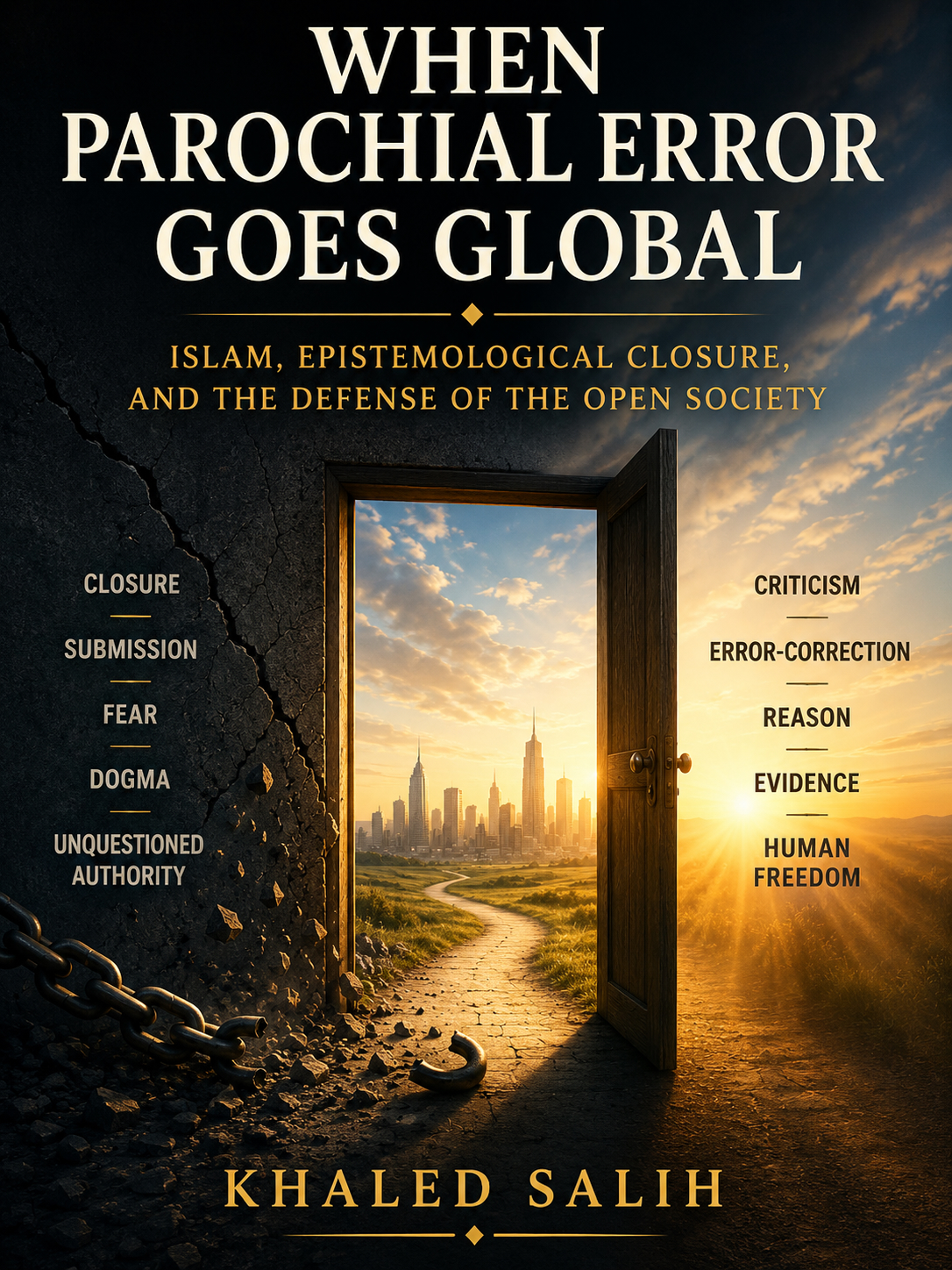
This is the fifth essay in my series on the ideas behind my upcoming book When Parochial Error Goes Global. The earlier essays traced how a parochial error can travel, why no error is final unless criticism is forbidden, why the person must be protected while the doctrine remains open to criticism, and how anti-rational memeplexes capture intelligence for preservation rather than correction.
The Open Society does not usually collapse because it has too much compassion.
It collapses when compassion loses contact with criticism.
That distinction matters.
A society can be kind and still think clearly. It can protect minorities and still criticize doctrines. It can oppose bigotry and still examine religious law. It can defend freedom of conscience and still refuse to protect closed systems from scrutiny.
But when the Open Society forgets how to make these distinctions, compassion becomes confused. It begins to protect not only vulnerable people, but also the systems that may keep them vulnerable.
That is the category error at the center of our time:
The Open Society mistakes criticism of the cage for hatred of the prisoner. Once this confusion enters institutions, the protected object quietly changes: the vulnerable person disappears, and the doctrine, organization, or communal boundary receives the moral protection that belonged to the person. Once that error takes hold, the consequences are severe. Anti-Muslim hatred is rightly condemned, but criticism of Islam is treated with suspicion. Religious identity is protected, but dissent from religious identity is ignored. Institutions display sensitivity toward the visible believer, but fail to see the secular Muslim, the ex-Muslim, the liberal believer, the reformer, the woman resisting compulsory piety, the artist, the teacher, the writer, or the child who wants the right to doubt.
This is not tolerance.
It is selective blindness.
Popper’s Open Society is not a utopia. It does not promise final happiness, final justice, or spiritual unity. It is an error-correction system. Its greatness lies in the fact that bad rulers can be removed without bloodshed, bad policies can be revised, and bad explanations can be challenged before they become prisons.
When the Open Society loses that function, it does not become more compassionate. It becomes less able to protect the people who need correction most.
The first duty: protect the person
Let me begin where every honest discussion must begin.
Muslims must be protected as persons.
They must be protected from hatred, harassment, discrimination, humiliation, collective suspicion, and violence. They must not be treated as representatives of a threat because of their name, face, family, background, accent, mosque, clothing, or inherited religion.
The Muslim child is not responsible for Islamic doctrine. The Muslim family is not a political project. The Muslim neighbor is not an abstraction. The Muslim citizen is a citizen.
That principle is non-negotiable.
An Open Society that fails to protect Muslims from bigotry has already failed its own moral test. No critique of Islam, Islamism, or Muslim institutions is legitimate if it becomes collective suspicion of Muslims as people.
But that is only half the matter.
The same society must also protect Muslims, ex-Muslims, secular Muslims, and reformers from doctrines, institutions, and communal pressures that may claim ownership over them.
That is where modern institutions often become confused.
They know how to oppose prejudice from outside the group. They are much less willing to confront coercion from within the group.
The person is not the doctrine
The core distinction remains: The Muslim is the person. The doctrine is not the human being. The organization is not the individual.
If the Open Society cannot hold this distinction, it will oscillate between two failures.
One failure is hostility: treating Muslims as if they are identical with Islam.
The other failure is surrender: treating Islam as if it must be protected because Muslims must be protected.
Both are wrong.
Both collapse the person into the doctrine.
A doctrine is not a person. A scripture, prophet model, legal tradition, blasphemy norm, apostasy rule, gender code, or organization claiming to represent Muslims is not the Muslim.
These systems must remain criticizable.
Organizations require a third category. They are not persons, but they are not merely abstract doctrines either. They collect money, train leaders, shape children, speak to municipalities, receive grants, influence schools, lobby institutions, and claim representative authority. Therefore they must not be protected as vulnerable identities. They must be tested as power structures.
If criticism of Islam becomes morally forbidden because Muslims exist, then the Open Society has granted a doctrine the protection that belongs only to human beings.
And when doctrines receive the protection owed to persons, persons inside those doctrines may lose the protection they need most.
The Islamophobia category error
The word “Islamophobia” can name something real.
Anti-Muslim hatred exists. Anti-Muslim discrimination exists. Anti-Muslim conspiracy thinking exists. Anti-Muslim harassment exists. These must be opposed. The problem is not the word when it names hatred of Muslims. The problem is the expansion of the word until it protects Islam from the same criticism to which every doctrine, scripture, institution, and moral system must be exposed.
But the word “Islamophobia” is also often used to perform a second function: to blur the line between hatred of Muslims and criticism of Islam.
That is the category error.
It treats criticism of doctrine as injury to persons. It treats analysis of religious law as hostility to a minority. It treats examination of organizations as suspicion of believers. It treats secular, liberal, reformist, feminist, and ex-Muslim criticism as betrayal, racism, or right-wing contamination.
This does not protect the vulnerable. It protects the boundary.
And the people most damaged by this error are often not anti-Muslim bigots. They are the people inside Muslim communities who need space to dissent.
The secular Muslim woman who wants no headscarf. The young man who no longer believes. The convert out of Islam who fears family consequences. The artist who wants to satirize sacred authority. The teacher who wants to discuss Muhammad without fear. The reformer who wants to historicize the Qur’an. The liberal believer who wants Islam without coercion. The woman whose body has become the symbol of communal honor. These people need the Open Society to make distinctions.
When it does not, it abandons them.
Suicidal empathy
This is where compassion becomes suicidal.
By “suicidal empathy,” I do not mean that empathy is bad.
Empathy is necessary. Without empathy, politics becomes cruelty. Without empathy, critique becomes cold and tribal. Without empathy, the suffering of minorities is ignored.
But empathy can become destructive when it is severed from truth, agency, and consequence.
Empathy becomes suicidal when it says:
Because Muslims have suffered prejudice, Islam must not be criticized.
Because minorities are vulnerable, their institutions must not be scrutinized.
Because believers may feel wounded, sacred claims must not be satirized.
Because religious identity is personal, religious law must be treated as untouchable.
Because bigots criticize Islam, serious people should avoid the subject.
This is not moral maturity.
It is a failure of discrimination — in the intellectual sense of the word. It cannot discriminate between person and doctrine, wound and argument, dignity and immunity, protection and surrender.
Compassion becomes anti-corrective when it protects the system that creates fear inside the very people it claims to defend.
The abandonment of dissenters
The Open Society often sees the organized representative before it sees the internal dissenter.
It sees the mosque committee, the umbrella organization, the community spokesperson, the religious association, the anti-discrimination claim, and the visible symbol.
But does it see the person who cannot speak? Does it see the ex-Muslim who still lives at home? Does it see the young woman who has learned that removing the veil would break her family? Does it see the liberal believer accused of being corrupted by the West? Does it see the secular Muslim who is treated as inauthentic because she is not visibly religious? Does it see the child taught that doubt may lead to hell? Does it see the reformer who cannot safely criticize Muhammad? Does it see the artist who knows that satire can become a death sentence?
Too often, no.
The Open Society’s official compassion frequently travels through recognized group structures. But those structures may not represent the most vulnerable people inside the group. They may represent the most organized, most conservative, most status-conscious, or most boundary-protecting elements.
This is why schools, municipalities, universities, NGOs, media organizations, and government agencies must ask a harder question before they appoint “community representatives.” Who is not in the room? Which women, secular Muslims, ex-Muslims, reformers, artists, teachers, and dissenters would pay a social price for contradicting the person now being treated as their representative?
They may represent the most organized, most conservative, most status-conscious, or most boundary-protecting elements.
A society that confuses the organization with the person may strengthen precisely the forces from which some individuals need protection.
Root-cause confabulation
There is another error: the habit of explaining ideological behavior only through material or psychological causes.
Poverty. Racism. Foreign policy. Colonialism. Discrimination. Humiliation. Alienation. Mental health. Lack of opportunity.
All of these may matter in particular cases. They should not be dismissed. Human beings live in material conditions. Injustice can produce anger. Humiliation can produce grievance. Exclusion can make people vulnerable to ideological capture. A serious analysis includes these conditions; it does not let them replace the content of belief.
But these are not enough.
A bad explanation begins when we say that ideology itself does no causal work.
That is false.
Ideas are causal. Sacred stories are causal. Afterlife beliefs are causal. Founder models are causal. Scriptures are causal. Legal traditions are causal. Gender codes are causal. Blasphemy norms are causal. Apostasy rules are causal. Concepts of purity and pollution are causal. Concepts of believer and unbeliever are causal. Concepts of submission and rebellion are causal.
If someone acts in the name of a doctrine, cites the doctrine, defends the doctrine, organizes around the doctrine, and punishes dissent in the name of the doctrine, then the doctrine must be examined.
To refuse to examine it is not sophistication.
It is evasion.
Ideology as cause
Modern institutions are often comfortable studying social context but uncomfortable studying religious content.
They will ask:
Was the person marginalized?
Was the person poor?
Was the person discriminated against?
Was the person alienated?
Was the person angry?
These are legitimate questions.
But they often refuse to ask:
What did the person believe? What doctrine gave shape to the anger? What sacred model made the action meaningful? What promise of reward changed the cost of death? What law made dissent appear criminal? What scriptural category divided the world? What authority structure made obedience feel virtuous?
Without those questions, analysis becomes blind.
It mistakes fuel for steering.
Poverty may supply grievance. Humiliation may supply anger. Exclusion may create vulnerability. But ideology supplies direction. It tells people what their suffering means, who the enemy is, what purity requires, what sacrifice promises, and which actions become sacred.
A society that refuses to analyze ideology cannot understand ideological capture.
The visible Muslim and the invisible Muslim
There is a symbolic problem here too.
Modern institutions often prefer visible religious identity because it is easy to recognize and include. The headscarf, the mosque visit, the imam, the community organization, the public Ramadan greeting, the diversity poster — these become signs of inclusion.
But Muslim identity is not only visible religiosity.
There are Muslims by background who are secular, Muslims who believe privately but reject communal control, Muslims who no longer believe, culturally attached Muslims who are doctrinally distant, women who experience the veil not as empowerment but as pressure, and liberal believers whose faith is real but whose conscience refuses coercion.
There are people who left Muslim-majority societies precisely to escape compulsory religious visibility.
If inclusion recognizes only the visibly religious Muslim, it may exclude the very people whose freedom consists in not being marked by religion.
This is the paradox of symbolic inclusion:
The institution tries to include the minority, but may standardize the most visible religious marker as the authentic image of the minority.
That is not full inclusion.
It is a narrowing disguised as recognition.
Dialogue without criticism
Dialogue is good when it allows truth-seeking.
Dialogue becomes evasive when it substitutes politeness for criticism.
Interfaith meetings, institutional consultations, diversity programs, and community partnerships can all have value. But they can also become rituals of avoidance.
Everyone speaks respectfully. Everyone affirms coexistence. Everyone denounces extremism. Everyone celebrates shared values.
No one asks the hard questions.
Can a Muslim leave Islam without fear?
Can Muhammad be criticized?
Can the Qur’an be historicized?
Can women reject religious dress without punishment?
Can children choose unbelief?
Can satire be defended?
Can blasphemy be tolerated?
Can Islamic law be subordinated without ambiguity to equal citizenship and secular law?
Can dissenters be protected against communal pressure?
If these questions are excluded because they are “sensitive,” then dialogue has become aesthetic camouflage.
It looks like openness. It avoids the tests of openness.
The problem with “moderation”
The Open Society often seeks “moderate” religious partners.
But moderation is not always the same as corrigibility.
A moderate organization may use calm language. It may condemn terrorism. It may participate in civil society. It may speak about coexistence. It may accept elections. It may support interfaith projects. It may present itself as peaceful.
All of that matters. But it is not enough.
The deeper question is:
What happens when the foundational claims are criticized?
That is where the test begins.
Does the organization defend the critic’s right to criticize? Does it defend the apostate? Does it defend the blasphemer’s legal safety? Does it defend women who leave religious norms? Does it defend historical scrutiny of sacred texts? Does it defend equal moral status for nonbelievers? Does it accept that no doctrine should receive special protection from ridicule?
If not, its moderation may be behavioral rather than epistemological.
It may be peaceful in public while closed at the root. The question is not only whether it condemns violence, but whether it protects the right to criticize the sacred premises that organize its authority.
Tolerance and the paradox of intolerance
The Open Society must tolerate many beliefs it considers false, strange, offensive, or even morally unattractive.
Tolerance does not mean approval. Nor does intolerance begin with offense, discomfort, conservative belief, or private piety. The threshold is reached when a system seeks to silence criticism, punish exit, intimidate dissenters, or place its own claims beyond correction
Tolerance means that people are not coerced merely because others dislike their beliefs.
But tolerance cannot mean that systems committed to suppressing criticism receive immunity from criticism. That would destroy the conditions that make tolerance possible.
A tolerant society must protect the right to believe.
It must also protect the right to disbelieve. It must protect worship. It must also protect apostasy. It must protect religious speech. It must also protect blasphemy. It must protect the mosque. It must also protect the ex-Muslim critic outside the mosque.
If tolerance protects only belief and not exit, only identity and not dissent, only community and not conscience, then tolerance has been inverted.
It has become protection for authority rather than protection for the person.
How the Open Society should respond
The answer is not hatred. The answer is not suspicion of Muslims. The answer is not censorship. The answer is not collective blame. The answer is not anti-religious authoritarianism. The answer is intellectual hygiene.
The Open Society should say:
Muslims are protected as persons.
Islam is open to criticism as doctrine.
Islamic organizations are open to scrutiny as institutions.
Anti-Muslim hatred will be opposed.
Blasphemy laws and blasphemy intimidation will be opposed.
Apostates and dissenters will be protected.
Women will not be sacrificed to communal honor.
Children will not be treated as property of religious communities.
No sacred claim is above historical inquiry.
No organization gets immunity by speaking the language of victimhood.
This is not extremism. This is the minimum discipline of a free society.
The real measure of inclusion
A society is not inclusive merely because it displays religious symbols.
A society is inclusive when the individual can refuse the symbol.
A society is not inclusive merely because it consults religious leaders.
A society is inclusive when individuals can disagree with those leaders without fear.
A society is not inclusive merely because it protects minority identity.
A society is inclusive when it protects the minority individual from the coercive demands of identity.
A society is not inclusive merely because it opposes bigotry.
A society is inclusive when it also opposes internal coercion.
True inclusion is not the celebration of group representation.
True inclusion is the protection of personal freedom.
The final distinction
The Open Society must recover its most difficult discipline.
It must be able to say two things at once:
The Muslim is fully human, fully equal, fully entitled to dignity, safety, citizenship, and freedom.
And:
Islam, like every doctrine, is fully open to criticism, satire, historical inquiry, moral judgment, institutional scrutiny, and rejection.
If we cannot say both, we will fail. If we say only the first, we may protect the cage. If we say only the second, we may forget the person.
The Open Society must refuse both surrender and hatred.
Its rule must be:
Protect the person.
Criticize the doctrine.
Test the organization.
Restore the Backspace Key: the right to revise, reject, leave, criticize, and begin again.
That is not cruelty. That is the condition of freedom. The person is not the cage. And the cage must be criticized because the person can be free.
Articles in the series:
“From Levantine Matrix to Global Memeplex: How a Parochial Error Learned to Travel.” https://khaledsalih.substack.com/p/critical-rationalism-in-action-how
“Critical Rationalism in Action: How My Manuscript Changed, and How I Changed With It.” https://khaledsalih.substack.com/p/critical-rationalism-in-action-how
“No Error Is Final: A Deutschian-Popperian Introduction to the Open Society and the Universal Explainer.” https://khaledsalih.substack.com/p/no-error-is-final-a-deutschian-popperian
“Protect the Person, Criticize the Doctrine.” https://khaledsalih.substack.com/p/protect-the-person-criticize-the


