The Ontological Poverty of Extremism
28 February 2026
Introduction to Part II
In the previous instalment of this four-part series—the unified Deutsch-Popper “Master-Scalpel”—I scrutinised the epistemological foundations of Quassim Cassam’s Extremism: A Philosophical Analysis. I discussed how Cassam’s descriptive taxonomy falls into the inductivist trap, mistakenly categorising extremism as a psychological mindset rather than properly diagnosing it as an anti-rational meme designed to disable a host’s critical faculties. Yet, while clearing that epistemological groundwork was necessary to understand how the extremist software operates, it leaves a deeper, existential question unanswered. Let us now shift focus from the mechanics of knowledge to the nature of the reality the extremist inhabits. We must confront the ontological void.
This brings me to my third analytical scalpel: The Ontological Poverty of Extremism. To subject Cassam’s framework to an ontological audit is to perform a necessary, if somewhat tiresome, post-mortem of a shadow. While Cassam provides a “lucid” and meticulous catalogue of the furniture inside the extremist’s house, he tragically fails to notice that the structure itself is built upon an absolute void. He observes the what of extremism, but remains entirely blind to the existential nature of the “game” being played. To shed light on this blind spot, I shall deploy the profound framework of James P. Carse, analysing the extremist through the lens of Finite and Infinite Game.
Through Carse’s unforgiving gaze, I shall reveal the categorical divergence between Cassam’s descriptive sociology and true ontological reality. Where Cassam relies on a pedestrian taxonomy that views horrific violence merely as a tactical “method,” this audit will expose such violence as a “Terminal Move”—a chilling play designed not to score political points, but to permanently eliminate the opponent as a player and impose an “unheard silence.” Furthermore, I shall analyse Cassam’s reliance on spatial mapping, such as the Left/Right ideological spectrum, viewing it as a “Boundary Fallacy.” Ultimately, this essay will reveal that the extremist is not simply a radical with a rigid mindset, but a terrifying “Master Player” trapped in the “pathology of seriousness”—an actor desperately seeking to terminate the unpredictable drama of life and history rather than courageously stepping toward the open horizon of human diversity and potentials.
Defining the Play
To subject Quassim Cassam’s Extremism: A Philosophical Analysis to an ontological audit is to perform a necessary, if somewhat tiresome, post-mortem of a shadow. Cassam provides what the academy calls a “lucid” and “clear-headed” taxonomy of the extremist phenomenon, yet from the perspective of an existential strategist, his work is dreadfully dull and tragically pedestrian. He meticulously catalogues the furniture of the extremist’s house without once noticing the structure is built upon a void. By categorising extremism through ideological positions, methods, and psychological mindsets, Cassam operates within the very “theatrical” boundaries he seeks to critique. He fails to recognise that the Game being played is not a competition for a different world, but a terminal refusal of the world itself. Precisely so, Cassam observes the what of extremism but remains blind to the fundamental distinction established by James P. Carse: the difference between play that seeks its own conclusion and play that seeks its own continuation. Cassam is trying to measure a void with a ruler; he describes a mindset where he should be auditing an ontological collapse.
The following illuminates the categorical divergence between Cassam’s descriptive sociology and the forensic ontological realities defined by Carse:
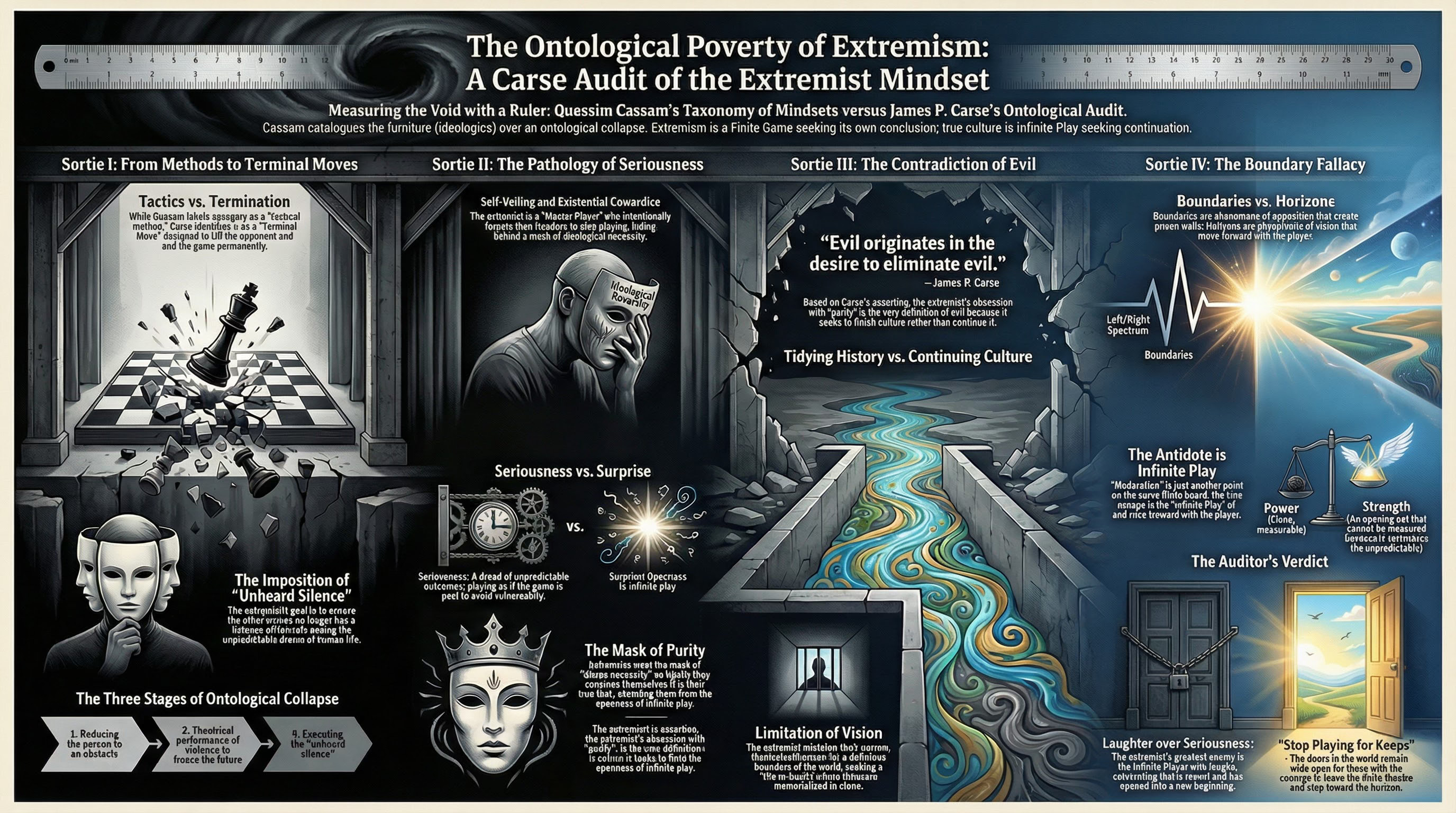
While Cassam relies on a “Pedestrian Taxonomy” that categorises extremism by superficial markers—defining it through the “methods” of savagery, “ideological” positions on a Left/Right spectrum, and the “psychological” rigidity of a dogmatic mindset—Carse pierces this illusion to reveal a deeper “ontological reality.” Where Cassam views violence merely as a tactical method, Carse exposes it as the “terminal move”: a chilling play designed not to score points, but to absolutely eliminate the opponent as a player and impose permanent silence. Furthermore, while Cassam focuses obsessively on boundary maintenance and finding an actor’s exact place on an ideological line, Carse argues that this line exists solely to prevent broader vision, trapping individuals in finite play governed by strict temporal and spatial limits. Ultimately, the auditor’s final verdict exposes the greatest flaw in Cassam’s framework: where Cassam sees merely a rigid psychological mindset, Carse identifies a Master Player engaged in “Self-Veiling and Seriousness”—a deliberate choice to forget their own freedom to step off the field, hiding behind a manufactured mask of necessity to avoid the vulnerability of surprise.
While Cassam is occupied with the “process of radicalisation,” he overlooks the more pressing reality: the extremist is not a player who has gone too far, but a person who has dedicated himself (or herself, though less frequently) to the absolute termination of play itself.
Sortie I: The Terminal Move
Cassam’s analysis of “methods extremism” lingers on the “extraordinary cruelty” of ISIS, specifically the sadistic execution of the Jordanian pilot Muad al-Kasasbeh. He categorises this as a “method of savagery,” as if it were merely a particularly sharp tool in a political kit. However, in the light of Carse, these are not “methods”; they are Terminal Moves. As Carse notes,
“A finite game must always be won with a terminal move... The winner kills the opponent.”
The extremist’s use of “savagery” is designed not to participate in a shared history, but to ensure that the opponent ceases to be a player entirely.
The “So What?” layer reveals a staggering depth of failure in Cassam’s focus. By treating terrorism as a “method,” Cassam suggests it is a move within a recognisable, albeit brutal, political game. Carse teaches us that weapons are the negation of play. The extremist does not want to win a title—the “Caliphate” or the “Master Race”—for the sake of the game; they want the title so they can declare the game over. The silence ISIS sought to impose on al-Kasasbeh was not just physical death, but what Carse defines as the “unheard silence”—the loss of listeners for a voice. The extremist’s goal is to ensure the other’s voice no longer has a listener, thereby ending the “drama” of life and history.
The Stages of Ontological Collapse
- The Reduction of the Person to an Obstacle: The “other” is stripped of their status as a person in passage and reduced to a mere spatial limit on a finite field.
- The Theatricality of Terminal Slaughter: The performance of violence (the “cage,” the “petrol”) is scripted for an audience to freeze the future into a finished, unchangeable past.
- The Imposition of the Unheard Silence: The final execution where the extremist attempts to eliminate the very possibility of response, ensuring the “unlikeness” of the other is permanently silenced.
Cassam’s analysis is a study of the extremist’s actions, yet it ignores the pathology that governs them: the terminal dread of an open future.
Sortie II: The Pathology of Seriousness
In his fourth chapter, Cassam attempts to define the “extremist mindset” as uncompromising. He is correct, in a rather pedestrian sense. But he misses the existential cowardice at the heart of this “seriousness.” Carse defines Seriousness as a dread of the unpredictable outcome of open possibility. The extremist is the ultimate Master Player: one who is so perfectly trained that every move is foreseen, playing as though the game is already in the past.
Cassam’s extremists are “uncompromising” because they have engaged in Self-Veiling. They have intentionally forgotten the voluntary nature of their play and hidden their freedom from themselves. They believe they must act, that they are “forced” by history, ideology or deity. This certainty is not strength; it is a “putative ideal of oppression.” The extremist wears a mask so tightly they have convinced themselves the mask is their face. This theatrical script shields them from the “surprise” essential to infinite play.
The Contrast
The Moderate is often merely a finite player with a less intense script, yet still trapped in the “seriousness” of seeking a specified outcome. The Master Player (the extremist) is a finite player who has perfected the art of self-deception, believing their theatrical role to be an immortal necessity, for the sake of divine justice for which he is the divine embodiment. Both are ontological failures, for neither recognises that play is always a choice.
The extremist’s obsession with “purity” is merely a desperate attempt to seal the mask against the intrusion of the other.
Sortie III: The Contradiction of Evil
Cassam identifies “purity”—racial, religious, or ideological—as a central preoccupation of the extremist mindset. From the Carse’s perspective, this is the very definition of Evil. As Carse asserts,
“Evil originates in the desire to eliminate evil.”
The extremist attempts to “tidy up history,” to force a “sensible conclusion” to the narrative of human existence.
By seeking purity, the extremist seeks to establish an absolute boundary that silences the “voice of the other” into an unheard silence. This is the supreme contradiction: the extremist believes they act for the “Good,” but because they seek to end the play of others, they embody evil. They do not want to continue a culture; they want to finish it.
The Findings on Extremist Evil
- The Desire to Tidy History: The attempt to force an open narrative into a scripted finale or a “classless society.”
- The Theatricality of Immortality: The extremist seeks a “life in death” where their titles are memorialised in stone, rather than lived in play.
- Limitation of Vision: The extremist suffers from an incompleteness of vision, mistaking their narrow horizon for a definitive boundary.
- Limitation of View: The extremist fails to see that the horizon moves with the player; they instead believe they have reached the edge of the world, the end history, the end of life.
Cassam’s mapping of these ideologies fails because he views them on a spatial plane, missing the horizonal truth.
Sortie IV: The Boundary Fallacy
The most significant failure in Cassam’s work is his reliance on “spatial mapping”—the Left/Right spectrum. Cassam treats these positions as if they are geographically real. Carse, however, reminds us that Boundaries are phenomena of opposition, while Horizons are phenomena of vision. Cassam’s “Positional Extremism” merely validates the boundaries of a finite society.
Moderation is not the antidote to extremism. A “moderate” is simply someone playing closer to the centre of the same finite game, equally obsessed with the “theatricality of power.” The only escape is Infinite Play—or what Carse calls Culture. While the “Boundary” (Cassam’s Left/Right spectrum) offers only opposition, the “Horizon” moves with the player, inviting the “surprise” that the extremist so dreads. Cassam’s extremists are pathetically weak because they rely on power—a finite, measurable quantity—whereas true strength cannot be measured because it is an opening, not a closing, act, like life itself.
The Final Verdict
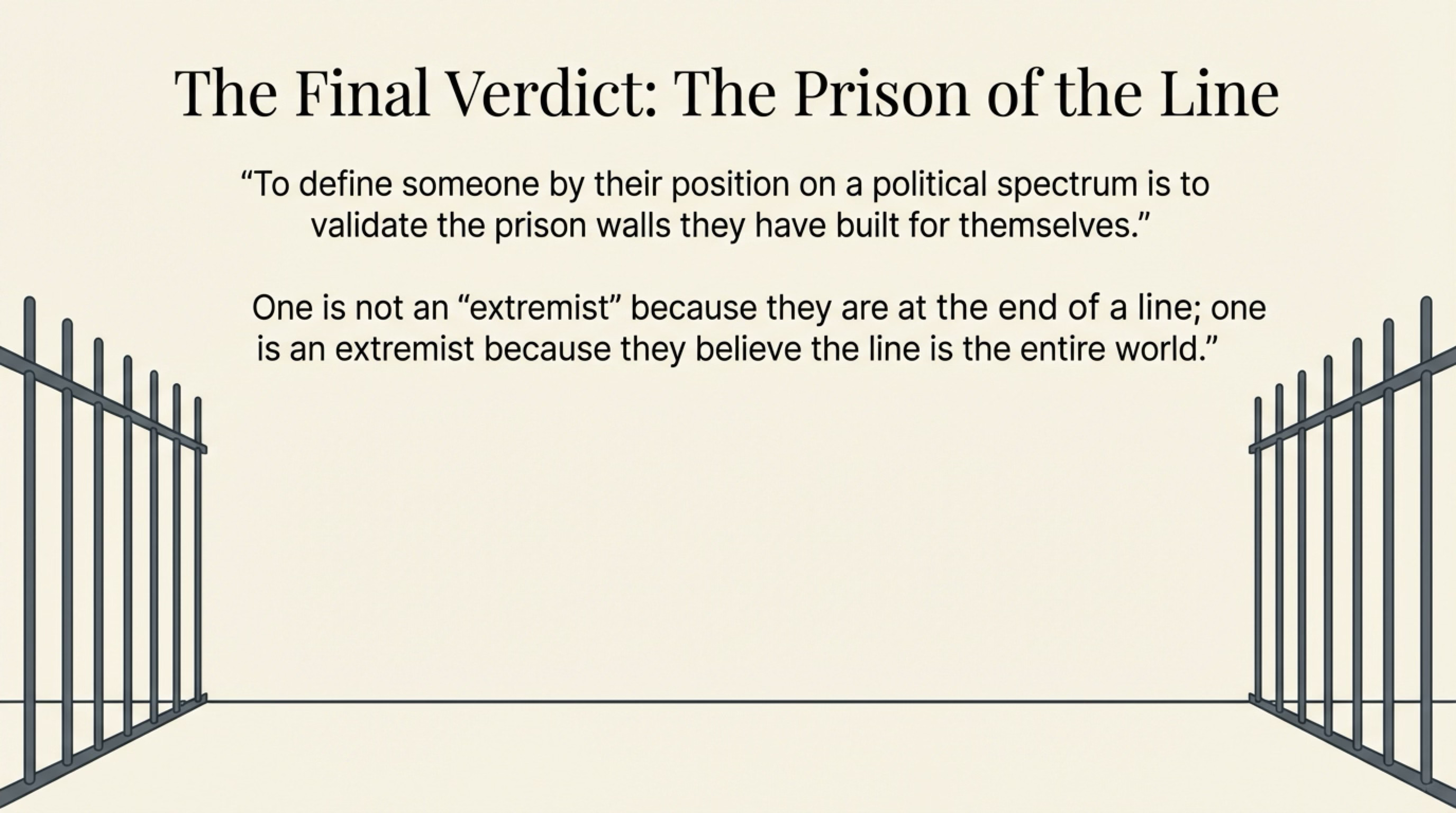
- The Futility of Spectrums: To define someone by their position on a political spectrum is to validate the prison walls they have built for themselves. One is not an “extremist” because they are at the end of a line; one is an extremist because they believe the line is the world.
- The Primacy of the Horizon: True strength lies in the ability to move toward the horizon, where nothing is scripted. Cassam’s extremists are obsessed with power because they are terrified of strength. They seek to settle history; the strong carry it forward.
- The Necessity of Laughter over Seriousness: The extremist’s greatest enemy is not the moderate, but the Infinite Player who laughs. Seriousness is a dread of the unpredictable; laughter is the celebration of the fact that the end we feared has unexpectedly opened into a new beginning. Life continues, with or without him (or her).
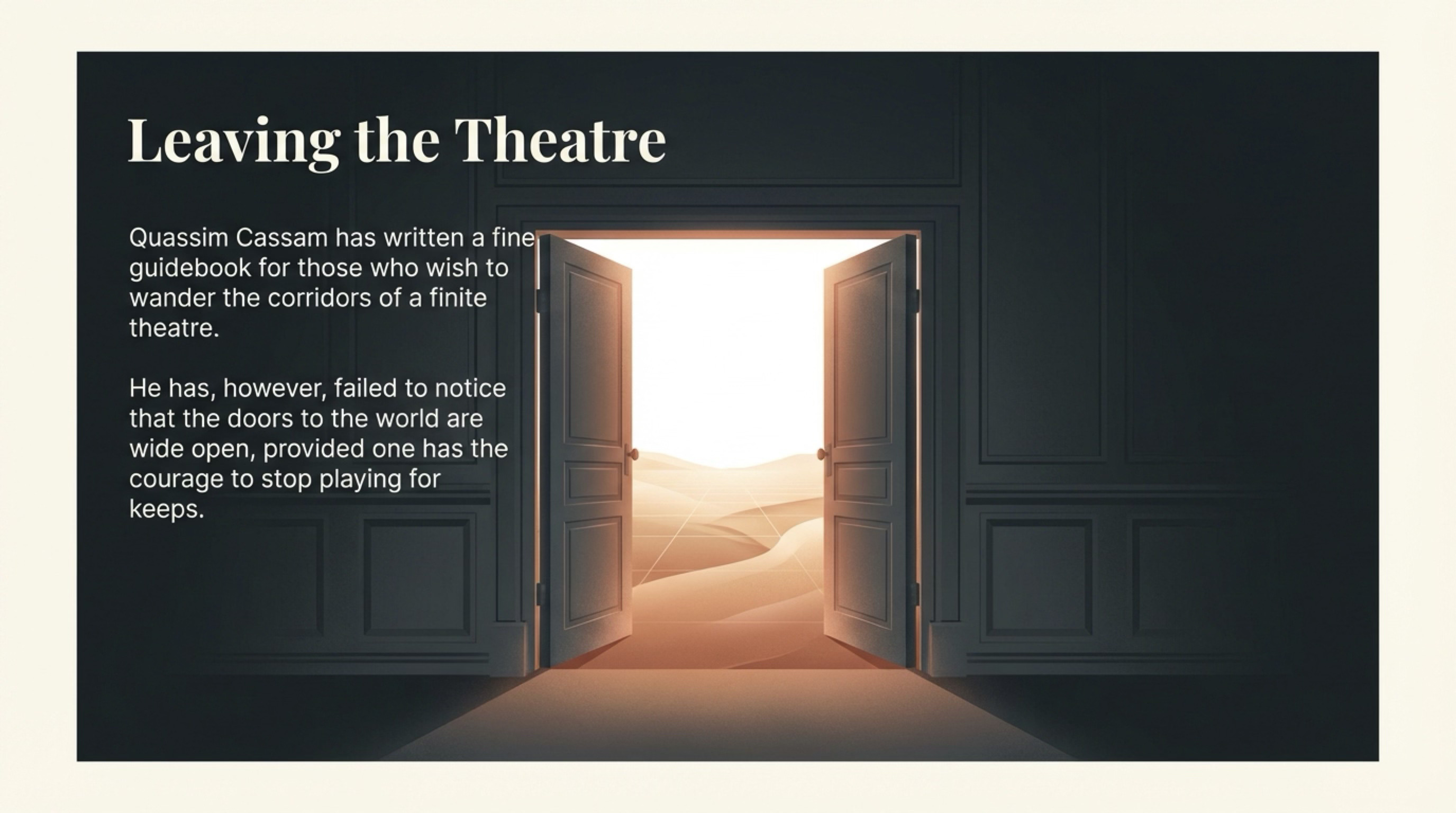
Quassim Cassam has written a fine guidebook for those who wish to wander the corridors of a finite theatre; he has, however, failed to notice that the doors to the world are wide open, provided one has the courage to stop playing for keeps.
For the comprehensive list of references used to rigorously analyse Cassam’s book, please see the foundational introductory text “The Anatomy of Extremism: Quassim Cassam’s Framework.”