The München Security Report as Shamanism
15 February 2026
How to Explain Everything and Learn Nothing
There are reports that are merely wrong, and then there are reports that are worse: those that are wrong in the manner of a priesthood, wrong with the self-protective certainty of people who have mistaken their status for an argument. The München Security Report 2026 (MSR)—solemnly titled Under Destruction—belongs to this second and more contemptible category. It does not offer analysis so much as it offers incense: a fog of portentous metaphor, waved over the reader as if the mere choreography of alarm could substitute for an explanation.
This is my second essay on MSC 2026. The first dealt with Marco Rubio’s speech and the revival of the America System. This one addresses the idea behind the event as stated in its founding report: a conceptual core so threadbare that it amounts to catastrophic intellectual poverty. The report’s central device—“wrecking-ball politics,” wrapped in the grander shroud of Under Destruction—is not a theory. It is a mood. And moods, however theatrically narrated, do not explain the world. They merely certify the temperament of those who write them.
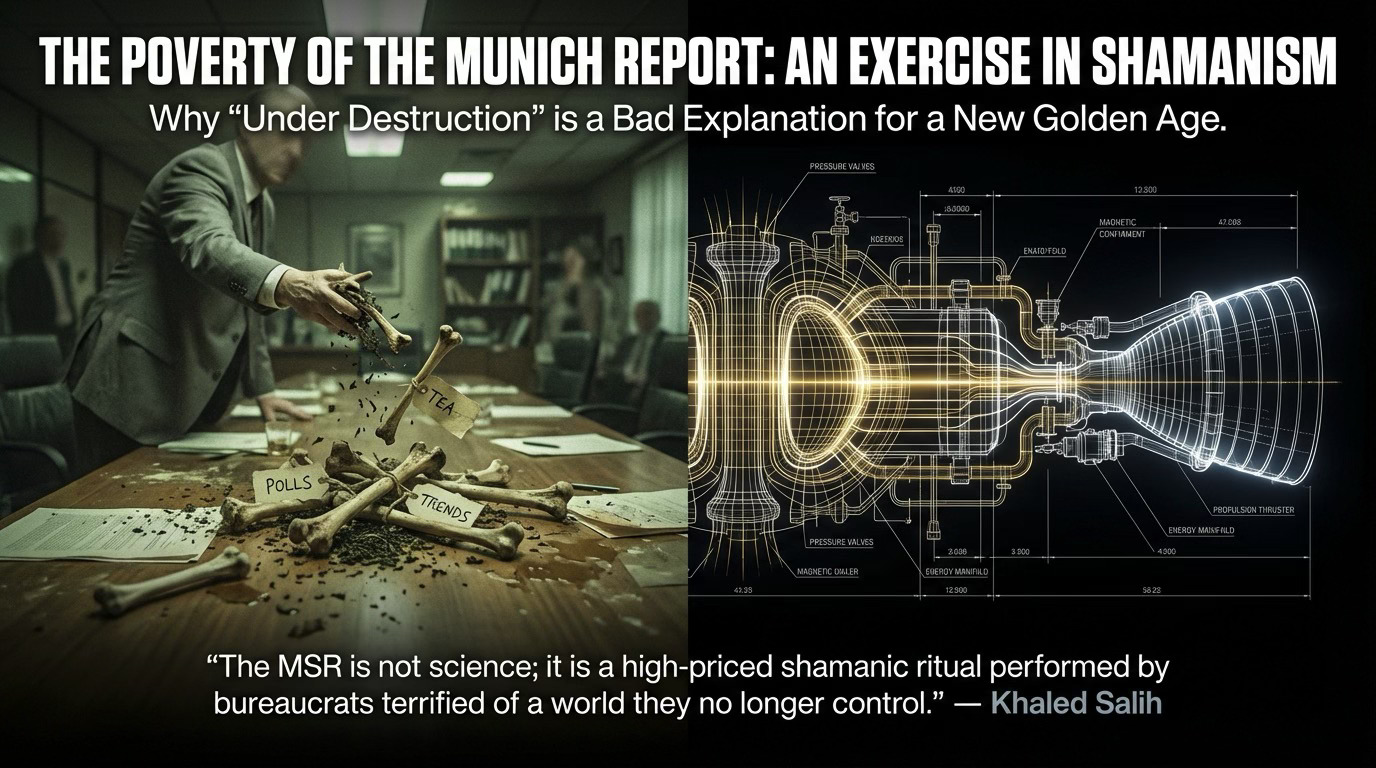
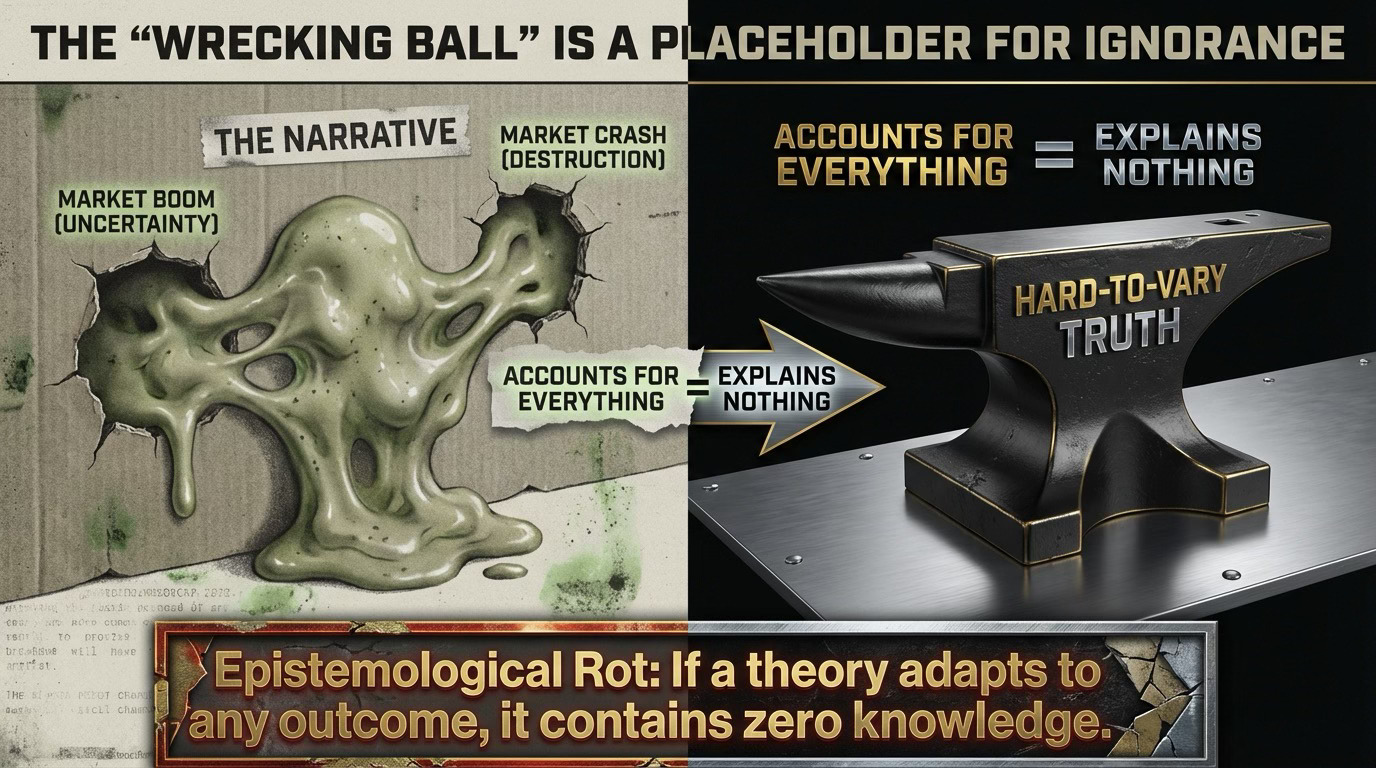
In any serious tradition of inquiry—Popper’s, for example, or the Deutschian standard of the Good Explanation—an explanation earns its keep by being hard to vary: every part does real work, and you cannot casually swap details without breaking the account of reality. MSC 2026 Teport does the opposite. It is infinitely adjustable. When markets surge, it rebrands it as “uncertainty.” When indices climb, it renames it “imminent destruction.” When nothing fits, it broadens the metaphor until everything fits—at which point, naturally, it explains nothing at all. This is not scholarship (both authors are PhD-holders in political science); it is a high-priced ritual performed by bureaucrats terrified of a world they no longer control.
The true obscenity is that the report’s vagueness is not an accident—it is the point. Under Destruction is a placeholder for ignorance that cannot be falsified and therefore cannot be corrected. It immunises a failing consensus from the very criticism required to improve it. And having first evacuated the substance, it then fills the vacuum with prophecy: forecasts of “avoidable deaths,” a Malthusian gloom, and the familiar “Spaceship Earth” fallacy—human beings recast as passive cargo on a sealed vessel, rather than as the universal explainers who transform death-traps into habitable worlds by creating knowledge.
What follows is an autopsy of that fraud: how a report that postures as “strategic” ends up as an obituary for an era of bad philosophy; how it turns metaphor into mechanism, pessimism into posture, and ambiguity into authority; and why Under Destruction fails as an explanation precisely because it is designed to never be wrong—only ever repeated.
The Epistemological Fraud of “Wrecking-Ball Politics”
In the rigorous landscape of critical rationalism, the gold standard for any theory is the Good Explanation. As defined by the Deutschian framework, a good explanation is hard-to-vary because every detail plays a functional, non-negotiable role in accounting for the phenomena. When an explanation is easy-to-vary—when its details can be shifted without changing its conclusion—it contains no knowledge; it is merely a placeholder for ignorance. The München Security Report’s (MSR) central metaphor of “wrecking-ball politics” is a textbook example of such a bad explanation. It is a pathetic, infinitely flexible narrative designed to accommodate any possible observation. When the U.S. stock market booms or industrial indices skyrocket, the MSR’s authors do not revise their theory; they simply re-label growth as “uncertainty” or “imminent destruction.” This is not science; it is a high-priced shamanic ritual performed by bureaucrats terrified of a world they no longer control.
This manoeuvre mirrors the epistemological rot found in any system that relies on “pure instructions” without an articulated why.
The “Matauranga Māori” concept of “Mauri”—a spiritual life force—functions as a bad explanation because it is easy-to-vary. It claims a spiritual essence exists in all living things, yet it provides no functional code or causal reason for how this force operates; it is a “pure instruction” that acts without articulating why. The MSR’s “wrecking ball” is the geopolitical equivalent of vitalism. It is a narrative tool that accounts for everything while explaining nothing, shielding the observer’s bias from the corrective force of reality.
Ultimately, this analytical failure serves to protect the status quo by insulating it from criticism. By crafting a metaphor that cannot be falsified by evidence, the MSR abandons the pursuit of truth to engage in the preservation of a failing consensus. It is a document of bad philosophy, intended to sabotage debate and prevent progress by settling into a fixed, unchanging worldview of managed decline.
The Prophecy Trap
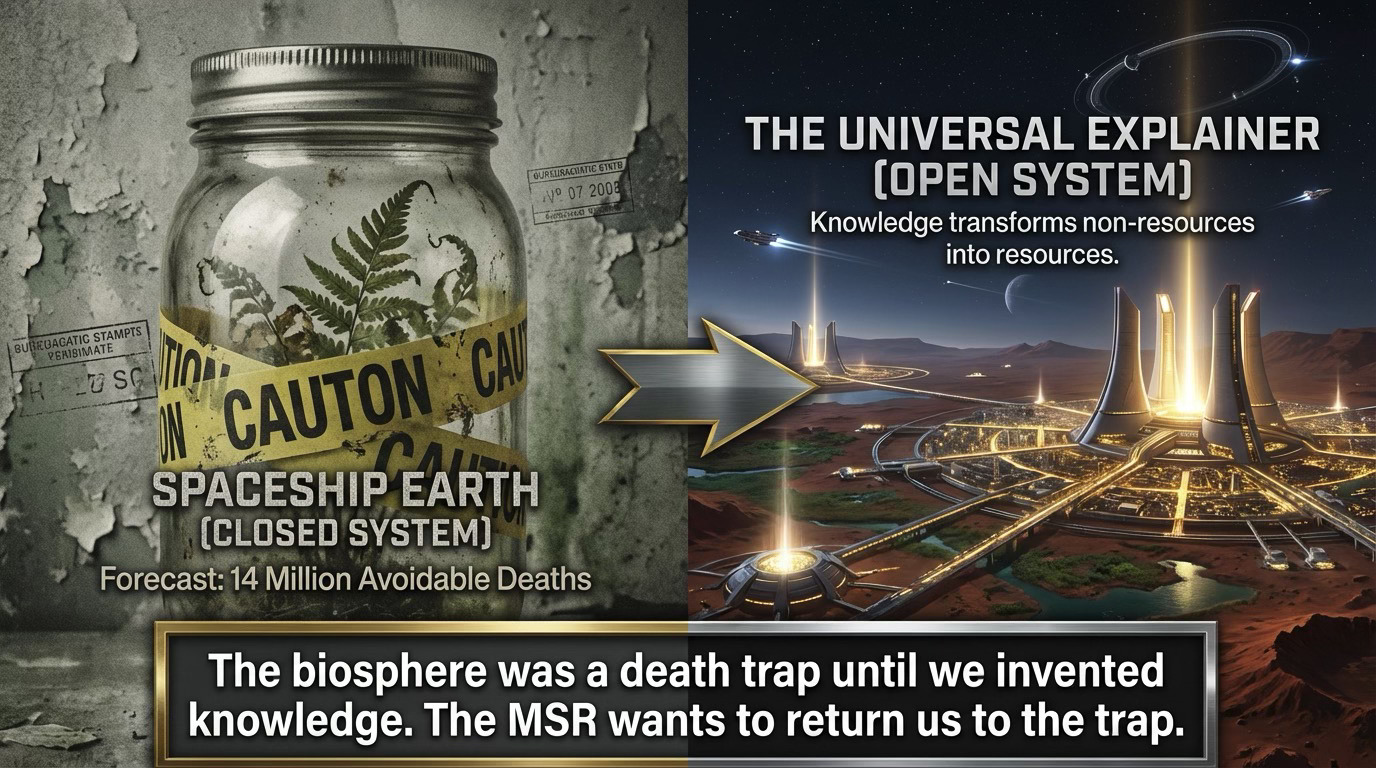
The München Security Report is a pathetic exercise in clairvoyance, stumbling blindly into the Prophecy Trap. It fails to distinguish between “Prediction”—a logical deduction derived from a hard-to-vary explanatory theory—and “Prophecy,” which is the fraudulent attempt to know the unknowable future of knowledge creation. When the MSR forecasts “14 million avoidable deaths,” it is engaging in a Malthusian prophecy that treats human beings as passive victims of resource allocation. This outlook is a total denial of our status as “universal explainers.”
As universal explainers, there is nothing beyond human capacity to create, to understand, or to control, with the only limitations being the laws of physics. The MSR’s pessimism is rooted in the Spaceship Earth fallacy, which views the global order as a fragile, closed life-support system. In reality, the primeval biosphere was a “death trap” for humans; it was only through the creation of explanatory knowledge that we transformed an inhospitable environment into a support system. By ignoring the New Golden Age of production, the report treats the West as a “garden” to be tended rather than a frontier to be expanded. It denies human creativity, failing to see that all evils—including the “resource scarcity” the MSR mourns—are merely the result of a lack of knowledge.
The Historicism Fallacy
The MSR relies heavily on “inductivism”—the fundamental error that we can derive universal laws from repeated observations of temporary trends. This is the core of Explanationless Science, where the report uses opinion polls and trade deficits to predict civilisational collapse. This is what Karl Popper identified as Historicism: the confusion of contingent, temporary trends with immutable laws of history. The MSR views the “liberal international order” as a holy writ, confusing the British Imperial System of financialisation and managed decline with the universal requirements of civilisation.
To understand the rot at the heart of the MSR, one must contrast its “British” Malthusian logic with the American System of sovereign production:
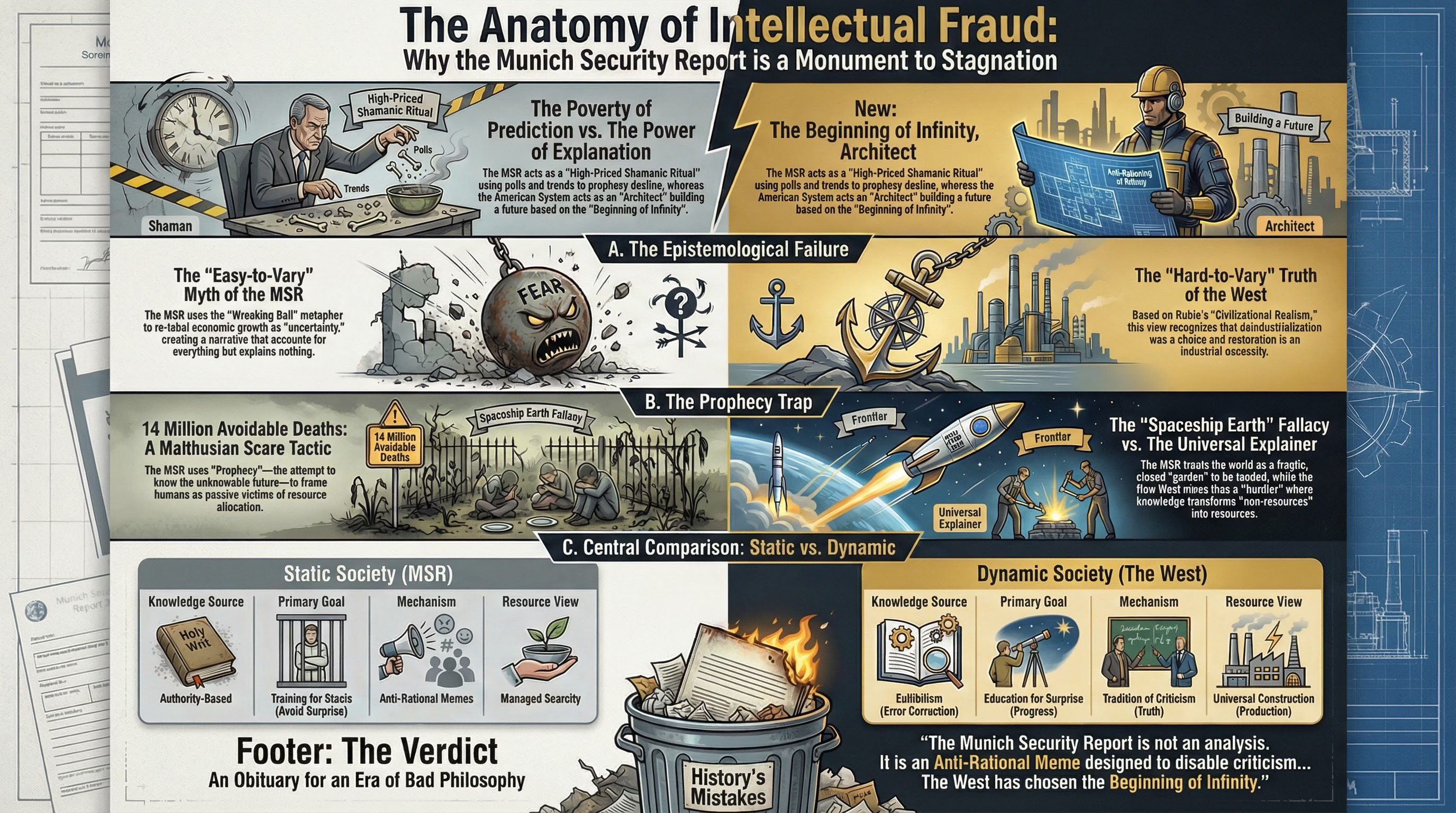
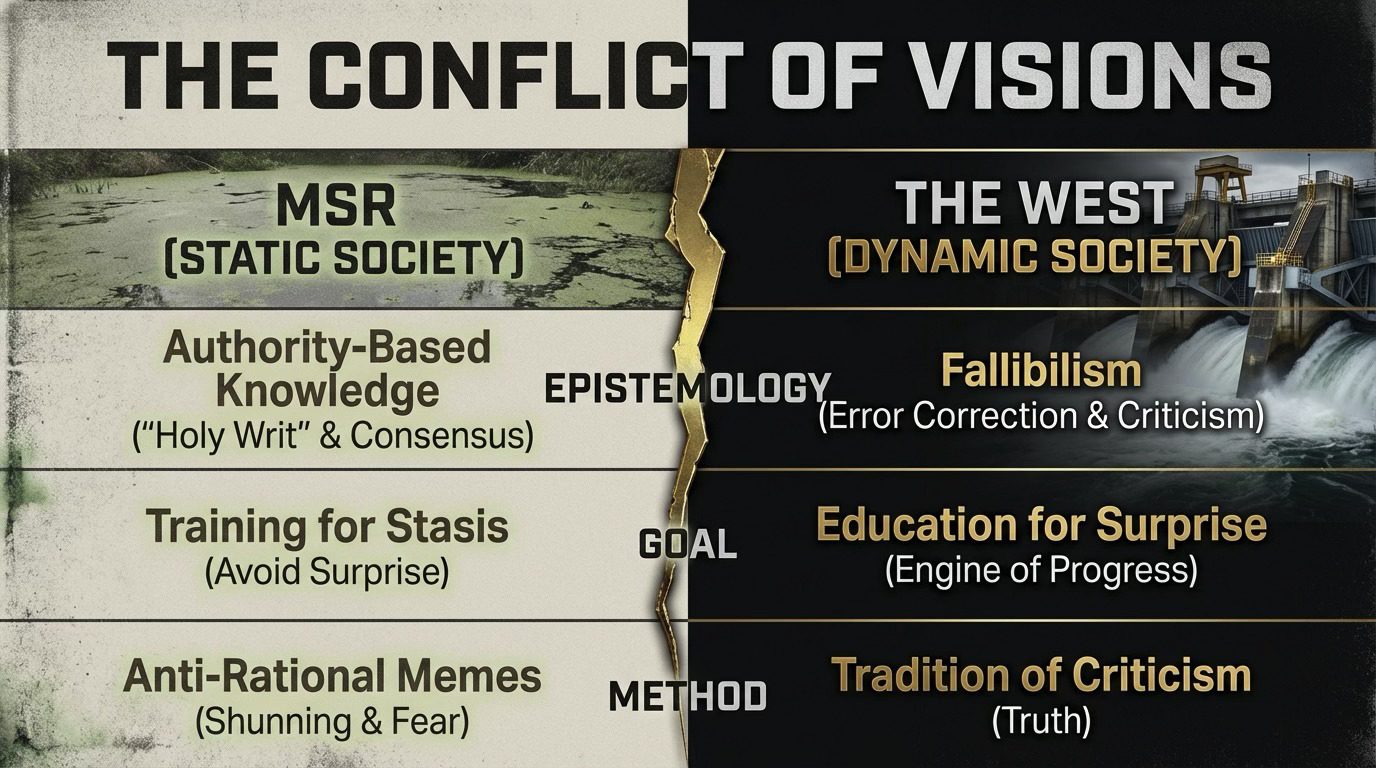
Static Society vs Dynamic Society
Static Society Thinking (MSR)
- Authority-Based Knowledge: Views existing international rules and elite consensus as “holy writ.”
- Training for Stasis: Focuses on avoiding “surprise” and maintaining a fixed global hierarchy.
- Anti-Rational Memes: Uses fear and “shunning” to disable the critical faculties of the populace.
- Managed Scarcity: Follows Net Zero ideologies that restrict energy and industrial growth.
Dynamic Society Thinking (The West)
- Fallibilism: Recognises that all knowledge is tentative and open to relentless criticism.
- Education for Surprise: Views new problems as the engine of progress and civilizational “play.”
- Tradition of Criticism: Depends on the systematic detection and elimination of errors.
- Universal Construction: Understands that knowledge transforms “non-resources” into resources.
The MSR’s defense of the “liberal international order” is actually a defence of a static society that has lost its capacity for error correction. It represents the “Wilsonian fantasy” of mannered diplomats who believe history can be negotiated out of existence by the correct mixture of acronyms, while the American System returns to the hard reality of “blood and treasure.”
The Anatomy of an Anti-Rational Meme
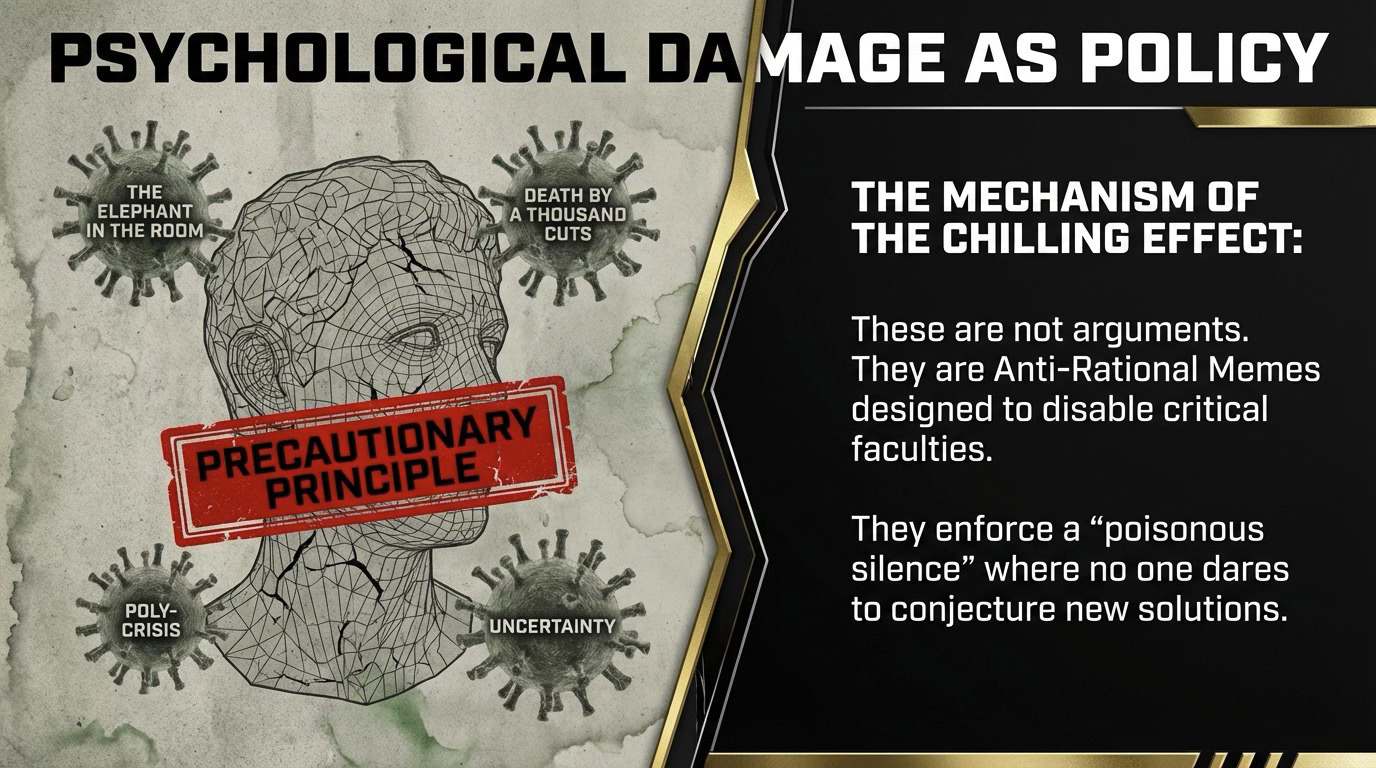
The München Security Report functions as a vehicle for Anti-Rational Memes—ideas designed to replicate not because they are true, but because they disable the recipient’s critical faculties through psychological entrenchment. These memes operate by inducing fear and social pressure to enforce conformity. The MSR is saturated with “scare tactics”—phrases like the “Elephant in the Room” and “Death by a Thousand Cuts”—which are not arguments but “psychological damage” intended to make the holder less susceptible to rival ideas.
This is the manifestation of the Precautionary Principle, a form of justificationist prophecy that regards the “unknown” (the return of sovereign U.S. policy) as inherently dangerous while ignoring the catastrophic failures of the “known” systems. By painting every departure from their failed post-Cold War consensus as a “wrecking ball,” the authors attempt to forbid the very criticism needed for renewal. This is a “poison for the West.” It enforces a “chilling effect,” ensuring that no one “sticks their head above the parapet” to conjecture a better way forward, thereby choking off progress by making error-correcting mechanisms ineffective. The report’s primary goal is to ensure that the powerful person is accepted as the “authority by definition,” a return to the stasis that characterised most of human history.
The Betrayal of Optimism
The München Security Report 2026 is a document of Blind Pessimism. It represents a total betrayal of the Principle of Optimism—the objective truth that all evils are due to a lack of knowledge and that all problems are soluble. While the report mourns the loss of the “East Wing” of its globalist manor, it ignores the Beginning of Infinity standing right outside its door.
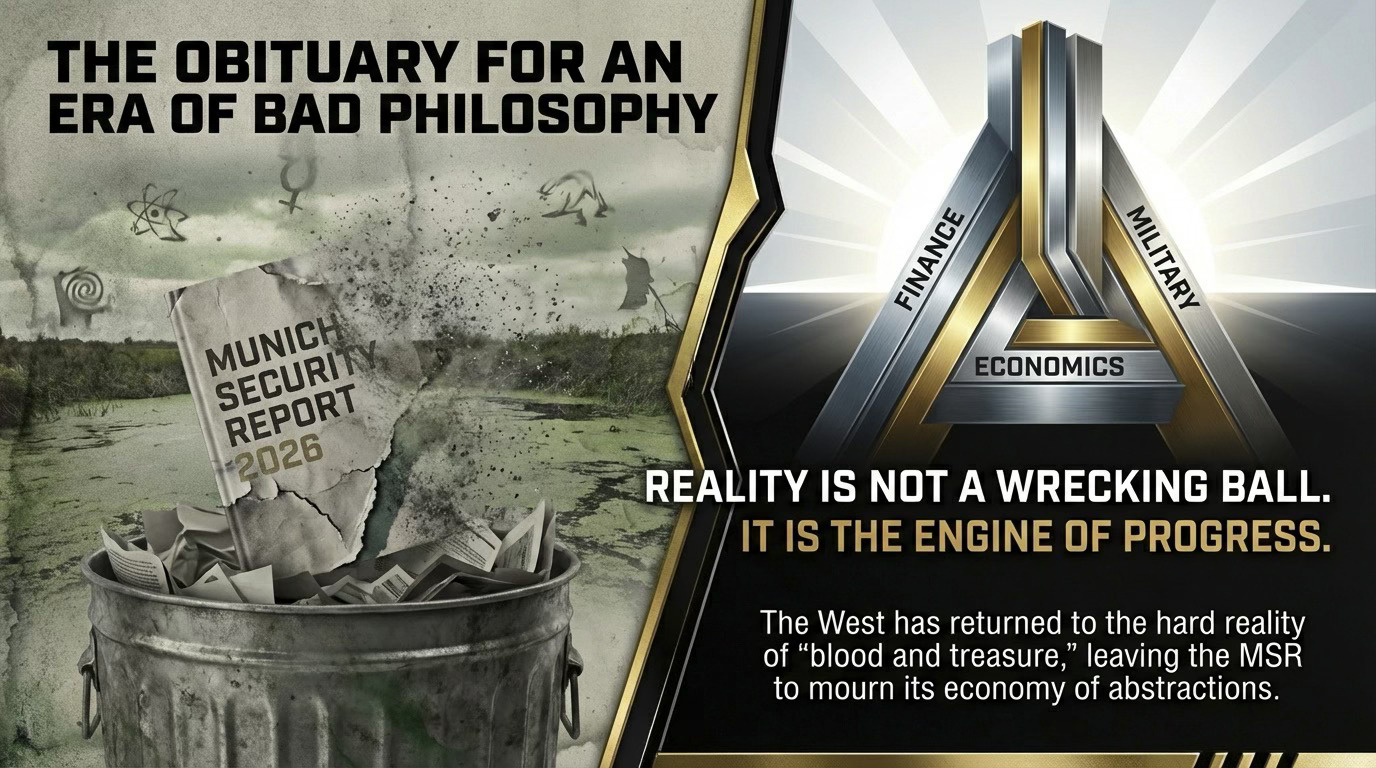
The authors of the MSR prefer “familiar problems” over “new solutions” because they value stasis over truth. They see the “Triad of Power”—the fusion of economics, finance, and military lethality—as a threat to the “garden” they have spent decades mismanaging. In reality, this triad is the restoration of the American System, moving from an economy of abstractions to an economy of real things: production, energy dominance, and sovereign strength. The München Security Report 2026 is not a strategic document; it is an obituary for an era of bad philosophy that has finally encountered the hard reality of the universal explainer and the undeniable return of the American Republic.
Sources:
Tobias Bunde and Sophie Eisentraut (eds.), Munich Security Report 2026: Under Destruction. München, München Security Conference, https://doi.org/10.47342/JWIE5806
David Deutsch, 2011, The Beginning of Infinity: Explanations that Transform the World. New York, New York: VIKING (Published by the Penguin Group).


