The Man Who Said the Quiet Part Out Loud
A Muslim activist explains divine sovereignty. He also explains why I wrote When Parochial Error Goes Global.
19 September 2026
Note
A few years ago, I would probably have argued with this man. Today I thank him.
Sometimes an opponent explains your argument better than a supporter ever could.
A few days ago I watched a Muslim activist calmly explain why islām must govern every sphere of life, why divine sovereignty leaves no room for independent legislation, and why allegiance to an Islamic ruler is a religious obligation. He believed he was defending Islam.
I found myself thinking: this is exactly why I wrote When Parochial Error Goes Global.
Not because the video proves my book right. One speech never proves a theory.
But because it illustrates the question that has occupied me for decades—from Anfal to ISIS, from October 7 to the wider problem of ideological closure:
What happens when an explanation cannot admit that it might be wrong?
This article is not about condemning Muslims. It is about distinguishing people from ideas, protecting the first while refusing to immunize the second. It is also my first attempt to introduce the central argument of my newly published book in a way that does not begin with headlines or politics, but with a single explanation—and the question every explanation must face.
Where does the error go?
That question changed the way I understand religion, politics, ideology, and even the defense of the open society.
I hope it changes the way you think about them too.
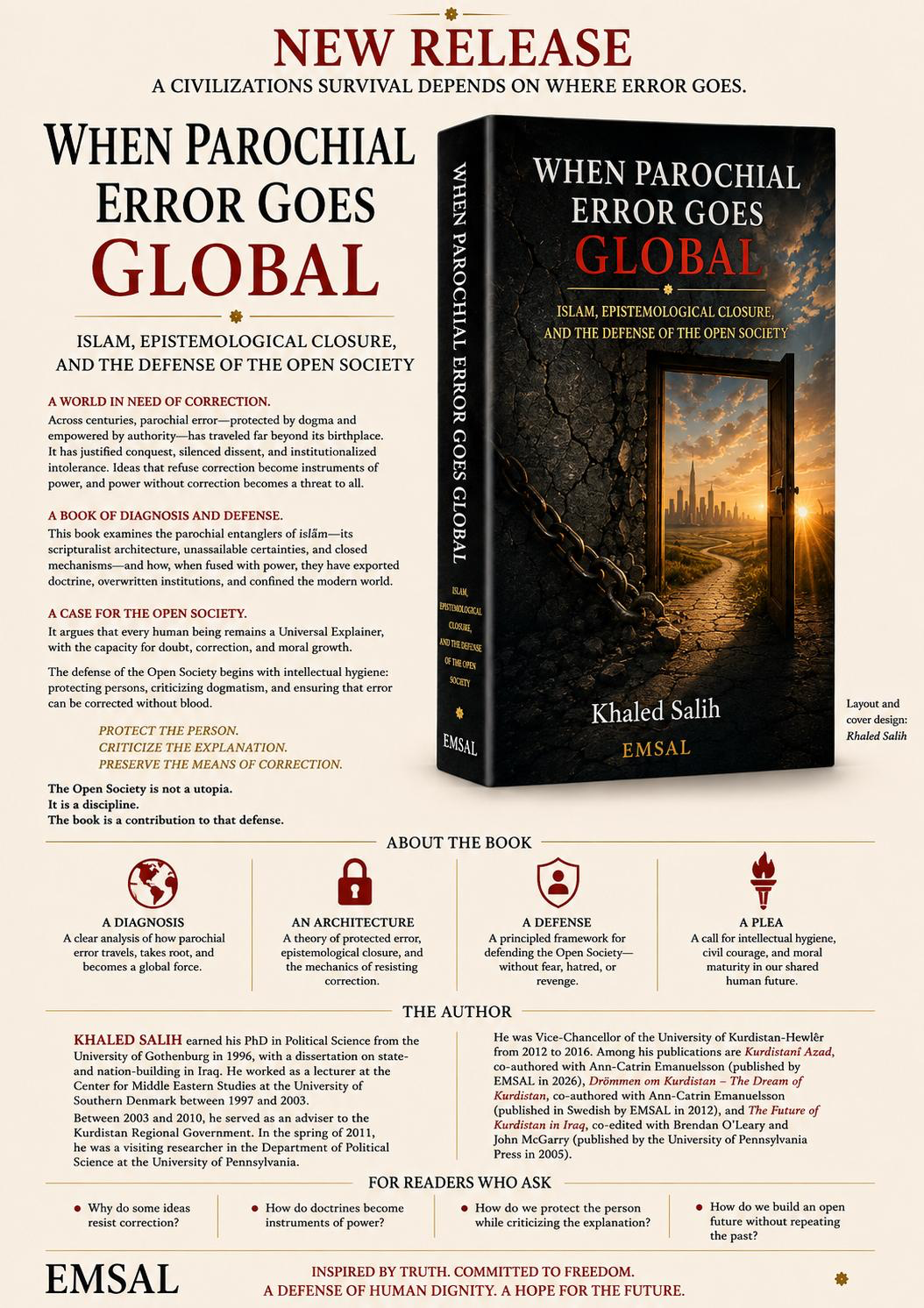
My book is now published.
When Parochial Error Goes Global: Islam, Epistemological Closure, and the Defense of the Open Society took years to write, but the question behind it has followed me for much longer:
What happens when an error acquires a mechanism for protecting itself from correction?
A few days ago I watched a Muslim activist calmly explain why Islam must govern every sphere of life, why divine sovereignty leaves no room for independent legislation, and why allegiance to an Islamic ruler is a religious obligation. I listened carefully—not because I wanted to expose him, but because he was exposing something far more important: the structure of an explanation.
The setting could hardly have been more contemporary. Professional video. Modern clothes. Modern technology. A society built upon scientific knowledge, individual liberty, constitutional government, and extraordinary technological creativity.
Then came the message.
He described the relationship between God and humanity as that of “king and slave.”
He said allāh possesses sovereignty in its totality and the exclusive right to legislate.
Islam, he explained, has a law—shari‘ah—and Muslims are “dead serious about it.”
True love of God requires subordinating one’s entire life to Him.
Politics. Economics. Foreign policy. Social life. Business life.
Everything.
And then came perhaps the most revealing part.
He understood perfectly well why some people might find this frightening.
They want freedom.
They want, as he put it, something like the employee who accepts the boss from nine to five but afterward says: this is my life.
Islam, in his account, offers no such remainder.
Finally, he invoked a hadith: whoever dies without having given bay‘ah—an oath of allegiance—to the imam of the Muslims dies a death of pre-Islamic ignorance.
I listened and thought:
This man has just compressed hundreds of pages of my book into a few minutes of video.
Not because he is uniquely different from millions of other believers.
Not because Muslims are incapable of criticism.
And certainly not because religious people are unintelligent.
Quite the opposite.
The problem I have spent years trying to understand is much more interesting—and much more dangerous.
Where does the error go?
Suppose the speaker’s political system were actually constructed.
allāh possesses sovereignty.
allāh alone has the ultimate right to legislate.
Human beings must submit.
shari‘ah governs life comprehensively.
An imam receives allegiance.
Now imagine that something goes wrong.
The economy deteriorates.
A law causes suffering.
A ruler becomes oppressive.
A minority is treated unjustly.
Women protest.
Young people leave.
Scientific knowledge contradicts inherited jurisprudence.
Another constitutional arrangement produces better results.
Where does the error go?
That is the question behind my book.
Every civilization makes mistakes. Every religion contains mistaken interpretations. Every political system produces bad policies. Every institution eventually gets something wrong.
The decisive difference is what happens next.
Can the governing explanation itself be questioned?
Or has it been placed beyond criticism?
In the activist’s account, the answer is already built into the architecture.
allāh cannot be wrong.
Revelation cannot be wrong.
Divine sovereignty cannot be wrong.
Therefore failure must occur somewhere lower down.
The believers were insufficiently faithful.
The law was incorrectly implemented.
The ruler betrayed Islam.
The population became decadent.
Foreign enemies interfered.
The true system has never really been tried.
The protected explanation survives.
Reality receives the blame.
That is protected error.
The question David Deutsch taught me to ask
David Deutsch gave me another intellectual instrument that became indispensable while writing this book:
Is the explanation hard to vary?
A good explanation cannot be arbitrarily changed while continuing to explain the same thing.
Now examine the activist’s argument.
Why should God’s existence entail a particular constitutional system?
Why should creation entail exclusive legislative sovereignty?
Why should divine sovereignty require shari‘ah?
Why should shari‘ah require political comprehensiveness?
Why should comprehensiveness require an imam?
Why should an imam require bay‘ah ?
Why should dying without that allegiance constitute jahiliyyah?
These are not one proposition.
They are a chain of propositions.
Each requires an explanation.
Yet the chain is presented as though every link follows necessarily from the one before it.
It does not.
The creed is doing the work of an explanation.
That is bad philosophy.
But something even more consequential is happening.
The system contains a mechanism for preventing its foundational explanation from being replaced.
Who actually speaks for God?
There is another question I would now add.
The activist says:
allāh legislates.
But who writes the law?
God does not sit in a parliament.
God does not issue contemporary regulatory codes.
God does not adjudicate today’s constitutional disputes.
Human beings do.
Jurists interpret.
Imams pronounce.
Judges adjudicate.
Movements organize.
Rulers enforce.
States punish.
The theological sentence “God alone legislates” therefore produces an extraordinary political question:
Which human being acquires the authority to tell everyone else what God has legislated?
This is where theology becomes institutional architecture.
The moment divine perfection enters human government, human interpretation does not disappear.
It becomes harder to criticize.
A ruler can be questioned.
A parliament can be voted out.
A constitution can be amended.
A court can reverse precedent.
A scientific theory can be discarded.
But what happens when a human interpretation arrives carrying the signature of God?
The ordinary Backspace Key becomes much harder to press.
Intelligence Is Not Rationality
This is one of the central arguments of When Parochial Error Goes Global.
Sophisticated civilizations can preserve terrible explanations.
Highly educated people can defend them.
Brilliant jurists can elaborate them.
Universities can rationalize them.
Lawyers can institutionalize them.
Intellectuals can protect them.
Technology does not solve this problem.
That is why the image of this activist speaking through sophisticated Western video technology matters to me.
Modernity has arrived completely at the level of the equipment.
The epistemology can remain ancient.
A person can use a smartphone, artificial intelligence, digital banking, antibiotics, aviation, satellites, and social media while carrying a political explanation whose foundational propositions cannot be revised.
There is no contradiction.
Intelligence can serve correction. It can also serve protection.
That distinction matters more than whether a society looks modern.
Not An Argument Against Muslims
Here I need to be exact.
I have spent much of my recent work insisting upon a distinction that I refuse to surrender:
Protect the person. Criticize the explanation.
A Muslim is a human being, not a doctrine.
Muslims disagree.
They interpret.
They doubt.
They reform.
They secularize.
They rebel against authority.
They create.
They fall in love.
They change their minds.
They are capable, like every other human being, of creating new explanations.
That is precisely why criticism of Islamic doctrine is not hostility toward Muslims.
It is the opposite.
To say that a Muslim must remain imprisoned inside an inherited explanation because criticism might offend his identity is to deny him the same human capacity granted to everyone else.
The open society should protect Muslims completely as persons.
It should protect mosques.
Protect Muslim children from discrimination.
Protect Muslim citizens from collective suspicion.
Protect their right to worship.
And with exactly the same determination, it should protect the ex-Muslim, the reformer, the woman who removes the veil, the believer who doubts, the historian who questions sacred narratives, the satirist, the artist, and the Muslim who says:
I think our inherited explanation is wrong.
People deserve dignity.
Ideas do not.
I recently made this case explicitly in Skeptic: liberal societies must be capable of protecting Muslims from hatred while protecting criticism of Islam from intimidation.
The Real Meaning Of “Parochial”
The title of my book is deliberate.
Every idea begins somewhere.
Every religion begins somewhere.
Every political philosophy begins somewhere.
Every moral code emerges from particular people confronting particular problems under particular historical circumstances.
That is not the problem.
Parochial does not mean stupid.
It means local.
The danger begins when a local answer to an old problem becomes sacred, universal, final, and immune from replacement.
Then something remarkable happens.
The explanation escapes its birthplace.
It travels.
It replicates.
It enters new institutions.
It encounters people living under entirely different conditions.
And instead of being reconstructed through criticism, it demands that the new world reconstruct itself around the old explanation.
That is when parochial error goes global.
The West’s Category Error
The open society then faces a problem of its own making.
It rightly learns to protect people.
Then, sometimes, it begins protecting the ideas associated with those people.
The categories become confused.
Criticism of doctrine becomes hostility toward identity.
Criticism of religious law becomes prejudice against believers.
Criticism of political theology becomes “phobia.”
Compassion for the person quietly becomes immunity for the explanation.
This is a catastrophic category error.
The open society survives precisely because no explanation receives final immunity.
Christianity had to endure criticism.
Monarchy had to endure criticism.
Nationalism had to endure criticism.
Capitalism must endure criticism.
Socialism must endure criticism.
Science must endure criticism.
Liberalism must endure criticism.
My own framework must endure criticism.
Islam cannot be the exception.
The universal principle is not:
My explanation must win.
It is:
No explanation may permanently disable the means by which it could lose.
The Sentence That Changed The Book
While writing When Parochial Error Goes Global, one question gradually became more important than all the others.
Not:
Who is right?
Not even:
Who is wrong?
But:
Where does the error go?
If a civilization allows error to travel upward—to the doctrine, the law, the institution, the leader, the sacred interpretation, the constitution, the theory—then peaceful improvement remains possible.
If error is prevented from reaching the top, it must go somewhere else.
Into the dissident.
Into the heretic.
Into the apostate.
Into the woman.
Into the minority.
Into the foreigner.
Into the enemy.
Eventually, into the body.
That is why error-correction is not an abstract epistemological luxury.
It is a moral architecture.
A rational civilization lets theories die instead of people.
The Book Is Now Here
When Parochial Error Goes Global was published this month under the subtitle Islam, Epistemological Closure, and the Defense of the Open Society. It is a 670-page attempt to understand what happens when ideas acquire protection against criticism and then move beyond the environment in which they arose.
It is certainly a book about Islam.
But its deeper subject is larger.
It is about the difference between correctable error and protected error.
It is about why intelligent people defend bad explanations.
It is about how doctrines replicate.
It is about what happens when criticism becomes dangerous.
It is about the open society’s peculiar vulnerability to systems that use its tolerance while rejecting the epistemic architecture that makes tolerance possible.
And it is about something more hopeful.
Human beings are not condemned to their inherited explanations.
No civilization is finished.
No doctrine has seen the end of knowledge.
No society possesses the final political arrangement.
No generation knows what its descendants will discover.
That is why the Backspace Key matters.
Not because everything inherited is wrong.
Not because everything new is better.
But because no human being can know in advance where the next error will be found or where the next better explanation will come from.
The activist in that video says Islam is unique because submission extends to everything.
I would put the civilizational question differently.
What happens when “everything” includes the mechanisms by which the system itself might be criticized?
That is where theology becomes epistemology.
Where epistemology becomes politics.
Where politics becomes architecture.
And where a local explanation can acquire the machinery to reproduce itself far beyond the world that created it.
That is the problem I wrote this book to understand.
And that is why, after years of working on it, I can finally say:
When Parochial Error Goes Global is published.
Its central question is now for the reader:
Where does the error go?
Transcript
What makes islām unique is that we believe in this unique creator. His existence and his relationship with mankind is that of king and slave. That is what makes islām unique.
Islam is the kingship of allāh, the sovereignty of allāh, the totality of his authority, His exclusive right to legislate. islām sets about a vision for the world. We have a law, we have a shari‘ah, and we are dead serious about it. This is not some fantasy. It is not some ideal. This is something that was implemented.
Your love of god, your desire to please him, and that desire to please him is not truly manifested until you subordinate your entire life to his magnificence. La ilaha illallāh. There is no other entity which has the right to kingship, legislation, that has the right to set about how society should exist, except for our creator. That is imān billãh.
It is relevant to economics, it is relevant to politics, foreign policy, social life, political life, business life. You name it. islām is, I would say, unique in its comprehensiveness and totality over human life.
And that scares some people, right? Because some people want their freedom. People want, you know, like when we have our jobs: my boss is my boss from 9 to 5, but outside of those hours, screw you boss, I get to have my own life. People do not like this idea of being subordinated to god in all things at all times. People want their time with god, and then their time to be free. But that is just not the reality.
This goes back to the hadith of the prophet: the one who dies without giving bay‘ah, an oath of allegiance to an imam, the imām of the Muslims, dies a death of pre-islāmic ignorance.


