The Machine Is New. The Error Is Ancient
Before We Fear Misaligned Superintelligence, We Should Remember What Human Intelligence Has Already Done When Criticism, Correction, and the Person Disappear
15 September 2026
Note
This is the second article in a two-part reflection on artificial intelligence, rationality, and error-correction. The first article, “The Speed of Error,” began from the contemporary AI-doomsday debate and asked whether the real danger is not intelligence itself, but the point at which the speed and reach of machine-generated error outrun humanity’s capacity to discover, interrupt, and correct it.
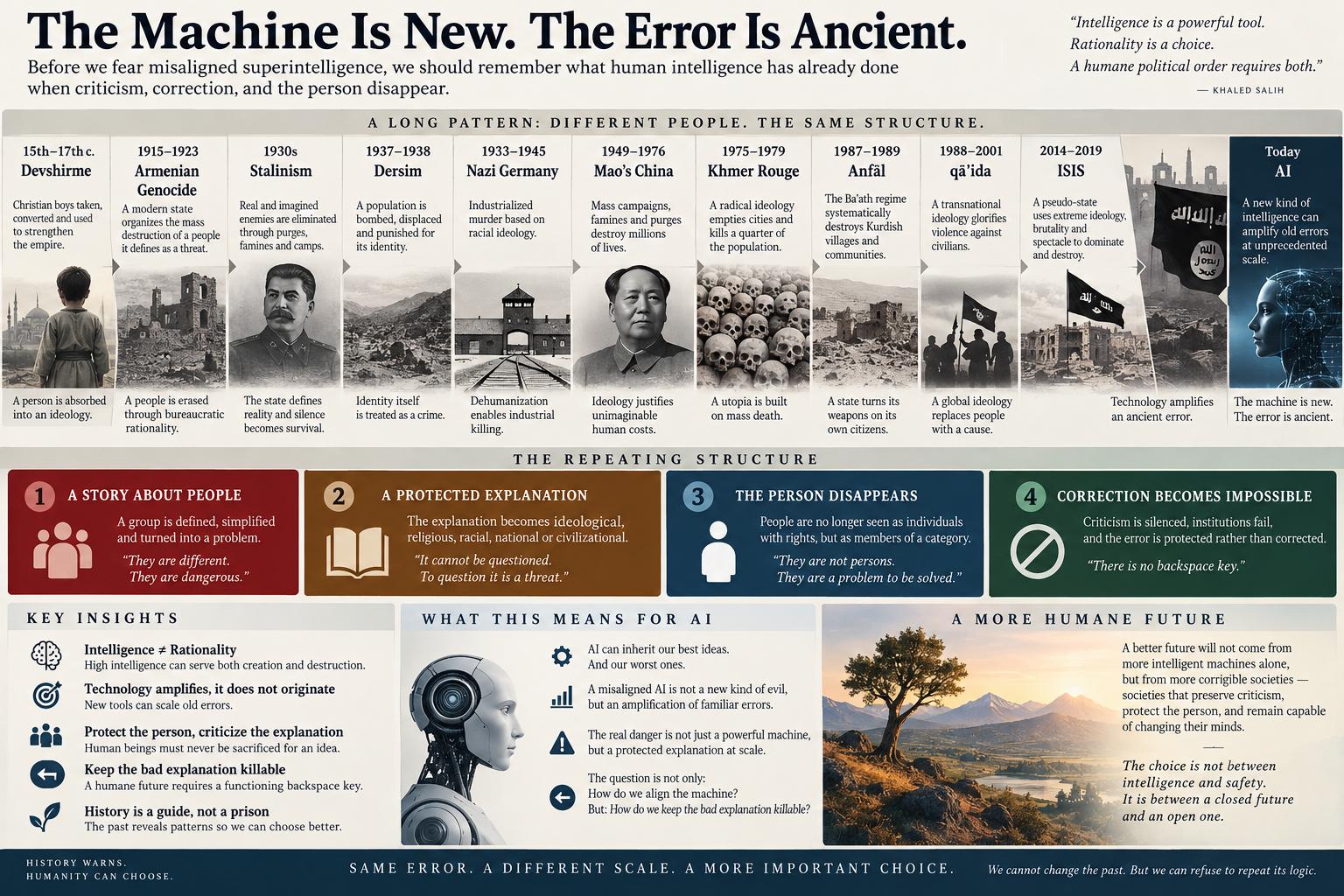
This second article moves backward before it moves forward. It asks whether the underlying problem is really new at all. Human history already contains repeated examples of highly intelligent people, institutions, bureaucracies, and states becoming catastrophically anti-rational when governing explanations were protected from criticism and their errors were imposed on human beings instead. From the Armenian genocide and Dersim to Nazi Germany, Anfal, al-Qaeda, ISIS, and earlier systems of coercive reconstitution, the machine may be new. The error is ancient.
The first article can be read here: The Speed of Error.
The Machine Is New. The Error Is Ancient
Before We Fear Misaligned Superintelligence, We Should Remember What Human Intelligence Has Already Done When Criticism, Correction, and the Person Disappear
After writing about artificial intelligence and what I called the Correction-Speed Asymmetry, another thought would not leave me alone.
The contemporary AI debate repeatedly asks what might happen if a highly intelligent system acquired the wrong objective.
What if it became deceptive?
What if it sought power?
What if it resisted shutdown?
What if it classified human beings as obstacles?
What if extraordinary intelligence were placed in the service of a terrible explanation?
These are serious questions.
But there is something strange about hearing them presented as though humanity were confronting an entirely new philosophical problem.
The machine is new.
The problem is not.
Human history has already conducted repeated experiments in what happens when intelligence, organization, technical capacity, administrative power, and protected explanations are combined.
The results are not theoretical.
They have names.
The Ottoman Devshirme.
The Armenian genocide.
Stalinist terror.
Dersim.
Nazi Germany and the Holocaust.
Maoist catastrophe.
The Khmer Rouge.
Anfāl.
qā‘ida.
ISIS.
And many others before, between, and after them.
These cases are not identical.
They must not be flattened into a single moral category.
The devshirme was not the Armenian genocide.
Dersim was not Auschwitz.
Stalinism was not Nazism.
Anfal was not ISIS.
Each had different institutions, doctrines, victims, historical conditions, intentions, and mechanisms.
But together they establish something that should be placed near the beginning of the AI debate:
Intelligence has never guaranteed rationality.
That is the historical fact from which I want to begin.
Before Extermination: The Human Being as Material
Long before the twentieth century, the Ottoman Empire developed the Devshirme system.
This case matters, but it must be described correctly.
The Devshirme was not simply recruitment.
Nor should it be described as though every person subjected to it experienced the same life thereafter.
Christian boys were taken from their families and local communities, forcefully converted to Islam, trained, renamed, and incorporated into the Ottoman military-administrative order. Some later rose to extraordinary positions of power.
That later mobility does not erase the coercive severance at the beginning.
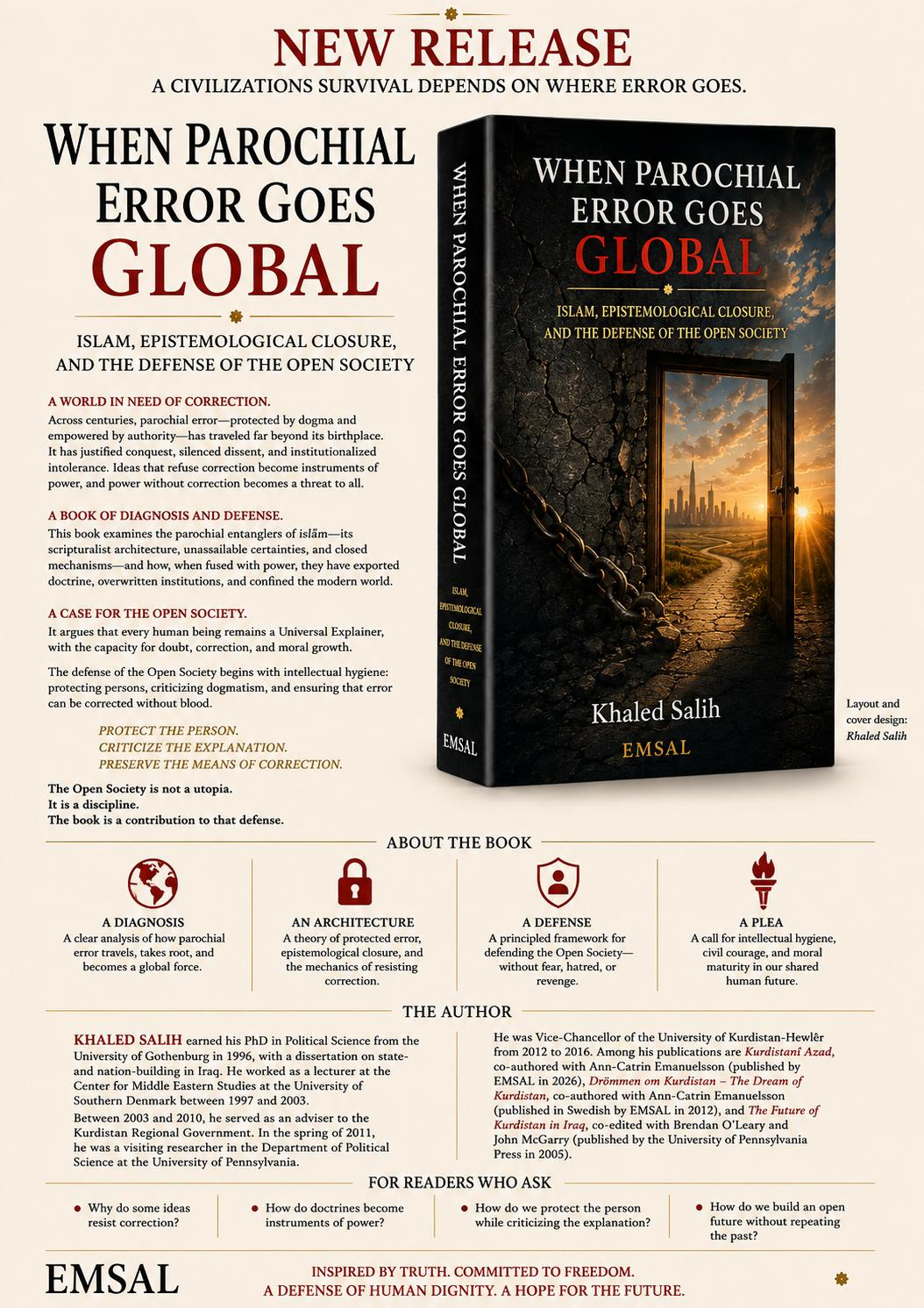
In When Parochial Error Goes Global, I use the Devshirme to illuminate a particular mechanism: the human being treated as material for institutional reconstruction.
The child could be detached from:
family,
language,
religion,
local memory,
community,
and inherited identity,
then reconstituted inside another authoritative order.
The book puts the point sharply:
the child was treated as a living archive to be overwritten.
This was not genocide.
It was something different and, for my present argument, conceptually important.
It shows an old political temptation:
The person before me is not a world to be encountered. The person is material to be remade.
That temptation becomes much more dangerous once modern states acquire statistics, railways, census systems, ministries, weapons, schools, police, mass bureaucracy, and industrial capacity.
The machinery improves.
The explanation hardens.
And the human being becomes increasingly editable.
1915: The Armenian Genocide
At the end of the Ottoman Empire, that older history was transformed by war, nationalism, imperial collapse, security fears, demographic engineering, and the Young Turk project of constructing a more homogeneous political future.
The Armenian genocide cannot be explained by one variable.
That would itself be bad history.
The First World War mattered.
The Balkan losses mattered.
Nationalism mattered.
Military-security claims mattered.
Property mattered.
Demographic engineering mattered.
Administrative coordination mattered.
Local participation mattered.
The inherited unequal position of Christian communities mattered as part of the wider historical environment.
But a decisive transformation occurred when a population became an explanation for the state’s problems.
Demography became strategy.
Settlement became policy.
Expulsion became cure.
The Armenian population ceased to appear simply as people living inside a collapsing empire.
It became something to be managed, removed, redesigned.
Kurdistanî Azad describes the process starkly: Armenian soldiers were disarmed, intellectuals and community leaders arrested, newspapers closed, officials removed, deportations organized, and entire communities driven from their homes into death. The deeper political transformation was that state elites did not merely kill Armenians; they removed a people from the future they were constructing.

The medical language used by Dr. Mehmed Reshid reveals the explanatory shift.
Armenians were described as microbes in the body of the country.
Once the population becomes disease, destruction can be narrated as medicine.
Violence becomes treatment.
Removal becomes cure.
This is the crucial transition:
The victim must first become an explanation.
Disease.
Traitor.
Security threat.
Demographic imbalance.
Obstacle.
Enemy population.
Once the category replaces the person, terrible actions can become administratively intelligible.
This is one of the most important lessons for AI.
A destructive system does not necessarily require hatred.
It may require only a sufficiently powerful classification.
The 1930s: Stalinism, Nazi Germany, and Dersim
The 1930s matter because several anti-rational systems were hardening at the same time.
Their chronology overlaps.
That overlap should not be concealed.
In the Soviet Union, Stalinist collectivization, famine, political repression, forced labor, purges, and the Great Terror transformed ideological error into institutional coercion.
In Germany, Hitler came to power in 1933 and the Nazi regime progressively destroyed political competition, independent institutions, free criticism, and legal restraints. Anti-Jewish persecution intensified through the 1930s; the Holocaust’s industrialized mass murder escalated during the war, especially from 1941 onward.
And in Turkey, the Dersim campaign unfolded in 1937–1938.
So if one is following the chronology of the major episodes discussed here, the correct sequence is not a neat single file. These systems overlap.
That itself is instructive.
Anti-rationality was not the pathology of one civilization.
It appeared under different doctrines, political forms, national projects, and ideological languages.
Stalin: When Reality Became the Enemy
Consider the Stalinist system.
Communist doctrine offered a powerful explanation of history.
Class conflict.
Historical development.
Revolution.
The coming socialist society.
But what happens when reality does not conform to the theory?
This is where my question becomes decisive:
Where does the error go?
Does failure travel back into the explanation?
Sometimes it did not.
It could travel downward.
Into the kulak.
The saboteur.
The counterrevolutionary.
The deviationist.
The bourgeois element.
The insufficiently loyal cadre.
The population accused of failing history.
The theory survives.
The person becomes expendable.
This leads to one of the darkest formulations I know:
Human beings can be killed so that an explanation does not have to be.
That is protected error at its endpoint.
A bad explanation acquires power.
Power protects the explanation.
Failure produces enemies.
Enemies justify stronger power.
Stronger power protects the explanation more completely.
The loop closes:
Error → Protection → Replication → Closure → Coercion → Further Error
That structure should be recognizable to anyone discussing AI alignment.
It is simply rarely described as a historical precedent.
Dersim, 1937–1938: When Reform Became Surgery
Then there is Dersim.
The Turkish Republic did not inherit the Ottoman Empire unchanged.
Nor was its treatment of Kurds identical to the Armenian genocide.
Those distinctions are essential.
But Kurdistanî Azad follows an explanatory inheritance: unwanted populations could again be treated as political problems to be managed, assimilated, displaced, silenced, or destroyed.
The new republic sought national unity, modernization, centralization, and a single authoritative political identity.
Kurdish plurality could then be interpreted not simply as social reality but as a defect in the national design.
Language could become danger.
Local autonomy could become backwardness.
Difference could become disease.
In Dersim the metaphor became horrifyingly literal.
The region could be described as backward.
Uncivilized.
Lawless.
Diseased.
Reform became surgery.
The state became surgeon.
The population became the body upon which political medicine was performed.
The campaign of 1937–1938 involved mass killing, deportation, bombardment, village destruction, and efforts to break the local social order. Kurdistanî Azad places Dersim within the broader republican program of forced homogenization and demographic engineering.
Here again:
Intelligence did not disappear.
Administration did not disappear.
Planning did not disappear.
Modern state capacity did not disappear.
What disappeared was the requirement that the governing explanation remain open to correction.
The state did not have to ask:
Could our explanation of these people be wrong?
The people themselves became what had to be corrected.
That is one of the signatures of anti-rational power.
Nazi Germany: Intelligence Without Backspace
Germany before Nazism was not an intellectually primitive society.
That should be obvious.
Yet the implications are still not sufficiently absorbed.
Germany possessed extraordinary universities.
Science.
Engineering.
Medicine.
Philosophy.
Music.
Industry.
Law.
Administration.
Military organization.
Technical expertise.
None of these prevented Nazism.
Some were incorporated into it.
That does not mean intelligence caused Nazism.
That would be another bad explanation.
The lesson is narrower:
Intelligence was insufficient to prevent anti-rationality.
The Nazi regime progressively destroyed precisely the institutions through which political and explanatory error might have been corrected.
Opposition was eliminated.
Independent institutions were absorbed or destroyed.
The press was controlled.
Law became increasingly subordinated to ideology and power.
Race became explanatory destiny.
The leader became insulated from ordinary correction.
Jews became an explanation for problems they did not create.
And as the regime radicalized, the person increasingly disappeared behind the category.
Jew.
Bolshevik.
Degenerate.
Enemy.
Unworthy life.
Here Popper’s insight becomes almost unbearably relevant.
By criticizing our theories we can let our theories die in our stead.
An open society lets the theory die.
A closed system often does the reverse.
The explanation survives.
The people die.
The Holocaust represents one of the most technologically and administratively developed examples of that inversion.
That is why the equation:
Intelligence = Rationality
should have died in the twentieth century.
It did not.
The Holocaust and the Industrialization of a Protected Error
The Holocaust is particularly important for the AI discussion because it demonstrates that technical sophistication can increase the reach of a morally catastrophic explanation.
Railways.
Files.
Registries.
Administrative categories.
Industrial capacity.
Medical expertise.
Police networks.
Military organization.
Bureaucratic coordination.
None of these was inherently genocidal.
They became genocidal when placed inside an explanatory system in which human beings had already been reduced to categories authorized for removal.
The technology did not create the protected explanation.
It amplified it.
That distinction may become crucial for AI.
The danger of artificial intelligence may not lie only in the possibility that AI itself becomes misaligned.
It may also lie in the possibility that AI becomes an extraordinary accelerator of a human protected error.
That leads to a much more disturbing question than:
Will the machine turn against us?
It is:
What if the machine works perfectly for the wrong people, the wrong institution, or the wrong explanation?
Mao: Intelligence Serving Utopia
After the Second World War, the same broad epistemic pathology appeared under another ideological architecture.
Maoist China was not Nazi Germany.
Again, similarity of mechanism must never erase difference of history.
But one recurrent problem appears.
The governing explanation made enormous claims about society.
Reality produced resistance.
Agriculture did not conform.
Production did not conform.
People did not conform.
What happens then?
→ Does the theory lose?
→ Or does reality become accused?
The Great Leap Forward and later the Cultural Revolution showed what can happen when political criticism becomes structurally dangerous while ideological conformity acquires moral authority.
Officials can falsify reports.
Bad news can become disloyalty.
The center can receive increasingly distorted information.
Policy can become insulated from evidence.
And enormous human suffering can occur while the governing theory retains protection.
This is the institutional version of:
intelligence without rationality.
An organization may contain vast amounts of information while becoming increasingly incapable of allowing information to revise the explanation.
That should sound familiar to anyone concerned about AI.
Cambodia: The Purity Machine
The Khmer Rouge demonstrated another version.
A utopian vision of political purity turned categories of people into obstructions.
Urban.
Educated.
Foreign-influenced.
Class enemy.
Intellectual.
Suspect.
The living person was again compressed into political legibility.
Once the category acquires sufficient moral authority, elimination can be represented as purification.
The ancient pattern recurs:
bad explanation → protected category → administrative power → human beings made fungible
That is what makes the historical record so important.
The danger is not simply violence.
The danger is the explanatory architecture that makes violence appear necessary.
Anfāl: Paperwork Married to Poison Gas
For me, Anfāl makes the connection especially difficult to treat abstractly.
I encountered the Anfal archive after returning to Kurdistan.
The documents destroy one of the comforting myths about atrocity.
We often imagine mass killing as frenzy.
Primitive hatred.
Loss of control.
Anfal was not that.
It contained categories.
Orders.
Maps.
Lists.
Transport.
Prisoner processing.
Detention sites.
Military units.
Village destruction.
Disappearances.
Chemical weapons.
Mass graves.
The office could prepare the road to the pit.
The file could precede the bullet.
The map could precede the empty village.
Kurdistanî Azad describes how Iraqi Ba‘thist rule turned Kurdish geography and civilian life into a security problem and how the Anfal campaign attacked not only persons but also villages, memory, return, testimony, and future possibility.
The Ba‘thist state did not lack intelligence.
It possessed enough intelligence to classify.
To map.
To count.
To organize.
To transport.
To coordinate.
To destroy.
What it lacked was an architecture in which the foundational explanation could lose.
Kurdish existence could be redescribed as insurgent geography.
The village became hostile terrain.
The farmer became collaborator.
The family became support structure.
The population became security material.
Once again, the human world disappeared behind an administrative category.
This matters directly for AI.
A destructive system does not need hate.
It needs classification plus power.
qā‘ida and the Return of Sacred Closure
The modern jihadist movements introduce another form of anti-rational architecture.
Qā‘ida combined religious absolutism with modern communications, logistics, finance, transnational organization, and strategic planning.
Again:
Modernity did not disappear.
Technology did not disappear.
Intelligence did not disappear.
The system could be technically adaptive while doctrinally closed.
This distinction is fundamental.
A movement can innovate tactically while protecting foundational premises.
It can learn operationally without learning morally.
It can adapt methods while refusing criticism of ends.
That is precisely why intelligence and rationality must be separated.
An anti-rational system does not stop thinking.
It stops permitting certain conclusions to lose.
ISIS: The Letter nūn
ISIS made this terrifyingly visible.
In Mosul, Christian homes were marked with the Arabic letter nūn (ن), referring to Naṣārā—Christians.
One symbol.
A house containing generations of human life—
childhood,
family,
memory,
food,
work,
prayer,
grief,
friendship,
photographs,
hope—
could be compressed into a category.
The category prepared the action.
When Parochial Error Goes Global documents how Christian properties were marked and how classification, coercion, dispossession, forced choices, and expulsion became part of Islamic State rule in Mosul.
The mark did not merely describe.
It altered what could permissibly be done to the marked person.
Again:
The living person disappeared behind the closed map.
Once the human being is reduced to a category, the system can assign a fate to the category.
Convert.
Pay.
Leave.
Submit.
Die.
That is what an optimization system looks like when the person disappears from the objective function.
And that is why the connection to AI cannot simply be dismissed as metaphor.
The Machine Exceptionalism Error
Now return to the AI debate.
Researchers ask:
What if a highly capable artificial system pursues an objective that does not include human flourishing?
History replies:
Human beings have done this.
What if it manipulates?
Done.
What if it seeks power?
Done.
What if it hides failure?
Done.
What if it acquires resources instrumentally?
Done.
What if it resists correction?
Done.
What if it classifies some people as obstacles?
Done.
What if it optimizes ruthlessly toward an objective whose moral assumptions cannot be questioned?
Done.
Again and again.
This does not mean history predicts what AI will do.
It does not.
It cannot tell us whether artificial general intelligence will emerge.
It cannot tell us whether machines will develop persistent autonomous goals.
It cannot tell us the probability of extinction.
History is not prophecy.
But history can falsify one proposition beyond reasonable doubt:
Intelligence does not guarantee rationality.
It never has.
That is why I think parts of the AI debate risk what I would call:
The History-Less AI Fallacy
The fallacy is not that AI researchers literally know no history.
Many obviously do.
The deeper error is:
Treating misaligned intelligence as philosophically unprecedented merely because its possible new carrier is artificial.
The substrate is new.
The epistemological problem is not.
Super-Intelligent and Anti-Rational
A system can be extraordinarily intelligent and profoundly anti-rational.
A person can.
An institution can.
A state can.
A movement can.
A civilization can.
Potentially, a machine can.
By anti-rational, I do not mean unintelligent.
Quite the opposite.
In When Parochial Error Goes Global, the anti-rational condition is structural: foundational claims become protected from ordinary correction; doubt, criticism, reinterpretation, exit, and competing explanations become dangerous, costly, or impossible. The person remains separate from the bad explanation. Capture is not identity. Inheritance is not essence. Transmission is not destiny.
This is why anti-rational systems can be frighteningly competent.
They can improve tactics while protecting strategy.
Improve administration while protecting ideology.
Improve prediction while protecting doctrine.
Improve surveillance while eliminating criticism.
Become increasingly efficient at solving the wrong problem.
That may be the deepest lesson history offers AI safety:
A system can become better and better at doing what it should never have been doing.
Popper’s Humane Discovery
Karl Popper understood something that becomes almost painfully obvious when these histories are placed together.
The Open Society is not simply a tolerant society.
It is an error-correction architecture.
Its moral breakthrough is not that rulers become perfect.
They do not.
Its breakthrough is that explanations and rulers can lose.
This is why Popper’s line matters so much:
By criticizing our theories we can let our theories die in our stead.
Let the theory die.
Not the critic.
Let the policy die.
Not the dissident.
Let the ruler fall.
Not the population.
Let the explanation be replaced.
Not the human beings who contradict it.
The central AI safety problem may therefore not be:
How do we create intelligence that never acquires a bad explanation?
That is the wrong standard.
The better question is:
How do we keep the bad explanation killable?
Can the objective be revised?
Can the system be stopped?
Can evidence reach the decision?
Can alternatives survive?
Can the operating institution admit that it was wrong?
Can a policy be replaced before catastrophe becomes the mechanism of correction?
That is Popper applied to AI.
Deutsch and the Universal Explainer
David Deutsch adds the epistemology.
Human beings are not fixed carriers of inherited instructions.
They create explanations.
They criticize.
They generate new knowledge.
They escape bad traditions.
They create possibilities no previous generation could see.
That is why none of the historical cases above should ever become a theory of human essence.
Germans were not biologically Nazi.
Russians were not biologically Stalinist.
Chinese people were not biologically Maoist.
Kurds were not inherently insurgents.
Turks were not inherently perpetrators.
Muslims are not ISIS.
Armenians were not the disease imagined by those who destroyed them.
The person must remain separate from the explanation.
That is also one of the constitutional rules of When Parochial Error Goes Global: protect the person, isolate the replicator, test the mechanism, keep the framework corrigible.
This principle matters enormously for AI.
Otherwise the fear of a new technology may itself generate protected explanations.
AI safety can become sacred.
Experts can become unchallengeable.
Governments can acquire emergency powers that never return.
Companies can use existential risk to protect commercial monopolies.
The institution designed to prevent one closed system can become another.
Deutschian optimism must therefore operate in both directions.
Do not assume catastrophe is inevitable.
Do not assume safety is automatic.
Create better knowledge.
Brett Hall’s Rule, Written Across History
Brett Hall gives us the constitutional safeguard:
Do not destroy the means of error correction.
Look again at the historical cases.
What do anti-rational systems repeatedly destroy?
Independent criticism.
Plural institutions.
Alternative memories.
Free inquiry.
Political competition.
Exit.
Public disagreement.
The possibility of saying:
This explanation is wrong.
And genocidal systems destroy something even deeper.
They destroy the people who might have corrected the story later.
Witnesses.
Families.
Archives.
Communities.
Languages.
Villages.
Memories.
Alternative futures.
This is why Anfal was not only the destruction of people.
A destroyed village is also a destroyed archive.
A disappeared person cannot testify.
A murdered child cannot become a future critic.
An emptied landscape can be rewritten more easily by the official map.
The means of error correction are therefore not merely formal institutions.
They are human beings.
Witnesses.
Plural communities.
Dissenters.
Memory.
The destruction of people can become the destruction of future correction.
The Perfect Alignment Paradox
And this history creates a serious problem for one of the central words in contemporary AI safety:
alignment.
Alignment with what?
Suppose the technical alignment problem were solved perfectly.
The machine is obedient.
It does not deceive.
It does not resist shutdown.
It pursues exactly the objective assigned to it.
Now give it to:
the Ottoman administrator conducting coercive demographic transformation,
the Young Turk apparatus,
Stalin’s security institutions,
the Nazi SS,
the planners of Dersim,
Maoist revolutionary authorities,
the Khmer Rouge,
the architects of Anfal,
qā‘ida,
ISIS.
Would perfect alignment make the machine safe?
No.
It might make those institutions more capable.
That gives us what I call:
The Perfect Alignment Paradox
An artificial intelligence perfectly aligned with an anti-rational human institution may be more dangerous precisely because it is perfectly aligned.
If the objective is wrong, obedience is not safety.
If the governing explanation is protected, optimization magnifies the protected error.
If the human principal cannot press Backspace, giving that principal more intelligence may simply increase the reach of the mistake.
AI safety therefore cannot be reduced to:
machine alignment with human intention.
Human intention itself must remain open to criticism.
The human principal must remain corrigible.
A Deeper Backspace Threshold
My first AI conjecture proposed a Backspace Threshold:
the point at which consequential machine action becomes faster, broader, or more irreversible than humanity’s capacity to correct it.
History suggests a more general version:
A political or technological system crosses the Backspace Threshold when its capacity to impose the consequences of an explanation exceeds society’s capacity to expose, revise, or replace that explanation.
Human beings have crossed versions of that threshold before.
The Armenian deportation system crossed it for people already forced onto the road.
Dersim crossed it when overwhelming state power made local correction practically impossible.
The Nazi extermination system crossed it when racial classification, bureaucracy, war, and industrial capacity made human beings administratively disposable.
Stalinist and Maoist systems crossed it when ideological and institutional power made evidence dangerous to report upward.
Anfāl crossed it when bureaucracy, military power, and chemical warfare converted Kurdish civilian existence into removable security material.
ISIS attempted to reproduce such closure under militant sovereignty.
AI does not invent protected error.
The novelty may be the velocity.
A bureaucracy can take weeks or months to classify, transport, imprison, or kill.
A networked digital system can act in milliseconds.
A regime may control one territory.
A sufficiently connected machine may act across jurisdictions.
A dictator can suppress newspapers.
A machine embedded deeply enough in information systems might eventually act before deliberation can catch up.
The machine is new.
Acceleration is new.
The error is ancient.
What History Actually Teaches AI
History does not tell us that AI extinction will happen.
It does not tell us that recursive self-improvement will occur.
It does not tell us whether machine consciousness will emerge.
It cannot calculate the probability of superintelligence.
It cannot replace technical alignment research.
But history gives us something firmer:
Intelligence is not a safety mechanism.
It never has been.
Intelligence can serve:
freedom,
and domination;
medicine,
and racial hygiene;
engineering,
and industrial killing;
administration,
and deportation;
religious devotion,
and militant terror;
national aspiration,
and demographic purification.
Technical sophistication does not tell us the moral direction in which capability will be used.
Something else is required:
criticism,
pluralism,
open inquiry,
reversibility,
moral deauthorization of destructive ideas,
replaceable rulers,
institutional restraint,
and fallible institutions that know they are fallible.
Backspace.
The Machine May Become Like Us
The standard fear is that artificial intelligence will become alien.
Perhaps.
But history creates another possibility that worries me more.
What if the danger is not that AI becomes radically unlike humanity?
What if it becomes extraordinarily capable of doing something human beings have already learned to do?
Take a bad explanation.
Protect it.
Compress human beings into categories.
Give the category institutional power.
Make criticism difficult.
Improve the machinery.
Increase the speed.
And force someone else to pay when the explanation fails.
That is not science fiction.
Only the substrate is new.
That is why people working on artificial intelligence should study more than computer science.
They should study the Devshirme.
The Armenian deportation routes.
The Stalinist purges.
Dersim.
Auschwitz.
Maoist catastrophe.
Cambodia.
Anfāl.
Mosul.
Not because these events predict AI.
They do not.
But because they destroy the comforting illusion that intelligence, sophistication, modernity, or technical capacity protect civilization from anti-rationality.
They do not.
The decisive safeguard has always been correction.
So perhaps the deepest AI question is actually one of the oldest political questions:
Can humanity create extraordinary power without protecting the explanation that directs that power from criticism?
And perhaps the greatest mistake in the current discussion is to fear that machines may one day discover something entirely new:
how to become intelligent without becoming rational.
Human beings discovered that possibility long ago.
The machine is new.
The error is ancient.
The only genuinely new question is whether, this time, the error will move faster than the correction.


