The Kurds Have Been Asked to Surrender Power Before the State Has Learned to Correct It
28 August 2026
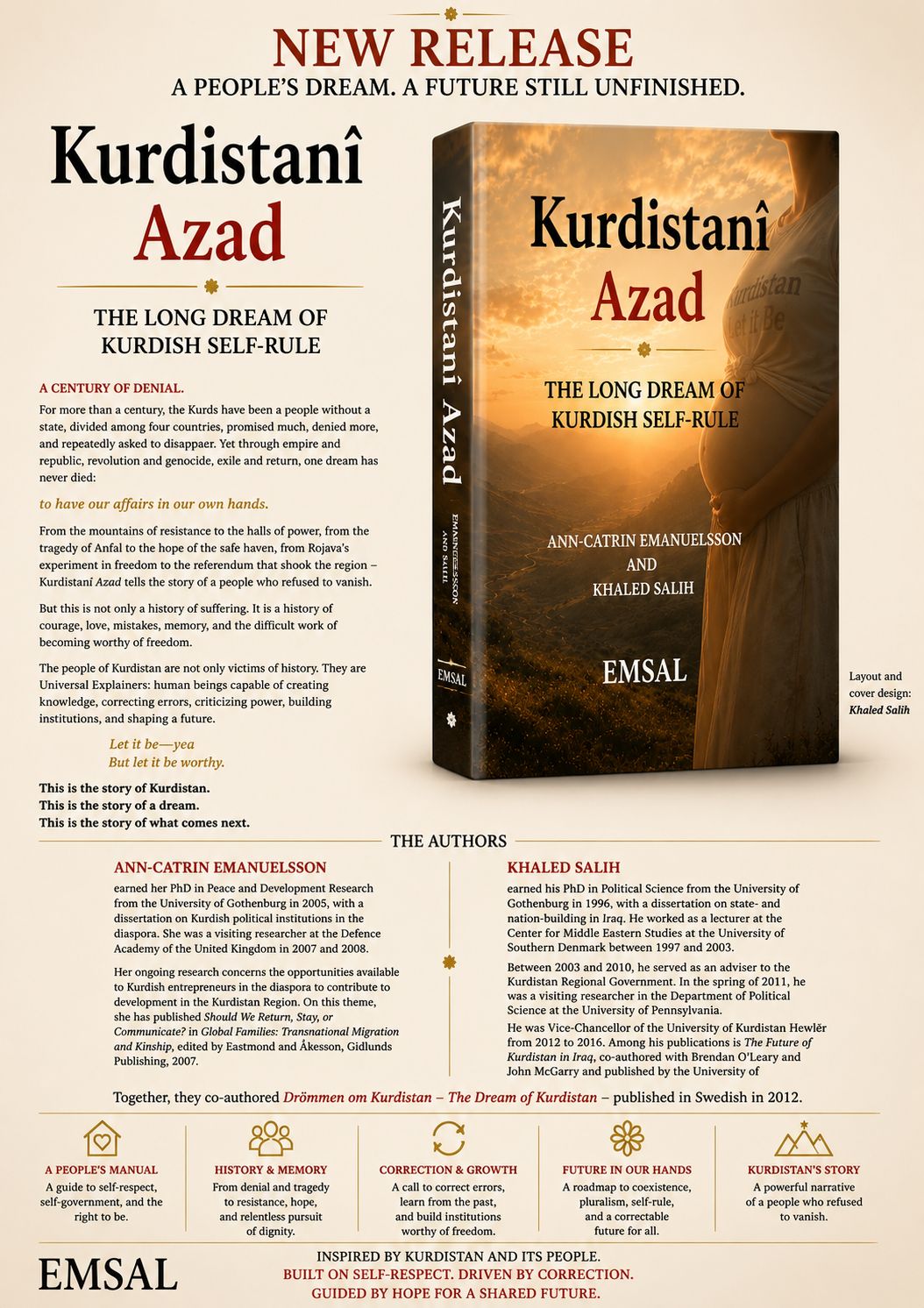
For a longer discussion see: Kurdistanî Azad. The Long Dream of Kurdish Self-Rule.
Note:
The Kurds in Syria are surrendering something tangible: military command, territorial control, resources, institutions and bargaining power.
In return, they are receiving something potentially historic: recognition, citizenship, language rights and inclusion in the Syrian state.
But there is a dangerous space between promise and institution.
So I think we are asking the wrong question.
Not:
What did the Kurds gain?
But:
What replaced the power they gave up?
A promise is not a court.
Recognition is not constitutional protection.
Goodwill is not architecture.
And inclusion is not necessarily correction.
The real test will come later, when the international spotlight has moved elsewhere and Damascus makes a decision that harms its Kurdish citizens.
What happens when Damascus is wrong?
If the answer is criticism, courts, constitutional limits, local institutions, elections and peaceful reversal, then something genuinely historic may be happening in Syria.
If the answer is dependence on whoever happens to rule Damascus, then the Kurdish question has not been solved.
The cage has merely changed shape.
My new essay asks a larger question that reaches far beyond Kurdistan:
When can a people safely surrender power?
My conjecture: only when the protective function of that power has been transferred into institutions capable of correcting the state itself.
Because the highest achievement of political order is not defeating resistance.
It is making resistance less necessary by making correction possible.
Syria may be integrating the Kurds. The harder question is whether it is building institutions that can survive its own future errors.
The Kurds in Syria may be about to discover one of the oldest political truths in the Middle East:
Power is easiest to surrender when promises are strongest.
The danger appears later.
By then, the soldiers have been integrated.
The checkpoints are gone.
The oil fields are no longer yours to bargain with.
The border crossings are controlled elsewhere.
The autonomous institutions have been absorbed.
And the people who made the promises may no longer be in power.
This is why the most important question raised by the dissolution of the SDF is not:
What did the Kurds gain?
It is:
What replaced the power they gave up?
That is the real test.
The SDF was never freedom.
An army is not democracy.
Territorial control is not an Open Society.
And Kurdish political institutions should not be romanticized simply because they emerged under persecution, war and abandonment.
But power performs functions.
It can deter domination.
It can create bargaining leverage.
It can make an otherwise indifferent state negotiate.
It can prevent certain decisions from being imposed without cost.
That is what matters here.
For years, the Kurds in Syria possessed an unusual concentration of survival power: armed forces, territorial administration, control over important resources, border access, external alliances and a degree of political autonomy.
Much of that is now being surrendered, dissolved or absorbed into the Syrian state.
In exchange, the reported gains are real.
Citizenship.
Recognition of Kurdish identity.
Recognition of Kurdish language.
Commitments to Kurdish education.
Official recognition of Nowruz.
Participation in state institutions.
Some localized security arrangements.
These things matter.
A state that once denied important aspects of Kurdish existence is now acknowledging them.
That should not be dismissed.
But recognition and protection are not the same thing.
And protection and correction are not the same thing either.
A government can recognize a language.
A constitution can protect it.
A court can enforce that protection.
A political system can allow citizens to remove those who violate it.
Those are four different things.
The mistake is to treat them as interchangeable.
They are not.
A promise is not a court.
An appointment is not representation.
Recognition is not self-rule.
Goodwill is not architecture.
And inclusion is not necessarily correction.
The current Syrian transition will ultimately be judged by one question:
What happens when Damascus is wrong?
Not today.
Not while the agreement is fresh.
Not while foreign governments are watching.
Later.
Suppose a future Syrian government restricts Kurdish-language education.
Suppose it recentralizes local administration.
Suppose Kurdish political parties are marginalized.
Suppose former SDF officers are purged.
Suppose local fiscal arrangements are altered.
Suppose a future government becomes more authoritarian, more Islamist, more Arab nationalist, or simply less interested in honoring the compromises of 2026.
What happens then?
Where does the error go?
That is the question I have increasingly come to regard as the central test of political institutions.
When rulers make mistakes, where can those mistakes travel?
Can they move upward into the law, the doctrine, the policy, the ministry, the government?
Or do they move downward into the citizen?
Into the minority?
Into the dissident?
Into the weaker party?
A functioning political order allows error to travel upward.
It permits criticism.
Appeal.
Litigation.
Opposition.
Elections.
Reversal.
Replacement.
A defective order sends error downward and calls the result stability.
This is why external guarantees are never enough.
America can guarantee an agreement.
Turkey can guarantee one.
Iraq can endorse one.
A Syrian president can promise one.
But governments change.
Interests change.
Wars change.
Alliances disappear.
The Kurdish political experience contains enough examples of abandoned guarantees to make this point almost unnecessary.
The serious question is not:
Who guarantees the deal?
It is:
What survives the guarantor?
That answer has to be institutional.
Courts.
Constitutions.
Independent media.
Competitive politics.
Local government powers.
Freedom of association.
Protected language rights.
Transparent fiscal arrangements.
Civil society.
Electoral replacement.
None of these institutions is infallible.
That is precisely the point.
A good political system is not one in which mistakes cannot happen.
Such a system does not exist.
A good political system is one in which mistakes can be found and corrected without requiring another war.
That is the standard.
And it reveals something larger about the Kurdish predicament.
The Kurdish problem is often described as a problem of powerlessness.
That is only partly true.
Kurds have repeatedly demonstrated an extraordinary ability to generate power under conditions in which very little should have been possible.
Guerrilla movements.
Political parties.
Diaspora networks.
Pêşmerge forces.
International alliances.
Autonomous administrations.
De facto states.
Regional governments.
The more difficult problem begins after power has been acquired.
How is survival power converted into correctable institutions?
That may be the deeper Kurdish political problem.
Acquiring power is difficult.
Knowing when it can safely be surrendered may be harder.
The ideal sequence is clear.
Survival power produces negotiation.
Negotiation produces constitutional protection.
Constitutional protection produces enforceable institutions.
Those institutions produce pluralism, criticism and peaceful political replacement.
Then—and only then—does autonomous coercive power become genuinely unnecessary.
But there is another sequence.
Power is surrendered.
Promises are made.
Central authority expands.
The international spotlight moves elsewhere.
The guarantees weaken.
And a population discovers that what it received was recognition without leverage.
The two sequences can look almost identical in the beginning.
That is why sequence matters.
I would formulate the principle this way:
Never dismantle an existing mechanism that prevents uncorrectable domination until a superior mechanism of error correction can perform the same function.
That is not an argument for permanent guerrilla forces.
It is the opposite.
Armed organizations are crude, dangerous and expensive mechanisms of political protection.
A civilized constitutional order should make them obsolete.
But obsolete means functionally replaced.
It does not mean politically inconvenient.
If armed deterrence previously prevented domination, what now performs that function?
If territorial autonomy protected local decisions, what protects them afterward?
If control over resources generated bargaining leverage, what prevents future fiscal coercion?
If foreign sponsorship provided security, what domestic institution makes such sponsorship unnecessary?
This is what I would call the Institutional Equivalence Test.
Whenever political actors surrender an existing form of power, ask:
What performs its protective function now?
This test should be applied relentlessly.
Including to Kurdish institutions themselves.
Because Kurdish politics does not become immune to criticism simply by being Kurdish.
Could the autonomous administration tolerate serious opposition?
Could its ideological assumptions be challenged?
Could journalists criticize its leadership?
Could Arab communities contest decisions effectively?
Could the governing political structure lose power peacefully?
If not, then it too contained protected errors.
The standard must remain universal.
Protect the person.
Criticize the explanation.
Preserve the means of correction.
Never allow error to become protected merely because it carries a Kurdish, Arab, Islamic, secular, revolutionary or national label.
This is why I resist both triumph and despair over the current Syrian settlement.
It is too early for either.
The Kurds in Syria have not simply won.
Nor have they simply lost.
They are attempting something much more difficult:
the conversion of coercively defended autonomy into institutionally protected citizenship.
If that conversion succeeds, then the disappearance of the SDF may eventually be understood not as defeat but as progress.
The highest Kurdish achievement would not be the permanent preservation of a separate army.
It would be the creation of a Syria in which Kurds no longer need one.
But that outcome requires more than recognition.
It requires a Syrian state capable of correcting itself.
That is the part that cannot be skipped.
Otherwise the cage has not disappeared.
It has simply become more sophisticated.
The old cage was denial.
Then came siege.
Then armed autonomy.
Now comes conditional recognition.
What comes next is not predetermined.
One path leads toward constitutional pluralism.
The other leads back toward centralization.
And this is the larger conjecture I take from the entire episode:
The test of successful political integration is not whether a minority has been admitted into the state. It is whether that minority has acquired peaceful means for correcting the state.
That principle reaches far beyond Syria.
Far beyond Kurdistan.
It reaches into the basic architecture of civilization itself.
The most successful political order is not the one that has eliminated resistance.
It is the one that has made resistance less necessary by making correction possible.
So the question beneath all the headlines remains:
What happens when Damascus is wrong?
If Syria can answer that institutionally, something genuinely new may be beginning.
If it cannot, then the Kurdish question has not been solved.
It has merely been postponed.


