The Knife and the Parasitic Mind: Ideology, Violence, and Human Resilience
1 January 2026
“Our Word or No Word”
The attempted murder of Salman Rushdie was not an aberration, nor was it an impulsive excess committed by a lone fanatic who briefly lost his way. It was the predictable, long-delayed execution of an idea—a directive that had been issued, sanctified, preserved, and patiently incubated for more than three decades. What occurred at Chautauqua was therefore not merely an act of violence, but the moment when an abstract doctrine finally demanded its payment in blood. To understand it requires more than sympathy for the victim or revulsion at the crime; it requires a forensic examination of the mental ecosystem that produced the assailant and the moral architecture that allowed the threat to outlive the original regime that pronounced it.
Let me start with a simple but unfashionable premise: the most decisive battles of our age are not fought between states or armies, but within the human mind itself. Drawing on Salman Rushdie’s Knife and Gad Saad’s The Parasitic Mind, I treat the attack as a case study in ideological infection—one in which a human consciousness was colonised by a lethal idea pathogen, while another resisted annihilation through language, reason, and love. The knife that was meant to silence a writer instead exposes a deeper conflict: between dogma and freedom, resentment and creation, the parasitic and the generative. What follows is not an exercise in outrage, but an analysis of how civilisations decay when ideas are immunised against criticism—and how they survive when individuals refuse to surrender the sovereignty of their own minds.
The 2022 attack on Salman Rushdie was the chilling, kinetic expression of a decades-old fatwa. In this essay I shall analyse that violent collision through two interpretive lenses: Salman Rushdie’s profound personal testimony in his memoir, Knife, and the rigorous intellectual frameworks of evolutionary behavioural scientist Gad Saad from The Parasitic Mind. To make it crystal clear from the outset: Rushdie’s Knife is not merely a memoir of survival but a real-world validation of Saad’s thesis: that the primary battle for civilisation is fought not on geopolitical battlefields, but within the individual human mind, where the “life ideals” of love and art must confront and dismantle the “idea pathogens” of dogmatic hate.
My core objective is to shed light on the psychology of the attacker, evaluate the nature of Salman Rushdie’s profound resilience, and derive deeper insights into the fundamental conflict between individual freedom and weaponised ideology. By juxtaposing the mind of the assailant with the response of the survivor, I hope to illuminate the stark choices facing our modern era. My attempt, the second on Knife, is therefore a journey into the heart of human nature, exploring its capacity for both destructive, blind faith and for the extraordinary, life-affirming power of love and art. [For the first essay, see “After the Knife: Salman Rushdie and the Infinite Game of Defiance.”]
Anatomy of an Idea Pathogen
To understand the events at Chautauqua, it is vital to see the assassin not as an isolated individual but as the product of infectious ideas. His actions represent the final, kinetic expression of a ideological contagion. Let me offer a critical analysis of a consciousness consumed by what Gad Saad identifies as idea pathogens, using Salman Rushdie’s own astute, if imagined, interrogation of his attacker, whom he calls “the A.”
The Time Traveller and the Ostrich Parasitic Syndrome
In his memoir, Rushdie characterises his attacker not as a contemporary figure but as a “murderous ghost from the past,” a “time traveler” executing an antique threat. This characterisation offers a textbook clinical manifestation of Gad Saad’s concept of Ostrich Parasitic Syndrome (OPS), a malady of disordered thinking that causes individuals to construct an alternate, ideologically driven reality by rejecting observable truth.
Saad defines OPS sufferers as those who “reject realities that are otherwise as clear as the existence of gravity.” Rushdie’s imagined dialogue with his attacker vividly portrays this syndrome. When pressed on the value of human life outside his belief system, the assassin reveals a mind that has fully detached from the principles of a pluralistic, secular world:
You don’t even believe in allāh. An atheist is the lowest of the low. You don’t deserve to talk to me. You are not my equal.
This assertion is not a statement of opinion but a declaration from a manufactured reality where his ideology is the sole arbiter of worth. The assassin, like the sufferers of OPS Saad describes, has buried his head in the sand of dogma, choosing its certainty over the complexities of the real world.
The Motive: Beyond Faux-Causality
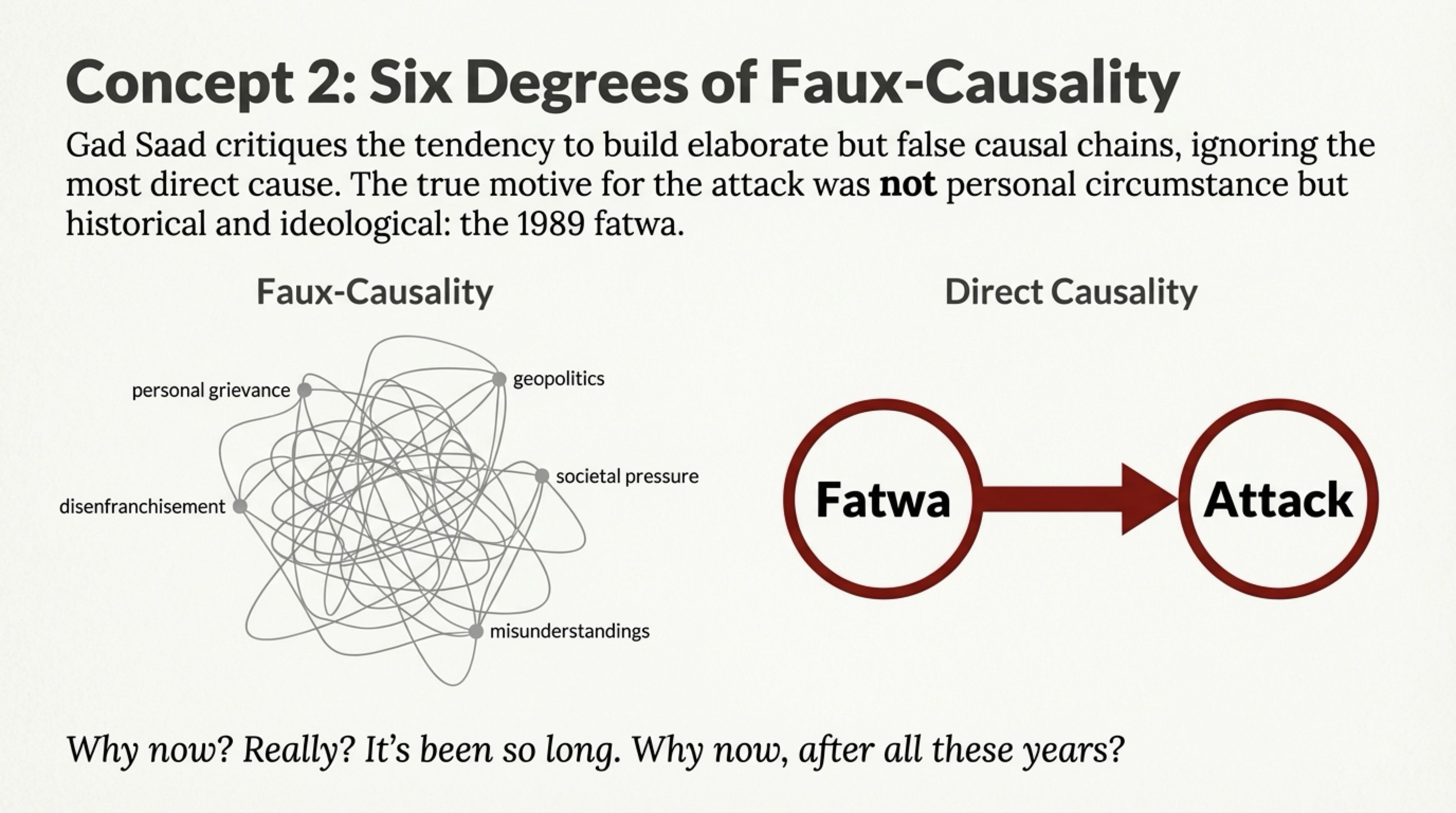
In The Parasitic Mind, Gad Saad critiques the tendency to construct elaborate but false causal chains to explain complex events, a phenomenon he terms “six degrees of faux-causality.” He argues that in explaining global terrorism, observers often pin the blame on tangential factors like disenfranchisement, ignoring the most direct cause: ideological doctrine.
The attack on Rushdie presents a clear case for this argument. Explanations rooted in the attacker’s personal circumstances prove insufficient. The true motive is not circumstantial but historical and ideological: the 1989 fatwa. Rushdie himself expresses bewilderment at the timing, reinforcing the ideological, rather than personal, nature of the motive:
“Why now? Really? It’s been so long. Why now, after all these years?”
The assassin was acting not on a recent grievance but on an old command. The root cause was the idea pathogen itself, which had lain dormant for years before finding a willing host. He was the instrument of the violence.
The Psychology of Resentment and Victimhood
Saad’s frameworks of Collective Munchausen Syndrome and the Oppression Olympics provide a powerful lens for understanding the attacker’s psychology. This was not a simple case of ideological adherence, but a desperate psychological appropriation. Rushdie intuits that the attacker was a loner, “disappointed by life,” who “needed to blame” an external source for his inadequacies. For a man whose life was defined by personal failure, the fatwa acted as a narrative parasite, offering a pre-packaged, redemptive identity—that of a righteous avenger—to give meaning to his resentment.
By adopting this victim-avenger narrative, the assassin elevates his personal failures into a holy war. He embodies the ethos Saad describes: “I am a victim therefore I am.” Rushdie pierces this psychological armour with a devastating question that exposes the deeply personal resentment fuelling the ideological fire:
I’m just wondering who you were really trying to kill. Some girl who brushed you off? ... Was I the proxy murderee?
This suggests the assassin weaponised a global ideology to settle a deeply personal score, transforming his perceived victimhood into a mandate for murder.
While the assassin’s mind demonstrates the sterile vacuum created by an idea pathogen, the mind of his target reveals the generative, resilient power of the ideals it sought to nullify.
Salman Rushdie and the Ideals of Truth and Freedom
Salman Rushdie emerges from the pages of Knife not merely as a victim, but as the exemplar of the very principles the attack sought to extinguish: freedom of thought, the power of art, and the sanctity of the individual. His response, chronicled with painstaking honesty, serves as a powerful case study in intellectual and psychological resilience against ideological terror.
Language as the Ultimate Weapon
In the aftermath of the attack, Rushdie faced a choice: to retreat into silence or to reclaim the narrative. His decision to write Knife is a profound manifestation of what Gad Saad defines as the foundational “life ideals” of Freedom and Truth. For Rushdie, language itself became the tool for his survival and self-reclamation. He reached a central realisation that would guide his recovery, a thesis that stands as the intellectual core of his memoir:
Language, too, was a knife. It could cut open the world and reveal its meaning, its inner workings, its secrets, its truths…. Language was my knife. If I had unexpectedly been caught in an unwanted knife fight, maybe this was the knife I could use to fight back…. I would answer violence with art.
This decision was an act of supreme agency. By choosing to write, he refused to let violence have the final word. He engaged in what Saad calls the “battle of ideas,” using his own weapon of choice to dismantle the narrative imposed upon him by his attacker.
The Rejection of the Victimhood Narrative
Gad Saad describes a modern pathology he calls the homeostasis of victimology, an ethos where “it pays to be a member of the perpetually aggrieved.” Salman Rushdie’s recovery is a powerful and conscious repudiation of this mindset. He understood that the attack threatened to drag him back into the “narrative of scandal” surrounding The Satanic Verses, a role he had long fought to escape. His refusal is unequivocal:
“I have no intention of living in that narrative anymore.”
Instead of focusing on grievance, Rushdie’s journey is one of determined agency. His focus is on healing, on his love for his wife and family, and on the painstaking work of returning to life and literature. He actively chooses to “remake and reclaim” his world, demonstrating that true survival is not about dwelling on the injury but about rebuilding a life of meaning and purpose in its wake.
The Bulwark of Love and Human Connection
The sterile, dehumanising ideology of the attacker finds its ultimate antithesis in the deep, personal bonds that anchor Rushdie’s life. Throughout Knife, his family—his wife Eliza, his sister Sameen, and his sons, including Milan—form a bulwark of love that proves essential to his survival.
The relationship with his wife, the novelist and poet Rachel Eliza Griffiths, is portrayed as the central, life-affirming force against the nihilistic hatred. In a moment of profound literary insight, Rushdie describes their “meet cute” as a “comic foreshadowing” of the attack. During that first encounter, a mishap with a glass door resulted in “the broken glasses, the blood... the fall to the floor in a daze.” These same elements reappeared in the intentional violence at Chautauqua. The parallel is stark: one scene, an accident born of burgeoning love that initiated a life together; the other, a deliberate assault born of ancient hate that sought to end it. Love, in this telling, is not a passive emotion but an active, resilient defence. Rushdie frames the stakes of his survival in the context of their shared life:
“Could our happiness survive such a blow?”
The memoir answers with a resounding yes, positioning intimate, human love as the most powerful antidote to abstract, ideological hate.
Having profiled the agent of destruction and the agent of creation, let us now turn to the broader implications of the violent intersection for understanding human nature itself.
Human Nature and the War of Stories
The violent, 27-second encounter between Salman Rushdie and his attacker was more than a personal tragedy; it was a microcosm of a larger, global struggle. In this final section, This section synthesises the analysis of the attacker and the survivor to extract fundamental truths about human nature, resilience, and the critical importance of narrative in the modern world.
Human Duality
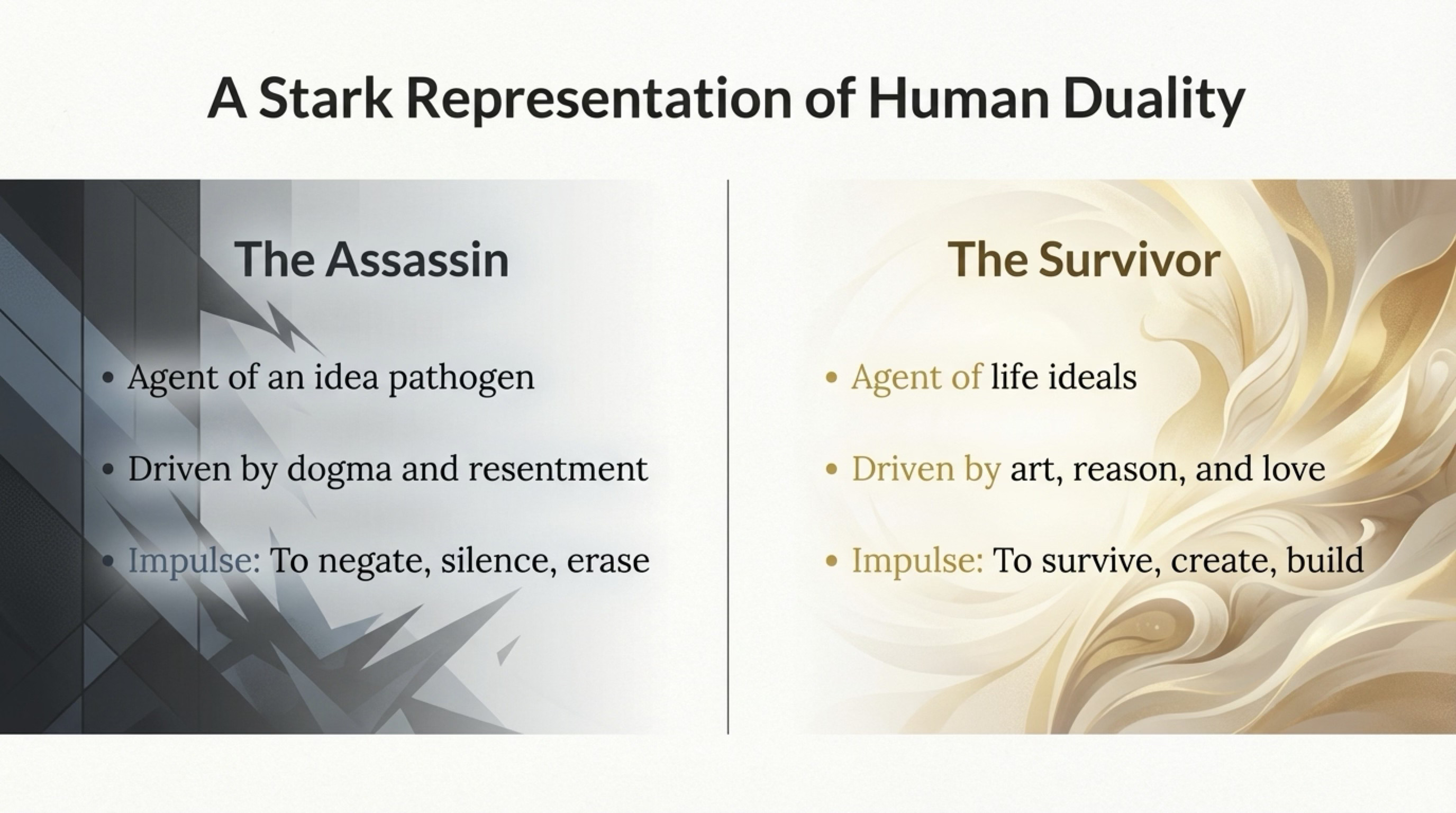
The event at Chautauqua offers a stark representation of human duality. On one side stands the assassin, an agent of an idea pathogen, driven by dogma and resentment to negate, silence, and erase. On the other stands Salman Rushdie, a creator, who uses art, reason, and love not only to survive but to build something new from the wreckage.
Rushdie himself contemplates this chilling contrast with devastating force. He considers the possibility that for his attacker, the 27 seconds of the assault may have been a moment of “happy” intimacy and historical fulfilment. He juxtaposes this fleeting, destructive ecstasy against the more than five years of “deep happiness” he shared with his wife Eliza—a private, generative happiness that, in his words, “the knife came to cut apart.” This framing distills the conflict to its essence:
the destructive impulse, which finds its climax in a momentary act of violence, versus the creative impulse, which builds meaning slowly over years through love and work.
The World War of Stories
In his memoir, Rushdie powerfully articulates the idea that we are engaged in a global “world war of stories”—a battle between “incompatible versions of reality.” This concept connects directly to Gad Saad’s urgent call for intellectually courageous individuals to participate in the “battle of ideas” and defend the principles of reason and freedom.
The attack was not merely a physical assault on one man; it was an assault on the entire story of free inquiry, artistic expression, and individualism. It was an attempt to prove that the narrative of violent dogma could triumph over the narrative of liberal democracy. Rushdie’s survival and his subsequent decision to “answer violence with art” is his counter-move in this war. His concluding remarks at the PEN America Gala serve as a rallying cry:
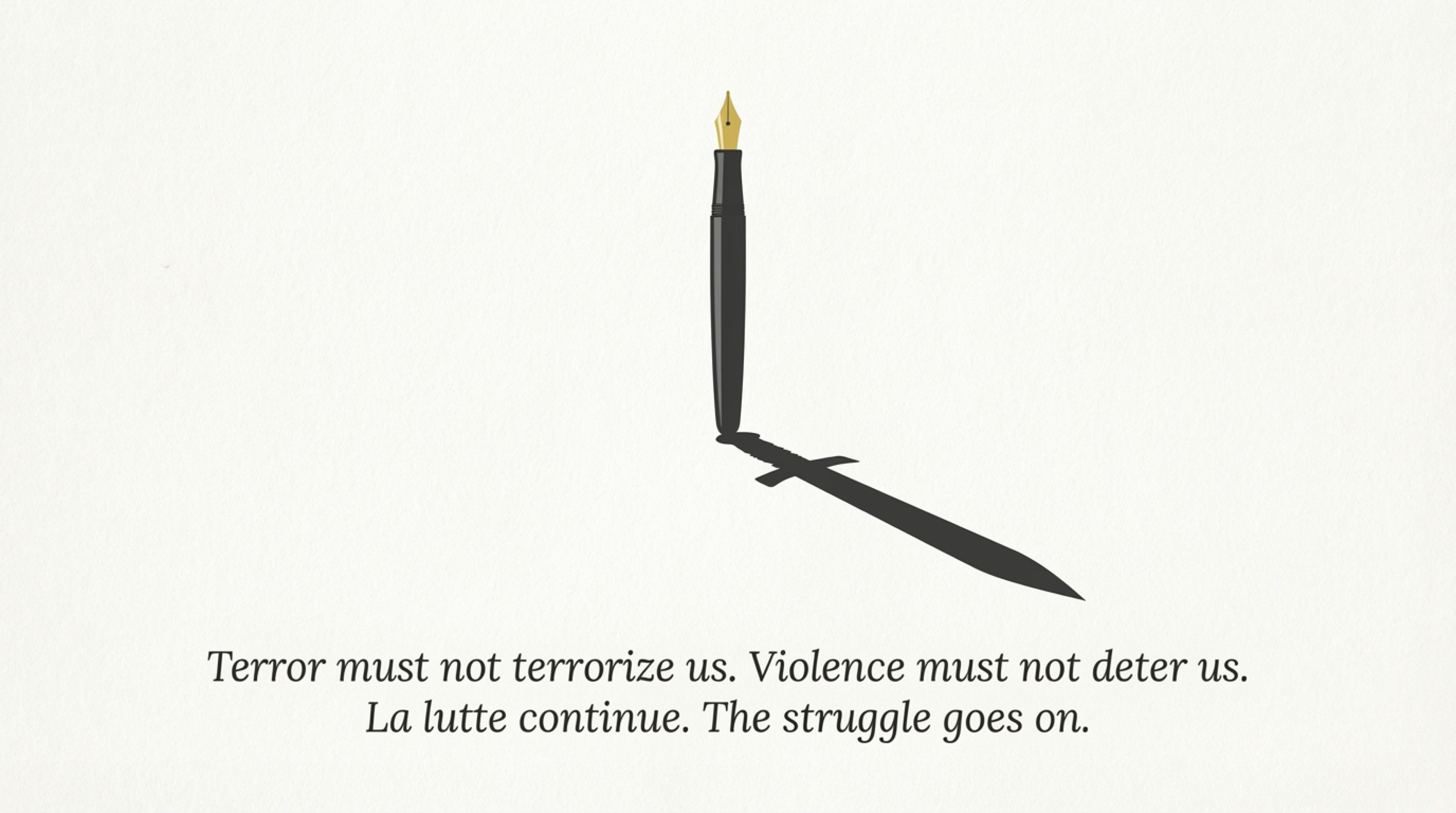
“Terror must not terrorize us. Violence must not deter us. La lutte continue. The struggle goes on.”
Resilience, Art, and the Reclamation of Self
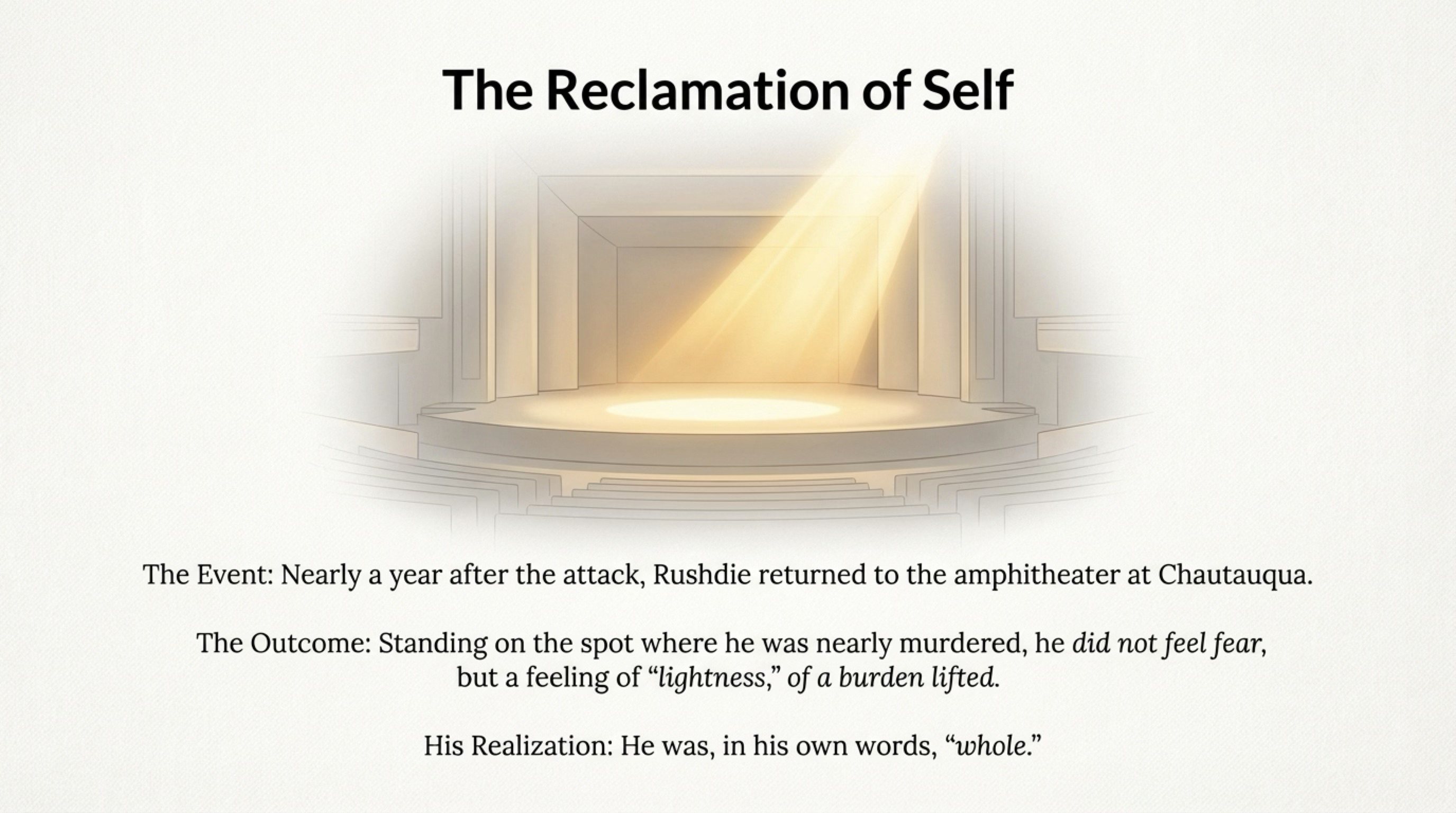
Ultimately, Knife is a profound meditation on the nature of recovery. Rushdie’s journey demonstrates that resilience is not a passive state but an act of profound intellectual and creative will. In the immediate aftermath of the attack, he had visions of “majestic palaces and other grand edifices that were all built out of alphabets,” as if his mind was already rebuilding his world with the material of his art.
This act of reclamation finds its symbolic conclusion in his return to the amphitheatre at Chautauqua nearly a year later. Standing on the spot where he was nearly murdered, he does not feel fear, but something unexpected: a feeling of “lightness,” of a burden lifted. He was, in his own words, “whole.” This moment signifies the ultimate triumph of the human spirit. He has not only survived the attempt on his life but has integrated the experience, transformed it, and made it his own.
By transforming his trauma into a masterwork of art, Salman Rushdie achieved a victory his attacker could never comprehend. He did not simply save himself; he provided a timeless testament to the enduring power of the individual creative will as the ultimate bulwark against ideological nihilism. In this global war of stories, his single, free voice has provided the response.
References:
Salman Rushdie, 2024, Knife: Meditations After an Attempted Murder. New York, NY: Random House.
Gad Saad, 2021, The Parasitic Mind: How Infectious Ideas Are Killing Common Sense. Washington, DC: Regnery Publishing, A Division of Salem Media Group.