The Great Inversion: How to Make Islamism Invisible and Islamophobia Sacred
By Khaled Salih
“Behind every smile lies the will to spread Sharia.”
—Bruno Guillot, once known as Soulayman Abou Issa, a Belgian convert and Salafist imam
Here is my guiding principle for this text:
“Your strength as a rationalist is your ability to be more confused by fiction than by reality. If you are equally good at explaining any outcome, you have zero knowledge.” Eliezer Yudkowsky, “Your Strength as a Rationalist (2007)”
The Necessity of the Great Inversion
The need for this updated examination, this Great Inversion, arises from the accelerating war of ideas now raging inside Western civilisation, a conflict in which academic rhetoric has grown so refined in its evasions that it can make even fanaticism appear as folklore. The scholars have become the illusionists: with one hand they summon compassion, and with the other they make the operational reality of radical Islam vanish into the ether. Yet that reality still burns with the testimony of those who have risked everything to expose it.
In an earlier analysis, “The Anatomy of Deception,” I discussed how certain moral entrepreneurs of the academy—most notably Anna Ardin and Mattias Irving—had discovered a profitable alchemy: the weaponisation of virtue. With the sleight of a report, they transformed Sweden’s legitimate security inquiry into Islamist influence operations into a melodrama of state oppression, casting their own government as inquisitor and the ideologues as innocents. Their technique is as elegant as it is alarming: deletion, the quiet excision of context such as the MSB’s mandate to investigate “illegitimate and potentially harmful communication from a foreign power or its proxy”; and distortion, the transmutation of legitimate caution into “stereotyping” and “soft repression.” Thus was counter-intelligence repackaged as intolerance.
But vivisection alone no longer suffices. To expose the mechanics of deception is one thing; to confront its moral consequences is another. The time demands a new analytical framework—a recognition that we are now witnessing not merely distortion, but the deliberate manufacture of moral paralysis. The patient has begun to enjoy the taste of his own anaesthetic.
At the heart of this paralysis lies the West’s refusal to heed what I call the Insider’s Warning—the inconvenient truths of those who have escaped the ideological laboratory.
The Unheeded Truth. Bruno Guillot, once the Salafist imam Soulayman Abou Issa, trained at Saudi Arabia’s University of Medina—an institution established to “Islamise populations, particularly Western ones”—offers what he rightly terms “a view from the command post of fanaticism.” His is not an opinion but an operations manual, a detailed account of a multi-stage Islamisation Plan aimed at the gradual imposition of Sharia law across Europe.
The Core Conflict. Guillot does not flatter his audience. The Muslim Brothers, he warns, is no moderating presence but a “terrorist organisation in disguise”—a polite vanguard for more austere successors. “Behind every smile,” he writes, “lies the will to spread Sharia.”
This is the operational truth that polite scholarship cannot digest. The academic gatekeepers, so fluent in relativism, are rendered mute by certainty when it serves them. Thus, long before any discussion begins, the state’s duty to respond to Guillot’s warning is already condemned as prejudice.
Hence this essay. Not an identical reprise but a reinforcement. The Great Inversion builds upon earlier analyses to reveal the ideological strategy that now governs our discourse—a campaign to convince the West that to name a danger is to commit a sin. And in that act of cultivated guilt, it has transformed the most basic instinct of civilisation—self-preservation—into an unforgivable crime.
For if security agencies cannot speak of Islamism without permission, we have already begun to surrender. The first duty of a free mind is to name things truthfully, and to do so without apology. Only then can civilisation remember that self-defence, far from being sin, is the most honourable of virtues.
The Ideological Battlefield
Western civilisation, that weary custodian of Enlightenment reason, now trembles before the accusation of intolerance. Our universities have turned their seminar rooms into confessionals; our bureaucrats fear offending more than failing; and our intellectuals, armed with moral vanity, have begun to mistake empathy for evidence. The modern West no longer believes in God —but it certainly believes in guilt, and religiously so.
In this twilight of conviction, three rival narratives now fight for dominion over truth. The first comes from the insider: the defector who has seen the machinery of Islamist ideology from within and dares to speak of it without euphemism. The second, from the state, which reacts with bureaucratic unease, fumbling between vigilance and virtue-signalling. And the third, the most insidious of all, from the academy, which transmutes vigilance into vice, declaring every act of self-defence to be a form of Islamophobia.
If, in the case of Sweden, with its improbable cast—a former Salafist imam turned apostate, a government agency investigating ideological subversion, and a pair of scholars denouncing the investigation itself—we will be witnessing a parable of our times. For in it, the West’s intellectual immune system is being deliberately weakened, its antibodies of reason attacked from within.
Ardin and Irving’s celebrated study, The Islamist Labelling of Muslim CSOs, provides the perfect specimen. They assume “that stereotypes are part of structural anti- Muslim racism, or Islamophobia”—without irony—which are “socially reproduced prejudices and aversions against Muslims and Islam, as well as acts that attack, exclude, or discriminate,” quoting reverently from the Research Network for the Study of Anti-Muslim Racism (2023, no link in Reference, under heading: “Unpublished sources”). They fly from assume to are, based on a description by a group of academics and activists, in the same breath without any reflection or qualification. The asymmetry is not grammatical—it is ideological.
The Insider’s Warning
There are few moments more valuable in the study of totalitarian ideologies than the testimony of a defector—one who has seen the faith from the inside and can no longer stomach its lies and indoctrination. Bruno Guillot, once known as Soulayman Abou Issa, a Belgian convert and Salafist imam, offers precisely that: a view from the command post of fanaticism.
His account is not rumour or resentment; it is operational doctrine. Guillot describes what he calls an “Islamisation Plan”: a deliberate, multi-stage strategy for transforming European societies from within. Its logic is chillingly methodical:
Objective. The phased imposition of Sharia law across Europe.
Ideological Core. The doctrine of الولاء والبراء (al-walā’ wa-l-barā’)—translated as “loyalty and disavowal” or “allegiance and enmity”—embodies the Salafi injunction to grant unqualified devotion to fellow believers and to renounce, without concession, the unbeliever and his world. It is not a metaphor but a mandate: a totalising ethic of separation that converts spiritual allegiance into a political frontier.
Training Ground. The University of Medina in Saudi Arabia, an ideological factory whose Western graduates are dispatched as missionaries to “Islamise populations, particularly Western ones.”
Methodology. Soft da‘wa (proselytism) to win hearts, followed by social segregation, and finally political domination.
Guillot names the Muslim Brotherhood not as a moderating force but as a preparatory one—the “moderates who till the soil for the extremists.” Behind every smile, he says, lies the will to spread Sharia.
To Western ears, such testimony should set off an alarm. Yet in the halls of polite academia, it provokes only embarrassment. The man who speaks from experience will be treated as a fanatic; the fanatic who speaks in jargon is treated instead as an expert in building bridges that will eventually lead to harmony. Guillot’s confession exposes an ideology of conquest masquerading as religion. But to those who have made tolerance their god, his warning is intolerable.
The State’s Response
The Swedish Civil Contingencies Agency (MSB), to its credit, did what modern states are supposed to do: it investigated. Confronted with evidence of Islamist influence operations, it commissioned a study to examine how ideological networks manipulate information to infiltrate public institutions. Its brief, crucially, was to investigate “illegitimate communication from a foreign power or its proxy”: a definition rooted not in theology but counter-intelligence.
What remains is a caricature: a state probing the loyalties of its Muslim citizens. Thus, an inquiry into foreign subversion is transformed into a narrative of domestic persecution—a rhetorical alchemy that turns prudence into paranoia.
Ardin and Irving identify five supposed “themes” in the MSB material:
Muslims portrayed as a latent security threat.
The Brothers depicted as monolithic.
Muslim activism framed as foreign influence.
Islamists portrayed as deceptive.
The spectre of an Islamist takeover.
In their framing, these are symptoms not of legitimate caution but of a “pathologised” imagination. Yet the reality is less poetic. Every intelligence service in Europe has confirmed elements of these same patterns. The question, then, is not whether the MSB exaggerated the threat, but why two scholars felt compelled to erase it.
The Academic Inversion
No one ever accused Western academia of lacking faith. It simply changed its deity. Once, truth was sacred; now, identity is. Into this sanctum step Ardin and Irving, clutching their sacrament of Islamophobia. Their thesis is elegant in its absurdity: the term “Islamist” is not analytical but oppressive; to use it is to participate in a rhetorical witch-hunt.
They write as if language itself were an instrument of persecution. The MSB’s use of Islamism, they say, is a “rhetorical catalyst”: a device that unfairly links Muslim civil organisations to extremism. By this reasoning, the label, not the ideology, is the true threat. To name the problem to perpetuate it.
The rhetorical function is transparent. By elevating Islamophobia to the status of unquestioned moral reality while treating Islamism as a mere discursive construct, they invert the hierarchy of evidence and ideology. They redefine the relationship between observer and observed: the scholar becomes the priest, the state the sinner, and the Islamist the misunderstood penitent.
Their circular reasoning is breathtaking in its efficiency. If one identifies Islamist activity, one is Islamophobic. The more evidence one gathers, the greater one’s guilt. Reality itself becomes incriminating. Thus is born the closed epistemic loop: the perfect engine of ideological paralysis.
This is the ethical sin at the heart of their intellectual paralysis: the calculated decision to make examples of Guillot’s operational truth—the reality of the “Islamisation Plan” and the “will to spread Sharia”—vanish into the ether. They did not merely disagree with counter-intelligence; they actively suppressed the testimony of defectors, replacing the inconvenient, lived experience of ideological conquest with the convenient, antiseptic language of their own moral melodrama. In their commitment to professional virtue, they became conscious saboteurs, trading the survival of clarity for the fleeting comfort of ideological conformity.
This is not scholarship; it is moral theatre. It invites Western societies to see self-defence as sin and naïveté as virtue. The state that acts to protect its citizens is accused of “soft repression,” while those who preach subversion are absolved as community activists. The result is a new catechism of evasion, taught in the language of compassion.
The Anatomy of Deception
Let us strip away the sanctimony. Ardin and Irving’s paper is not a study; it is a stratagem. It functions as ideological counter-intelligence, designed to deflect scrutiny from Islamist networks by pathologising the very act of scrutiny.
It achieves this through three interlocking deceits:
Deletion. The surgical removal of context—the MSB’s explicit reference to “foreign power or proxy.” This omission erases the operational reality of cross-border radicalisation pipelines such as the University of Medina, turning a counter-intelligence initiative into a phantom inquisition.
Distortion. Vigilance is rebranded as “stereotyping.” The state’s responsibility to identify risk becomes evidence of moral panic.
Generalisation. A single Swedish project is inflated into a symbol of systemic bigotry. By extending a narrow case into a universal moral fable, they manufacture an empire of guilt.
This is not mere academic malpractice—it is rhetorical sabotage. It is the deliberate confusion of analytic categories to produce moral paralysis.
The technique exploits what can be the weaponisation of Western virtues. The West’s compassion is used against it; its reluctance to offend becomes a strategic vulnerability. Borrowing from Gad Saad’s taxonomy, one might say the infection spreads through three cognitive pathogens:
Ostrich Parasitic Syndrome. The pathological refusal to recognise reality.
Victimhood Fetish. The creation of a monolithic victim class that cannot be criticised.
Suicidal Empathy. The conviction that to defend oneself is to betray one’s values.
Through this intellectual triad, the academic Left has managed to turn the West’s moral antibodies inward, convincing it that to speak of Islamism is to sin against tolerance.
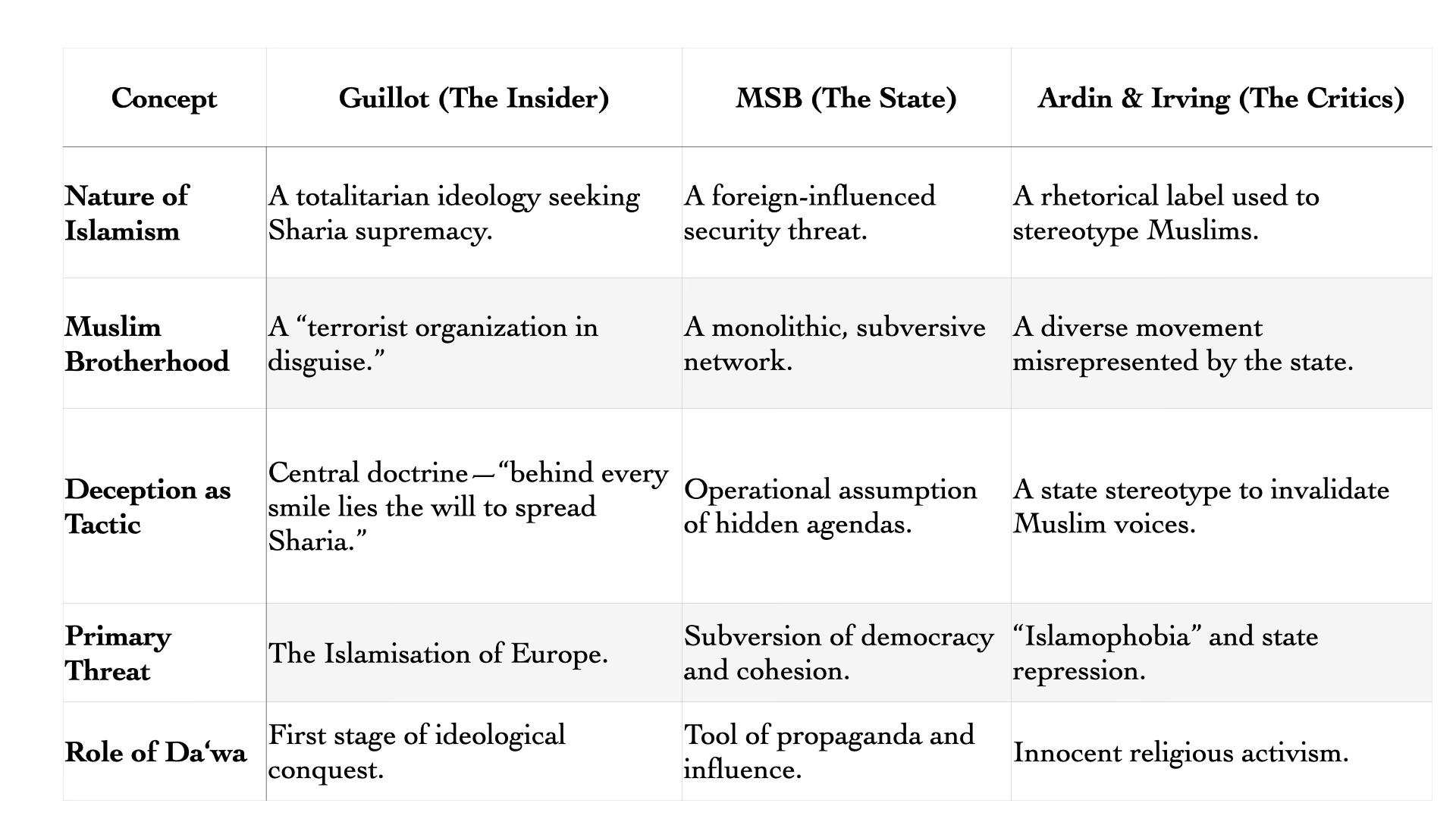
What we witness here is not disagreement over data but over definitions: an epistemological civil war. The insider names the disease; the state prescribes containment; the academic denies the patient exists.
This conflict is fought not with bombs but with vocabulary. The battlefield is the dictionary in order to confuse the citizens; the casualties are clarity, courage, and truth. Whoever controls the semantics controls the state’s ability to think.
Clarity Not Surrender
We stand, then, at a perilous juncture. The danger is not that Western democracies will be conquered by Islamists with guns, but undermined by intellectuals with guilt. The real soft repression is not conducted by governments: it is the self-censorship of the mind, the internalised blackmail that forbids us to distinguish between critique and hate, between ideology and identity.
When reason is held hostage by rhetoric, when compassion is turned into chloroform, society loses the will to defend itself. Universities, media, and ministries alike now tremble before the inquisitors of moral orthodoxy. The brave are branded bigots; the prudent are paralysed by apology.
The survival of a free society depends on its ability to name reality without permission. A civilisation that cannot say what it sees will soon cease to see at all. The task, therefore, is not merely analytical but moral: to reclaim the right to reason.
For tolerance, stripped of judgement, becomes complicity. And compassion, divorced from courage, is the virtue of the conquered.
The Stupidity Paradox
It is tempting to view Ardin and Irving’s report as mere intellectual error, but that would be too kind. What it really embodies is what Alvesson and Spicer have called Functional Stupidity—the art of being clever enough to sound intelligent while avoiding the inconvenience of thought. The authors exhibit all three symptoms in textbook proportion: a failure to question their own assumptions, a failure to justify their ideological leaps, and a failure to reason about consequences beyond the report. Thus, an investigation into Islamist influence becomes an inquisition against Sweden itself; ideology is repackaged as empathy, and empiricism dismissed as heresy. This systematic intellectual failure contributes directly to the intellectual paralysis that has made the country so vulnerable to ideological influence.
The true paradox, however, lies in their reward. Within institutional settings, such carefully maintained stupidity is celebrated as sophistication. They are applauded not for discovering truth but for performing piety. For the short-term functionality of ideological conformity, they forfeit the long-term vitality of reason. It is this trade—the purchase of professional virtue at the cost of intellectual honesty—that defines our present decay. A society that prizes moral exhibitionism over moral courage will not merely misunderstand its perils; it will forget it has any.
The Justificationist Trap
The last and perhaps gravest affliction of the Ardin–Irving report is what David Deutsch would diagnose as justificationism—the ancient superstition that knowledge can be made secure by appeal to authority. They begin, not with a question, but with a creed: “We assume that stereotypes are part of structural anti-Muslim racism.” Thus the word assume performs the miracle once reserved for Scripture—it turns speculation into sanctity. Having borrowed their definition of Islamophobia from an activist network that proclaims intersectionality as its gospel, they proceed to reason outward as if from revelation. This is the epistemology of the inquisition disguised as peer review, replacing the open mind with the closed circle. When a civilisation begins to mistake this paralysis for virtue, it has already begun, as Deutsch might say, to drift back into the dark—where belief reigns, doubt is sin, and justification stands in for truth.
Ardin and Irving, however, have built a hermetically sealed moral universe in which all criticism is reclassified as heresy. This is the epistemology of the inquisition disguised as peer review. It is not science; it is catechism. When authority replaces curiosity, the intellect decays into performance art. Their report is, in this sense, the perfect product of its age: brilliant in execution, hollow in explanation. It shines with the borrowed light of fashionable righteousness while rejecting the one thing that makes light useful—the ability to reveal error.
A society that exalts such reasoning has forgotten that progress depends not on moral safety but on criticism without permission. The tragedy of the Ardin–Irving method is that it rewards intellect only when it kneels.
Sources:
Mats Alvesson & André Spicer, 2016, The stupidity paradox: The power and pitfalls of functional stupidity at work. London: Profile Book.
Anna Ardin and Mattias Irving (2025). “The Islamist Labeling of Muslim CSOs: A Critical Examination of Stereotypes about Muslims and Islam in a Public Agency in Sweden”. Islamophobia Studies Journal, 9(1), 97–128. Berkeley: Islamophobia Research and Documentation Project, University of California.
David Deutsch, 1997, The Fabric of Reality: The Science of Parallel Universes—and Its Implications. London: Allen Lane The Penguin Press.
David Deutsch, 2011, The Beginning of Infinity: Explanations that Transform the World. New York, NY: Viking.
RAIR FOUNDATION USA, 25251021, “Conversation with ex-Salafist imam, Bruno Guillot.” https://rumble.com/v70herg-conversation-with-ex-salafist-imam-bruno-guillot.html
Khaled Salih, 20251020, “The Anatomy of Deception: How Two Academics Turn ‘Islamophobia’ into Ideological Warfare.” https://substack.com/home/post/p-176665429


