The Grace of Power: Masoud Barzani
By Khaled Salih
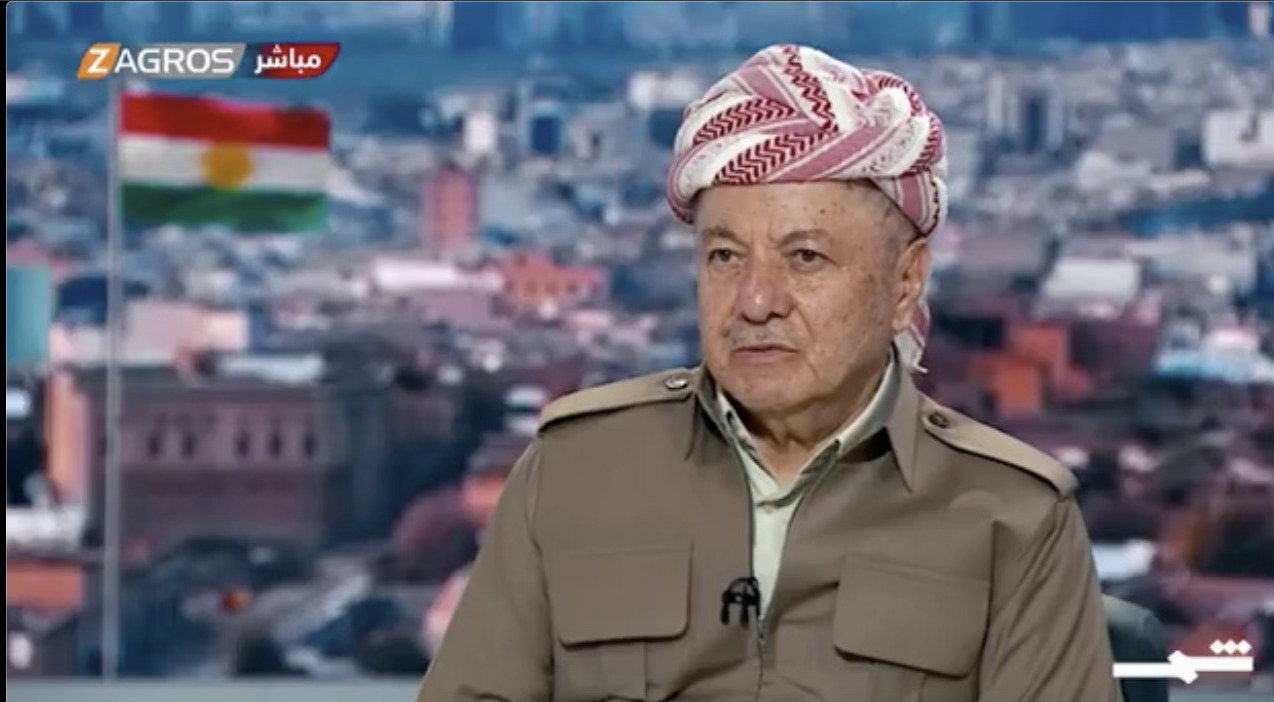
This hour-long interview with President Masoud Barzani on Zagros-tv was timely, measured, and strategically positioned a week ahead of Iraq’s federal elections. It offered a dignified review of the Kurdistan Region’s record and priorities, while signalling clear expectations for the national political process. Framed with calm insistence on constitutional norms and stability, it set the stage for post-election alliances and policy debates without resorting to campaign rhetoric.
Religion, in the hands of a seasoned politician, is a velvet cosh. Watch how President Barzani begins by doffing his cap to the almighty, and you can see the performance being laid like charges under a bridge: humility first, so that triumph won’t look like swagger; gratitude next, so that prosperity acquires a nimbus of benediction rather than the vulgar odour of mere competence. By the time the figures, the kilowatts and the kilometres of asphalt arrive, they have been pre-laundered in sacrament. Baghdad’s shambles, alas, remains stubbornly secular — misrule, graft and the usual militia idolatry—while Erbil’s order comes garlanded with grace. This is not theology; it is stagecraft of a high order, a way to make policy sound like providence and to render criticism a form of bad manners.
Let us do a rigorous dissection of President Masoud Barzani’s performance, demanding that we scrutinise his rhetoric — a blend of devout religious humility and stark political calculation — against the unyielding evidence of the interview transcript. It behoves us to proceed with diligence, thematic structure, and an uncompromising critical eye, observing the mechanics of power disguised in the vestments of faith.
The Calculus of Grace
The interview with President Masoud Barzani presents a fascinating case study in strategic political communication, particularly in a landscape rife with historical grievance and systemic corruption. The core tension of the conversation rests on Barzani’s simultaneous invocation of divine favour and his detailed, material explanation for the Kurdistan Region’s (KRG) success.
Barzani, as the veteran statesman, must negotiate two essential realms: the spiritual (appealing to faith and expressing humility) and the secular (detailing practical policy, administration, and political warfare). The obvious observation that leaps immediately to the forefront is the calculated utility of divine intervention in his narrative.
The Curious Case of the Divine Bounty
Upon being congratulated on the KRG’s economic and developmental miracle, Barzani immediately adopts a posture of profound gratitude. He states unequivocally:
“I feel pride and honour, and I thank my Lord for this blessing and what He has bestowed upon my people.”
This attribution of success to lord’s bounty (فضل ربي) functions rhetorically to elevate the KRG’s achievement beyond mere political fortune; it is a sanctified success.
Yet, this spiritual acknowledgement, intended perhaps to temper the appearance of political arrogance, is instantly and definitively undermined by Barzani’s subsequent comparative analysis of the rest of Iraq.
If the KRG’s 24-hour electricity, infrastructure, and economic boom are truly a blessing, one must logically question why this same blessing is conspicuously withheld from the majority of Iraq. Barzani steps neatly around the theological quandary of divine favouritism by introducing the secular explanation — an explanation that places accountability squarely on the shoulders of his political rivals in Baghdad.
The lack of progress in the central and southern provinces is not a failure of divine will, but a failure of human ethics and administration:
- Administrative Breakdown: Baghdad suffers from “chaos, truly, unfortunately,” lacking “sound planning” and “sound administration.”
- Moral Corruption: Projects are exploited “for enrichment and not for reconstruction,”
- Absence of Resolve: There is no “real will” (إرادة حقيقية) for progress.
The implication is devastatingly clear: God provides the opportunity, but human corruption, mismanagement, and lack of will preclude the realisation of that grace elsewhere. The divine favour is thus repurposed not as a final cause, but as a moral mandate, validating the KRG’s clean governance while condemning Baghdad’s venality. This deft manoeuvre, moving seamlessly from the pulpit to the policy brief, suggests the “grace of the lord” serves as a superb rhetorical shield for what is, in practice, a ruthless political critique.
Critical Reflection on Barzani’s Performance and Thinking
A critical reflection on Barzani’s interview reveals a systematic and disciplined performance built upon strategic defiance, conditional cooperation, and sophisticated self-positioning.
The Constitution: Champion or Pickpocket’s Tool?
Barzani positions himself as the ultimate constitutional loyalist, the man who laboured over the document more than anyone else. His entire defensive strategy against Baghdad’s pressure rests upon demanding a return to the constitutional principles of “partnership, balance, and consensus.”
The critical contradiction is immediate and sharp: While demanding constitutional adherence, Barzani simultaneously dismisses the Federal Supreme Court — the very body tasked with upholding that document — as “politicised and biased” and explicitly rejects its rulings. This is the classic strategy of selective fidelity: the Constitution is the “referee” only when its decisions favour the KRG. When the referee rules against him, the referee must be discredited and replaced, perhaps by the unelected “Union Council.” This betrays a willingness to discard democratic infrastructure when it restricts Kurdish autonomy, prioritising the KRG’s enduring existence over institutional consistency.
Strategic Messaging and Election Posturing
The decision to participate in the Iraqi parliamentary elections, despite labelling the current law as “unjust and unfair,” was presented not as an act of democratic belief, but as a calculated strategic exercise.
- The Power Display: The objective was transparently non-electoral: to “show others the strength and size of the Kurdistan Democratic Party” (KDP) by achieving a million votes. Barzani concedes that this will not change the immediate seat count, but it serves as a powerful message to potential allies and adversaries alike.
- Conditionality of Cooperation: His involvement is strictly conditional, aiming for a new alliance with “authentic forces” in Baghdad to repair the broken political process. If this opportunity for reform is lacking, he threatens withdrawal: “each incident will be handled as it arises.” This is not partnership; it is an ultimatum based on leverage.
Defiance and the Rhetoric of Endurance
Barzani consistently invokes the historical suffering and resilience of the Kurdish people — chemical attacks, Anfal operations, village destruction — to justify their current obstinacy. He asserts that the KRG “will not compromise on its rights” and “will not kneel.” This positions the KRG’s struggle as an infinite game of survival, exemplified by his comparison of the KDP to an “oak tree” that withstands every difficulty.
Crucially, this rhetoric is paired with a strategic capacity for forgiveness. He recalls the refusal to harm captured Iraqi soldiers after the 1991 uprising. This historical magnanimity is used to draw a moral distinction: while Baghdad maintains a hostile “culture of rejecting the other,” the Kurdish people retain a “clean heart” (نظيف القلب) and a culture of peaceful coexistence, making them morally superior custodians of their region.
The Political Utility of Coexistence
The celebration of coexistence—the care and protection afforded to Christians and Yazidis — is presented as a profound, inherited cultural trait. While this may be genuinely held, it serves a critical political function: it provides the KRG with international legitimacy and a sharp moral contrast to the sectarian strife and instability afflicting the rest of Iraq. By highlighting the zero rate of religious crimes and the heroism of Christian villagers who chose to die with their Barzani neighbours, Barzani showcases the KRG as the stable, civilised alternative — the antithesis of the “chaos” prevalent beyond its borders.
A Study in Calculated Contradiction
President Barzani’s interview is not merely a summary of current political woes; it is a masterful presentation of an entrenched leader who is acutely aware of the necessity of maintaining moral high ground while engaging in relentless political trench warfare.
The performance, systematic and unyielding, presents a figure who uses faith as ballast and competence as a weapon. He credits divine grace for the opportunity of prosperity, but reserves the right to blame human corruption for its failure elsewhere, neatly reconciling spiritual humility with absolute political accountability. His thought process is defined not by illogical contradiction, but by calculated synthesis: he demands constitutional rights while rejecting their judge, threatens withdrawal while seeking alliance, and uses historical grievance to justify perpetual political defiance.
The result is a portrait of a statesman whose thinking is rigorously structured to uphold one paramount objective: ensuring that the “oak tree” of Kurdistan endures, unbent by Baghdad’s political winds or the moral decay of corruption. One cannot accuse him of manipulation; merely of being exquisitely deliberate.
God Doesn’t Do Coalitions
That is a question of remarkable political acuity, compelling us to examine where President Barzani chooses to deploy the almighty as a guarantor and where he insists upon the unforgiving realities of mortal political combat. The internal disunity of the Kurdish political class — an issue frequently cited as the existential Achilles’ heel of the region — provides the perfect crucible for testing the sincerity and consistency of his rhetoric.
The Imbroglio of Kin and the Retreat of the Deity
The Diagnosis of Disunity: A Human Failure of Will
The interview, though cutting off the direct response to the interviewer’s observation that the “enemy of the Kurds is their disunity,” leaves absolutely no ambiguity regarding Barzani’s assessment of the internal fracture. He addresses the issue not through philosophical generalities, but through the detailed, exasperating reality of political obstruction.
The disunity is systematically defined as a calculated act of political sabotage carried out by rivals, specifically concerning the protracted delay in forming the Kurdistan Regional Government (KRG) following the internal elections:
Stalling and Electoral Chess
Barzani presents the failure to form a functional KRG government as a deliberate act of pre-meditated stalling, aimed at manipulating the balance of power.
- The Accusation of Delay: He describes the situation as “unfortunate and harmful even to the reputation of the region.” Although the KDP immediately sought to form a broad-based government, the matter narrowed down to the KDP and the PUK (Patriotic Union of Kurdistan).
- The Strategic Motive: Barzani explicitly states that information reached the KDP suggesting the PUK was stalling (يماطل), deliberately waiting until after the Iraqi federal parliamentary elections.
- The Miscalculation: This delay was based on the PUK’s conception (tasawwur) that the KDP would suffer a crushing defeat (hazima nakra’ / هزيمة نكراء) in the federal elections. The objective was baldly opportunistic: if the KDP was weakened in Baghdad, the PUK hoped they would gain the upper hand (اليد العليا) in the subsequent formation of the KRG government.
- The Moral Failure: This political opportunism occurred despite the parties having reached a good agreement on administration and even having negotiated a ministerial distribution that was fair — in fact, “even more than the PUK’s electoral entitlement.”
In short, Barzani’s address of disunity is a direct, detailed denunciation of a fellow Kurdish party’s political avarice and short-term thinking, which placed tactical gains over the reputation and stability of the regional state itself. The internal enemy is thus named, quantified, and assigned a specific date for its nefarious calculation.
Why Divine Intervention Cannot Sanitise Political Infighting
Here we arrive at the critical nexus of the inquiry. Why, when internal disunity represents a threat potentially more insidious than Baghdad’s external pressures, is the summoning of “the grace/bounty of my lord” suddenly absent?
The answer is found in the transactional nature of Barzani’s spiritual rhetoric: divine favour is summoned to celebrate successes achieved through disciplined human effort; it cannot be summoned to excuse failures resulting from intentional political malpractice.
The Spiritual Contract: Grace vs. Corruption
As established in our prior discussion, Barzani’s theology of governance operates on a simple premise:
- KRG Success: When celebrating the miracle of the KRG (electricity, development, stability), he credits God for the blessing. This attribution frames the KRG’s success as morally and administratively deserved, a divine reward for “precise implementation” and “sound planning.”
- Iraqi Failure: When examining Baghdad’s failures, he attributes the lack of progress to human corruption, “chaos,” and the absence of “real will.”
The Case of Internal Disunity
Internal disunity (the PUK’s stalling) falls squarely into the category of human failure — a failure of political ethics, strategic vision, and moral priorities.
- Political Choice, Not Divine Curse: The KRG’s delayed government formation was not caused by a sudden lack of electricity or a mysterious drought, but by the conscious, political choice of leaders waiting for a potential election outcome. This is entirely within the realm of political will and human agency.
- Accountability: To summon divine intervention regarding the internal failure would either absolve the specific actors (the PUK) of responsibility or require Barzani to suggest that god withdrew his grace specifically from the Kurdish political class. Barzani, ever the pragmatic politician, is keenly focused on establishing accountability for the failure to govern and securing the moral high ground. He is detailing a cynical, self-serving calculation, not lamenting a tragic, unavoidable fate.
In Barzani’s communication strategy, divine grace provides the canvas of opportunity (the freedom and resources), but the political actors must provide the paint and the brush (the planning, the will, and the unity). When the actors choose to smear the canvas with internal conflict and short-term opportunism, they forfeit the right to claim divine sanction. The internal political squabble is too tawdry, too demonstrably self-inflicted, to warrant the glorious intervention of the almighty. It is, quite simply, a base matter of politics that Barzani is keen to expose rather than sanctify.
In the end, the trick is simple and rather clever: place the wreath of piety upon the brow of success, and hang the albatross of failure around the neck of your opponents. God is permitted to bless, but never to exculpate; the ledger is balanced on earth, in human hands, with names and dates and signatures. If Barzani’s communication strategy holds, Kurdistan’s gains are not an accident of oil and luck but proof of will, while the rest is a morality tale about what happens when men prefer impunity to institutions. One may quarrel with the theology, the arithmetic, or the tone, but not with the intent: to fuse gratitude with grit and to make the oak look inevitable. The sermon done, the politics begins — and one suspects it was politics all along.


