The Finality of Fanaticism: Qutb’s Game Against Life Itself
By Khaled Salih
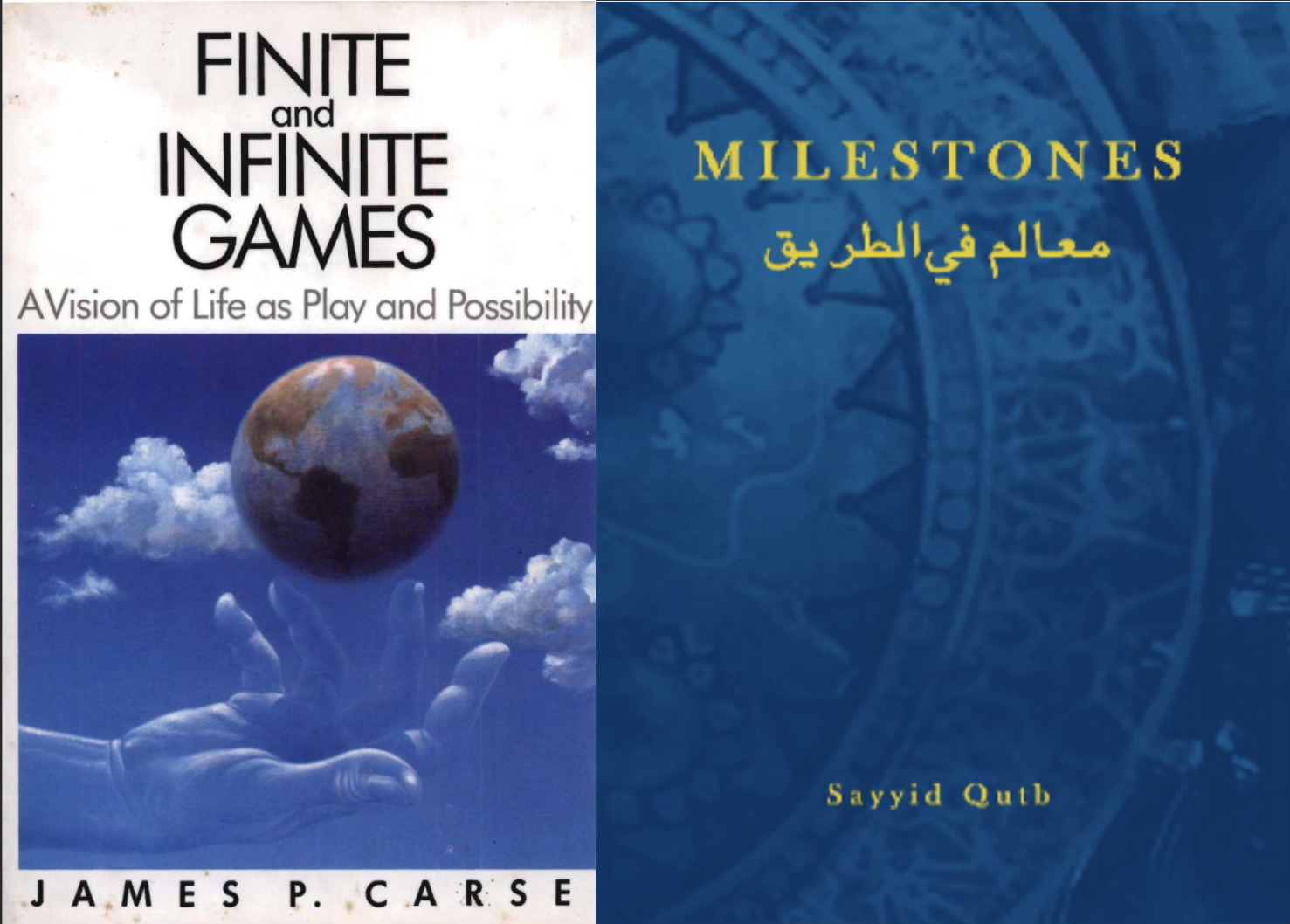
It begins, as these things often do, with a man who believed the universe was insufficiently tidy. Sayyid Qutb, with the zeal of a schoolmaster who has caught the cosmos misbehaving, declared that history itself was an exam gone wrong — one to be corrected, retaken, and marked “perfect” under divine supervision. In Milestones, his fevered scripture of ideological tidiness, the messiness of human play is to be replaced with the precision of command. Freedom, doubt, surprise — those unreliable amusements of civilisation — are to be disciplined into submission. In his earnest jihād against the unpredictable, Qutb does not so much argue with the modern world as file a lawsuit against it for existing.
A Framework for Analysis
In this article I shall do something unusual: Applying the philosophical framework developed by James P. Carse in Finite and Infinite Games to the ideological project articulated by Sayyid Qutb in his seminal work, Milestones. The purpose is to use Carse’s distinct categories of human activity not as a moral judgement, but as an analytical tool to understand the deep structure, internal logic, and ultimate trajectory of Qutb’s vision. The central thesis is that Qutb’s programme for an islāmic revival constitutes a quintessential Finite Game as defined by Carse — a contest played for the express purpose of winning a final, unchallengeable victory. I shall proceed in a systematic fashion: first, I shall establish the theoretical groundwork by defining Carse’s terms; second, I shall map Qutb’s project onto the core characteristics of a Finite Game; and finally, it will explore how this classification suggests the project is inherently unsustainable, undermined by the self-limiting contradictions that Carse argues are inherent in all finite play. This analysis will be based exclusively on texts by Carse and Qutb, examining the ideological architecture of each without reference to external historical or biographical context.
The Nature of Finite and Infinite Games
To analyse Sayyid Qutb’s ideological methodology, it is strategically imperative to first establish a clear understanding of the core concepts presented by James P. Carse. His distinction between two fundamental types of human engagement — finite and infinite games — provides the essential theoretical toolkit for our subsequent analysis. Let us start, therefore, to establish the clear, distinct definitions of these two modes of play, outlining their rules, boundaries, purposes, and the contrasting ways in which their players orient themselves towards the past, present, and future.
The Finite Game
James P. Carse offers a concise and powerful definition for the first mode of human engagement: “A finite game is played for the purpose of winning”. The entire structure and logic of such a game flows from this singular objective. Its defining characteristics are as follows:
- A Conclusive End. Finite games are played to be won, an act which brings the play to a definitive conclusion. The victory of one player necessitates the defeat of the other, whose capacity for further play is terminated.
- External Boundaries. Finite games are always constrained by externally defined boundaries. Carse notes that “the date, place, and membership of each finite game are externally defined,” situated within a larger “world time” and a specific geography.
- Fixed Rules. The rules of a finite game are agreed upon before play begins and cannot change. They function as the contractual terms that allow for a winner to be declared, and their authority is absolute for the duration of the game.
- Theatrical Play. Because they are played for an audience to achieve a pre-determined outcome, finite games are theatrical. Roles are performed with seriousness, and in retrospect, the outcome appears inevitable. As Carse explains, “every move fit into a sequence that made it inevitable that this player would win.”
- The Acquisition of Titles. The ultimate prize in a finite game is a title, which Carse defines as “the acknowledgment of others that one has been the winner of a particular game.” Titles are public, timeless, and serve to take the winner out of further play in that specific contest.
The Infinite Game
In sharp contrast to the finite game, the infinite game is defined by an entirely different purpose: “an infinite game for the purpose of continuing the play”. The objective is not to end the game by winning, but to ensure that the game never ends. Its characteristics are the inverse of finite play:
- An Open-Ended Purpose. The goal is simply to keep the game in motion. Infinite players do not seek to defeat their opponents, as this would bring the play to a halt.
- Internal Boundaries (Horizons). An infinite game has no definite beginning or end and is not bound by external time or space. “Anyone who wishes may play,” and the game creates its own time. Its limits are not fixed boundaries but ever-receding horizons.
- Changeable Rules. The rules of an infinite game must change during the course of play. This is a necessary mechanism to prevent any single player from winning and thereby ending the game for everyone.
- Dramatic Play. Infinite play is dramatic, meaning it is open-ended, avoids specific outcomes, and embraces unpredictability. It prepares players not against surprise, but for surprise.
- Playing with Boundaries. Where finite players operate within strict boundaries, infinite players play with boundaries, constantly testing, changing, and dissolving them to open new fields of play.
With these foundational definitions established, we can now proceed to apply this framework to the ideological structure and purpose of Sayyid Qutb’s project as detailed in Milestones.
Classifying the Muslim Game
This section will discuss the core tenets of Sayyid Qutb’s project as outlined in Milestones, analysing its fundamental structure through the lens of Carse’s framework. The purpose is to determine whether its architecture — its stated goals, its definition of players, and its conception of the playing field — aligns with the properties of a Finite Game. By examining these structural elements, we can begin to classify the nature of the ideological contest Qutb envisions.
A Singular Purpose
At its core, Qutb’s project is explicitly goal-oriented, aiming for a conclusive end-state. The struggle is not designed to continue indefinitely but to reach a terminal point of absolute victory. This is evident in his description of the final triumph, which he defines as the moment of “conquest,” after which “you see the people entering into the religion of allāh in multitudes.” This vision is not one of perpetual engagement with other worldviews, but of a final, decisive outcome that concludes the historical struggle. This singular, terminal goal aligns perfectly with Carse’s primary definition of a finite game: it is “played for the purpose of winning.”
Defining the Players
Qutb meticulously delineates the participants in his envisioned struggle, creating a clear and non-negotiable division between the players. On one side is the muslim vanguard, a group that must be “distinct by itself,” operating under its “own leadership.” On the other side is jahiliyyahh (ignorance), a comprehensive category that encompasses all other systems, traditions, and forms of leadership. By defining jahiliyyahh as a monolithic opposition that includes even “so-called ‘Muslim’ societies,” Qutb eliminates any ambiguous middle ground. This is a crucial move in finite play, as it prevents the rules of participation from changing and ensures the opponent remains a fixed, externally-defined target, rather than a potential partner in an evolving, infinite game. This sharp demarcation directly corresponds to Carse’s principle that the “membership of each finite game” is “externally defined.”
Setting the Boundaries
The playing field in Qutb’s project is as clearly demarcated as its players. He divides the world into two mutually exclusive zones: dar al-islām (the adobe of islām) and dar al-harb (the adobe of war). The boundaries are not ethnic or geographical in the conventional sense, but ideological. Qutb asserts that a muslim’s country is not a “piece of land” but the place “where the islāmic faith is dominant and its shari‘a is operative.” This binary worldview perfectly illustrates Carse’s concept of a finite game operating within well-defined boundaries. From a Carseian perspective, these ideological boundaries are not passive lines on a map but active frontiers of conflict and warfare, necessary to sustain the tension of the finite game. As Carse observes,
“A boundary is a phenomenon of opposition. It is the meeting place of hostile forces.”
This finite structure — a clear goal, unambiguous players, and hostile boundaries — necessitates an equally rigid method of play. Let us now demonstrate how Qutb’s prescribed methodology is not dramatic and open-ended, but theatrical and scripted, designed to guarantee the pre-ordained outcome.
The Method of Play
Having established the finite structure of Qutb’s game, I shall now assess its method of play. The focus here will be on whether the game is theatrical (scripted and resistant to surprise) or dramatic (open-ended and embracing surprise), according to Carse’s distinction. We will examine Qutb’s prescribed manhaj (methodology) for his vanguard to determine if it is designed to follow a known script toward a pre-ordained conclusion.
A Scripted Progression
Qutb’s methodology for the islāmic movement is not one of improvisation but of faithful re-enactment. He stresses a staged progression, citing Ibn Qayyim’s outline of the prophet’s mission as the definitive model: a sequence moving from preaching, to migration, to fighting specific enemies, and ultimately to fighting “the polytheists until allāh’s religion was fully established.” This historically-derived, phase-by-phase plan provides a clear script for action. This approach aligns perfectly with Carse’s description of theatrical play, where, in retrospect, “every move fit into a sequence that made it inevitable that this player would win.” The path is not discovered; it is followed.
Training vs. Education
Carse makes a crucial distinction between preparing for a known future and preparing for an open one. “To be prepared against surprise is to be trained. To be prepared for surprise is to be educated,” he writes, adding that “Training repeats a completed past in the future.” Qutb’s model for preparing the vanguard is unequivocally a form of training. The explicit goal is to replicate the “completed past” of the “unique qur’ānic generation” in order to achieve a pre-determined future. This approach is designed to eliminate surprise by adhering to a proven formula, not to cultivate the resilience needed to adapt to the unexpected. It is a preparation against the surprises of jahiliyyahh, not for the surprises of an open-ended historical drama.
The Role of the Master Player
Within Carse’s framework, the ultimate finite player is the Master Player, one who “plays as though the game is already in the past, according to a script whose every detail is known prior to the play itself.” While Qutb’s vanguard are the human actors, the ideological framework itself assumes the role of the Master Player. The divine script (the qur’ān) and the perfected historical performance (the life and methodology of the prophet) provide the vanguard with a known path to a guaranteed victory. In this formulation, the vanguard are not Master Players themselves but rather actors attempting to perfectly embody the script authored by the one true Master Player, whose victory is already inscribed in the past. The outcome is not in doubt; the play is a performance of a truth already established.
Qutb’s methodology, therefore, is fundamentally theatrical — a scripted performance designed to repeat a successful past. This leads directly to the final act of the game: the nature of its conclusion and the prize that is won.
The Terminal Move
The endgame is the most crucial determinant in classifying a game as finite. A finite game must have a conclusion; an infinite game must not. Let us then dive into the nature of victory in Sayyid Qutb’s project, equating it with James P. Carse’s concepts of the “terminal move,” the acquisition of a timeless title, and the ultimate act of terminating all other forms of play — an act that Carse, within his specific philosophical system, defines as evil.
Annihilating the Opponent
The end-state envisioned in Milestones is absolute and uncompromising. The objective is not to coexist with or persuade the opposition, but to “annihilate all such systems” of jahiliyyahh. The fight against the unbelievers continues until “allāh’s religion was fully established,” leaving no other system of governance or belief in a position to compete. This goal corresponds directly to Carse’s description of the conclusion of a finite game: “A terminal move results, in other words, in the death of the opposing player as player. The winner kills the opponent.” Qutb’s aim is the political, social, and ideological death of jahiliyyahh as a player on the world stage, thereby ending the game.
Winning the Timeless Title
The prize for this victory is not merely territory or political power, but a definitive, timeless status. Qutb quotes the qur’ānic verse that grants his community its ultimate purpose and identity: “You are the best nation produced (as an example) for mankind.” In Carse’s terms, this status is the ultimate title — a public, divinely sanctioned, and unchallengeable recognition of victory. It is a timeless acknowledgement that is not subject to further contest. By winning this title, the muslim community is, as Carse would phrase it, taken “out of play,” its supremacy established for all time.
The Elimination of Play as an Act of Evil
Carse offers a stark and provocative philosophical definition of evil: “Evil is the termination of infinite play.” He applies this principle directly to totalising ideologies, making an explicit and unambiguous reference that resonates with Qutb’s project:
It is evil to think history is to end with a return to Zion, or with the classless society, or with the islāmicisation of all living infidels.
Within the logical confines of Carse’s system, Qutb’s explicit goal to establish allāh’s sovereignty over the entire earth — effectively the “islāmicisation of all living infidels” — is a perfect embodiment of this definition. It is a project designed to bring history to what its proponents see as its “sensible conclusion,” thereby terminating the infinite, open-ended play of human culture and society.
Since Qutb’s project is a finite game aiming to terminate all other play, it becomes subject to the inherent, self-defeating contradictions that, according to Carse, plague all such cosmic endeavours.
The Inherent Contradiction
Let me now synthesise Carse’s arguments to demonstrate why any finite game that attempts to encompass all of human existence is, by its own nature, philosophically unsustainable and poised for failure. The analysis will focus on the fundamental contradictions that arise when the rigid, bounded mechanics of finite play are imposed upon the infinite, dramatic, and surprising nature of life itself. Qutb’s project, as a cosmic finite game, thus contains the seeds of its own undoing.
The Contradiction of Forced Play
Carse identifies an “invariable principle” of all play: “Whoever plays, plays freely. Whoever must play, cannot play.” Play is an essentially voluntary act. Qutb’s project, however, seeks to create a world where the game of islām is the only one available. Once victory is achieved, all of humanity must exist within its framework, either as believers or as subservient dhimmis under its law. This creates a system where actors are no longer freely choosing to play; they must participate. By making play compulsory, the system violates the foundational principle of play itself, transforming it from a free, dynamic activity into a static, coercive reality.
The Triumph of a Static Past over an Open Future
Finite games are fundamentally about the past. As Carse argues, “Death, in finite play, is the triumph of the past over the future, a condition in which no surprise is possible.” Qutb’s goal is to establish a permanent, universal system based on the completed and perfected past of muḥammad’s era and the “unique qur’ānic generation.” This represents an attempt to impose a final, static order on the world, effectively ending history by freezing it in a state of perfected submission. This orientation directly opposes that of the infinite player, who plays not to finalise the past but to remain open “toward the horizon, toward surprise.”
A Game Played Against Itself
Carse’s ultimate critique of finite play is its inherent self-contradiction. “Because the purpose of a finite game is to bring play to an end with the victory of one of the players, each finite game is played to end itself. The contradiction is precisely that all finite play is play against itself.” This paradox lies at the very heart of Qutb’s project. The vanguard is a movement defined by its struggle against jahiliyyahh. Its purpose is to engage in a world-historical contest to establish allāh’s sovereignty. Should it succeed, it would create a world without jahiliyyahh to struggle against, thereby eliminating the very conditions that give the movement its purpose and dynamism. It is a game designed to make itself obsolete, a finite process that cannot account for the infinite continuation of human history.
These inherent contradictions reveal the project’s philosophical unsustainability, suggesting that its attempt to impose a final boundary on human existence is a game played against reality itself.
A Finite Game Against an Infinite Reality
So far, I have sought to demonstrate that Sayyid Qutb’s ideological project, as articulated in Milestones, is unequivocally a Finite Game when viewed through the philosophical framework of James P. Carse. It is characterised by its singular purpose of achieving a conclusive victory, its strict definition of players and boundaries, its reliance on a theatrical script derived from a completed past, and its ultimate aim for a terminal move that ends the contest in its favour.
The project’s finite nature, however, is its fundamental philosophical weakness. By seeking to impose a permanent conclusion on the dramatic, open-ended evolution of human existence, it sets itself against the infinite game of life itself. Its logic is trapped in what Carse identifies as the core contradiction of all such endeavours: it is a game played against itself, a movement whose success would render its own existence meaningless. According to the logic of Carse’s philosophy, any attempt to bring history to a permanent conclusion is a self-defeating and unsustainable endeavour, one destined to be undone by the simple, inexorable fact that the infinite game of life always continues.
And so we arrive, not at revelation, but at redundancy. The moment Qutb’s imagined victory is achieved, the game collapses — its rules petrified, its players silenced, its future padlocked. In trying to imprison infinity within the narrow cells of certainty, he ends up convicting himself of philosophical suicide. History, that mischievous saboteur of all totalitarian dreams, will simply shrug and move on. The infinite game continues, careless of its would-be referees, while the prophets of finality remain forever at their posts — guarding the tombs of ideas that never learned how to breathe.
Sources:
James P. Carse, 1986, Finite and Infinite Games: A Vision of Life as Play and Possibility, New York: The Free Press, A Division of Macmillan, Inc.
Sayyid Qutb, 2006, Milestones (ma’alim fi’l-tareeq). Birmingham: Maktabah Booksellers and Publishers,


