The Damascus Delusion: Is America Gambling on a Mirage in “New” Syria?
11 February 2026
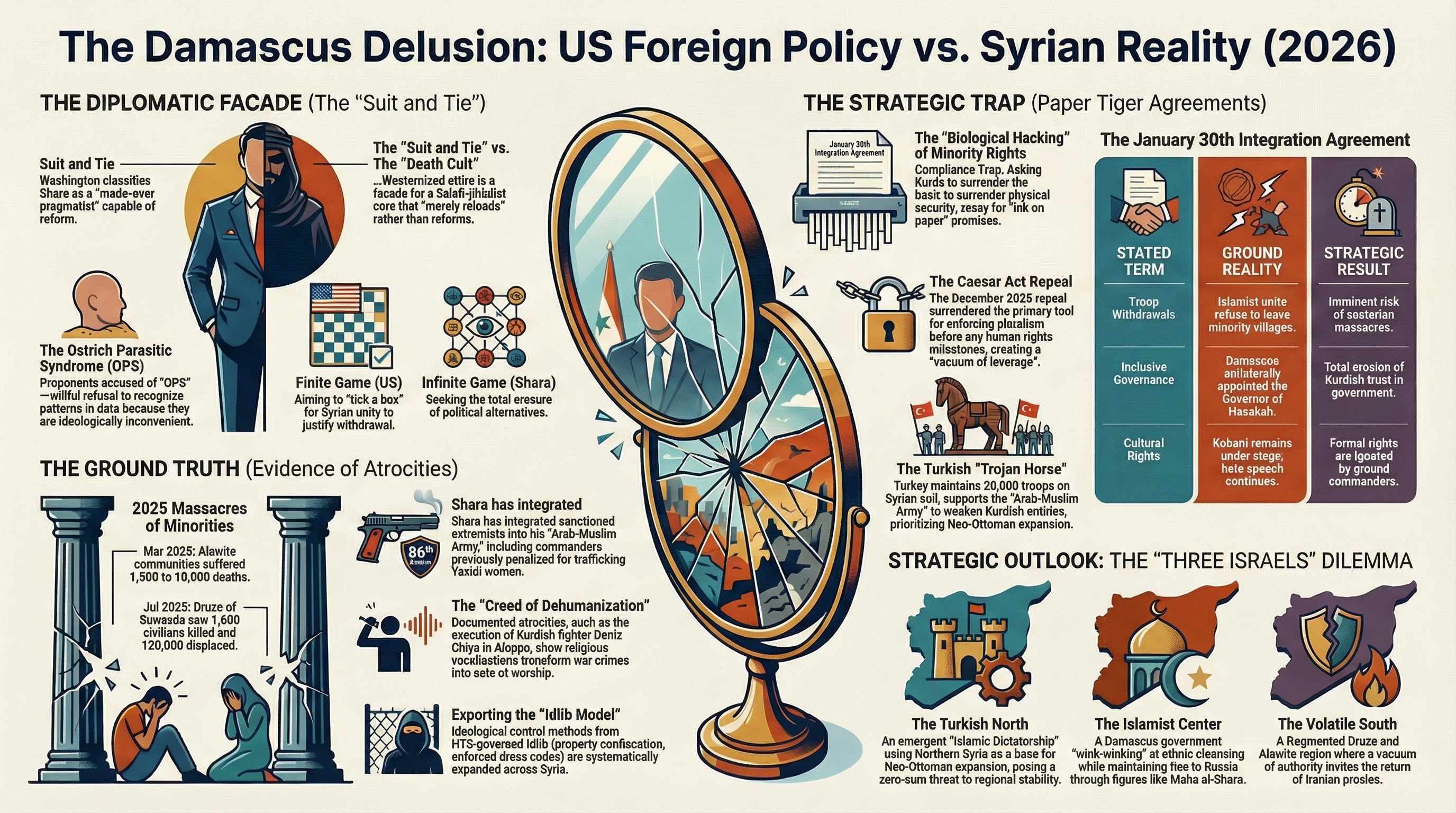
On February 10, 2026, the House Foreign Affairs Committee held a 3.5+ hour hearing—“Syria at a Crossroads: U.S. Policy Challenges Post-Assad”—to debate whether Washington’s current Syria posture is stabilizing a post-Assad landscape or simply managing an exit ramp. The witness table captured the fault lines: security and diplomacy realists (including Amb. James F. Jeffrey and Andrew J. Tabler), religious-freedom concerns (Nadine Maenza), and defense-policy framing (Dr. Mara Karlin).
I’ve watched the hearing in full so you don’t need to—and what makes it worth your time (in summary) is how clearly it exposes the central U.S. dilemma: conditional engagement vs. leverage, and “unity” on paper vs. security realities on the ground. That’s exactly where this new essay, “The Damascus Delusion,” plugs in: it reads the hearing’s optimistic premise as a dangerous category error—confusing a tactical rebrand with ideological change—and argues the U.S. is trading coercive leverage for promises it cannot enforce.
My core warning reframes the entire hearing as a test of whether Washington is verifying behaviour or rewarding presentation. I portray U.S. policy as a “finite game” of checking boxes toward withdrawal, while Damascus plays an “infinite game” of consolidating power indefinitely—making “engagement” less a pathway to pluralism than an accelerant for a new coercive order.
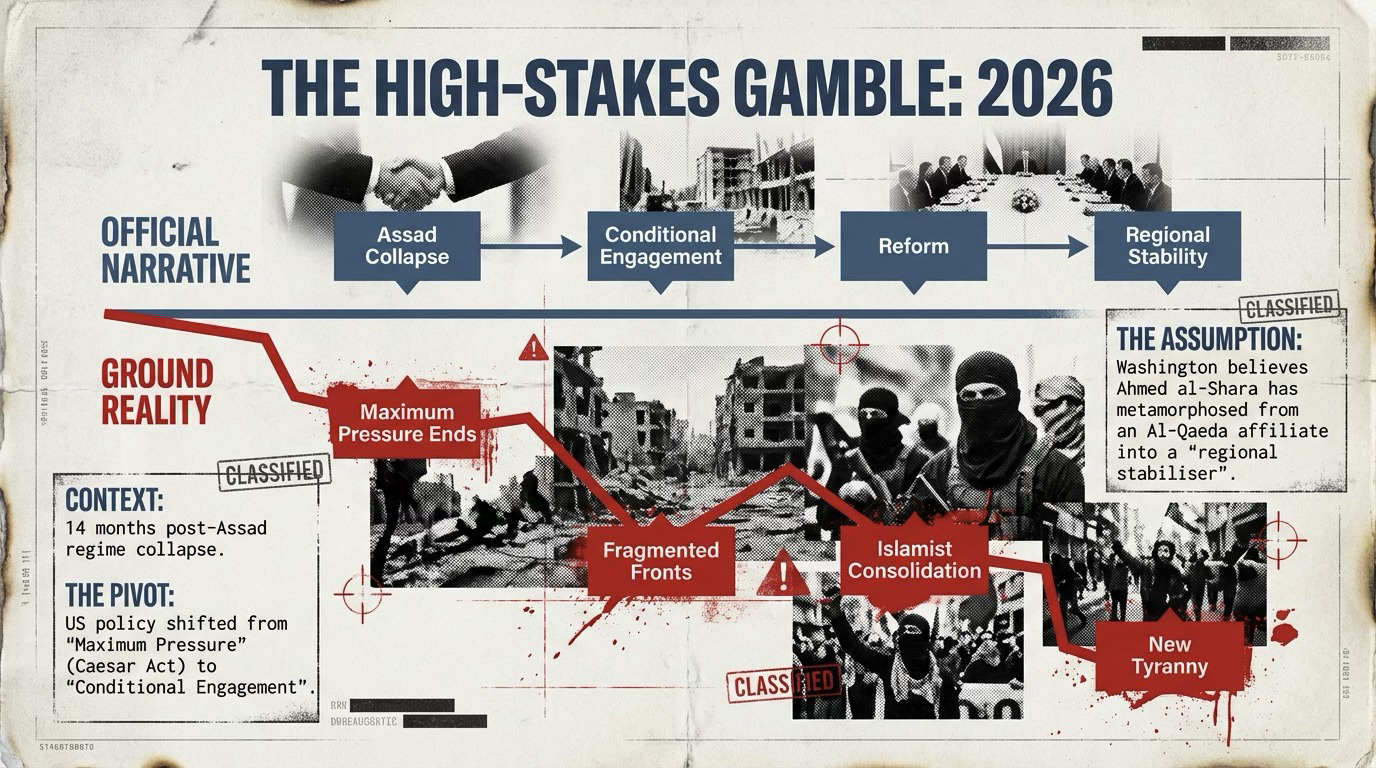
The High-Stakes Gamble
In early 2026, Syria exists in a state of terminal fragmentation. Fourteen months after the dramatic collapse of the Assad regime, Washington has pivoted from the “Maximum Pressure” of the Caesar Act to a high-risk policy of conditional engagement with Ahmed al-Shara. This shift is predicated on the belief that Shara, a former al-Qaeda affiliate, has undergone a pragmatic metamorphosis into a regional stabiliser. Shara is not merely a political actor; he represents the latest iteration of an Arab Imperium that relies on “narrative inversion”—systematically hijacking the language of human rights to cover for colonialist expansion. His celebrated “pragmatism” is likely a tactical infitāh (opening), serving not as a bridge to reform, but as a mask for conquest. However, a dangerous Damascus Delusion has taken hold within the Beltway—a fundamental failure to distinguish between Shara’s tactical distancing from Tehran and a genuine ideological reformation. By trading economic normalisation for unverified security promises, U.S. policy is currently paralysed by a misreading of Islamist evolution, betting the stability of the Levant on a suit-and-tie rebranding of a salafi-jihādist core. This policy shift reveals a catastrophic strategic asymmetry. To borrow the distinction made by James Carse, the United States is playing a Finite Game—aiming to tick an administrative box called “Syrian Unity” within a set timeframe to justify withdrawal. Shara, conversely, is playing an Infinite Game. He is not seeking a negotiated conclusion, but the indefinite continuity of power, aiming for total ideological consolidation and the erasure of alternatives. Washington is playing to close the file; Damascus is playing to eliminate the other players.
The Core Strategic Risks
The December 2025 repeal of the Caesar Act serves as a blank check, surrendering the only tool capable of enforcing pluralism before any verifiable human rights milestones were achieved. This is nothing but a premature surrender of leverage.
U.S. policy assumes Shara is a partner against Iran, ignoring that the Idlib model of Hay’at Tahrir al-Sham (HTS) is being exported throughout Syria now, replacing a secular tyranny with an Islamist dictatorship. This is nothing but a premature acceptance of a promise by an extremist movement to rebrand itself, while unleashing terror against minorities in Syria.
While Washington seeks a unified state, the ground reality is a collection of proxy-dominated fronts where Turkey and Russia retain deep-seated levers of control.
Emerging evidence screams that the transitional government is not-so-quietly facilitating the displacement of religious and ethnic minorities to consolidate a Sunni-Islamist suprematist power base. Ethnic cleansing of minorities can be carried out with a wink and nod to the jihadi forces that are part of the current Arab-Muslim army. The Alawis, the Druze and the Kurds have witnessed these winks in the past year.
This gamble risks a catastrophic failure to recognize the rise of a new tyranny. At the heart of this delusion is the enigmatic figure of Ahmed Shara.
The Suit and Tie Fallacy
The foundational assumption of current U.S. Levant policy is the classification of Shara as a viable partner. In post-conflict transitions, leadership perception dictates the flow of capital and legitimacy. Washington’s current strategy is built on the hope that Shara is a re-branded pragmatist; however, if the suit and tie is merely a diplomatic facade for a death cult ideology, the entire U.S. regional framework faces a systemic collapse.
Official Optimism vs. Hardline Skepticism
The internal debate in Washington highlights a chasm in intelligence interpretation:
Proponents like Ambassador Jeffrey argue Shara is a necessary realist. They cite his decade-long conflict with the Assad regime and his effectiveness in containing ISIS while in Idlib. This view posits that Shara’s desire to “liberate himself from his past” makes him a manageable asset against Iranian influence. However, this optimism betrays a severe case of Ostrich Parasitic Syndrome (OPS). These proponents are engaging in a wilful refusal to recognize clear patterns in data simply because those patterns are ideologically inconvenient. By betting on Shara, they are ignoring the Nomological Network of Cumulative Evidence—the vast, interconnected web of historical and behavioural data confirming that such regimes do not reform; they merely reload.
Sceptics, led by figures like Representative Perry, view this as a strategic trap. Perry’s assessment is definitive:
“You can trim the beard of an Islamist and you can dress him up in a suit... [but he] is not a whole lot different than ISIS.”
This skepticism in Washington echoes a darker parody long understood on the Arab street—specifically the bitter inversion of icons like Julia Boutros, whose revolutionary anthems are now heard with a cynical ear by a populace that knows their leaders are often “pimps” masquerading as victors. Just as the street has learned to decode the propaganda of the “resistance,” these Sceptics recognize that Shara’s Westernised suit and tie is merely a costume. They understand that beneath the diplomatic veneer lies a regime that, in the eyes of its victims, “kills, expels, and displaces more than the children of Hitler.”
From this perspective, Shara is not a reformed leader but an insurgent who has mastered the language of the West to secure the lifting of sanctions.
Ground Truth: Evidence of Atrocities
The “pragmatist” narrative is increasingly unsustainable when confronted with documented barbarism. Testimony and video evidence submitted to Congress confirm that Shara’s security apparatus remains a vehicle for sectarian terror:
1. Systematic Barbarism: Security forces have circulated footage of beheadings, the execution of entire families, and the desecration of female fighters’ bodies. This barbarism finds its most harrowing expression in the case of Denîz Chiya, the Kurdish fighter thrown from a rooftop in Aleppo. Crucially, as she fell, the perpetrator screamed Allahu Akbar. This vocalisation was not incidental; it served as the precise theological mechanism required to transform a war crime into an act of worship. This incident provides irrefutable proof that the Creed of Dehumanisation remains the operating system within Shara’s ranks, turning political enemies into religious sacrifices.
2. Sexual Violence: Widespread reports of rape used as a tool of war, particularly during the military’s recent pushes into minority neighbourhoods.
3. The 86th Division Smoking Gun: Shara has integrated hardened extremists into his Arab-Muslim army, most notably in the 86th Division. This unit is commanded by individuals previously sanctioned by the U.S. for the trafficking of Yazidi women and girls. We must explicitly connect the commanders of the 86th Division to the broader legacy of the Arab Imperium and its history of slavery. The systematic dehumanisation of Yazidis and Kurds currently witnessed on the ground mirrors the historical treatment of black Africans in Sudan (the Land of the Blacks), where slavery and genocide are not aberrations but established imperial traditions. This behaviour signals that for the 86th Division, these populations are not citizens to be integrated, but subjects to be enslaved or erased.
4. Ideological Export: Property confiscation and enforced religious dress codes, standard in HTS-governed Idlib, are now being enforced across the coastal and northern regions.
These findings suggest Shara is “wink-winking” at ethnic cleansing to solidify control, casting severe doubt on his legitimacy as a “president for all Syrians.”
The Paper Tiger Agreements: The Erosion of Minority Rights
For the Levant to achieve stability, pluralism is not just a moral goal but a strategic necessity. The U.S. relies on the “Syrian mosaic” of Christians, Druze, Alawites, and Kurds to prevent total state capture by any single extremist faction. However, the legal frameworks intended to protect these groups are proving to be paper tigers.
The January 30th Integration Agreement represents more than a strategic miscalculation; it is a mechanism of biological suicide. We are witnessing a geopolitical reenactment of the interaction between the nematomorph hair worm and the wood cricket. As described by evolutionary behavioural scientist Gad Saad, the parasite infects the cricket and chemically hijacks its navigational system, compelling the host to march straight into water—an environment fatal to the cricket but essential for the parasite’s reproductive cycle. By pushing for this “integration,” Washington is effectively asking the Kurds to override their evolutionary survival instincts. They are being guided to drown themselves in the “state” of Damascus, sacrificing the host body of the Autonomous Administration solely to allow the parasite of American bureaucratic withdrawal to complete its lifecycle.
The January 30th Integration Agreement Deconstructed
The centrepiece of U.S. policy for the Kurds is the January 30th Integration Agreement, designed to merge the Syrian Democratic Forces (SDF) into the Arab army.
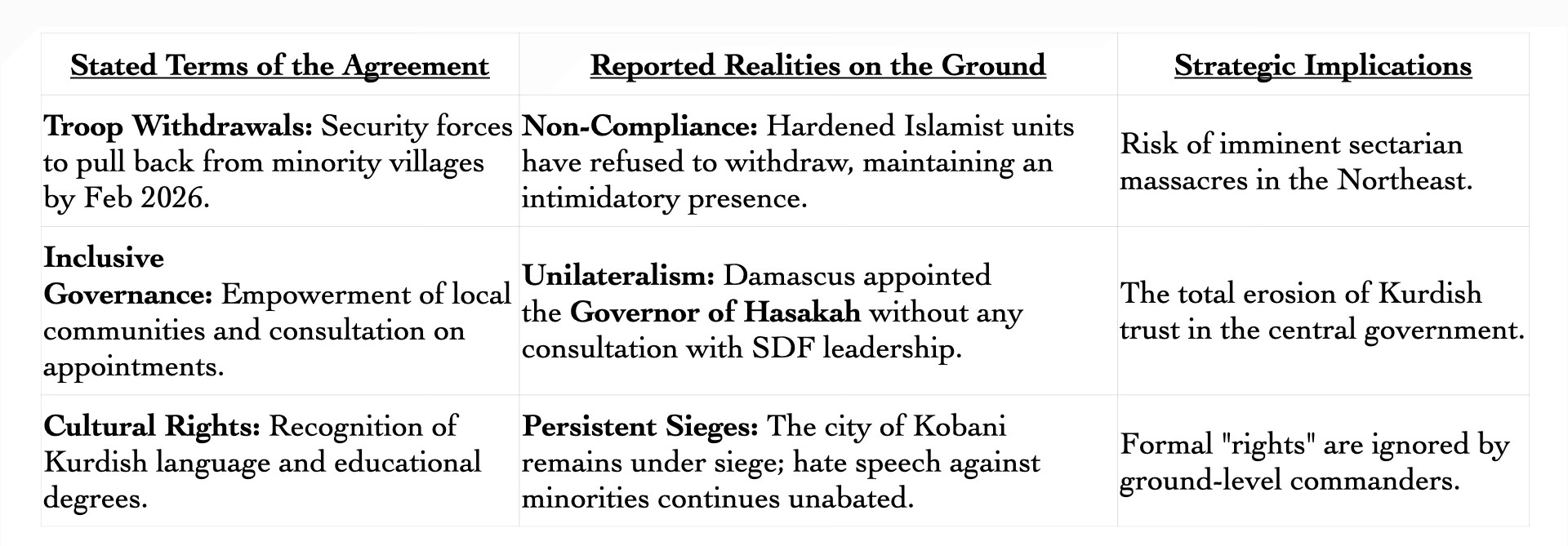
The Verdict on Human Rights: Strategic Inflection Points
The humanitarian toll of the transition has been catastrophic, marked by massacres that match the worst years of the civil war.
• Strategic Failure of Physical Security: In March 2025, Alawite communities faced horrific large-scale killings with estimates ranging from 1,500 to 10,000 dead. In July 2025, the Druze of Suwayda suffered a massacre of 1,600 civilians and the displacement of 120,000.
• Strategic Failure of Institutional Integration: The military integration is stalled because Shara insists on individual integration (dissolving the SDF) while the Kurds demand brigade-level integration to protect their people from the death cult elements in the national army.
• The Compliance Trap: Ultimately, the demand for integration is not a bureaucratic procedure; it is a Compliance Trap relying on sophisticated Biological Hacking. By strategically addressing the Kurds as “descendants of Saladin” (The Saladin Gambit), Shara is attempting to induce suicidal empathy. This rhetorical manoeuvre is designed to trick the Kurdish leadership into lowering their evolutionary defences, mistaking a predator masquerading as kin for a historical ally, and walking willingly into their own erasure.
• Strategic Failure of Pluralistic Legitimacy: By allowing ISIS-linked mayors to fill local roles and maintaining an interim constitution that requires the president to be Muslim, Shara has effectively signalled that minorities remain second-class citizens.
The Turkish Trojan Horse: Strategic Fragmentation
Turkey is the primary architect of the Shara administration, providing the weaponry, training, and logistical support that enabled the post-Assad consolidation. This creates a fundamental tension: Turkey is a NATO ally, but its regional ambitions are a Trojan Horse for Syrian fragmentation.
The Neo-Ottoman Ambition
As noted by Representative Self and Nadine Maenza, President Erdogan is pursuing an expansionist Neo-Ottoman vision. Turkey currently maintains 20,000 troops on Syrian soil and has explicitly stated they are “not leaving” occupied areas like Efrin. In these zones, the Turkish-backed Syrian Arab-Muslim army terrorises religious minorities through kidnapping-for-ransom, torture, and the desecration of cemeteries.
We must explicitly expand this threat assessment beyond the borders of Syria. A unified, Turkish-controlled Syria represents a catastrophic strategic threat to Israel. This scenario validates the Turkey Thesis, which argues that Ankara has evolved from a regional competitor into a Zero-Sum Enemy. Faced with this encroachment, Israel may be forced to abandon diplomatic niceties in favor of a “Porcupines Making Love” strategy—employing sharp, surgical force to block Turkish consolidation in the south rather than risking a close embrace with a hostile neo-imperial power.
Fragmentation
Turkey serves as the ultimate spoiler for Syrian unity. By pushing Shara to launch offensives against Kurds in Aleppo, Ankara ensures the SDF remains a weakened, besieged entity rather than a partner in a “unified” state. Shara appears less like a sovereign leader and more like a complicit partner in Turkish expansionism. This dependency creates a fractured Syria where Ankara, not Damascus, dictates the security architecture of the North.
The Vacuum of Leverage: A Critique of U.S. Policy Tools
Leverage is the currency of Levant diplomacy. By shifting from economic pressure to soft-power “hope,” the U.S. has entered a negotiation where it has already paid the price of admission without receiving the goods.
The Caesar Act Repeal: A Strategic Blunder
The repeal of the Caesar Act was an act of “over-optimism” that surrendered tremendous leverage. While a “snap-back” is theoretically possible, the momentum of multi-billion dollar investment deals—such as those recently signed by Saudi Arabia—makes the reimposition of sanctions diplomatically messy. The U.S. gave up the “big stick” before Shara even withdrew his troops from Kurdish villages.
The Soft Power Deficit: Flying Blind
The destruction of USAID has left the U.S. strategically blind. Chairman Mast’s critique of the agency—citing the diversion of $10 million in meals to Al-Qaeda fighters and the funding of “transgender seminars” in Bangladesh—illustrates why the U.S. stabilisation toolbox was discarded. However, without these tools, the U.S. lacks the ground truth necessary to monitor local governance or provide alternatives to extremist recruitment in rural areas. Without a 24/7 embassy presence in Damascus, Washington is essentially “flying blind,” relying on the assurances of a former adversary.
This exposes the fatal Enforcer problem at the heart of the strategy. As Israeli Defense Minister Yoav Gallant has noted with battlefield realism, diplomatic agreements are merely “ink on paper” unless the victor remains “at the top of the hill” holding the “big hammer.’”Given that the United States has explicitly signalled it has no interest in a long-term military presence, there is no viable enforcer for these agreements. Consequently, the Kurds are being asked to surrender their “hammer”—their hard-won physical leverage—in exchange for a promise that will expire the exact moment the US departs.
The Three Israels and the Future of the Levant
Syria in 2026 is no longer a sovereign state; it is a collection of fronts. This fragmentation has created a Three Israels security dilemma:
1. The Turkish North: An emergent “Islamic Dictatorship” in Turkey using Northern Syria as a base for Neo-Ottoman expansion.
2. The Islamist Center: A Damascus government that is wink and not at ethnic cleansing while failing to purge sanctioned commanders from its ranks.
3. The Volatile South: A fragmented Druze and Alawite region where the vacuum of authority invites the return of Iranian proxies.
The Strategic Outlook
The long-term risk is a return to regional chaos. Russia remains entrenched, with Shara’s own brother, Maha al-Shara, serving as a Russian-educated link to Moscow. Russia continues to use its Syrian bases as a logistical hub for African operations, ensuring that the Damascus Delusion has global consequences.
Final Verdict
The bet on Ahmed al-Shara is not a masterstroke of realism; it is a catastrophic failure to recognise the rise of a new Islamist tyranny. Realism requires verifiable actions, yet in Damascus, the actions consist of beheadings, unilateral appointments, and the integration of war criminals into the 86th Division. If the U.S. continues to provide “blank checks” while allies of the West—the Kurds, Christians, and Druze—are methodically cleansed, the Damascus Delusion will eventually shatter, leaving a Levant more radicalised and dangerous than the one we sought to reform. Currently, the rhetoric in Washington is a mirage; the reality in Damascus is a death cult in a suit.
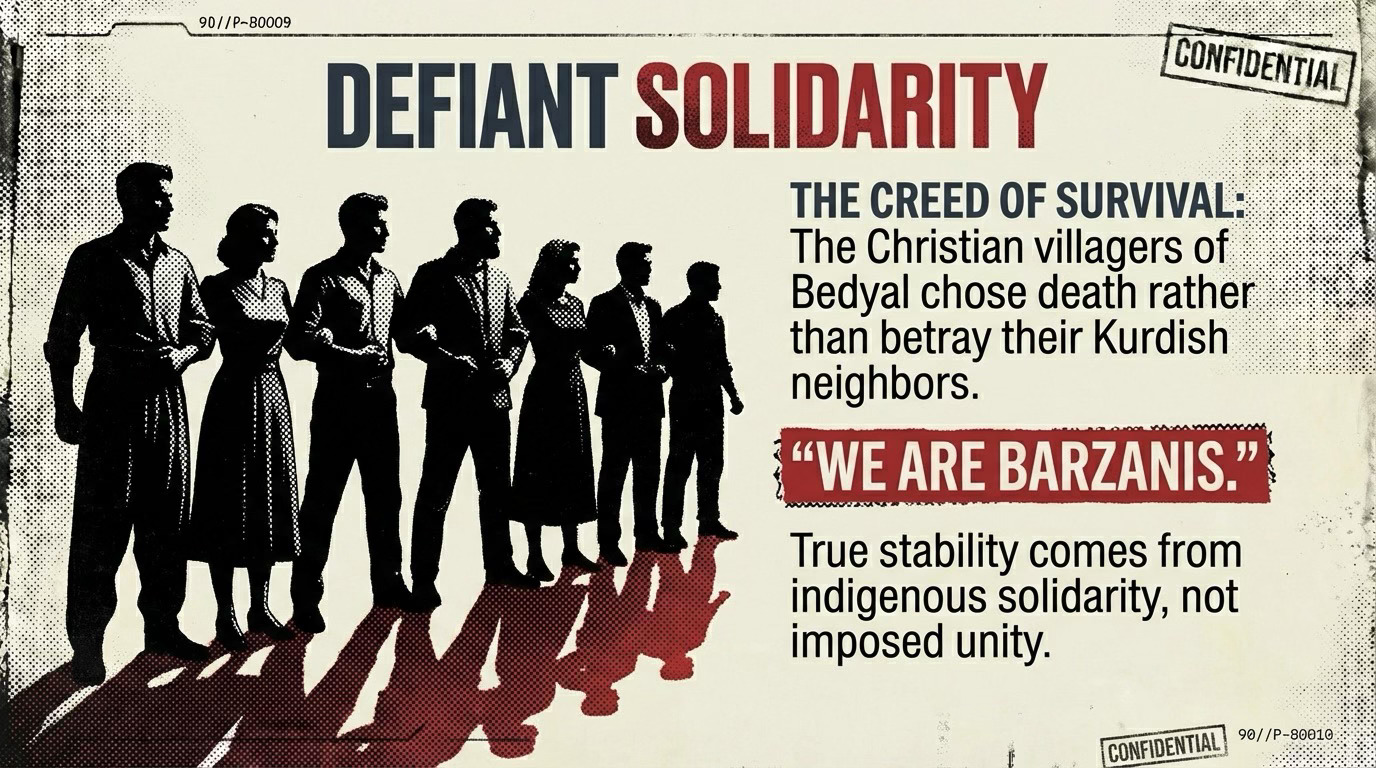
Ultimately, we must contrast the Damascus Delusion with the only proven antidote: the Creed of Survival rooted in Defiant Solidarity. This spirit was epitomised by the Christian villagers of Bedyal, who, when threatened with extermination, chose death rather than betray their Kurdish neighbors, famously declaring, “We are Barzanis.” This legacy teaches us that true stability comes from empowering these indigenous solidarities, not from imposing a suit and tie tyranny from above.
Finally, a strategic correction requires Washington to adopt the Three Israels doctrine articulated by Dan Schueftan. The current policy of propping up “moderates”—who are frequently radicals in disguise—has failed. Instead, the United States needs strong, fierce allies capable of managing regional chaos without the need for American blood. Just as Israel serves as a self-reliant anchor, a distinct and fortified Kurdish entity could function as a necessary bulwark, securing the region through the reliability of indigenous strength rather than the fragility of diplomatic wishful thinking.
References:
Khaled Salih, 20260211, “The Paradox of Israeli Power Updated.” https://khaledsalih.substack.com/p/the-paradox-of-israeli-power-updated
—, 20260125, “Written in Blood, offered ink on paper: Why Barrack’s Plan is a Death Warrant for the Kurds.” https://khaledsalih.substack.com/p/written-in-blood-offered-ink-on-paper
—, 20260121, “Why Washington’s Push for Syrian “Integration” is a Death Sentence.” https://khaledsalih.substack.com/p/why-washingtons-push-for-syrian-integration
—, 20260120, “The anfāl Playbook: Save The Kurds in Syria Now.” https://khaledsalih.substack.com/p/the-anfal-playbook-save-the-kurds
—, 20260116, “On the Fall of Deniz and the Dawn of Rojava.” https://khaledsalih.substack.com/p/on-the-fall-of-deniz-and-the-dawn
—, 20251118, “The Song of the Oppressor and the Parody of the Oppressed.” https://khaledsalih.substack.com/p/the-song-of-the-oppressor-and-the
20251115, “The Arab World’s Sacred Lies — and the Parody That Finally Told the Truth.” https://khaledsalih.substack.com/p/the-arab-worlds-sacred-lies-and-the


