“The Cure for Cancer”
Israel’s 12-Day Campaign and the Strategic Fulfillment of a 30-Year Mission
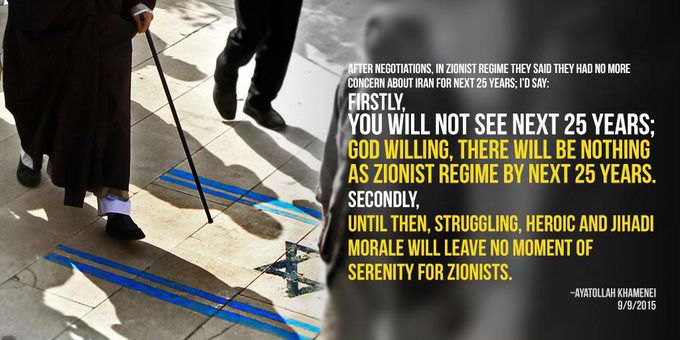
Possibly Ayatollah Khamenei walking on the Israeli flag, as he posted a prophecy on September 9, 2015, declaring in bold letters that Israel would cease to exist within 25 years.
“Imagine you’re a scientist working on a cure for cancer and after 30 years, you finally discover it!”
–– A Mossad Officer
A Mission Three Decades in the Making
Over the past decade, Ayatollah Ali Khamenei and other high-ranking Iranian officials have intensified their rhetoric, consistently branding Israel as a “cancerous tumor” that must be eradicated, signaling an unyielding hostility toward the Jewish state. In 2012, Khamenei declared, “Israel is a cancerous tumor that should be cut and will be cut,” openly endorsing groups opposing Israel. This rhetoric escalated in 2018 when he tweeted, “#Israel is a malignant cancerous tumor in the West Asian region that has to be removed and eradicated,” and again in 2020, calling Israel a “long-lasting virus” to be eliminated through Palestinian jihad. In 2023, he reiterated, “This cancer will definitely be eradicated at the hands of the Palestinian people.” Mojtaba Hosseini, Khamenei’s representative in Iraq, echoed this in 2020, predicting Israel’s demise within 25 years as a “cancerous growth.” This escalating narrative, rooted in Iran’s revolutionary ideology, underscores a relentless commitment to Israel’s destruction, framed as a regional and religious imperative.
On June 13th 2025, Israel embarked on a military campaign to end Iran’s illusion of certainty, security and self-righteousness in a defining statement that was not only about missiles, airstrikes, or geopolitics, but as a tsunami of creativity and boldness: “Imagine you’re a scientist working on a cure for cancer and after 30 years, you finally discover it,” a Mossad officer explained recently. That cure was delivered in 12 days and President Trump was quick to call it the “12-Day War.” People involved in the preparation saw it not just as a military victory, but the culmination of decades of singular focus, sacrifice, and strategic patience. The 12-day war was a tactical strike and the endpoint of a generational mission that will redefine Israeli security doctrine and regional power dynamics and beyond.
This essay explores the long arc of this mission, from the Mossad’s early obsession with Iran’s nuclear aspirations to the transformative consequences of the 2024 war, interweaving external commentary and scholarship on the evolution of Israeli intelligence, Iranian strategy, and the shifting sands of Middle Eastern alliances.
The Genesis of the Mossad’s Iran Doctrine
The Mossad’s focus on Iran began, according to one officer, in the early 1990s, when Israel identified Tehran’s intent to acquire nuclear weapons. For three decades, Mossad allocated roughly 80% of its time and energy toward countering that threat. This strategic shift was institutionalized under Meir Dagan’s leadership from 2002 onward, when the Iranian file became the top operational priority, surpassing threats from Syria, Lebanon, or Palestinian groups.
This shift mirrored a larger strategic realignment within Israeli intelligence. Authors like Ronen Bergman [1] have documented how Israel’s security agencies became laser-focused on preemptive and often covert strategies—sabotage, assassinations, cyberwarfare—to counter nuclear proliferation threats. Operations like Stuxnet (2010), the assassination of Iranian scientists, and the theft of nuclear archives in 2018 exemplify this deep-rooted, remarkably sophisticated, campaign.
The Missed Opportunity and the Trauma of Diplomacy
The officer mentioned above identifies a painful missed opportunity around 2012–2013. Iran was militarily vulnerable, Syria was consumed by civil war, and Hamas was relatively weak. But diplomacy intervened. Secret U.S.-Iranian talks, followed by the 2015 Joint Comprehensive Plan of Action (JCPOA), derailed what Mossad officers believed could have been a low-cost decisive blow.
This sentiment—of betrayal by the international community—is well echoed in Israeli political and military discourse. As former Israeli Prime Minister Benjamin Netanyahu pointed out in his 2015 U.S. Congress address, the JCPOA “paves Iran’s path to the bomb” rather than blocking it. The Mossad officer’s claim that the deal “tied our hands,” reflects this wider institutional frustration, where diplomacy was seen not as a safeguard, but as a constraint on action. Khamenei’s quote above was posted shortly after the JCPOA was finalised.
October 7 and the Iranian Miscalculation
What ultimately reignited Israel’s opportunity was Iran’s direct missile strike in April 2024. This marked a threshold moment—transforming a “cold war fought via proxies and espionage into a conventional hot war.” The analogy here is apt. Just as Pearl Harbor provoked U.S. entry into WWII, Iran’s decision to fire directly from its own territory gave Israel—and the U.S.—a casus belli for direct retaliation.
Trump’s re-election in November 2024, combined with Iran’s botched assassination plots against Trump and Pompeo, ensured Iran’s fate. The officer notes, “By April 2024, everyone understood that this war was going to end with Iran’s nuclear program being set back by many years.” It was, finally, the green light Mossad had been preparing for since the Clinton administration.
Dominance Through Intelligence and Air Superiority
When asked what enabled Israel’s overwhelming victory, the officer singles out two factors: intelligence and air dominance. Unlike wars built on sudden mobilization, this campaign rested on a trove of intelligence gathered over years—perhaps decades. That foundation enabled rapid targeting and neutralization of Iran’s air defenses, allowing Israel to operate with impunity over Western Iran.
Indeed, this mirrors the IDF’s broader doctrine of “deterrence through dominance,” where technological and informational supremacy offset demographic and geographic limitations. The officer describes Iran’s air force as “outdated, poorly maintained,” with real threats stemmed only from ground-based assets. Once those were neutralized, the war became, in his words, “one-sided.”
The Road Not Taken: Why Regime Change Was Not Pursued
Despite military success, Israel stopped short of targeting Iran’s leadership. The officer emphasizes that while “Khamenei deserves it,” targeting a sitting head of state carries political and strategic risks that outweigh short-term benefits. International norms, potential escalation, and the precedent it would set kept Israel’s hand restrained.
Still, he advocates a bold shift: from military deterrence to regime change. “You can’t kill the snake by cutting off its tail. You need to go for the head.” Here, the officer articulates a view long held by many in Israeli security circles—that it is Iran’s regime, not just its weapons, that poses the existential threat.
This sentiment aligns with neoconservative views in the U.S. post-Iraq, though with caution. Experts like Ray Takeyh and Reuel Marc Gerecht (Council on Foreign Relations) have similarly argued that no lasting peace is possible without regime transformation in Tehran. The Mossad officer echoes this, citing Iran’s internal fragility—minority discontent, lack of allies, and economic strain—as factors that could be harnessed.
A New Regional Order: Post-War Realignments
The war’s regional aftermath is already taking shape. The officer notes a shift in Lebanon, where open criticism of Hezbollah is now tolerated, and even Syria is discussing normalization with Israel. Most dramatically, Gulf States are moving closer to Israel, weary of letting the Palestinian cause holding them back.
Indeed, the Abraham Accords (2020) were only the beginning. As analysts like Hussein Ibish (Arab Gulf States Institute) have noted, the Sunni Arab monarchies prioritize countering Iran over supporting Hamas or Fatah. The officer concludes that October 7 was designed to block Saudi-Israel normalization—but it failed.
This new power dynamic offers Israel a diplomatic opening: to isolate Iran further, project deterrence, and reshape the Middle East before the next U.S. presidential election.
Strategic Relief, Not Strategic Complacency
The 12-Day War, for the Mossad officer and his colleagues, was the end of the beginning, not the end itself. The war fulfilled a generational mission—halting Iran’s nuclear program, vindicating decades of covert efforts, and altering regional power structures. Yet the officer warns against complacency. Iran will adapt. It will rebuild. And until the regime falls, the existential threat remains.
The analogy to curing cancer is not just metaphorical. It captures the deeply emotional, professional, and moral gravity with which Israeli operatives view their work. They see themselves not as warmongers, but as guardians—guarding not only Israel’s security, but, in their eyes, the stability of the entire region. For now, the cure has been found. But the disease, as the Mossad officer insists, is ideological, institutional, and still alive.
[1] Ronnn Bergman, 2018, Rise and Kill First: The Secret History of Israel’s Targeted Assassinations. New York: Random House.


