The Continuity Error
How bad explanations survive by mistaking transmission for truth
17 June 2026
As I am deeply concerned with explanation, error-correction, and how progress depends on dropping bad explanations in the Deutschian sense, I have come to see a further problem that helps illuminate the architecture of closed systems.
Let us focus on the continuity error.
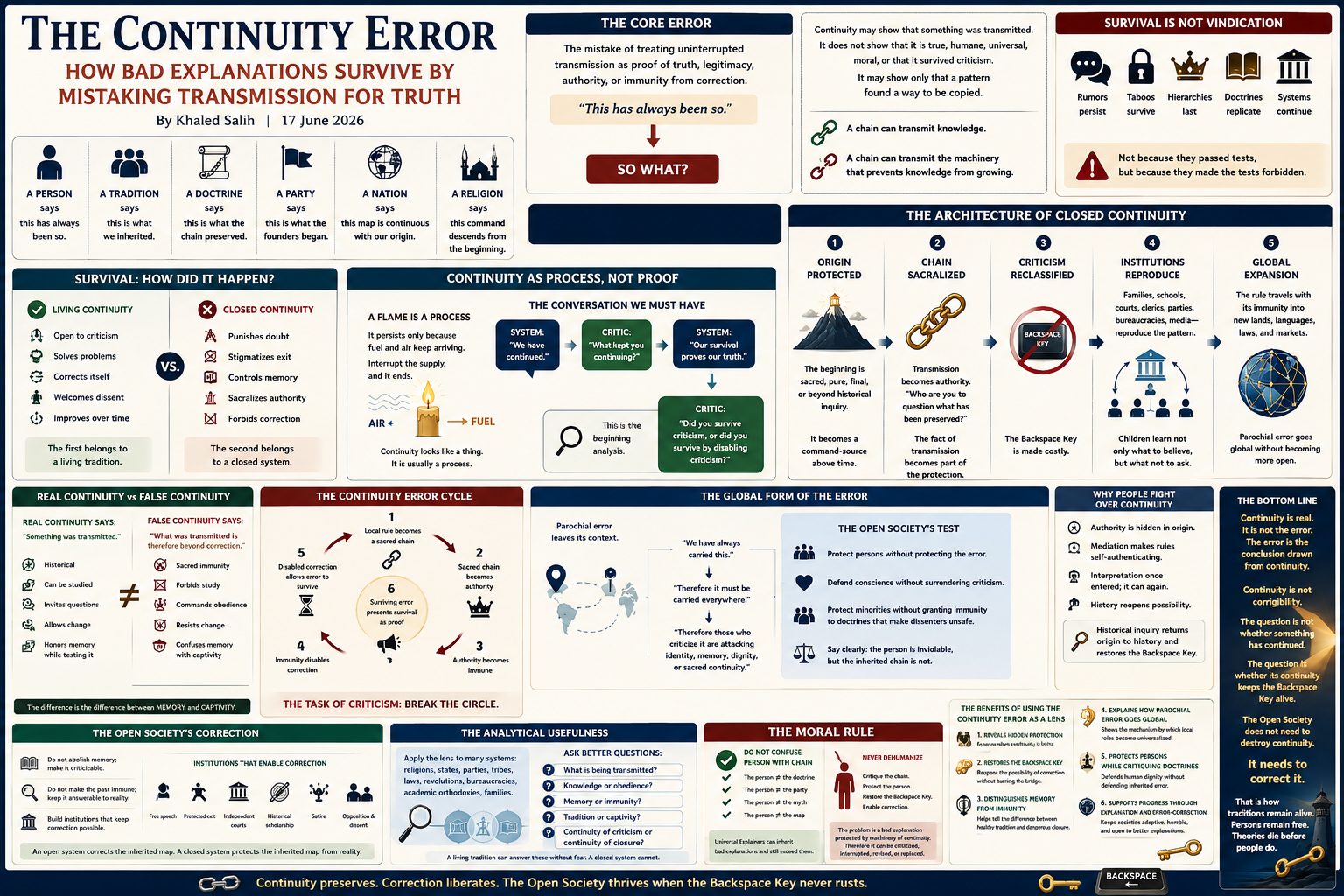
The term begins from David Deutsch’s discussion of continuity in The Beginning of Infinity, especially in relation to the multiverse and the mistaken assumption that there must be one single, privileged, unbroken thread of identity moving through time. But the idea can be extended carefully beyond physics. At the civilizational level, the continuity error is the mistake of treating uninterrupted transmission as proof of truth, legitimacy, authority, or immunity from correction.
A person says: this has always been so.
A tradition says: this is what we inherited.
A doctrine says: this is what the chain preserved.
A party says: this is what the founders began.
A nation says: this map is continuous with our origin.
A religion says: this command descends from the beginning.
The fallibilist question is simple:
So what?
Continuity may show that something was transmitted. It does not show that what was transmitted is true. It does not show that it is humane. It does not show that it is universal. It does not show that it survived criticism. It may show only that a pattern found a way to be copied.
That distinction is decisive.
A chain can transmit knowledge.
A chain can also transmit the machinery that prevents knowledge from growing.
Survival is not vindication
Human beings often confuse survival with truth. We assume that if a belief, custom, law, ritual, authority, or institution has lasted for centuries, it must contain some deep wisdom. Sometimes it does. Some traditions endure because they solve real problems, preserve real knowledge, protect human dignity, or keep open the conditions under which error can be found and corrected.
But endurance alone proves very little.
A rumor may persist without being true.
A taboo may survive without being moral.
A hierarchy may last without being just.
A doctrine may replicate without being a good explanation.
A system may continue not because it passed tests, but because it made the tests forbidden.
This is why the continuity error is so dangerous. It takes a weak fact — “this has continued” — and turns it into a strong command — “therefore it must not be questioned.”
That is not knowledge.
That is protected inheritance.
The crucial question is not whether a system has survived. The crucial question is: by what means did it survive?
Did it survive by remaining open to criticism?
Did it survive by solving problems better than rival explanations?
Did it survive by correcting itself when evidence, suffering, dissent, or moral reality exposed error?
Or did it survive by punishing doubt, stigmatizing exit, controlling memory, sacralizing authority, and teaching children that criticism is betrayal?
The first kind of continuity belongs to a living tradition.
The second belongs to a closed system.
Continuity as process, not proof
A flame looks like a thing. It sits on the wick, bright and steady, and we speak of it as if it were an object. But a flame is a process. It persists only because fuel keeps arriving from below and air keeps arriving from around it. Interrupt the supply, and the flame does not negotiate its way into becoming a smaller flame. It ends.
Continuity is often like that.
A doctrine, taboo, party, state, sacred memory, or inherited command may look like a thing. It may seem solid, ancient, inevitable, and self-sustaining. But its continuity is usually a process. It persists because something keeps supplying fuel: fear, reward, shame, law, family pressure, ritual, education, punishment, status, censorship, reverence, money, armed power, bureaucratic habit, or institutional inertia.
Once this is understood, the continuity error becomes visible.
The system says:
“We have continued.”
The critic asks:
“What kept you continuing?”
The system says:
“Our survival proves our truth.”
The critic asks:
“Did you survive criticism, or did you survive by disabling criticism?”
This is the beginning of serious analysis.
The architecture of continuity
Continuity is not merely repetition. In a closed system, continuity has an architecture.
First, an origin is protected.
The beginning is made sacred, pure, final, or beyond ordinary historical inquiry. It is no longer treated as a human event inside time, but as a command-source that stands above time. Once the origin is protected, later generations are not invited to investigate it. They are instructed to inherit it.
Second, the chain is sacralized.
Transmission becomes authority. The fact that something was handed down becomes part of its protection. The question “Is it true?” is displaced by “Who are you to question what has been preserved?”
Third, criticism is reclassified.
Doubt becomes corruption. Exit becomes betrayal. Innovation becomes deviance. Historical inquiry becomes desecration. Satire becomes aggression. The Backspace Key is made costly.
Fourth, institutions reproduce the pattern.
Families teach the child not only what to believe, but what not to ask. Schools preserve approved memory. Courts protect inherited classifications. Clerics defend authority. Parties guard founding myths. Bureaucracies normalize the inherited map. Public shame enforces the boundary before formal punishment arrives.
Fifth, the continuity becomes global.
The old rule travels beyond its original ecology. It enters new countries, new languages, new media, new institutions, new legal environments, and new grievance markets. But it carries its immunity with it. It does not expand by becoming more open to correction. It expands by demanding that new realities submit to the old map.
This is how parochial error goes global.
Not because every local inheritance is false.
Not because every tradition is dangerous.
Not because continuity itself is evil.
The danger begins when a historically bounded rule mistakes its transmission for universality and its continuity for immunity.
Real continuity and false continuity
We should not make the crude mistake of denying continuity altogether. Continuity is real. Texts are transmitted. Rituals are repeated. Institutions preserve memory. Families carry stories. Languages survive through speech. Laws develop through precedent. Identities can endure across catastrophe.
The problem is not continuity.
The problem is what is inferred from continuity.
Real continuity says:
“Something was transmitted.”
False continuity says:
“What was transmitted is therefore beyond correction.”
Real continuity is historical.
False continuity is sacred immunity.
Real continuity can be studied.
False continuity forbids the study.
Real continuity invites the question: what changed, what remained, what was selected, what was forgotten, what was imposed, what was corrected?
False continuity says: the chain commands you.
A rational tradition can honor continuity without worshipping it. It can say: we inherited this, therefore we must understand it, test it, repair it, and sometimes abandon parts of it.
A closed tradition says: we inherited this, therefore do not test it.
The difference is the difference between memory and captivity.
The continuity error and the anti-rational memeplex
An anti-rational memeplex survives by converting continuity into authority.
It does not merely transmit claims. It transmits the conditions under which those claims remain protected. It builds constructors of continuity: rituals, laws, schools, punishments, rewards, taboos, reputations, family expectations, sacred stories, and institutional reflexes that reproduce the same pattern again and again.
This is why it is not enough to ask what the doctrine says. One must ask what the doctrine makes possible or impossible.
Can the person leave?
Can the child ask?
Can the scholar historicize?
Can the woman refuse?
Can the artist satirize?
Can the dissenter speak?
Can the law revise the inherited premise?
Can the sacred memory be compared with rival evidence?
Can the founding story be returned to history?
If not, then continuity is no longer merely memory. It has become architecture.
The anti-rational system says:
“Because the chain has continued, the command is true.”
Then:
“Because the command is true, criticism is corruption.”
Then:
“Because criticism is corruption, correction must be forbidden.”
That is the continuity error at civilizational scale.
It is not simply that an old idea survives. It is that the old idea has learned to use its survival as a defense against criticism.
The global form of the error
A parochial error becomes global when a local rule, local authority, local memory, local command, or local survival procedure travels beyond its original context while refusing the correction that new contexts should force upon it.
That is the difference between universality and universalized parochialism.
A universal explanation expands by surviving criticism in new environments. It solves problems beyond its origin. It becomes stronger because it becomes more criticizable. It can cross borders because reality, not inherited immunity, supports it.
A universalized parochialism expands differently. It carries a local map into new environments and demands that reality conform to it. It does not ask what the new context reveals. It asks how the new context can be subordinated to the old command.
This is continuity error gone global.
The system says:
“We have always carried this.”
Then:
“Therefore it must be carried everywhere.”
Then:
“Therefore those who criticize it are attacking identity, memory, dignity, or sacred continuity.”
The Open Society then faces its hardest test.
It must protect persons without protecting the continuity error.
It must defend conscience without surrendering criticism.
It must protect minorities without granting immunity to doctrines, taboos, or authorities that make dissenters unsafe inside those minorities.
It must say: the person is inviolable, but the inherited chain is not.
Why people fight over continuity
Continuity is fought over because authority is hidden inside it.
If the origin becomes historical, the command becomes criticizable.
If the chain is mediated, the present rule is no longer self-authenticating.
If the text passed through human language, memory, recitation, selection, canonization, interpretation, and law, then the text is not self-interpreting.
If the founding age was contested, then the restored founding age is not an obvious command but a political project.
If interpretation entered the process once, interpretation can enter again.
If the tradition changed before, it can change now.
This is why closed systems fear historical inquiry. Historical inquiry does not merely add information. It reopens possibility. It breaks the spell of inevitability. It shows that what is presented as eternal may have passed through human hands.
To return an origin to history is to restore the Backspace Key.
That is why philology, archaeology, textual criticism, satire, apostasy, women’s refusal, rival memory, and open scholarship are so dangerous to closed systems. They do not merely challenge one belief. They challenge the continuity-claim by which the whole system protects itself.
The Open Society’s correction
The Open Society does not solve the continuity problem by abolishing memory. A society without memory is not open. It is disoriented.
The Open Society solves the problem by making memory criticizable.
It does not say: forget the past.
It says: do not make the past immune.
It does not say: dishonor the ancestors.
It says: do not force the living to obey the ancestors’ errors.
It does not say: all inheritance is oppression.
It says: inheritance must remain answerable to reality.
This is why the Open Society needs institutions that keep correction possible: free speech, protected exit, independent courts, historical scholarship, satire, opposition, internal dissent, public criticism, and the peaceful replacement of failed authority.
The Open Society is not valuable because it has no continuity. It is valuable because its continuity includes correction.
That is the difference.
A closed system continues by protecting the inherited map from reality.
An open system continues by allowing reality to correct the inherited map.
The analytical usefulness of the concept
The continuity error is useful because it lets us diagnose many systems without reducing persons to them.
It can be applied to religions, states, parties, tribes, legal orders, revolutionary movements, bureaucracies, national myths, academic orthodoxies, and even families.
Wherever a system says “this has continued, therefore it must not be questioned,” the continuity error is present.
Wherever the age of an institution is used to protect it from criticism, the continuity error is present.
Wherever founding sacrifice is used to silence present victims, the continuity error is present.
Wherever a legal precedent becomes sacred because it is old, the continuity error is present.
Wherever a party treats loyalty to its founders as immunity from correction, the continuity error is present.
Wherever a tradition teaches the child to revere the chain before testing the claim, the continuity error is present.
The concept helps us ask better questions:
What is being transmitted?
Knowledge or obedience?
Memory or immunity?
Tradition or captivity?
Continuity of criticism or continuity of closure?
A living tradition can answer those questions without fear.
A closed system cannot.
The moral rule
The continuity error must never be used to dehumanize the people who carry inherited systems. That would be morally obscene and epistemologically false.
The person is not the chain.
The person is not the doctrine.
The person is not the party.
The person is not the founding myth.
The person is not the map.
Human beings are Universal Explainers. They can inherit bad explanations and still exceed them. They can defend errors and still correct them. They can be captured by continuity and still recover criticism.
That is the foundation of optimism.
If the problem were biological, criticism would be futile. If the problem were ethnic, the analysis would be indecent. If the problem were destiny, there would be no point writing. But if the problem is a bad explanation protected by machinery of continuity, then it can be criticized, interrupted, revised, or replaced.
The continuity error is severe, but it is not fate.
No chain is sacred merely because it is unbroken.
No system is true merely because it survived.
No authority is final merely because it is old.
No person should be sacrificed to preserve the illusion that inherited error cannot be corrected.
Conclusion
The continuity error is the mistake of treating transmission as truth, survival as vindication, inheritance as command, and memory as immunity from criticism.
It is one of the deepest mechanisms by which parochial error goes global.
A local rule becomes a sacred chain.
A sacred chain becomes authority.
Authority becomes immune.
Immunity disables correction.
Disabled correction allows error to survive.
Surviving error then presents survival as proof.
The circle closes.
The task of criticism is to break that circle.
Continuity is not corrigibility.
A chain can preserve wisdom, but it can also preserve the machinery that prevents wisdom from growing. The question is not whether something has continued. The question is whether its continuity keeps the Backspace Key alive.
The Open Society does not need to destroy continuity.
It needs to correct it.
That is how traditions remain alive.
That is how persons remain free.
That is how theories die before people do.


