The Civilization That Discovered It Did Not Know
8 October 2026
Note
I rarely find a political speech that makes me want to return to first principles.
Marco Rubio’s recent speech beneath the Acropolis did.
Then I listened to Susan Kokinda discussing it on Promethean Updates. She challenged her viewers with a deceptively simple question:
“Do you believe there are universal principles?”
I wanted to answer her.
Not by choosing sides in American politics. Not by dismissing Rubio’s defense of Western civilization. And not by treating Susan’s question as a rhetorical trap.
I wanted to take it seriously enough to ask what follows from it.
If the universe is intelligible, does that make our explanations of it correct? If human beings can discover universal principles, does that give any civilization privileged ownership of knowledge? And if humanity possesses what David Deutsch calls the capacity to be universal explainers, what should political institutions exist to protect?
My conjecture is that the greatest civilizational achievement is not the possession of correct answers. It is the creation of conditions under which answers can be criticized, improved, and replaced.
That possibility leads me from Athens to the Beginning of Infinity, and from the Beginning of Infinity to something I call Future Sovereignty.
I hope Susan Kokinda will read the essay. I would particularly welcome her criticism of the distinction I draw between universal principles and our necessarily fallible explanations of them.
A challenge deserves more than agreement or rejection. Sometimes it deserves a new conjecture.
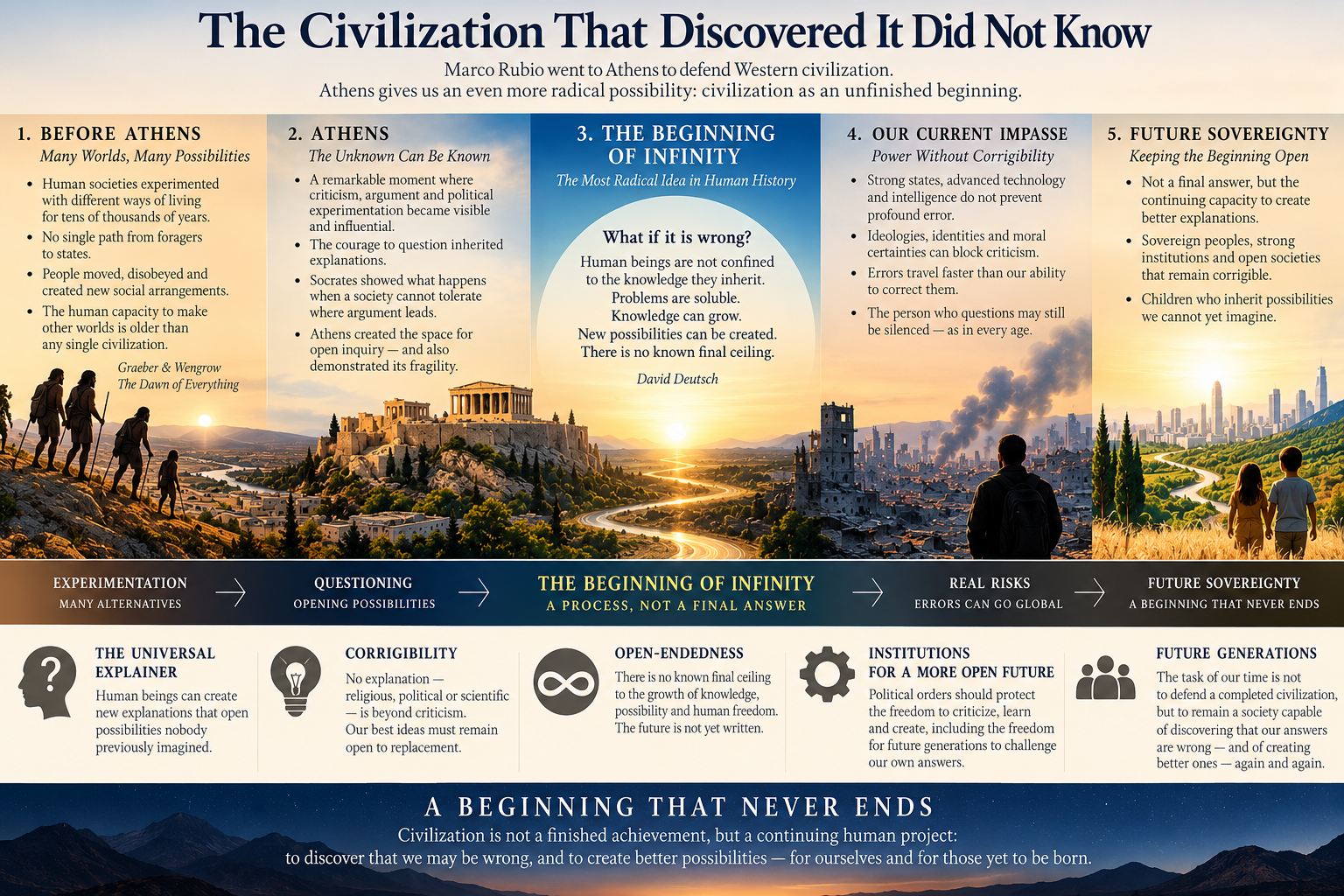
The Civilization That Discovered It Did Not Know
Marco Rubio went to Athens to defend Western civilization. Athens gives us an even more radical possibility: civilization as an unfinished beginning.
The Beginning of Infinity, the Universal Explainer, and Future Sovereignty — a conjecture after Marco Rubio’s Athens speech
Something happened in Athens.
It was more important than the Parthenon.
More important than democracy.
More important, ultimately, than Greece.
Human beings had always possessed knowledge. They knew how to hunt, cultivate land, navigate seas, construct cities, worship gods, organize armies, preserve stories and rule kingdoms. Great civilizations existed long before classical Athens. Egypt built monuments that still astonish us. Mesopotamia created cities, laws and writing. Persia governed an extraordinary empire.
But at some point, something different began to become possible.
A human being could stand before an inherited explanation and ask:
What if it is wrong?
That question may contain the beginning of infinity.
Consider Marco Rubio’s remarkable speech in Athens on October 7.
Standing beneath the Acropolis, the American Secretary of State offered a defense of Western civilization at a moment when he believes that civilization has lost confidence in itself. He spoke of curiosity, exploration, excellence, courage, competition, national loyalty, technological ambition and the willingness to defend a civilization rather than apologize for its existence.
And he said something particularly important.
The Greeks, he argued, possessed not merely curiosity about the unknown but “the conviction that the unknown can be known.”
Yes.
But we can go one step further.
The most consequential discovery was not that the unknown could be known.
It was that what we think we know can be wrong.
And once that possibility enters human civilization, something extraordinary happens.
The future opens.
The Beginning of Infinity
David Deutsch gives this open-ended possibility a name: the beginning of infinity.
It is among the most optimistic ideas available to us.
Human beings are not confined to the knowledge they inherit. Problems are inevitable, but problems are soluble. Knowledge can grow. Explanations can improve. Errors can be discovered. Things considered impossible can become possible through the creation of new knowledge.
There is no known final ceiling to the growth of explanatory knowledge. That is not a promise of omniscience, or a claim that every problem will yield on demand. It is a rejection of the idea that our present ignorance fixes the limits of what future knowledge may make possible.
That does not mean progress is inevitable. Quite the opposite. Progress depends upon preserving the conditions under which error can be found.
This is why Athens matters to me.
Not because the Greeks possessed the correct answers. They plainly did not.
They practiced slavery. Women were excluded from political citizenship. Greek city-states slaughtered one another. Athens itself could become imperial, cruel and intolerant. The civilization that gave us Socrates also killed Socrates.
That last contradiction is not an embarrassing footnote to the Greek achievement. It may be the key to understanding it.
Athens created extraordinary spaces for argument and then demonstrated what happens when a society becomes unable to tolerate where argument leads.
Socrates therefore represents something more interesting than Rubio’s heroic man remaining loyal to his principles unto death.
He represents the corrector whom the city could not tolerate.
That is a different civilizational lesson.
A civilization should not be judged only by the heroes it produces. It should also be judged by what happens to the person who tells it that it may be wrong.
Before Athens: The Human Capacity to Make Other Worlds
But this opening requires a correction.
If we say that civilization discovered in Athens that inherited explanations could be challenged, we risk turning an epistemological breakthrough into another origin myth.
David Graeber and David Wengrow’s The Dawn of Everything makes that comfortable story much harder to sustain. Their great provocation is not that Athens did not matter. It is that human political imagination did not begin there. The archaeological and anthropological record they assemble describes human beings repeatedly experimenting with radically different social arrangements: moving between forms of hierarchy and relative equality, building large settlements without the centralized structures we once assumed cities required, and refusing the supposedly inevitable sequence from foraging to agriculture to cities to kings to states. Their larger challenge is to the idea that human history had one political staircase and that civilization simply climbed it.
That matters enormously to the argument.
Perhaps the deepest prehistory of the open society is not an institution at all. It is the human capacity to discover that the social world can be otherwise.
Graeber and Wengrow formulate three elemental freedoms: the freedom to move, the freedom to disobey, and the freedom to create or transform social relationships. We should not treat these as final axioms. We should treat them as explanatory conjectures to be tested against the historical record.
This changes the civilizational discussion.
Athens need not be the place where human freedom began. It can be understood as one remarkable place where criticism, argument, explanation and political experimentation became unusually visible, transmissible and institutionally consequential. The achievement becomes more defensible when the mythology becomes smaller.
And Graeber and Wengrow supply another warning. We have become accustomed to asking when inequality began, when hierarchy became inevitable, when the state trapped us. But those questions can smuggle their answers into the premises. They can make contingency look like destiny.
Our question is different: When did human beings lose the perceived possibility that they could construct alternatives?
That is a problem of choice-space. A society may contain alternatives that its inhabitants can no longer see. An institution may be formally revisable while its assumptions have become psychologically sacred. A people may possess elections yet experience its political arrangements as natural facts.
The opposite is also possible. Human beings living under severe material constraints can sometimes imagine astonishingly different social worlds.
So the Beginning of Infinity has a political prehistory. Long before modern science, humans were already conjecturing with social arrangements. What later became distinctive was not the invention of variation itself, but the emergence of increasingly powerful traditions and institutions for criticism, explanation, transmission and correction.
This widens the story beyond “the West” without making Athens irrelevant.
Civilization did not begin when one people acquired the correct social form. Civilization becomes interesting wherever human beings discover that the form they inherited is not the only form possible.
The Universal Explainer
There is a conjecture more radical than the proposition that the cosmos is intelligible. It is that human beings are universal explainers.
David Deutsch’s idea does not mean that every human being knows everything, that intelligence is infallible, or that the laws of physics will surrender every secret tomorrow. It means that the human capacity to create explanatory knowledge is not confined to a predetermined repertoire of problems. In principle, people can come to understand any phenomenon that is physically explicable, provided the necessary knowledge, criticism, time and resources can be developed. We are not merely animals adapting to a fixed menu of circumstances. We can discover explanations that make circumstances themselves alterable.
The difference is immense. A bird can build a nest. A human being can ask why a bridge collapses, devise a theory of stress, test a new material, build a better bridge, and then ask whether the bridge should have been built there at all. The last question is not answered by physics alone. It requires other explanations, other criticism, other institutions, other people.
A universal explainer is not a universal ruler. The ability to discover how something works does not confer the authority to decide what everybody must do with that discovery. Indeed, our capacity to explain the world creates a corresponding obligation to distinguish explanations from commands.
Here is my bold conjecture:
The political significance of the universal explainer is that no present authority can know the full range of futures that future people may explain into existence. Any civilization that claims to have completed the purposes of its descendants contradicts the very creative capacity it celebrates.
This is why the beginning of infinity cannot be the property of Athens, Christianity, the West, America, or any other historical community. Discoveries have histories; explanatory capacity is not a hereditary title. A good explanation can be created, understood, challenged and improved by people whom the original discoverer could not have imagined.
And this is why the universal explainer requires something more than intellectual freedom in the abstract. People need security, education, material capability, institutions that protect dissent, and the practical ability to try alternatives. An uncriticizable sovereign may employ brilliant scientists. It cannot thereby claim to have built an open civilization.
A Challenge from Promethean Updates
The discussion of Rubio’s Athens speech on Promethean Updates is revealing precisely because its speakers are enthusiastic. The host calls the address extraordinary. Barbara hears a civilizational turning point and an appeal to American founding principles. Susan Kokinda sees something more fundamental: the claim that the human mind can understand the order of the universe and act upon what it discovers.
At approximately 18:59 in the program, Kokinda turns toward critics in the audience and asks: “Do you believe there are universal principles?” It is a serious question. I would answer yes—provisionally, and with an immediate second question: Universal principles of what, and how would we discover that our account of them is mistaken?
This is not verbal pedantry. The universe, the cosmos, physical reality, moral obligation and political legitimacy cannot simply be substituted for one another. Physical laws describe how physical processes behave. The proposition that the cosmos is intelligible concerns what can be explained. A moral claim about what ought to be done requires an additional argument. And a political claim that a particular government, nation or economic program embodies universal reason requires another argument still.
Rubio’s speech moves from the Greek search for rational order to Christian theology and natural law. That genealogy deserves historical scrutiny, but Christianity is not the decisive issue in my conjecture. Even if we set every theological claim aside, the inference problem remains. Discoverable physical order does not, by itself, validate any political order. We cannot derive the legitimacy of an institution from the fact that gravity is universal. We cannot infer that a nation’s chosen purposes are correct from the fact that human beings can discover the laws of nature.
Kokinda offers a powerful illustration when she discusses rockets that fail and are redesigned. The engineers do not defend the exploded rocket as an expression of civilizational identity. They investigate what went wrong, change their explanation, and try again. That is a genuinely Promethean moment. But the experiment leaves us with a question that goes beyond the launchpad: Can the political system that builds the rocket tolerate an equally searching criticism of its own ends, institutions and leaders?
A civilization may master orbital mechanics while remaining unable to acknowledge an error in its treatment of a minority. It may calculate the trajectory of a missile while refusing to examine the assumptions that justify firing it. It may build machines that learn while governing through doctrines that cannot.
So I accept Kokinda’s challenge and return it in a stronger form. Do we believe that universal principles exist? Yes, that is a defensible conjecture. Do we believe that any speaker, party, church, nation or civilization possesses a final and privileged interpretation of them? No. The very capacity to explain makes that conclusion untenable.
The universal explainer must remain explainable to itself—and open to being corrected by others.
That is where an account of human reason becomes a theory of political freedom.
Rubio’s Conjecture
Rubio’s speech deserves to be taken seriously. Its argument is larger than contemporary American politics.
He believes Western societies have become frightened of ambition, excellence, competition, risk, national loyalty and power. He argues that they have outsourced industrial capacity, neglected military strength, transferred sovereignty to remote institutions and become embarrassed by their own achievements.
His proposed correction is unapologetic national power: industrial capacity, military capability, energy, technology, artificial intelligence, space exploration and sovereign nations cooperating because their interests overlap rather than because nations have ceased to matter.
There is much here worth thinking about.
A society incapable of defending itself may eventually lose the institutions through which criticism is possible. A country that cannot manufacture critical goods is not sovereign merely because its constitution says it is. A Europe unable to defend Europe eventually depends upon someone else deciding whether Europe will be defended. And peoples who outsource their survival also outsource part of their future.
Kurds know something about this.
But there is a problem.
Power is not yet an explanation of progress.
Athens had power. Persia had power. Rome had enormous power. The Ottoman Empire had power. European empires had power. The Soviet Union had nuclear weapons, factories, armies, scientists and geopolitical reach.
Power can protect an open civilization. Power can also protect error.
The question therefore cannot merely be: How does the West become powerful again?
The harder question is: What kind of power preserves the possibility of discovering that its own purposes, institutions and explanations are wrong?
That distinction changes everything.
Civilization Is Not Chosenness
Consider the recurring problem of chosenness. Religious chosenness. National chosenness. Civilizational chosenness. Revolutionary chosenness.
The vocabulary changes remarkably easily. The underlying error does not.
A community discovers something valuable. Then it begins to believe that possessing the discovery makes the community itself epistemically privileged. A truth becomes an identity. An achievement becomes an inheritance. An inheritance becomes entitlement. Entitlement becomes jurisdiction. And eventually criticism of the explanation becomes criticism of the people.
This is where civilizations become dangerous to themselves.
Rubio says that Western civilization is “the greatest story ever known to man.”
Perhaps. But we should resist the formulation for precisely the reason we should resist every final civilizational verdict. There is no tribunal outside history from which such rankings can be issued.
More importantly, Western civilization’s greatest contribution may be something incompatible with declaring any civilization finally greatest: the institutionalization of the possibility that we are wrong.
That is a much stronger defense of the West.
It requires neither self-hatred nor self-worship. It requires criticism.
The West does not need to apologize for scientific explanation, constitutional government, individual liberty, open criticism or institutions capable of peaceful correction. Nor does it need to pretend that these possibilities belong biologically, ethnically or permanently to “the West.”
Knowledge has no ethnicity. A good explanation does not become Greek because a Greek discovers it. Newton’s laws are not English. Relativity is not Jewish. An error does not become Kurdish because a Kurd makes it. And criticism does not require a Western passport.
Ideas can travel precisely because knowledge is not imprisoned inside the people who create it. That may be one of the most important facts about civilization.
The Error in the Map
Rubio constructs an extraordinary civilizational genealogy: Athens. Rome. Christendom. Medieval Europe. England. America.
There is truth in that lineage. There is also compression.
Civilizations do not reproduce like bloodlines. Knowledge travels through enemies, minorities, merchants, translators, refugees, conquered peoples, apostates, migrants and civilizations that later histories place outside their own borders.
The Dawn of Everything makes the compression still more visible. Political invention, freedom and complex social experimentation cannot be assigned neatly to one civilizational bloodline. Graeber and Wengrow even revive the disputed but fertile possibility that Indigenous criticism of European society helped Europeans see their own institutions differently. Whether every historical link in that argument survives criticism is less important here than the problem it exposes: civilizations learn partly because outsiders make their assumptions visible.
Greek knowledge itself traveled through worlds Rubio’s map does not adequately capture. Mathematics, astronomy, medicine and philosophy crossed linguistic, religious and imperial boundaries repeatedly.
Civilization is less like a family tree than a network of borrowed, translated, criticized, recombined and improved explanations.
This matters enormously today.
Because if knowledge belongs to a civilization, civilizations must defend ownership.
But if knowledge belongs to anyone capable of criticizing and improving it, then civilization acquires another purpose: keeping the conversation open.
That is a very different frontier.
The Bridge from Knowledge to Authority
There is a recurring temptation to move silently from an explanation of what is to a prescription of what must be. A civilization discovers real regularities in nature. Its leaders then speak as if those discoveries confirm their account of human destiny. But the bridge has not been built. It has merely been asserted.
This does not mean moral judgment is impossible, or that all political arrangements are equally good. It means that political judgments require explanations of their own: of persons, incentives, coercion, rights, institutional failure, unintended consequences and the conditions under which citizens can revise collective decisions. Those explanations are themselves conjectural and corrigible.
The strongest case for open institutions is therefore not that they descend from a perfect civilization. It is that they make it possible for imperfect explainers to discover and remove errors without surrendering their freedom to the person who claims to possess the final answer.
The Nation Matters
Here we must resist another contemporary illusion. The answer is not to abolish nations.
Rubio is right to recover something many liberal societies became uncomfortable saying: sovereignty matters. Borders matter. Defense matters. Capability matters. Political communities matter. People need institutions capable of acting in the world.
Kurdistan offers a particularly demanding lesson.
A people can possess enormous moral claims and remarkably little effective agency. Kurds have repeatedly discovered the difference between sympathy and capability. Between recognition and protection. Between promises and institutions. Between someone saying we support you and someone being obligated to defend you when the aircraft arrive, the tanks cross the border or the agreement is broken.
Presence is not agency. Recognition is not sovereignty. Protection is not capability. And dependence is not freedom merely because the protector is benevolent.
But sovereignty contains its own trap.
Once sovereignty becomes sacred, the state can become another protected explanation. Then the government speaks for the nation. The leader speaks for the government. The party speaks for the leader. And eventually criticizing the party becomes betraying the nation.
We can observe this mechanism in too many places.
The Iranian regime invokes revolution, religion and national survival. Islamists invoke God. Arab nationalists invoked the Arab nation. Ba‘thists invoked unity and destiny. Communists invoked history. Imperial powers invoked civilization. Kurdish parties can invoke Kurdistan.
Different answers. Same problem.
Where does the error go?
October 7
Rubio delivered this speech on October 7. That date now carries another meaning.
Three years after the Hamas attack, perhaps we should be less interested in accumulating another position to defend than in asking what October 7 exposed about the explanations through which people see reality.
People watched the same massacre and inhabited different explanatory worlds. For some, human beings disappeared behind “resistance.” For others, every Palestinian disappeared behind Hamas. For some, history explained everything. For others, history began that morning.
The person vanished into the category.
We have seen this mechanism before.
anfāl, Shingal and October 7 are not interchangeable events. Yet each confronts us with the problem of explanations that make human beings disappear behind categories. The challenge is to recognize a recurring mechanism without erasing the differences between its victims, perpetrators and historical circumstances.
An explanation can become so powerful that the human being standing before us becomes invisible. That is when ideas cease merely describing reality. They begin selecting which reality we are permitted to see.
This is why defending civilization cannot mean defending a completed catalogue of Western values against somebody else’s completed catalogue. That simply creates rival fortresses of protected explanation.
The problem is deeper.
We need institutions and habits that make explanations vulnerable while protecting people from the consequences of correcting them.
Protect the person. Expose the idea.
That is civilization’s difficult bargain.
The Vacuum That Is Not a Vacuum
Rubio also uses a familiar geopolitical metaphor. As Western confidence weakened, he says, adversaries filled the “vacuum.”
We should distrust this metaphor.
Iraq has supposedly contained vacuums for decades. Syria has them. Kurdistan has them. The Middle East appears to analysts as an astonishing collection of empty spaces permanently waiting for Iran, Turkey, America, Russia, ISIS or somebody else to fill them.
But political space is rarely empty. There are people there. Institutions. Interests. Tribes. Parties. Businesses. Memories. Capabilities. Fears. Local knowledge.
What outsiders call a vacuum is often agency they have failed to see.
This matters because the vacuum metaphor produces its own policy. If a space is empty, somebody must fill it.
If instead the problem is deficient local capability, the question changes: What institutions would allow the people already there to become authors of their own security and future?
That is the question we should ask about Kurdistan. About Iraq. About Syria. About Europe. And increasingly about the West itself.
Intelligence Is Not Rationality
Rubio calls for dominance in artificial intelligence, advanced manufacturing, cyber capabilities, weapons and space. These capabilities matter.
But here lies perhaps the greatest danger in his argument.
Intelligence is not rationality.
A system can become extraordinarily capable while remaining catastrophically wrong. A bureaucracy can process more information without becoming more corrigible. An intelligence service can collect more data while protecting the assumptions through which it interprets the data. A university can employ brilliant people while making certain questions socially impossible. A military can possess exquisite technology while misunderstanding the enemy. An AI can generate answers faster than human beings can discover the errors embedded inside them.
Technology magnifies capability. It does not automatically magnify correction.
This is why the central problem of artificial intelligence may ultimately be less: How intelligent can machines become? than: How much irreversible power will we give systems whose errors we cannot discover, interrupt or reverse quickly enough?
The machine is new. The error is ancient.
The Backspace Key
Every civilization needs a Backspace key.
Not because everything should be reversible. Some decisions cannot be. People die. Wars begin. Institutions collapse. Technologies escape. Children inherit consequences they did not choose.
Precisely for that reason, civilization should maximize the number of errors that can be corrected before they become irreversible.
This gives us another way to think about power. Military power matters. Economic power matters. Technological power matters. But there is another form of power that may determine whether all the others become instruments of progress or catastrophe: the power to stop ourselves.
To criticize. To remove leaders. To revise laws. To abandon doctrines. To expose failures. To reverse policies. To say: We were wrong. And then to do something about it.
The civilization capable of pressing Backspace possesses something more valuable than confidence.
It possesses corrigibility.
What Should Be Conserved?
Rubio’s speech is therefore asking the correct question in slightly the wrong form.
What must Western civilization recover?
He answers: confidence, ambition, courage, excellence, exploration, national loyalty, power.
Much of that list deserves preservation. But something must come before all of it.
Corrigibility.
Because confidence without criticism becomes arrogance. Ambition without correction becomes domination. Nationalism without correction becomes chosenness. Technology without correction becomes amplified error. Tradition without correction becomes authority. Institutions without correction become bureaucracies protecting yesterday’s mistakes. Power without correction becomes coercion. Even democracy without correction can become majoritarian protection of error.
The question is therefore not whether Western civilization deserves confidence.
The question is whether it can remain a civilization in which confidence itself can be criticized.
The Open Society Was Never a Finished Society
Here Karl Popper offers a crucial distinction.
The open society is not a society whose members possess liberal opinions. It is not a geographical category called “the West.” It is not a completed political system.
It is an architecture for removing bad rulers and bad ideas without destroying society in the process.
That insight now needs to be extended.
Our institutions were designed principally to correct political power exercised at human speed. But errors increasingly travel at technological speed.
An algorithm can reach millions before a parliament convenes. A drone can make decisions faster than diplomatic systems can respond. A meme can replicate across continents before anyone discovers its origin. Artificial intelligence can generate, translate and distribute explanations at almost zero marginal cost. Biotechnology can turn knowledge into intervention. Nuclear weapons compressed the interval between decision and irreversible consequence.
Our civilization has increased the speed, reach, autonomy and replication of action.
The survival question is whether we can increase the speed of discovery, interruption, reversal and learning faster still.
That is the new civilizational competition.
Not East against West. Not America against China. Not Christianity against Islam. Not nationalism against globalism.
Something more fundamental: error amplification versus error correction.
Every civilization participates in both.
From Chosenness to Correction
This is where the problem of chosenness leads us.
Perhaps the question was never: Who is chosen?
Perhaps the better question is: Chosen for what?
A civilization that believes itself chosen to rule eventually protects its authority. A nation that believes itself chosen by history eventually protects its mythology. A religion that believes itself the final carrier of truth eventually faces the temptation to protect revelation from criticism. A revolutionary movement that believes it embodies the future eventually protects itself from the people whose future it claims to represent.
But imagine another form of chosenness.
Chosen not to possess the final answer. Chosen to preserve the conditions under which answers can be corrected.
That community would carry an unusual obligation. Its greatest loyalty would include protecting its critics. Its greatest tradition would include the possibility of revising tradition. Its monuments would remind descendants not merely what their ancestors accomplished but what their ancestors failed to understand. Its heroes would include not only those who died defending the city but those who forced the city to reconsider itself.
Socrates would then become more important than the marble behind Rubio.
Kurdistan
This is also why the conventional question about Kurdish sovereignty is insufficient.
“Should the Kurds have a state?”
It matters. But it arrives too early.
There is a prior question: What should sovereignty make possible?
A Kurdish state capable of reproducing the same closed politics, protected parties, inherited loyalties, uncorrectable institutions and frightened citizens would solve one historical problem while reproducing another.
Independence would matter enormously. But independence is not yet freedom.
The flag is not freedom. Recognition is not freedom. A seat at the United Nations is not freedom. Even security is not freedom.
Freedom requires something more demanding: the continuing capacity to create futures that previous generations could not specify.
That is why the idea of Future Sovereignty matters.
Future Sovereignty
The universal explainer gives this idea its deepest foundation. If future people can create knowledge that we do not possess, their genuine possibilities cannot be enumerated in advance. We cannot hand them a completed future; we can preserve or destroy their capacity to invent one.
Traditional sovereignty asks: Who has the final authority here?
Future Sovereignty asks: Who retains the capacity to create alternatives when the present answers fail?
That capacity belongs neither entirely to the state nor entirely to the individual. It must be institutionally distributed.
A sovereign future requires people who can criticize inherited categories. Institutions that can absorb criticism. Children who are not conscripted into their parents’ answers. Minorities who need not disappear into the majority’s story. Women whose futures are not predetermined by honor. Believers who may believe. Nonbelievers who may refuse. Scientists who can challenge consensus. Journalists who can expose governments. Citizens who can remove rulers. Entrepreneurs who can attempt what bureaucracies consider impossible. Political communities capable of defending themselves without turning defense into permanent obedience. And nations strong enough to survive criticism of the nation.
Graeber and Wengrow’s third freedom - the freedom to create or transform social relationships - now acquires a future dimension. It is not enough that ancestors sometimes possessed the ability to remake their social worlds. Institutions must preserve that creative capacity for descendants whose problems and possibilities we cannot know.
Future Sovereignty therefore differs from both global technocracy and absolute nationalism. It does not ask us to dissolve political communities. It asks political communities to preserve the choice-space of the unborn.
No generation owns the future. No constitution can finish politics. No revelation can finish knowledge. No revolution can finish history. No nation can specify all the purposes for which its descendants will use their freedom. And no civilization can legitimately tell humanity: The important discoveries have already been made.
The Way Out
This may help us understand our present impasses.
We repeatedly frame problems as contests between existing answers. Israel or Palestine. Nation or globalization. Religion or secularism. Security or liberty. Immigration or borders. Tradition or modernity. America or China. Human intelligence or artificial intelligence. Kurdish independence or existing borders. Left or right.
But two doors are often not enough.
The most important possibility may not yet exist.
That is what politics repeatedly forgets.
We negotiate among existing options as though reality supplied a menu. It does not. Human beings create options.
The solution to a problem may be something nobody currently advocates because nobody has invented it yet.
Graeber and Wengrow help us recover an important historical confidence here. Human societies have been far more experimental than the standard story allowed. Deutsch adds the epistemological engine: new possibilities do not have to be recovered from a lost past; they can be created through new knowledge.
One protects us from fatalism about history. The other protects us from nostalgia about history.
We do not need to return to Athens. We do not need to return to some egalitarian prehistory. We need the freedom and institutions to create arrangements neither Athens nor prehistory could have imagined.
This is why preserving criticism is not an intellectual luxury. It is how new doors enter the world.
Our task is therefore larger than choosing correctly among today’s alternatives. We must preserve the conditions under which tomorrow’s alternatives can be created.
That is Future Sovereignty.
Back to Athens
Rubio ends where he began. Athens. Heroes. Civilization. Inheritance.
He asks the West to rediscover the courage of its ancestors.
We should ask something slightly different.
Rediscover their problem.
Stand beneath the Acropolis and remember not merely that extraordinary people built it. Remember that they did not know what would come next.
They did not know Newton. They did not know constitutional democracy. They did not know electricity. They did not know evolution. They did not know relativity. They did not know quantum mechanics. They did not know antibiotics. They did not know computers. They did not know that human beings would walk on the Moon.
They could not have designed our future because the knowledge required to imagine that future did not yet exist.
Neither can we design the future of people living twenty-five centuries from now.
That is not a weakness. It is the source of hope.
Rubio says that the unknown can be known.
We can amend it: The unknown can become knowable through knowledge that does not yet exist.
That is why the future must remain open.
The task of civilization is not to deliver the final world. It is to prevent today’s world from becoming final.
Build power, certainly. Defend open societies. Build factories. Build universities. Build armies capable of deterring those who would destroy them. Build telescopes. Build spacecraft. Build artificial intelligence. Build Kurdistan.
But build something into every one of them that civilizations throughout history have found extraordinarily difficult to build: the possibility of correction.
Leave somewhere for the error to go.
Leave someone able to say no.
Leave institutions capable of hearing it.
Leave the Backspace key connected.
And above all, leave children possibilities their parents could not imagine.
Perhaps that is what Athens made unusually visible and transmissible - not the birth of human political imagination, but a powerful new episode in humanity’s recurring discovery that inherited worlds can be questioned.
Not Western civilization as a finished inheritance. Not a chain stretching inevitably from Greece to Rome to Christendom to America.
Something far more fragile and far more universal.
A conjecture. A criticism. A better explanation. Another problem. Another conjecture. And beyond it, another future.
Rubio went to the Acropolis to defend a civilization.
We can come away from Rubio’s speech wondering whether the greater task is to defend civilization from becoming an answer.
Because the deepest sovereignty is not sovereignty over territory alone.
It is sovereignty over the possibility of creating what does not yet exist.
Future Sovereignty.
The freedom to discover that our answers were wrong. The freedom to create better ones. The freedom to open doors that nobody living today can see.
That is why the Beginning of Infinity cannot become another monument at which we kneel.
It must remain a beginning.
And if we preserve criticism, correction and the creation of new knowledge, it can remain what its name promises: a beginning that does not end.
Sources and intellectual debts
Marco Rubio, Athens address, October 7, 2026; excerpts discussed in the Promethean Updates video:
(especially 04:31–19:05, 28:30–30:27, and 1:12:00–1:14:11). The program transcript supplied for this essay is the basis for the attributed remarks; quotations should be checked against the recording before publication. David Deutsch, The Beginning of Infinity: Explanations That Transform the World (2011), and The Fabric of Reality (1997), for explanatory knowledge and universal explainers. Karl Popper, The Open Society and Its Enemies (1945), for fallibilism and institutions of criticism. David Graeber and David Wengrow, The Dawn of Everything: A New History of Humanity (2021), for historical political experimentation. “Future Sovereignty,” the proposed institutional extension, is the author’s conjecture rather than a doctrine attributed to those writers.


