The cilantro leader: A review of Amit Segal’s A Call at 4 AM
By Khaled Salih
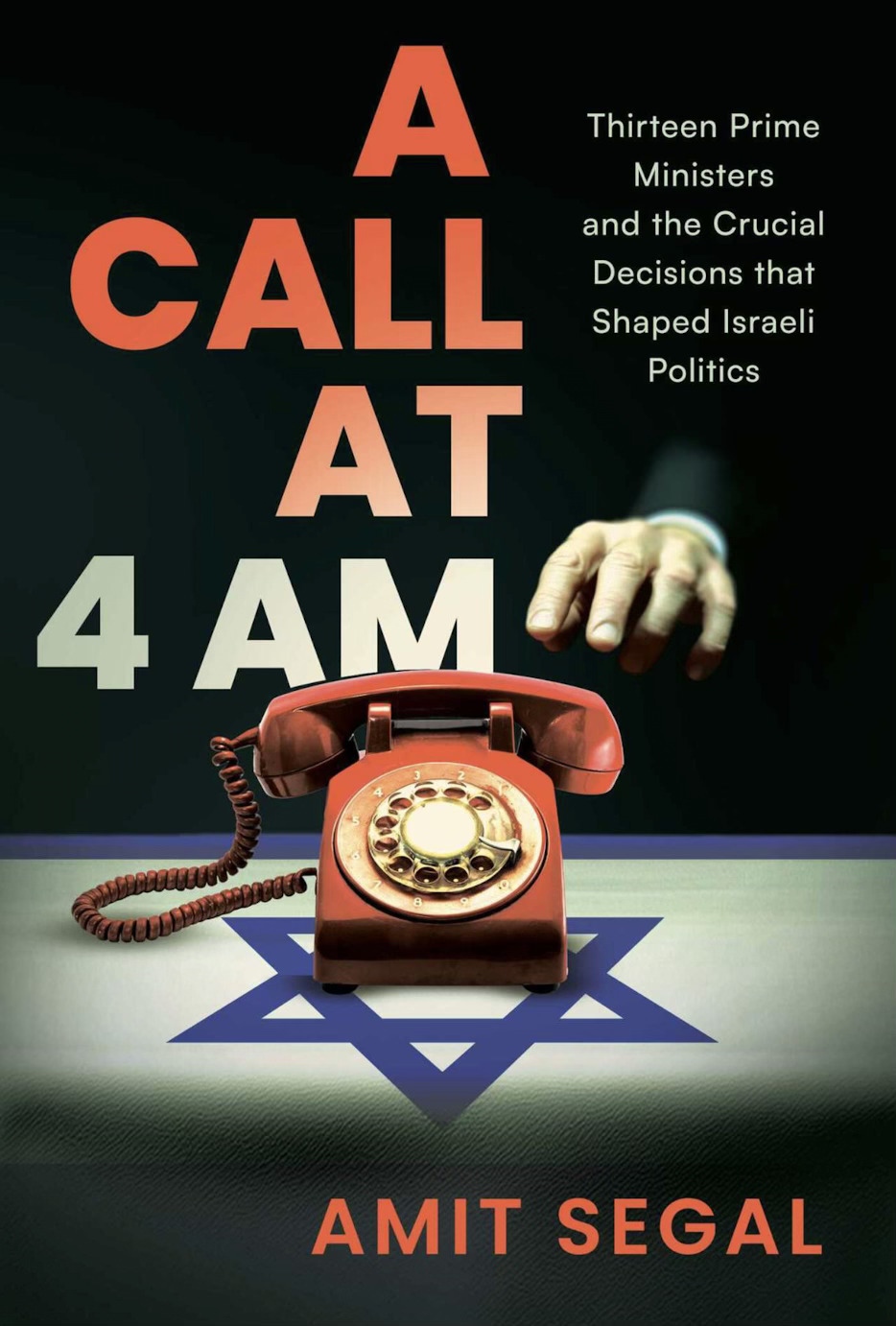
There is a scene at the beginning of Amit Segal’s new book that feels almost too perfectly allegorical. The Prime Minister of Israel, Benjamin Netanyahu, sits in a small office in his official Jerusalem residence, not with a foreign dignitary, but with detectives from the national anti-corruption unit. They are grilling him, a criminal suspect, about the colour of illicit champagne he allegedly received from a billionaire. “Pink,” he replies. At that moment, a knock on the door, a note slipped inside. “My apologies,” the suspect says, suddenly switching back to Prime Minister. “The president of the United States is looking for me on urgent business.” For Segal, this moment, the lurch from pink champagne to the red telephone, is the defining metaphor for Israeli leadership. It is a life lived at “dizzying speeds between highs and lows,” a constant, nauseating oscillation between global statesmanship and provincial scandal.
In his masterful 2025 book, A Call at 4 AM: Thirteen Prime Ministers and the Crucial Decisions that Shaped Israeli Politics, Segal, one of Israel’s most respected and influential journalists, attempts to unlock what has long been called the “chaotic black box” of Israeli politics. He does this not by chasing headlines, but by dissecting the pivotal, character-defining decisions of its leaders. Through a series of gripping case studies, Segal argues that the relentless pressure, the bizarre alliances, and the perpetual state of crisis are not accidents of history or geography alone. They are, rather, the direct and inevitable consequence of the nation’s very architecture.
Segal’s book succeeds because it reveals that this dizzying oscillation is not a quirk of personality but the signature rhythm of the office itself: a political system whose very architecture, as we shall see, was designed for crisis.
The original sin
To understand a nation’s soul, Amit Segal suggests, one must first examine its electoral system. Far from a technical detail for political scientists, it is the secret theatre of a society, reflecting its deepest fears, traumas, and aspirations. As A Call at 4 AM demonstrates with surgical precision, Israel’s political “chaos” is no accident; it is the direct consequence of a foundational choice made in a fit of absentmindedness.
Segal argues in his opening chapter that Israel was burdened from birth with a “world-exclusive electoral system” that amounted to an original sin. The decision was not the product of careful debate but was made on the fly in late 1948, mid-war, by just three men: David Ben-Gurion, Yitzhak Gruenbaum, and Pinchas Rosen. They were, as Segal notes, drowning in work, designing a flag, absorbing waves of immigrants, and repelling an Arab invasion. In a meeting that lasted little more than an hour, they forged a system of pure proportional representation that Ben-Gurion himself would later decry as “a cancer in the body of the nation.”
The consequences of this hasty decision, as outlined by Segal, have defined every subsequent day of Israeli political life. The book details a cascade of systemic dysfunction:
Remember the tyranny of the small. A low electoral threshold, currently just 3.25%, gives “totally disproportionate leverage” to small, niche parties. With just a handful of seats, they become indispensable “kingmakers,” capable of making or breaking governments and demanding massive concessions on budgets, ministries, and policy in exchange for their loyalty.
Keep in mind perpetual negotiation. The need to bargain with these kingmakers leads to fragile, unwieldy coalitions and chronic instability. Segal cites a stunning calculation: in Israel’s first 72 years, a staggering eleven years, two months, and four days were “frittered away” on election campaigns and endless coalition talks. The government, he writes, is like a superintendent perpetually busy “collecting maintenance fees on a shaky building” instead of actually governing.
Keep your eyes on the disconnected representative. Unlike systems with local constituencies (e.g., U.S. congressional districts or U.K. parliamentary constituencies), Israel elects national party lists. A politician from a Tel Aviv suburb has no specific constituents to answer to in the Galilee. Their loyalty is to the party bosses who control the list, creating what Segal calls a “disconnected” political class, insulated from the direct accountability that anchors most other democracies.
Segal masterfully frames this flawed architecture not as a dry political science lecture, but as the dramatic stage upon which every prime minister’s greatest crises are forced to play out. It is a system that breeds instability, rewarding shrewd political fighters over stable crisis managers: a structural reality amplified by the nation’s deepest cultural pressures.
The weight of the crown
This primordial fear is not merely a cultural backdrop; it is the political fuel that allows the state’s “unstable” machinery to persist. When survival is the only metric that matters, voters will tolerate any degree of political chaos, so long as they believe the person answering the 4 AM call is strong enough to keep the wolves from the door. Segal’s analysis makes clear that to govern Israel is to manage this deep and abiding sense of existential anxiety and immanent threat, a national subconscious belief that: “Beneath Israelis’ Western exterior lurks a terrible fear: One morning they will wake up and discover that Israel suddenly stopped existing overnight.”
The book’s central metaphor, drawn from its title and the subject of its second chapter, crystallises this reality. It is the story of Prime Minister Golda Meir, tormented by nightmares in the summer of 1973, who receives a real-life phone call at 4:00 a.m. on the holiest day of the Jewish year, Yom Kippur. “There’s going to be a war today,” a voice on the line says. Segal uses this moment to illustrate the ultimate question that animates the Israeli voter, a question that transcends economics, social policy, or quality of life: “When the red telephone rings at 4:00 a.m., who should answer?”
This fear, Segal argues, seeps into the very language of the state. During the COVID-19 pandemic, the public health body was not a committee but the “coronavirus cabinet,” borrowing the term for the top security forum because a regular ministerial body wouldn’t sound serious enough. It manifests in the national psyche, in the subconscious habit of stockpiling a few extra groceries, “just in case.” For decades, this fear was the foundation of the Labor party’s monopoly on power, a party of generals who were seen as the only credible guardians of the state. That monopoly was shattered by the intelligence failure of the 1973 war, but the primacy of security in the voter’s mind remains absolute. From that trauma onward, the central drama of Israeli politics has been the contest over who can most convincingly promise to keep the wolves from the door. And no modern leader has mastered the politics of fear more skilfully than Benjamin Netanyahu.
The ultimate survivor
Benjamin Netanyahu looms over Segal’s narrative as its inevitable centre of gravity. He is the leader who has most skilfully navigated, exploited, and ultimately been defined by the chaotic system the book details. He is presented not merely as a dominant politician, but as the living embodiment of the skills, paradoxes, and pathologies the Israeli political system demands of its leaders.
The cilantro leader
To explain Netanyahu’s unique political profile, one must turn to a fascinating analogy presented in the book: the idea of the “cilantro leader.”
“When Yair Lapid was a talk show host, he used to ask politicians: ‘If you were an animal, which would you be?’ With a slight twist, we might ask: ‘If prime ministers were vegetables, which would they be?’ Ben-Gurion, Begin, and Netanyahu were, of course, cilantro: You either love it or you hate it. Nobody can be apathetic to herbs with such a distinct aroma, and there is no point in trying to persuade people to change their minds. Nobody who hates cilantro has ever been persuaded to give it a chance because of its nutritional value. Ben-Gurion was loved and despised; Begin was revered and loathed. Some people cannot bear Netanyahu; others cannot imagine life without him.”
Some leaders are like radishes: unremarkable, perhaps a bit boring, but broadly palatable. They come to power to lower the temperature and heal divisions. Others are like cilantro: they evoke powerful, binary emotions. You either love them or you despise them. There is no middle ground. These leaders, like Ben-Gurion before him, are high-charisma, high-conflict figures who polarise society intensely but drive the agenda with relentless force.
Segal’s portrayal of Netanyahu, particularly in the chapter “Versus the Whole Left: Netanyahu’s Decision—Sticking to the Right at Any Cost,” perfectly captures this essence. He is a leader who thrives on division, who builds his power not by seeking consensus but by solidifying his base against a coalition of perceived enemies. He is the ultimate cilantro leader, and for decades, his flavour has defined the national palate.
The statesman and the suspect
A Call at 4 AM reveals that the key to surviving Israeli leadership is the ability to embody its contradictions. Contrast the statesman on the floor of the Knesset, bathed in applause, being lauded by a U.S. President at a ceremony marking the end of a brutal two-year war and the return of all living hostages. It is a moment of profound national relief, symbolized when the Knesset Speaker spontaneously removes the hostage-family pin from his lapel because, as he says, “this morning we were able to remove the photos.” Then, contrast this with the suspect in Segal’s introduction, cornered in a small office, forced to recall the colour of illicit champagne.
These are not contradictory figures. They are two sides of the same coin, a dual role required for survival. In a system where a prime minister can be ousted by a no-confidence vote on any given Monday afternoon, one must be both a global actor and a marshal political street-fighter. The ability to pivot seamlessly from a classified call with Washington to a cross-examination about pink champagne is not a character flaw; it is a core competency.
The decision that was never made
Perhaps the most powerful theme Segal weaves through his profiles is the chronic failure of Israeli leaders to retire gracefully. He paints a grim portrait of predecessors, Ben-Gurion, Begin, Sharon, Olmert, who clung to power until they were pushed out by scandal, illness, exhaustion, or defeat. There seems to be no cultural mechanism for a dignified exit.
Netanyahu is the apotheosis of this phenomenon. His longevity is a testament to his skill, but it also reflects this deeper systemic pattern. Prime Minister Benjamin Netanyahu, speaking at the Knesset on October 13, 2025, used his experience and longevity in politics to emphasise the unique support provided by Donald Trump. In his address to President Trump, Netanyahu characterized his long tenure by stating,
“I’ve seen a lot of American presidents. I’ve seen them all in the time that I’ve been here, and I’ve been here quite a lot of time.”
This remark subtly positioned Netanyahu as a veteran political figure who has witnessed, and worked with, numerous administrations in the White House. He immediately leveraged this vast experience to offer a significant validation of Trump’s actions, declaring that “No American president has ever done more for Israel,” adding, “it ain’t even close. It’s really not a match.” Netanyahu’s statement served to underscore his unparalleled perspective when assessing the beneficial relationship with the current American president, especially in light of the return of the hostages and the achievement of peace goals.
The book’s epilogue, titled “The Decision That Was Never Made,” serves as a poignant commentary on this reality. The ultimate political choice, Segal implies, is the one almost no Israeli leader has ever made: to leave power voluntarily, on their own terms. It is a decision that requires a form of political courage entirely alien to the country’s political DNA, and one that Netanyahu, the ultimate survivor, seems constitutionally incapable of making.
A gallery of gamblers
While Netanyahu is the book’s anchor, Segal masterfully extends his analysis across the political spectrum, using other prime ministers to illustrate different facets of the system’s unforgiving logic. These brief, incisive portraits reinforce his central thesis that the system itself, more than ideology, dictates the actions of those at the top.
In the chapter “Shtreimels for Peace,” Segal examines Yitzhak Rabin’s decision to forge an alliance with the ultra-Orthodox Shas party to pass the Oslo Accords. It is a prime example of the “bizarre alliances” required to govern. Here was a secular, left-wing peace camp, whose cultural values were antithetical to those of the Haredi world, forced into a partnership of necessity. The deal was only possible, Segal reveals, because Shas’s spiritual leader, Rabbi Ovadia Yosef, issued a religious ruling that ceding territory to save lives was permissible under Jewish law. That theological cover, in exchange for ministries and funding, shows how even the most pragmatic political bargains in Israel often require a religious imprimatur [a fatwa in muslim parlance]: a perfect illustration of the intersection of faith and realpolitik.
Decades later, Segal analyses Naftali Bennett’s decision to form his ideologically sprawling coalition in “The Last Exit: Breaking All the Rules.” This, Segal presents, is the system’s logic taken to its extreme conclusion. Bennett, a right-wing leader whose party held only a handful of seats, seized the premiership by assembling a coalition of hard-right nationalists, centrists, left-wing social democrats, and, for the first time, an independent Arab Islamist party. Their coalition agreement was a masterclass in avoidance, built on “agreeing to ignore the elephant in the room”: the major diplomatic and security issues that would have torn them apart.
These examples, from Rabin’s pragmatism to Bennett’s radical creativity, reinforce Segal’s central argument. They show how the personal decisions of leaders, whether on the left or the right, are almost always dictated by the impersonal, unyielding logic of a political structure that demands compromise, rewards opportunism, and makes ideological purity a luxury few can afford.
A masterclass in political psychology
Amit Segal’s A Call at 4 AM is more than just a history of prime ministerial decisions; it is an indispensable guide to the political psychology of modern Israel. Its lasting value lies in its fundamental shift in focus:
Away from the fleeting battles of daily political combat and toward the deeper structural, historical, and cultural forces that shape the nation’s destiny. Segal does more than just report on Israeli politics; he decodes its very DNA.
The book brilliantly illuminates how a slapdash decision made in 1948 created a political arena of perpetual crisis, and how a deep-seated national fear ensures that the question of security always trumps all else. It reveals a system that rewards leaders who can simultaneously operate on the world stage and in the backrooms of party politics, a system embodied most completely by the long and tumultuous career of Benjamin Netanyahu. By looking at the nation through the crucial choices of its leaders, Segal offers a compelling, coherent, and often unsettling portrait of a democracy under constant, immense pressure.
After journeying through the trials of thirteen prime ministers, Segal leaves the reader with a haunting implication: that in Israel, no leader, no matter how formidable, ever truly masters the system. In the end, the chaotic black box consumes them all.
Amit Segal, 2025, A Call at 4 AM: Thirteen Prime Ministers and the Crucial Decisions that Shaped Israeli Politics. New York, Nashville: Post Hill Press.


