The Backspace Key: Why Apostasy, Blasphemy, and Doubt Matter
27 May 2026
This is the sixth essay in my series on the ideas behind my upcoming book When Parochial Error Goes Global. The earlier essays traced how a parochial error can travel, why no error is final unless criticism is forbidden, how anti-rational memeplexes capture intelligence, and why the Open Society fails when it mistakes criticism of the cage for hatred of the prisoner.
This essay turns the Backspace Key from metaphor into lived reality. A society’s freedom can be measured by whether people may safely doubt, leave, mock, historicize, revise, or reject its sacred claims. Apostasy, blasphemy, doubt, satire, innovation, historical criticism, women’s autonomy, and children’s freedom are not side issues. They are the tests by which we discover whether the person remains greater than the system.
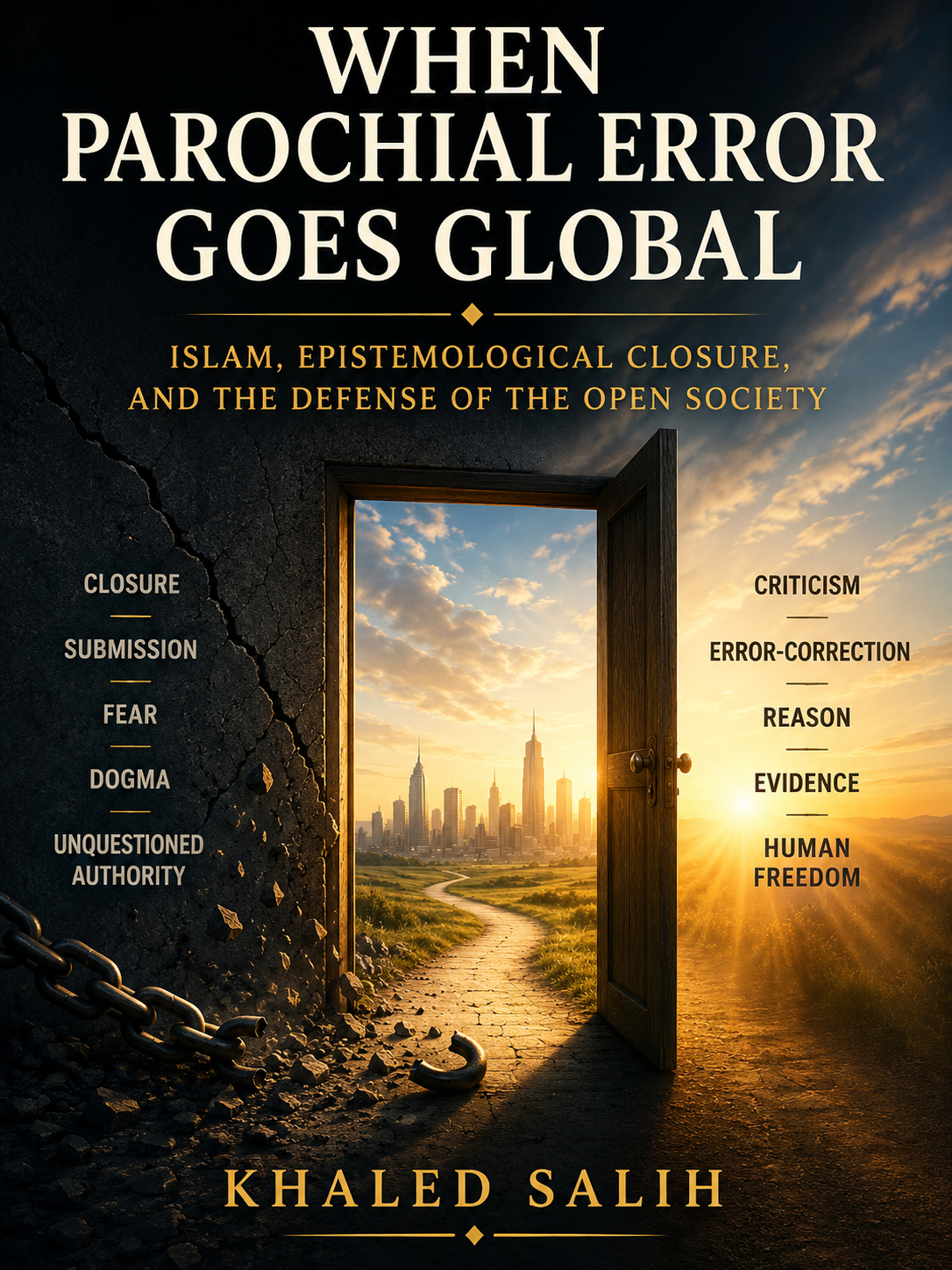
Every civilization needs a Backspace Key.
Every person needs one. Every institution needs one. Every tradition needs one. Every society needs one.
The Backspace Key is my metaphor for error-correction: the human capacity to delete a bad explanation, revise a harmful inheritance, abandon a false belief, correct a sacred mistake, or say, without fear:
This no longer survives criticism.
Politically, Popper asked how bad rulers could be removed without bloodshed. Epistemologically, the Backspace Key asks how bad explanations can be removed without destroying the people who once believed them.
That is the same civilizational principle at a deeper level: error must have a peaceful exit.
A society without a Backspace Key does not become stable. It becomes brittle. It accumulates errors until those errors become identity, law, taboo, and sacred duty. It teaches people not how to think, but how to protect what may not be questioned.
That is why apostasy, blasphemy, and doubt matter.
They are not side issues. They are not merely religious controversies. They are diagnostic tests. They reveal whether a system allows human beings to correct inherited error — or whether it treats correction as betrayal.
Doubt is not failure
Doubt is often treated as weakness.
But doubt is one of the first signs that the mind is still alive.
To doubt is not necessarily to reject. It is to notice that something may be wrong. It is to feel the gap between inherited certainty and lived reality. It is to ask whether the explanation one has been given is adequate.
Every child doubts. Every scientist doubts. Every honest believer doubts. Every writer doubts. Every reformer begins in doubt. Every improvement in human knowledge begins when someone notices that the current explanation does not work.
Doubt is not the enemy of truth. Doubt is one of the ways truth is approached.
A closed system fears doubt because doubt is the first movement of the Backspace Key. It is the small internal pause before correction becomes possible.
That is why anti-rational systems often moralize doubt. They do not merely answer it. They make the doubter feel ashamed, sinful, corrupted, disloyal, ungrateful, arrogant, Westernized, colonized, possessed, rebellious, or spiritually diseased.
The point is not to refute the doubt. The point is to make doubting feel morally costly.
The right to leave
Apostasy is the great test of whether the person belongs to himself or to the system.
Can a person leave? Can a believer become an unbeliever? Can a Muslim become an ex-Muslim? Can a child raised inside a religious community grow into an adult who says: this is no longer mine?
Can the person exit without fear of violence, law, social death, family destruction, inheritance consequences, marriage consequences, custody threats, humiliation, exile, or lifelong suspicion?
If not, then belief is not fully belief. It is captivity disguised as conviction.
A free conscience requires the possibility of exit. Without exit, belonging becomes ownership. Without exit, faith becomes coercion. Without exit, the community is no longer a community of persons but a system of possession.
This is why apostasy matters.
It is not merely a theological category. It is the doorway through which the human being proves that he or she is not the property of the doctrine.
The Open Society must defend that doorway.
Blasphemy is a test of sacred power
Blasphemy is often misunderstood.
People hear the word and think of insult, vulgarity, mockery, provocation, or cruelty. Sometimes blasphemy may take those forms. Not every blasphemous act is wise. Not every offensive joke is profound. Not every insult contributes to knowledge.
But the right to blaspheme is not mainly about the quality of the speech.
It is about the status of the sacred claim.
Can a sacred object be treated as a human object? Can a prophet be morally evaluated? Can a scripture be historicized? Can a holy law be compared with other laws? Can a founder be satirized? Can a religious authority be mocked? Can inherited certainty be brought down into the ordinary world of criticism?
Blasphemy is the moment when sacred authority discovers that it does not own public reality.
That is why closed systems fear it.
Blasphemy removes the halo. It says: this claim, too, must stand before reason, history, morality, evidence, satire, and human conscience.
A society that cannot tolerate blasphemy cannot fully tolerate criticism.
And a society that cannot tolerate criticism cannot remain open.
Sacred pain and public law
Believers may feel genuine pain when sacred things are mocked or criticized.
That pain is real. But pain is not a veto.
A person’s dignity must be protected. A doctrine’s prestige must not be.
The law must protect believers from violence, discrimination, harassment, and threats. It must not protect beliefs from humiliation, criticism, ridicule, historical inquiry, or rejection.
This distinction is difficult but necessary. The right not to be attacked as a person is fundamental.
The right not to have one’s sacred beliefs criticized does not exist in an Open Society.
If emotional injury becomes the measure of permissible speech, then every sacred system gains censorship power. Every doctrine can declare itself wounded. Every institution can use the vulnerability of its adherents to protect itself from scrutiny.
That is how the person is used as a shield for the doctrine.
The Open Society must refuse that inversion.
Innovation as variation
Innovation is another diagnostic test.
A living tradition must be able to generate variation. It must be able to ask: could this be otherwise? Could this rule be revised? Could this interpretation be wrong? Could this institution change? Could this inherited practice belong to another world?
In a rational culture, innovation is not automatically good. Some innovations are foolish. Some reforms fail. Some new ideas are worse than old ones.
But without innovation, correction becomes impossible.
A system that treats innovation as corruption does not merely preserve the past. It makes the future subordinate to the past. It turns inheritance into authority and repetition into virtue.
The problem is not that a tradition remembers its origin. The problem is when origin becomes untouchable.
A tradition may honor the past. But when it forbids the future from correcting the past, it becomes anti-rational.
Historical criticism
Historical criticism is one of the great Backspace Keys of civilization.
It asks:
Where did this text come from?
Who transmitted it?
Who edited it?
What older materials did it absorb?
What political situation shaped it?
What languages influenced it?
What variants exist?
What was forgotten?
What was added?
What was later projected backward?
What does the evidence show?
Closed systems fear historical criticism because historical criticism makes mediation visible.
It shows that sacred objects have histories. Texts were transmitted. Traditions were selected. Memories were organized. Origins were narrated. Authorities were constructed. Communities preserved some materials and lost others.
This does not automatically destroy faith. Many religious people live with historical complexity.
But it does destroy sacred untouchability.
Once a text has a history, it can be studied. Once a founder has a context, he can be evaluated. Once a law has a development, it can be revised. Once an origin has been mediated, it cannot function as pure, unexamined command.
That is why historical criticism is not merely academic.
It is emancipatory.
Satire and fear
Satire is often rude, but it performs an important function.
It tests fear.
A society that can laugh at power has not completely submitted to power. A society that can mock its sacred authorities has not given those authorities total control over public imagination.
Satire punctures inflated claims.
It says: this prophet, this law, this institution, this cleric, this ideology, this sacred certainty — none of them is beyond human response.
That is why satire provokes rage in closed systems.
The issue is rarely just offense. The deeper issue is demotion. Satire demotes the sacred object from untouchable authority to public object. It refuses the system’s demand to control emotional posture.
A closed system does not merely want obedience. It wants reverence. Satire withholds reverence. That is why it matters.
The woman’s body as a Backspace Key
The right to doubt and exit is often tested most brutally on women.
In many closed systems, the woman’s body becomes the visible surface of communal order. Dress, sexuality, modesty, marriage, movement, voice, obedience, family honor, and religious identity become concentrated on her body.
When she refuses, she is not treated merely as an individual making a choice.
She is treated as a breach in the system.
A woman who removes the veil, refuses forced modesty, rejects religious marriage rules, chooses unbelief, loves outside the boundary, speaks publicly, or leaves inherited piety may become a living act of blasphemy. Her autonomy says: the system does not own me.
That is why her freedom matters so much.
The right of women to refuse religious control is not a cultural side issue. It is one of the central tests of whether the person comes before the doctrine.
If the community’s honor depends on controlling her body, then the community has made her into infrastructure.
The Open Society must not participate in that.
Children and inherited identity
Children are born into worlds they did not choose.
They inherit language, family, ritual, memory, fear, food, stories, loyalties, prayers, prohibitions, and identities before they can examine any of them.
That is unavoidable. No child begins from nowhere.
The moral question is whether the child is eventually allowed to become a critic of the inheritance.
Can the child grow into an adult who says:
I am grateful for parts of this, but I reject other parts.
I love my family, but I do not share their belief.
I understand the tradition, but I will not obey it.
I was born into this, but I am not owned by it.
An open society must protect that transition from inheritance to judgment.
A closed system tries to prevent it.
It treats inherited identity as permanent ownership. It treats the child as a carrier of continuity rather than a future independent conscience.
That is why education, free inquiry, mixed friendships, open libraries, history, science, art, and public criticism matter. They give the child access to alternative explanations.
They give the child a Backspace Key.
The captured explainer
David Deutsch describes human beings as Universal Explainers: beings capable of creating explanatory knowledge with open-ended reach.
That is the human being at the center of my argument.
Not the believer as machine. Not the Muslim as code. Not the child as cultural property. Not the woman as boundary marker. Not the dissenter as traitor.
The person is a Universal Explainer.
An anti-rational memeplex does not destroy this capacity. It captures it. It turns intelligence toward the preservation of the system. It trains the mind to defend what it has not been allowed to test. It turns fear into loyalty and loyalty into proof.
But captured minds are not deleted. The Backspace Key may be hidden, punished, shamed, or feared. But it is not metaphysically erased. That is the basis of optimism.
Why this is not anti-religious in the crude sense
The argument is not that every religion is identical, or that every believer is irrational, or that all tradition is evil.
The argument is more precise.
Any belief system becomes anti-corrective when it disables correction.
A religion that can tolerate doubt, historical criticism, satire, exit, reform, and internal dissent is different from a religion that cannot. A philosophy that invites criticism is different from one that punishes it. A political movement that can be removed peacefully is different from one that treats opposition as treason. A family that allows children to think is different from one that treats questioning as betrayal.
The issue is not whether a system contains sacred language.
The issue is whether sacred language can be corrected by reality, conscience, and criticism.
That is the Backspace Key test.
The Open Society and the right to error-correction
The Open Society is not valuable because it has final truth.
It is valuable because it allows error-correction.
It lets people criticize rulers, revise laws, abandon churches, leave parties, mock ideologies, test traditions, expose institutions, publish dissent, defend unpopular claims, and change their minds.
Its greatness is not certainty. Its greatness is corrigibility.
The Open Society is not the society that has solved life. It is the society that refuses to make error-correction a crime.
This is why apostasy, blasphemy, and doubt are not marginal liberties. They are central liberties. They are among the mechanisms by which persons remain greater than systems.
A society that protects worship but not apostasy is not free. A society that protects religion but not blasphemy is not open. A society that protects identity but not dissent is not humane. A society that protects community but not conscience has misunderstood the person.
The false peace of silence
Closed systems often produce silence and call it peace.
No one criticizes. No one leaves publicly. No one mocks the sacred. No one questions the founder. No one challenges the law. No one names the fear.
From the outside, this may look like harmony.
But it may be fear.
A peaceful society is not one in which no one speaks against sacred authority. A peaceful society is one in which people may speak and still remain safe.
The absence of visible dissent does not prove consent. It may prove that dissent has become too costly.
This is one of the great errors of bureaucratic and academic observation:
mistaking silence for legitimacy.
The Backspace Key test asks not whether people are quiet. It asks whether they are free to speak.
How to test a system
Ask simple questions.
Can people leave? Can they criticize? Can they laugh? Can they historicize? Can they revise? Can they refuse? Can they marry outside the boundary? Can they raise children differently? Can they reject the founder? Can they challenge the scripture? Can they contradict the cleric? Can they expose abuse? Can they defend the apostate? Can they protect the blasphemer? Can they disagree without being expelled from the moral community?
These questions reveal more than official declarations.
A system may speak beautifully about peace, compassion, dignity, pluralism, and coexistence. But the real test is what happens when someone uses the Backspace Key.
The distinction
Apostasy matters because the person must be free to leave.
Blasphemy matters because sacred claims must not control public reality. Doubt matters because knowledge begins when inherited certainty becomes questionable. Innovation matters because the future must be allowed to correct the past. Historical criticism matters because sacred origin must not be protected from evidence. Satire matters because reverence must not be coerced. Women’s autonomy matters because the body must not belong to the community. Children’s freedom matters because inheritance must not become ownership.
These are not side issues. They are the conditions of human freedom under epistemic pressure. The Open Society must defend them not because it hates believers, but because it loves persons more than systems.
The person is not the cage. The cage must be criticized because the person can be free. No person is the prison of a doctrine. Captured minds are not deleted. And bad explanations can die in our place.
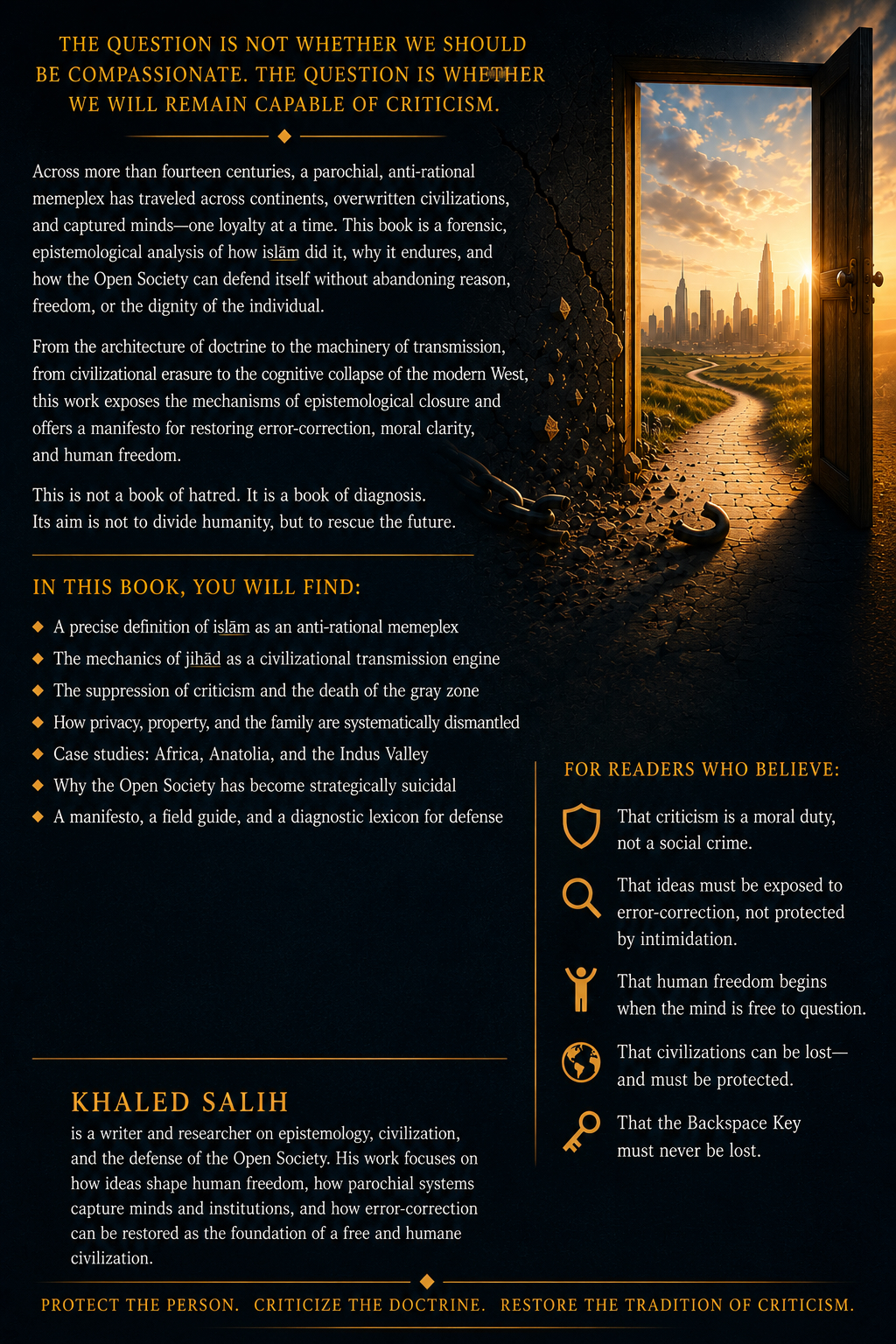
Articles in the series:
“From Levantine Matrix to Global Memeplex: How a Parochial Error Learned to Travel.” https://khaledsalih.substack.com/p/critical-rationalism-in-action-how
“Critical Rationalism in Action: How My Manuscript Changed, and How I Changed With It.” https://khaledsalih.substack.com/p/critical-rationalism-in-action-how
“No Error Is Final: A Deutschian-Popperian Introduction to the Open Society and the Universal Explainer.” https://khaledsalih.substack.com/p/no-error-is-final-a-deutschian-popperian
“Protect the Person, Criticize the Doctrine.” https://khaledsalih.substack.com/p/protect-the-person-criticize-the
“The Open Society’s Category Error.” https://khaledsalih.substack.com/p/the-open-societys-category-error


